News
OLADAYO POPOOLA AT 80: A GENERAL AS EXEMPLAR
- /home/naijuinz/public_html/wp-content/plugins/mvp-social-buttons/mvp-social-buttons.php on line 27
https://naijablitznews.com/wp-content/uploads/2024/02/EB1FB3FE-310B-4198-BFC4-1F272CB06081-1000x600.jpeg&description=OLADAYO POPOOLA AT 80: A GENERAL AS EXEMPLAR', 'pinterestShare', 'width=750,height=350'); return false;" title="Pin This Post">
- Share
- Tweet /home/naijuinz/public_html/wp-content/plugins/mvp-social-buttons/mvp-social-buttons.php on line 72
https://naijablitznews.com/wp-content/uploads/2024/02/EB1FB3FE-310B-4198-BFC4-1F272CB06081-1000x600.jpeg&description=OLADAYO POPOOLA AT 80: A GENERAL AS EXEMPLAR', 'pinterestShare', 'width=750,height=350'); return false;" title="Pin This Post">
By Tunde Olusunle
If not for the military coup of December 31, 1983 which torpedoed Nigeria’s Second Republic and threw him into the public glare, he would have remained the anonymous military professional he had always been.
About 20 years before that putsch which terminated the administration of President Shehu Usman Shagari and threw up Muhammadu Buhari as Head of State, he had enlisted in the Nigerian Army. He desired to pursue a career in a vocation he had long salivated about.
Beginning from 1964 when he was in the fourth form in Aiyedaade Grammar School, Ikire in the old Western Region, he had begun this quest. That year and the following, he wrote entrance examinations for the Nigerian Defence Academy, (NDA), Kaduna but was not offered admission.
Fate finally beckoned to him in 1967 when the outbreak of the Nigerian Civil War impelled the military authorities to recruit more officers. His possession of a West African School Certificate, (WASC) enabled his integration into the army via short service commission in 1967.

Thereafter, he was posted to the “Federal Guards, Lagos” most probably the contemporary equivalent of the “Brigade of Guards” which was responsible for the security of the seat of federal administration. He found himself in the thick of battle in 1968 in Asaba, in the former Midwestern State, surviving a bullet graze to his head.
Between 1971 and 1975, he was an instructor at the Nigerian Military Training College, (NMTC), Zaria jetting off to India within the period to attend the Battalion Support Weapons Course, in 1974. He equally had on-the-job training at the Royal Army Records Office, Stanmore, England in 1976. He trained at the Army Command and Staff College, (ACSC) between 1977 and 1978, which prepared him for elevation to the rank of Lieutenant Colonel. From Port Harcourt to Yola and thenceforth to India and Kaduna, the itinerant imperative of his job took him regularly around.
Whereas his regimental calling kept him away from the public sphere, things changed in January 1984 when the Buhari government posted Oladayo Popoola then still a Lieutenant Colonel to his home state of Oyo as Military Governor. The Oyo State of that time is today’s Oyo and Osun.
Buhari was unceremoniously unseated on August 27, 1985 barely 20 months in office and replaced by Ibrahim Badamasi Babangida his Chief of Army Staff, (COAS). Babangida believed that military officers overseeing the states as chief executives would be more objective in the discharge of their duties if they served outside of their home environments.
Reaffirming his confidence in Popoola, Babangida redeployed him to Ogun State in 1985 and remained in office until 1986 when he returned to regular military duties.
Popoola promptly overcame the initial shock of his transmutation from strictly military to a quasi-political official regimen. He needed to de-politicise the civil service; manage a bloated bureaucracy with as many as 44 Permanent Secretaries at the apex of statecraft and reorganise an education sector substantially bastardised in the name of politics. The “free education” programme enunciated by the Unity Party of Nigeria, (UPN) and operationalised in the South West where the party was dominant, ensured state governments picked the bills for primary and secondary school pupils.
The Oyo State Executive Council under Popoola, however, was compelled to reintroduce fees at the secondary school level, to forestall the breakdown of education at that level. He equally deftly navigated the time bomb of the rotation of the chairmanship of the Oyo State Council of Chiefs, unwittingly planted by his immediate predecessor, Dr Omololu Olunloyo.
His 20-month “apprenticeship” in Oyo State facilitated his seamless integration into the Ogun State system when he succeeded Donaldson Oladipo Diya September 4, 1985. Popoola met a disinterested populace and disenchanted civil service, allegedly terrorised by his predecessor in consonance with the “no-nonsense” mantra of the Buhari and Tunde Idiagbon government.
Popoola introduced a rare populist programme, the “Village Square Meeting” which took governance to the people. Commissioners and senior civil servants were encouraged to visit the people of Ogun State in their communities and villages, by the Popoola milieu. They discerned the sentimentts of the people and relayed same to the military governor for necessary action. He wrote personalised letters to privileged indigenes of Ogun State who stayed away to avoid collisions with the Diya government.
Upon attaining the rank of Colonel in 1986, Oladayo Popoola was posted to the Army Headquarters as Director of Personnel Services in the Adjutant-General’s Office. He attended the National Institute for Policy and Strategic Studies, (NIPSS), Kuru, Jos in 1990 and returned to the position of Director, Manpower Planning, Army Headquarters in 1991. Side by side with his military duties, Popoola registered for a part-time, five-year course in Law at the University of Lagos. He was excused to attend the one-year programme preceding the formal call-to-bar of attorneys, at the Nigerian Law School, Lagos in 1991, the same year he was promoted Brigadier-General. Back at the Army Headquarters his favourite grounds, he became Director of Personnel Services in 1993 and soon after, Director of Legal Services.
He was Chief of Administration in 1994; Chief of Logistics from 1997 to 1998 and then General Officer Commanding, (GOC) 82 Division of the Nigerian Army headquartered in Enugu. Concurrently, he was appointed member of the Provisional Ruling Council, (PRC), the highest policy and administrative body of the military government. That was the moniker crafted and preferred by Sani Abacha the army General who swept aside the “Interim National Government,” (ING) situated by his former principal, Babangida, at the beginning of his reign in November 1993.
Popoola was promoted Major-General in 1996. As Chief of Administration, (Army), he fully supported the initiative of a post-service housing scheme for the Army under the Abacha government. Popoola had justified his proposal against the backdrop of the imperative for decent accommodation for officers and men who wholly and selflessly invest in safeguarding and defending the country. Sources close to the former military Head of State recall that Abacha bought into the proposal chiefly because of the flawless integrity of the initiator, Oladayo Popoola. The Nigerian Army Housing Scheme has since been replicated by other services, military and paramilitary.
Indeed, the self-funding scheme has since become a pacesetter for the nation’s then nascent affordable housing industry.
In March 1999, he chaired the Presidential Committee on Development Options for the Niger Delta. The Committee recommended increased funding for infrastructural development in that oil-bearing catchment of the country, and the setting up of a “Niger Delta Consultative Council,” (NDCC).
He retired voluntarily from military service after logging 32 eventful years in service, in 1999. Many of his colleagues have been recycled in the nation’s political scheme especially with the advent of democratic rulership in the past 25 years. Popoola, however, has functioned from the quiet corner of a private entrepreneur and community leader, within the context of Ogbomoso his birthplace and Oyo State at large.
For over six years, he has been the Chairman of the Board of Trustees of the Precious Cornerstone University, (PCU), which is located in Ibadan, as part of the reinvestment of his experiences into the national development project.
Oladayo Popoola was born on February 26, 1944 in Isale Ora,Ogbomoso. He grew up at Nguru in present day Yobe State, Abeokuta and Ibadan owing to the itinerant character of his father’s vocations as tailor and trader. He attended Baptist Day School, Ijaiye, Abeokuta for his elementary education, and African Church Secondary Modern School, Apata, Ibadan as well as Aiyedaade Grammar School, Ikire for his secondary education.
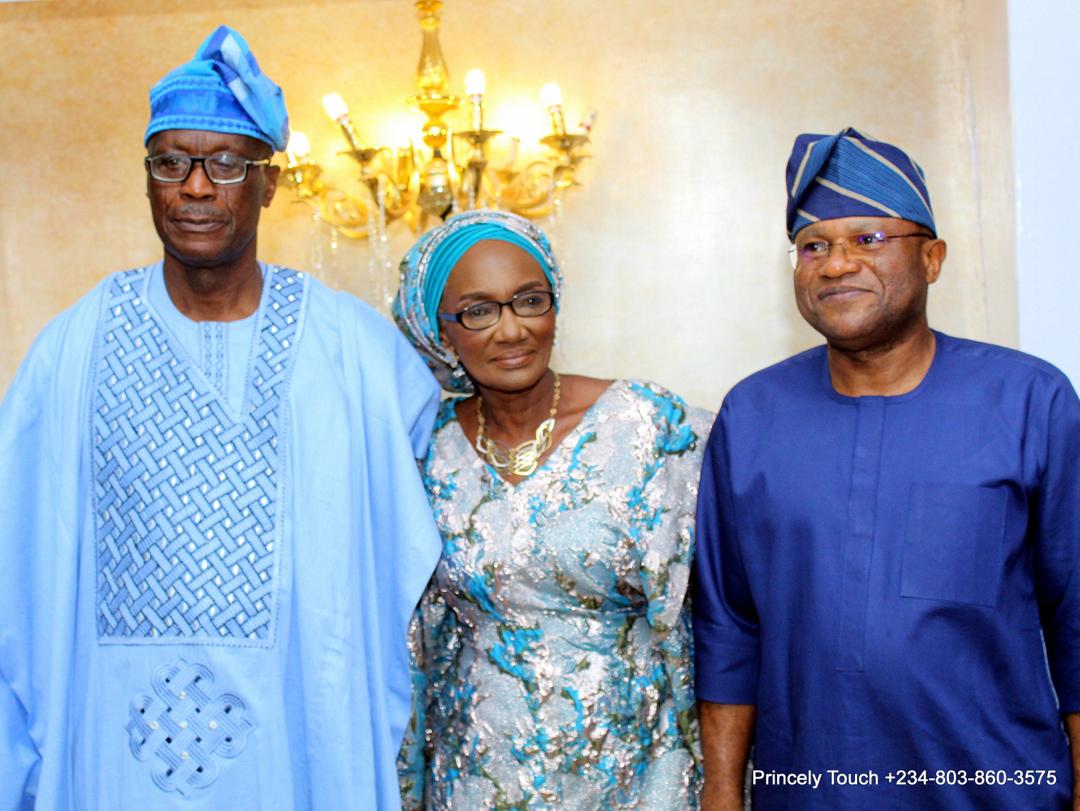
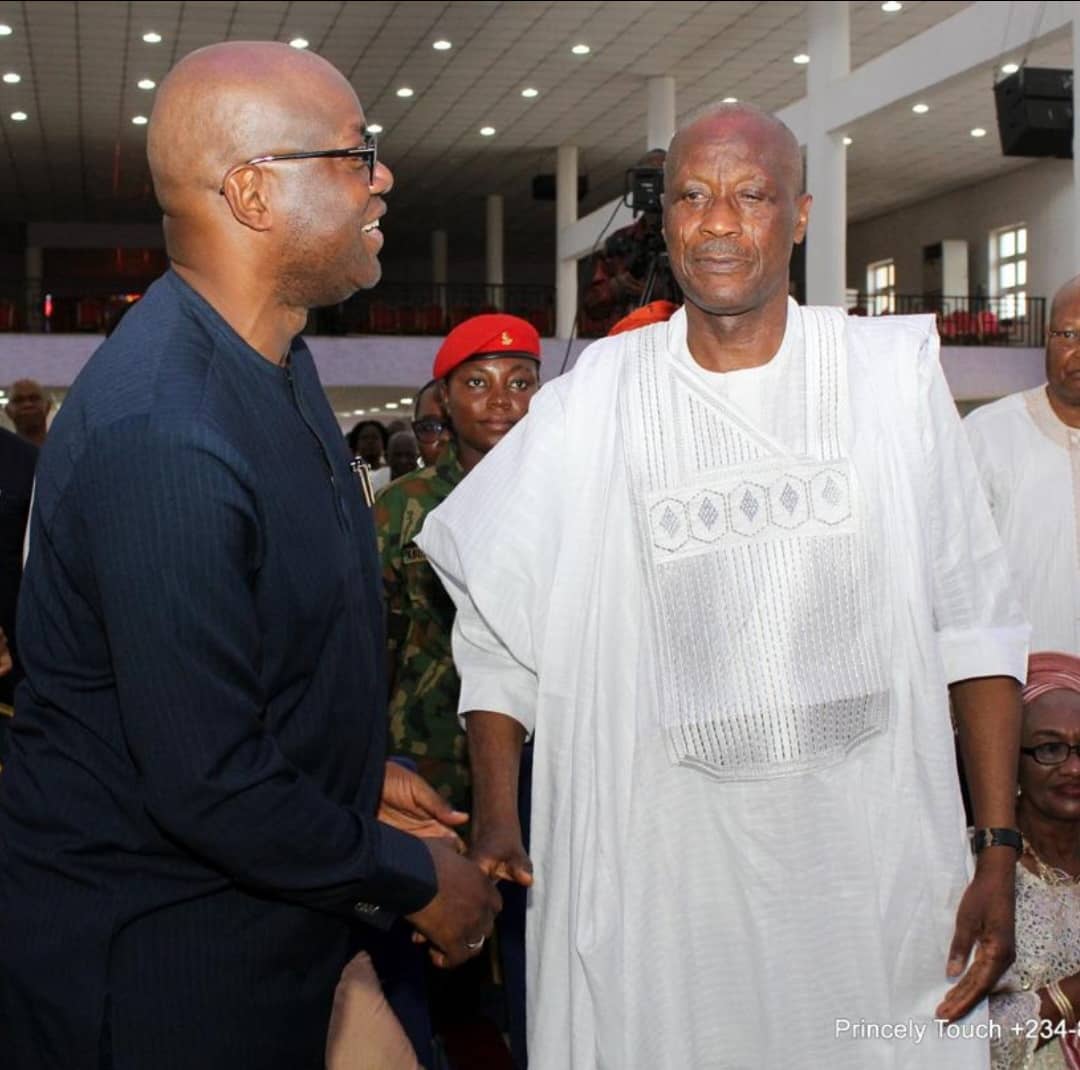
A thanksgiving service was held in Ibadan on Monday February 26, 2024 to commemorate the event of his 80thbirthday. Governor Seyi Makinde lauded Popoola’s uncommon altruism. He alluded to manner in which Popoola competently steered a crack team of elder statesmen, including Professor Daud Sangodoyin to amicably resolve the contestation between Oyo and Osun states for the ownership of the Ladoke Akintola University of Technology, (LAUTECH).
The institution was a subject of fiery controversy between Oyo and Osun states having being actualized before the excision of contemporary Osun State in 1991, from the ribs of the erstwhile monolithic Oyo State, with campuses in the original owner states.
National President of the Pentecostal Fellowship of Nigeria, (PFN), Bishop Wale Oke extolled Popoola’s humility, fear of God and fiscal frugality. Pastor Dotun Ajayi of the Vine Branch Church who delivered the sermon at the event congratulated Popoola for making it to the pedestals of octogenarians “in a country where life expectancy is 47 years for males and 52 for females. Ogun State which Popoola also served as military governor was represented by Noimot Salako-Oyedele, Deputy Governor of the state.
A Gala Night dinner was also held for General Popoola by senior serving and retired officers of the Nigerian Army Second Division domiciled in Ibadan. The tribute of the Chief of Army Staff, (COAS), Lieutenant-General Taoreed Abiodun Lagbaja to the celebrant was presented by the General Officer Commanding, (GOC) 2Division, Major-General Bamidele Alabi.
According to Lagbaja, Popoola’s “commitment to excellence and mentorship has been truly inspiring. Your legacies continue to live on and on in the hearts of those you have guided in our noble profession. Your impact in different segments of the society and the country at large has remained indelible in the sands of time.”
As a young Major, Popoola wedded his heartthrob Adebisi Adeoye on December 27, 1975. The union has been graciously blessed with children and grandchildren who are holding their own.
For his unalloyed service to country in the course of his exemplary career, he has since been decorated with the respected honour of “Officer of the Order of the Federal Republic, (OFR).” In April 2022, Popoola was conferred with an honorary doctorate, honoris causa by LAUTECH in acknowledgement of his contributions to national growth, among several other recognitions and acclamations.
• Tunde Olusunle, PhD, poet, journalist, scholar and author is a Fellow of the Association of Nigerian Authors, (FANA).
News
Gumi Questions Why No One Has Visited Boko Haram, Bandits to Negotiate Peace
Controversial Islamic cleric, Sheikh Ahmad Gumi, has questioned why no government official has visited Boko Haram terrorists and bandits to negotiate an end to their violence, the way past leaders engaged Niger Delta militants.
He made the comparison in a Facebook post on Saturday, recalling how former President Goodluck Jonathan and former Vice President Yemi Osinbajo both visited militants in the creeks to broker peace.
Gumi noted that both leaders, at different times, went into the creeks to meet militants and returned with programmes designed to end militancy in the region.
“The former President Jonathan visited Delta militants in the creeks, so also the former Vice President Osinbajo. They all came up with a program to tame the militants,” he wrote.
The cleric then asked who would extend similar engagement to Boko Haram and bandits terrorising parts of northern Nigeria without facing public backlash.
“Who is going to visit BH and Bandits to tame them without fools castigating them?” he asked.
Gumi has for years positioned himself as an advocate for dialogue with armed groups in the North-West and North-East, repeatedly visiting bandit camps in Zamfara and other states to hear their grievances.
He has consistently argued that negotiation, rather than military force, worked to end militancy in the Niger Delta and should be replicated in the North.
The cleric’s interventions have drawn both support and criticism. While some Nigerians accuse him of legitimising armed groups responsible for kidnapping, killings and cattle rustling, others credit his engagements with securing the release of kidnap victims.
The retired military officer has repeatedly denied backing terrorism, insisting his advocacy is aimed solely at ending the bloodshed through dialogue and rehabilitation.
The Niger Delta amnesty programme, launched in 2009 under the late President Umaru Yar’Adua and sustained by Jonathan, saw thousands of militants disarmed in exchange for training, stipends and reintegration support. The programme significantly reduced attacks on oil infrastructure in the region.
Jonathan first waded into the Niger Delta crisis in 2007 as vice-president, entering the creeks without an armed detail to meet ex-militant leader Government Ekpemupolo, popularly known as _Tompolo_, in Warri, Delta State.
He later said the meeting laid the groundwork for the amnesty programme granted to militants, which remains in place today.
Osinbajo similarly toured Niger Delta communities as acting president in 2017, engaging militants and traditional leaders directly.
He justified the outreach by arguing that those in the creeks were citizens with genuine grievances, not merely security threats.
News
Photo news: Gov Fubara performs groundbreaking/ foundation laying ceremony of Riven Medical Industries Project at Rumuosi, Port Harcourt
L-R: Managing Director, Enbay Pharmaceutical Industries Ltd, Mr Eniye Oweifie; Chairman, Obio-Akpor LGA, Dr Gift Worlu; Director Medical Services/Ag. Permanent Secretary, Rivers State Ministry of Health, Dr Vincent Wachukwu; Governor of Rivers State, His Excellency, Sir Siminalayi Fubara and Deputy Governor, Rivers State, Prof Ngozi Odu, during the groundbreaking/ foundation laying ceremony of the Riven Medical Industries Project at Rumuosi, Port Harcourt last Wednesday.


News
FG honours outgoing IMF Resident Rep, reaffirms strategic partnership with body
The Federal Government has reaffirmed its commitment to deepening its longstanding partnership with the International Monetary Fund (IMF), while paying tribute to the Fund’s outgoing Resident Representative in Nigeria, Dr. Christian Ebeke, for his significant contributions to the country’s economic reform efforts.
The commitment was reaffirmed at a farewell dinner held in Abuja in honour of Dr. Ebeke, where the Honourable Minister of Finance and Coordinating Minister of the Economy, Mr. Taiwo Oyedele, described him as a trusted partner whose professionalism, technical depth and constructive engagement helped strengthen cooperation between Nigeria and the IMF during a critical period of economic transition.
The Minister noted that Dr. Ebeke’s tenure coincided with the implementation of far reaching reforms aimed at restoring macroeconomic stability, strengthening public finances, improving investor confidence and laying the foundation for sustainable economic growth. He said throughout that period, the outgoing IMF Resident Representative remained closely engaged with Nigerian authorities, providing valuable technical support while demonstrating a deep appreciation of the country’s unique economic realities.
According to the Minister, Dr. Ebeke made significant contributions to policy discussions on fiscal reforms, domestic revenue mobilisation, public debt management, foreign exchange reforms and other strategic priorities of government. He added that his commitment to dialogue, mutual respect and practical problem solving further strengthened the longstanding relationship between Nigeria and the IMF.
Mr. Oyedele observed that beyond his professional responsibilities, Dr. Ebeke distinguished himself through his humility, accessibility and ability to build confidence across institutions. Rather than prescribing solutions from a distance, he engaged stakeholders with openness, listened carefully to differing perspectives and worked collaboratively in support of Nigeria’s development aspirations.
The Minister thanked Dr. Ebeke for his friendship, dedication and invaluable service to Nigeria, noting that the relationships built during his assignment would continue to strengthen cooperation between the Federal Government and the International Monetary Fund. He wished him and his family continued success, good health and fulfilment as he proceeds to his next assignment.
The Director, Internationl EconomicsRelations Department (IER) Stanley George, said Dr. Ebeke’s tenure would be remembered for its professionalism, constructive engagement and steadfast support for Nigeria’s economic reform efforts. He noted that the partnership between Nigeria and the IMF had grown stronger through sustained dialogue, mutual respect and shared commitment to the country’s economic progress, adding that Dr. Ebeke’s contributions would leave a lasting impact on the relationship between both institutions.
In a goodwill message, the Governor of the Central Bank of Nigeria, Mr. Yemi Cardoso, said Dr. Ebeke’s tenure coincided with a defining period in Nigeria’s economic reform journey, during which the Federal Government and the Central Bank implemented bold policy measures to restore macroeconomic stability, strengthen policy credibility, improve market confidence and lay a firmer foundation for sustainable growth. He commended the outgoing IMF Resident Representative for promoting constructive dialogue, facilitating technical cooperation and bringing professionalism, objectivity and a practical understanding of Nigeria’s economic realities to every engagement. The Governor expressed confidence that the strong collaboration between Nigeria and the IMF would continue under Dr. Ebeke’s successor.
Responding to the tributes, Dr. Christian Ebeke described his three year assignment in Nigeria as both a privilege and a professionally enriching experience. He said serving as the IMF Resident Representative gave him the opportunity to engage with government officials, development partners, the private sector, academia and other stakeholders committed to Nigeria’s economic development, describing the experience as one he would always cherish.
Dr. Ebeke said he would leave Nigeria with profound admiration for the resilience, talent and entrepreneurial spirit of its people. He expressed confidence that, with sustained reforms, sound economic policies and continued collaboration among stakeholders, Nigeria is well positioned to achieve inclusive and durable economic growth.
He expressed appreciation to the Federal Government, the Honourable Minister of Finance and Coordinating Minister of the Economy, the Governor of the Central Bank of Nigeria, officials across government institutions, development partners, members of the media and his colleagues at the International Monetary Fund for their friendship, cooperation and support throughout his assignment. He added that the cordial relationship between the IMF and Nigerian authorities had further strengthened the longstanding partnership dedicated to advancing the country’s reform agenda and sustainable development.
Reflecting on his time in Nigeria, Dr. Ebeke said the relationships he built and the memories he created would remain with him long after his departure, adding that he looked forward to following Nigeria’s progress and remaining a friend of the country in the years ahead.
The farewell dinner was attended by top government officials, including the Director General of the Debt Management Office, Mrs. Patience Oniha; the Statistician General of the Federation, Prince Adeyemi Adeniran; chief executives of government agencies; representatives of development partners and the diplomatic community; senior officials of the Federal Ministry of Finance; and other distinguished guests, all of whom joined in celebrating Dr. Ebeke’s remarkable service and enduring contribution to Nigeria’s economic reform journey.
The evening concluded with renewed appreciation for the enduring partnership between Nigeria and the International Monetary Fund and a shared commitment to sustaining the collaboration that has supported the country’s ongoing fiscal and macroeconomic reforms. Guests also wished Dr. Ebeke and his family continued success and fulfilment as he embarks on his next assignment.
-
News20 hours agoTax reform: FG inaugurates inter-ministerial C’ttee to develop 2026 VAT modification order
-
News17 hours agoAfter Taking Cocktail Of Drugs young Saudi Arabia prince found dead in London hotel
-
News17 hours ago20-year-old woman reportedly pours hot water on her pregnant co-wife in Bauchi, newborn baby d!es
-
Sports14 hours agoJust in: 23m support petition to ban Argentina from World Cup as FIFA pushes back
-
News11 hours agoBy 2036 money could become irrelevant- Billionaire Elon Musk asserts
-
News11 hours agoObi is a man of integrity, nobody should doubt his one term promise- Kwankwaso
-
News11 hours ago‘One of my outstanding ministers’ – Tinubu hails Umahi at 63
-
News17 hours agoBREAKING: Despite constitutional limit, President Donald Trump Declares For Third Term Bid with ‘Trump 2028’