

News
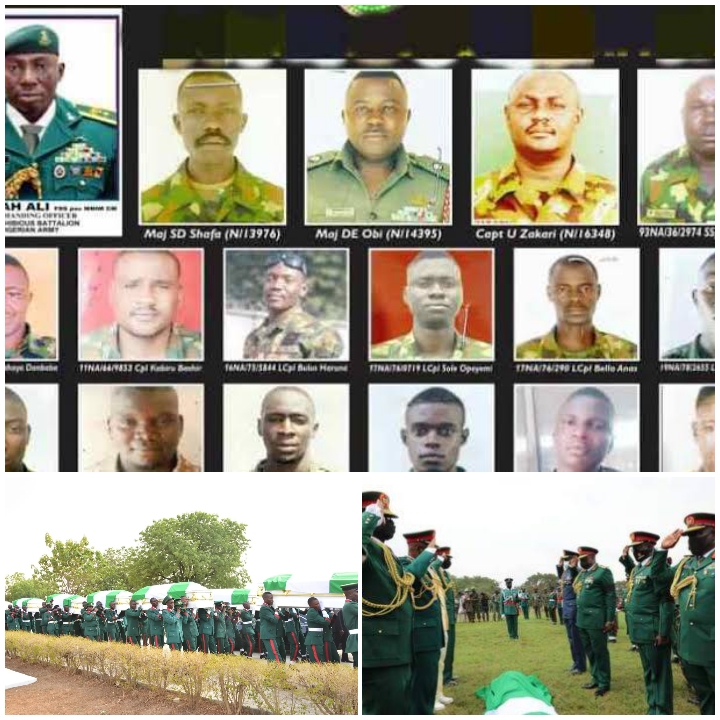
Okuama massacre: Tears as 17 soldiers go on final journey
By Ojomah Austin.
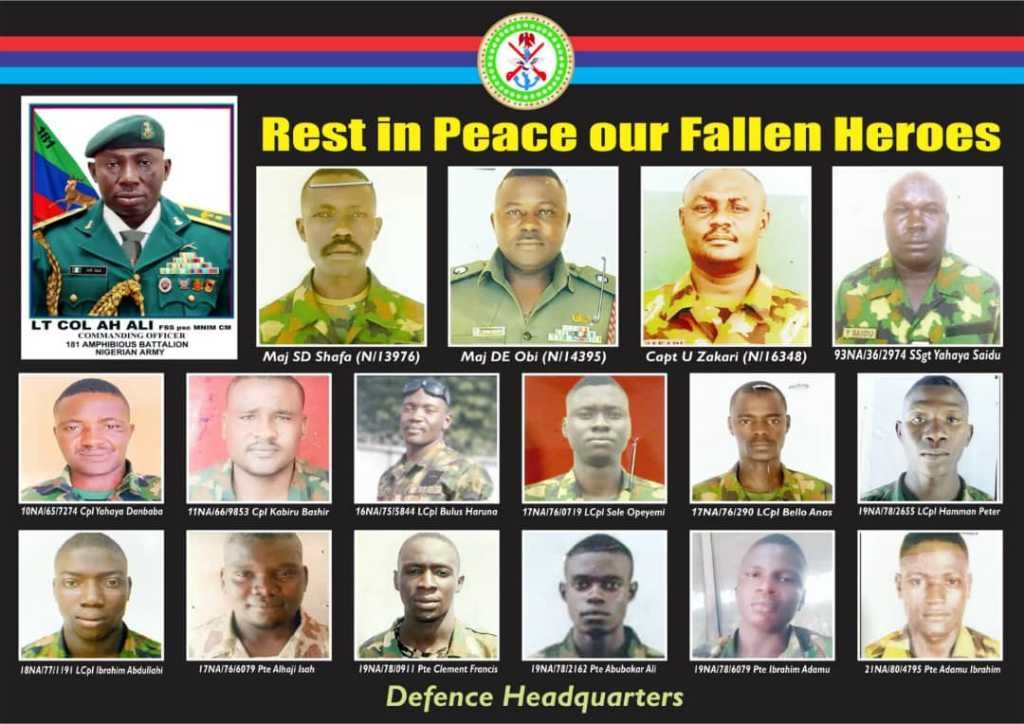
The 17 military personnel killed in Okuama community in Delta on March 14 have been laid to rest in Abuja.
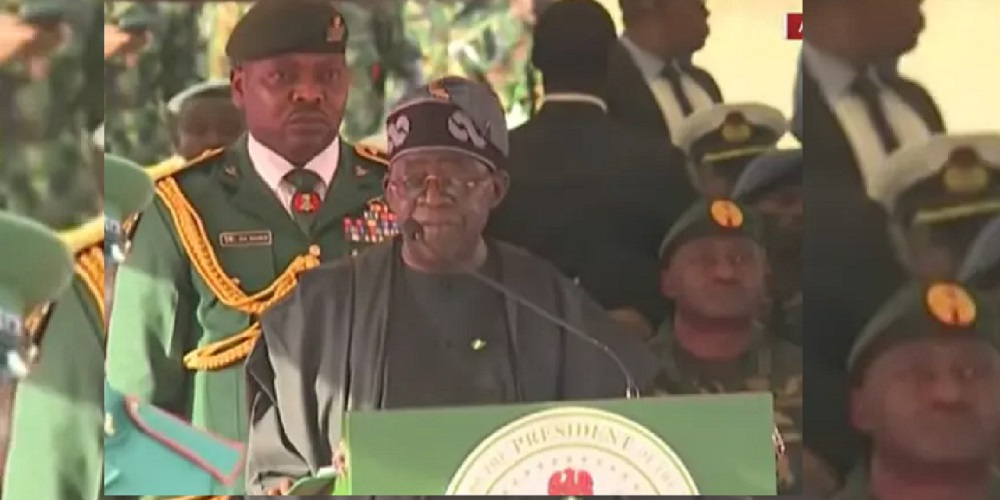
The corpses of the soldiers, which arrived at the National Military Cemetery in Abuja at about 2:26 pm on Wednesday, were committed to mother death after burial rites were observed.

President Bola Tinubu, Service Chiefs and other dignitaries were in attendance at the burial ceremony.
It will be recalled that the troops of 181 Amphibious Batallion, Bomadi Local Government Area of Delta State, while on a peace mission to Okuoma Community were ambushed and killed by some irate youths.
The incident occurred when the troops responded to a distress call following a communal crisis between Okuoma and Okoloba communities in Delta State.
The personnel comprised one Lieutenant Colonel, two Majors, one Captain and 13 soldiers.
The officers are Commanding Officer 181 Amphibious Battalion, Lt. Col. A.H Ali; Maj S.D Shafa (N/13976); Maj D.E Obi (N/14395) and Capt U Zakari (N/16348).
The soldiers are SSgt Yahaya Saidu (#3NA/36/2974); Cpl Yahaya Danbaba (1ONA/65/7274); Cpl Kabiru Bashir (11NA/66/9853); LCpl Bulus Haruna (16NA/TS/5844); LCpl Sola Opeyemi (17NA/760719); and LCpl Bello Anas (17NA/76/290).
They also include LCpl Hamman Peter (NA/T82653); LCpl Ibrahim Abdullahi (18NA/77/1191); Pte Alhaji Isah (17NA/76/6079); Pte Clement Francis (19NA/78/0911); Pte Abubakar Ali (19NA/78/2162); Pte Ibrahim Adamu (19NA/78/6079) and Pte Adamu Ibrahim (21NA/80/4795).
News
National Assembly Moves to Digitise Records, Translate Laws Into Local Languages
By Gloria Ikibah
The National Assembly is set to deepen the digitisation of parliamentary records, translate Nigerian laws into Hausa, Yoruba, Igbo and other local languages, and expand public access to legislative information as part of efforts to preserve the country’s democratic memory.
The Executive Secretary of the National Assembly Library Trust Fund, Hon. Henry Nwawuba, disclosed this on Monday in Abuja while declaring open the 2026 National Assembly Library Week, themed, “Parliamentary Memory: Connecting Records, Legislation and the People.”
Nwawuba said the three-day programme was designed as an annual platform to promote legislative research, access to information and effective utilisation of the resources of the National Assembly Library.
1. He described the library as more than a collection of books, saying it serves as the knowledge infrastructure of the legislature and a repository of parliamentary records, legislative information, research materials and the institutional memory of Nigeria’s democratic journey.
He explained that the library was working to ensure that lawmakers, legislative aides, researchers and other stakeholders have access to authoritative parliamentary records, including Order Papers, Votes and Proceedings, committee reports, Acts passed by the National Assembly, gazetted laws and oversight manuals.
According to Nwawuba, the Trust Fund was investing in electronic repositories and upgrading its E-Library, while developing a National Assembly Library mobile application to make legislative information more accessible to lawmakers, staff, researchers and members of the public.
He also announced plans for a Bills Tracker, which would enable users to follow bills and monitor their progress through the legislative process.
According to him, the library is developing infographics, audiovisual materials and video explainers to simplify Bills, Acts and legislative procedures for Nigerians.
He said the planned translation of laws into Hausa, Yoruba, Igbo and other local languages will broaden access to legislative information and enable more citizens to understand laws that affect their daily lives.
Nwawuba said the library will also organise public policy dialogues to deepen citizens’ participation in public hearings and create more opportunities for interaction among legislators, citizens, researchers and other stakeholders.
He therefore added that the initiatives were aimed at addressing inconsistencies in official parliamentary documents and the circulation of fake or unauthorised copies of National Assembly records.
Representing the President of the Senate, Godswill Akpabio, Senator Osita Ngwu urged lawmakers to make greater use of the library, particularly in an era of increasing misinformation, disinformation and the rapid development of artificial intelligence.
Ngwu described the library as a critical link between evidence, knowledge and legislative decision-making, and called for continued support for its development.
In a goodwill message, Speaker of the House of Representatives, Rt. Hon. Tajudeen Abbas, represented by the House Leader, Prof. Julius Ihonvbere, said legislative records were essential to understanding Nigeria’s legislative history and strengthening democratic governance.
Abbas said the strength of a legislature should be measured not only by the laws it enacted, but also by how effectively it documented its activities, preserved institutional knowledge and made such information available to future generations.
He asserted that technology and artificial intelligence could improve legislative research, records preservation and access to information, but cautioned that their adoption must be guided by accuracy, security, professional judgment and protection of the integrity of parliamentary records.
The Clerk to the National Assembly, Kamoru Ogunlana, said the National Assembly cannot be truly independent if it lacked the capacity to generate, preserve, retrieve and authenticate its institutional knowledge and records.
Ogunlana said the library had an important role as a bridge between parliamentary records, legislation and the people, stressing that Parliament could not be fully transparent if its records could not be found, understood and trusted.
He identified the Order Paper, Votes and Proceedings and Hansard as key components of Nigeria’s democratic memory, explaining that the Order Paper provides the agenda for legislative business, the Votes and Proceedings record decisions and proceedings, while the Hansard provides a comprehensive record of debates and lawmakers’ contributions.
The Clerk warned against the circulation of incomplete, outdated, altered or unauthorised Bills, Acts and other parliamentary documents, saying digital technology had made it possible for documents to be manipulated and circulated to thousands of people within minutes.
He stressed that the integrity of an Act depended not merely on the existence of a document, but on the ability to establish which version was authentic, which was authoritative and the legal process through which it emerged.
Ogunlana also called for stronger collaboration among the National Assembly, the Office of the Attorney-General of the Federation, the Nigerian Law Reform Commission and the Federal Government Press to ensure that Nigerians have easy access to current and authoritative versions of federal laws.
He noted that the continued widespread use of the Laws of the Federation of Nigeria, LFN 2004, highlighted the challenges of maintaining a current and authoritative consolidated body of federal legislation.
He explained that the LFN 2004 reflected the laws covered by that revision exercise and was not automatically updated whenever a new Act was enacted.
Ogunlana said the National Assembly must also strengthen cybersecurity, digital preservation, secure authentication, access controls, backup systems and staff training as parliamentary records become increasingly digitised.
He warned that while digitisation would make parliamentary information easier to access, search and disseminate, it could also expose records to cyberattacks, manipulation and impersonation of official sources.
The Clerk said digital platforms must therefore be accessible and secure, while electronic records must be available, authentic and traceable.
He said the National Assembly Library should evolve beyond being a repository where documents are kept to becoming an institution where parliamentary knowledge is preserved, authenticated and made accessible to lawmakers, researchers, journalists, civil society organisations, students and the wider public.
President of the Nigerian Library Association, Dr Lawal Umar, called for sustained investment in libraries and modern information technology to improve access to legislative information, while urging stronger collaboration between the National Assembly and state Houses of Assembly.
The Secretary-General of the Conference of Speakers of African Legislatures, Ambassador Debo Oyewale, said African legislatures had much to learn from one another in building institutions capable of preserving legislative memory, improving access to information and strengthening democratic governance.
News
Fire Guts Lagos Customs Office Shortly After New Deputy Comptroller Resumes
A fire on Monday gutted the Nigeria Customs Service (NCS) Western Marine Command office in Apapa, Lagos, destroying property reportedly worth millions of naira shortly after the command’s new deputy comptroller, Timothy Jonah, assumed duty.
The fire reportedly started around 10:23am in the conference room following an electrical surge before spreading to other sections of the building.
Customs personnel on duty initially battled to contain the flames before officials of the Lagos State Fire and Rescue Service arrived at about 10:45am to support the firefighting operation.
Speaking after the incident, Jonah described the timing as unfortunate, noting that he had only just arrived at the command to take over from his predecessor.
“I just resumed duty to take over, only to witness this fire outbreak,” he said.
Despite the incident, Jonah said the fire should serve as an opportunity for the command to strengthen its operations and safety measures.
“Every challenge, though negative, is an opportunity to strengthen our operations,” he said.
The deputy comptroller also announced plans to set up a committee to investigate the incident and establish the exact cause of the fire.
“In the meantime, we will set up a committee to investigate the cause of the fire,” Jonah said.
He commended Customs personnel and the Lagos State Fire and Rescue Service for their swift response, saying their efforts helped prevent the fire from causing further damage.
Jonah added that the command would review its existing safety protocols to reduce the risk of a similar incident in the future.
The exact value of the property destroyed had yet to be independently established as of the time of reporting, although the losses were estimated at millions of naira.
The Western Marine Command is one of the operational commands of the NCS in Lagos, with responsibilities covering maritime enforcement, trade facilitation and anti-smuggling activities.
The incident temporarily disrupted operations at the Apapa facility, located within one of Nigeria’s busiest maritime and commercial hubs.
Authorities are expected to assess the extent of the damage while the planned investigation determines how the fire started and whether electrical faults were responsible for the outbreak.
For Jonah, who had just assumed his new role, the incident marked an unexpected first challenge as he began his tenure at the command.
News
Nigerian Navy Opens 2026 Recruitment for Batch 39 — See Requirements and How to Apply
The Nigerian Navy has opened applications for its 2026 recruitment exercise for Batch 39 of the Nigerian Navy Basic Training School.
The recruitment exercise will run from October 2 to October 31, 2026, according to recruitment guidelines released by the Navy on Monday.
The Navy said the application process is free of charge and urged eligible Nigerians to complete their applications online.
How to Apply
Interested applicants are required to visit the official Nigerian Navy recruitment portal and complete the online application form.
Applicants are advised to provide accurate information and ensure that all required documents and details are correctly submitted before the application deadline.
The Navy also warned applicants against paying money to individuals claiming to have connections that can facilitate their recruitment.
«“Online registration and other recruitment processes are free of charge and no payment should be made at any point to anyone throughout the Exercise,” the Navy said.»
Basic Requirements
Applicants must meet the following conditions:
1. Be single and a Nigerian citizen by birth.
2. Possess a National Identification Number (NIN) slip/card or Bank Verification Number (BVN).
3. Be medically, physically and psychologically fit in accordance with the applicable Nigerian military standards.
4. Have no criminal conviction by a court of law.
5. Meet the minimum height requirement of 1.69 metres for males and 1.65 metres for females.
6. Be between 18 and 22 years old as of December 31, 2026.
Educational Qualifications
Applicants must possess at least five credits, including Mathematics and English Language, in not more than two sittings in any of the following examinations:
– WASSCE
– GCE
– NECO
– NABTEB
Candidates applying for tradesmen/tradeswomen positions must also possess the relevant Trade Test or City & Guild certificate, in addition to the required academic qualifications.
The Navy said further details on available trades and other recruitment requirements are contained on the official recruitment portal.
Applicants are advised to use only the official Nigerian Navy recruitment platform and avoid anyone demanding payment for registration, shortlisting or recruitment.
-
News11 hours ago2027: Elections must never be treated as do-or-die affairs – INEC Chair, Amupitan appeals to Emir of Zazzau
-
News18 hours agoNECO 2026: Kano beats Lagos, Oyo, emerges best-performing state
-
Metro17 hours agoTerrorists abduct newlywed couple, four others in Kwara
-
Foreign8 hours agoIran Rules Out Fresh US Talks as Trump Pushes for New Negotiations
-
News9 hours agoTinubu Plans NNPCL Share Sale After 2027 Election, Energy Expert Alleges
-
News9 hours agoObi: I Left Over $150m in Anambra, Enough to Offset Alleged $123.7m Debt