News
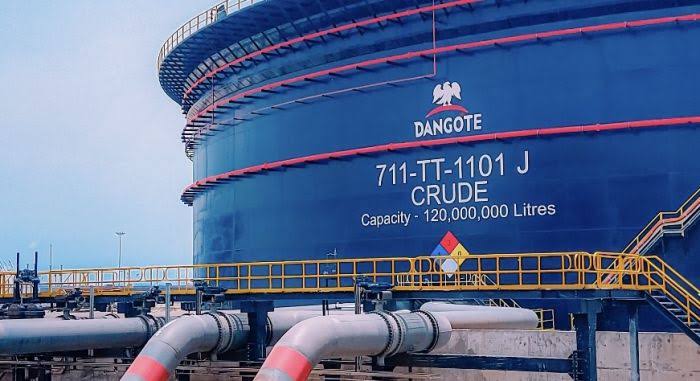
N739/litre Dangote petrol causes queues at MRS stations
- /home/naijuinz/public_html/wp-content/plugins/mvp-social-buttons/mvp-social-buttons.php on line 27
https://naijablitznews.com/wp-content/uploads/2024/09/images-2024-09-03T084333.396.jpeg&description=N739/litre Dangote petrol causes queues at MRS stations', 'pinterestShare', 'width=750,height=350'); return false;" title="Pin This Post">
- Share
- Tweet /home/naijuinz/public_html/wp-content/plugins/mvp-social-buttons/mvp-social-buttons.php on line 72
https://naijablitznews.com/wp-content/uploads/2024/09/images-2024-09-03T084333.396.jpeg&description=N739/litre Dangote petrol causes queues at MRS stations', 'pinterestShare', 'width=750,height=350'); return false;" title="Pin This Post">
Queues at MRS filling stations are growing longer by the day as motorists seek to buy petrol produced by the Dangote refinery at N739 per litre.

From Lagos Island to the mainland, The PUNCH observed that MRS filling stations were crowded with vehicles waiting to buy fuel, while other filling stations appeared largely deserted.
In many locations across Lagos, the queues spilled onto major roads, causing traffic congestion and affecting free vehicular movement at a time when Nigerians were travelling for the Yuletide season.

It was observed that many stations struggling for customers have refused to lower their pump prices below N800 per litre, forcing Nigerians to look for cheaper alternatives.
“Those filling stations will only see customers if there are no MRS filling stations around them, but the MRS filling stations are almost everywhere these days. Many of the dead filling stations we used to know are operating as MRS. This has made the situation very dicey for filling stations,” a marketer said anonymously.
Our correspondent reports that aside from MRS, other known Dangote partners such as Heyden and AP have yet to reduce prices to N739 per litre. Checks showed that these stations were selling petrol at prices ranging from N800 to N890 per litre, depending on location.
In areas with MRS filling stations, competing outlets were compelled to slash prices to remain competitive in the deregulated fuel market. Where there are no MRS stations, fuel sellers said they would continue to sell at old prices pending the arrival of new stocks purchased at N699 per litre.
On December 12, the Dangote refinery surprised depot owners and marketers when it slashed the gantry price of petrol by N129, from N828 to N699 per litre.
During a recent press briefing, the President of the Dangote Group, Aliko Dangote, said he had information that some marketers planned to keep pump prices high despite the reduction.
Consequently, Dangote vowed to enforce the new pricing regime, with MRS selling petrol at N739 per litre from last week Tuesday.
The PUNCH earlier reported that as more MRS filling stations in Lagos and Ogun states began dispensing Dangote refinery petrol at N739 per litre, motorists started boycotting outlets selling at higher prices.
“We are going to use whatever resources we have to make sure that we crash the price down. For this December and January, we don’t want people to sell petrol for more than N740 nationwide. Those who want to keep the price high to sabotage the government, we will fight as much as we can to make sure that these prices are down. If you have money to come and buy, you can pick up petrol at N699,” Aliko Dangote said.
Speaking with our correspondent, the spokesperson of the Independent Petroleum Marketers Association of Nigeria, Chinedu Ukadike, said marketers who refused to reduce prices would lose customers as bank interest charges accumulate.
“We are in a situation where competition can be determined by price. Patronage will be determined by pricing. Nobody is against you; nobody is regulating you. You will regulate yourself. The market will regulate itself. The time has gone when people were queuing at NNPC filling stations. Wherever the fuel is cheap, that is where the marketers go. So, we are in a price war. Demand and supply determine the price.
“Once Dangote has reduced the gantry price to N699, marketers will dive towards competitive pricing whereby they can retain their numerous customers; if not, interest from banks would be ‘eating’ your capital,” Ukadike said.
However, major oil marketers insist that the Dangote refinery, despite recent sharp price reductions and increasing domestic output, cannot solely meet Nigeria’s petrol supply needs, warning that reliance on a single source is already creating challenges in the downstream sector.
The Executive Secretary of the Major Energies Marketers Association of Nigeria, Clement Isong, said all MEMAN members currently purchase petrol from the Dangote refinery but stressed that supply constraints, logistics challenges and timing issues make it impractical for the refinery to be Nigeria’s sole source of supply.
Isong noted that the Nigerian Midstream and Downstream Petroleum Regulatory Authority had planned well for the Yuletide season by granting import licences, a move which the Dangote refinery said left its fuel unsold in storage tanks.
He explained that many marketers were deliberately avoiding large-volume purchases due to the risk of sudden price crashes that could wipe out margins.
“There’s a glut. There are excess products in the country. And there will continue to be imported products coming in. The authority planned well for the season; it is true that there are products everywhere. It’s just that you need to be able to buy at a good price for your station. But there are excess products in the system.
“But people are being careful because of the price. Nobody buys in large volumes. So, you know, there’s an advantage to volume purchase, to bulk purchase. The bigger you buy, the lower your unit cost. But if you buy in bulk now and the price crashes, then the bigger the amount of money you lose,” he warned.
Amid the intense competition, the Nigerian National Petroleum Company Limited also reduced petrol prices from N875 to between N825 and N840 per litre, depending on location. The state-owned company was one of the biggest petrol importers in November, according to a report by the Nigerian Midstream and Downstream Petroleum Regulatory Authority.
In the NMDPRA fact sheet, the NNPC, described as the supplier of last resort, said it imported petrol in November to build inventory and guarantee supply during the peak demand period.
However, at a landing cost of about N828 per litre, according to MEMAN, importers such as the NNPC would struggle to compete with Dangote’s N739 per litre pump price, forcing them to sell below cost.
Recall that the NNPC was previously the sole importer of petrol due to subsidies. With the commencement of petrol production by the Dangote refinery a year ago, the sector became fully deregulated, leading to the disappearance of queues at NNPC stations that were once caused by price differentials.
It was gathered that many NNPC filling stations in Lagos are now struggling to attract customers, as motorists opt for cheaper fuel elsewhere.
Meanwhile, as marketers lament losses running into billions of naira, Dangote said he was also losing money. Findings by The PUNCH showed that petrol importers risk losing as much as N100bn monthly following the refinery’s reduction in gantry prices.
At the same time, the refinery itself is projected to lose about N90bn monthly as a direct result of the price cut, highlighting the intensity of competition reshaping Nigeria’s downstream oil market.
Meanwhile, Dangote has announced the launch of a dedicated hotline for Nigerians to report any MRS Oil Nigeria Plc filling station selling petrol above the approved pump price of N739 per litre, warning consumers against buying ‘expensive’ petrol.
The refinery also warned marketers against creating artificial scarcity, stating that it is supplying up to 50 million litres of petrol daily.
In a statement, the refinery said the initiative underscored its commitment to transparency, affordability and consumer protection in the downstream petroleum market.
“The hotline number 0800123 5264 is now active nationwide, enabling consumers to promptly report violations and help maintain fair pricing across over 2,000 MRS stations. This measure follows the refinery’s recent commencement of nationwide PMS sales at N739 per litre, a strategic intervention aimed at stabilising fuel prices and easing the financial burden on Nigerians during the festive season,” the statement said.
The Dangote refinery reiterated its mission to deliver affordable, high-quality fuel while safeguarding national economic interests, pledging to continue supplying 50 million litres daily.
“We encourage Nigerians to avoid purchasing PMS at inflated prices when locally refined fuel is available at N739 per litre. Report any MRS station selling above this price by calling our hotline. Together, we can ensure that the benefits of this price reduction reach every consumer,” the statement added.
The queues at MRS filling stations are expected to ease as more outlets cut prices.
Credit: PUNCH
News
INEC set to publish details of 2027 Presidential, National Assembly candidates on August 1
The Independent National Electoral Commission (INEC) will on Saturday, August 1, 2026, publish the particulars of all presidential and National Assembly candidates contesting the 2027 general election for public inspection at its offices across the country.
The publication of the candidates’ details, contained in Form EC9, is in compliance with Section 29(3) of the Electoral Act, 2026, which requires the commission to make the personal particulars of nominated candidates available for public scrutiny within 21 days of receiving them.
Political parties concluded the online submission of the names, personal particulars and other required documents for their presidential and National Assembly candidates on Tuesday, July 14, 2026, after INEC granted a 72-hour extension to the original deadline. ExecutiveBranch
Under the commission’s revised timetable, nominations for presidential and National Assembly candidates were initially scheduled to be submitted between June 27 and July 11, 2026.
Section 29(1) of the Electoral Act, 2026, requires political parties to submit Forms EC9, EC9A, EC9B, EC9C, EC9D and EC9E, containing the names and personal particulars of their nominated presidential and National Assembly candidates, not later than 120 days before the election.
Speaking on whether the 72-hour extension would affect the publication date, INEC Deputy Director of Publicity, Wilfred Osilama Ifogah, said he did not expect any change, although he stressed that he was expressing a personal opinion rather than the commission’s official position.
“I doubt. It might not necessarily affect it. It’s just for the Commission to put the information together and submit it. This is my opinion. I’m not talking officially. When it gets to the time, you will see whether the Commission will publish it or not,” he said.
Meanwhile, the online submission of nominations for governorship and State Houses of Assembly candidates, which commenced on July 18, will continue until August 8, 2026.
INEC has scheduled August 29, 2026, for the publication of the personal particulars of governorship and State House of Assembly candidates through Form EC9.
The commission had earlier conducted party primaries for all elective positions between April 23 and May 30, 2026.
According to INEC’s election timetable, the presidential and National Assembly elections will hold on January 16, 2027, while the governorship and State Houses of Assembly elections are scheduled for February 6, 2027
News
CSOs, Youth Groups Push for Inclusive NYSC Reform, Convene National Dialogue
By Gloria Ikibah
A coalition of civil society organisations and youth groups has announced plans to convene a national dialogue on proposed reforms to the National Youth Service Corps (NYSC), seeking to ensure that the review process reflects the views of Nigerians before the Federal Government takes a final position.
The initiative, being organised by the Centre for Equity, Justice and Transparency in partnership with the Save Nigeria Movement, is expected to bring together policymakers, academics, former corps members, youth organisations, security agencies and other stakeholders to examine the future of the scheme and recommend practical reforms.
Convened by legal practitioners Sorkaa Tsembelee and Patrick Agbese, the one-day dialogue aims to generate a comprehensive working document that will be presented to the Federal Government as part of ongoing efforts to review the NYSC Act.
In a statement issued on Friday, the organisers said the forum was intended to provide an inclusive platform where stakeholders could contribute meaningfully to the reform process.
The statementread: “The essence of this dialogue is for critical stakeholders to make input into the proposed NYSC reforms before the President’s administration takes final decisions.
“We will have senior academics, former corps members, youth groups and other members of society to dissect the proposed reforms thoroughly.
“It will thereafter catalyse into a working document for the Federal Government. We will invite the CDS, the Army and others. Let everyone look at it and say their own.”
Established in 1973 after the Nigerian Civil War, the NYSC was designed to promote national unity, encourage integration among young graduates and foster national development through compulsory service outside their states of origin. Over the decades, corps members have played significant roles in education, healthcare, agriculture and community development, particularly in underserved communities.
However, growing concerns over the safety and welfare of corps members, inadequate funding, deployment policies and questions surrounding the relevance of some aspects of the programme have fuelled calls for a comprehensive review.
The organisers said the dialogue will assess whether the scheme still aligns with its founding objectives while identifying legislative and policy changes needed to address present-day realities.
They maintained that while reforms were necessary, the NYSC’s central mission of promoting national cohesion should be preserved alongside efforts to strengthen skills development, entrepreneurship and youth empowerment.
“This is not about tearing down an institution that has served Nigeria well; it is about refining it with the collective wisdom of those who have lived the experience and those who study its impact.
“Former corps members carry practical insights that policymakers often miss, and we want those voices at the table.
“Youth groups and civil society must not be spectators while decisions that will shape the next generation of Nigerian graduates are taken. The dialogue creates the space for genuine, structured input”, it added,.
According to the organisers, discussions will focus on critical issues including corps members’ welfare, security, orientation camp facilities, deployment procedures, funding mechanisms and the effectiveness of the Community Development Service (CDS) programme.
They added that academics will provide comparative analyses of national service models in other countries, while security agencies would offer institutional perspectives on improving the protection of corps members, particularly those posted to areas affected by insecurity.
“We cannot discuss NYSC reforms without hearing from those who secure the environment in which corps members serve. The CDS and the Army have institutional knowledge that is indispensable.
“Their perspectives on logistics, security and inter-agency coordination will enrich the final document.
“Senior academicians will help us situate the proposed reforms within the broader context of nation-building. We need evidence-based contributions, not just opinions”, the said.
The organisers said the ultimate goal was to produce practical recommendations capable of informing both legislative and executive action.
They explained that the final report would reflect contributions from former corps members, scholars, security agencies, youth organisations and civil society groups, providing government with workable proposals for strengthening the scheme without compromising its original mandate.
“The working document that emerges from this dialogue must be something the government can work with.
“It should reflect the views of those who have served, those who teach, those who protect, and those who advocate.
“Anything less would be a missed opportunity. We are calling on all stakeholders to come prepared to engage constructively.
“The future of the NYSC is too important to be decided in isolation. This national dialogue is our contribution to an open, inclusive process”, the statement further read.
News
No plans to increase electricity tariffs – Power Minister assures Nigerians
The Minister of Power, Joseph Tegbe, has declared that President Bola Tinubu’s administration has no intention to jerk up electricity tariffs beyond the current level.
He disclosed this during a media briefing in Abuja on Friday.
According to him, the Tinubu administration’s priorities are improving electricity service delivery, expanding access to electricity, and ensuring that Nigerians pay only for the electricity they consume.
The minister said that, over the last two weeks, the country has consistently generated 5,000 megawatts of electricity.
“We are already witnessing encouraging improvements in electricity generation. Over the course of the last two weeks, we have consistently generated 5,000MW.
“Permit me to address two issues that have generated considerable public discussion. First, there is no policy by this administration to increase electricity tariffs beyond the current level. Our priority is not a tariff increase in the immediate term. Our priority is service improvement, universal metering, and ensuring Nigerians pay only for the electricity they actually consume,” he stated.
He added that the objective of the Federal Government is to provide reliable electricity to homes across the country.
“Our ambition is clear: reliable electricity that powers our homes.”
Tegbe’s comments come amid debate over a fresh electricity tariff hike, fuelled by remarks made by Tinubu’s Special Adviser on Power Infrastructure, Sadiq Wanka.
Nigerian electricity consumers have kicked against the proposed electricity tariff hike.
-
News20 hours agoSenate Begins Oil Sector Probe, Summons NNPCL, CBN, Major IOCs
-
News13 hours agoDoctors Perform First Successful Manhood Transplant on 43-Year-Old Man
-
News20 hours agoEFCC forfeited assets Auction: Nigerian auctioneers alleges impersonation
-
News20 hours agoLeaked DSS Memo Warns of Fresh Terrorist Attacks
-
News11 hours agoWatch moment FCT minister Wike led security operatives to criminals hideout in Kukwaba
-
Economy13 hours agoSEE Black Market Dollar To Naira Exchange Rate Today 31st July 2026
-
News10 hours agoPhotos: Wike orders demolition of suspected criminal hideout in Abuja
-
News9 hours agoBan on sale of sachet alcoholic drinks remains – NAFDAC