News
80-year old grandpa nabbed with drugs concealed in mannequins(Photos)

- /home/naijuinz/public_html/wp-content/plugins/mvp-social-buttons/mvp-social-buttons.php on line 27
https://naijablitznews.com/wp-content/uploads/2026/01/8ea3f75e-6ee9-4a42-8520-14dd644a135e-497x600.jpeg&description=80-year old grandpa nabbed with drugs concealed in mannequins(Photos)', 'pinterestShare', 'width=750,height=350'); return false;" title="Pin This Post">
- Share
- Tweet /home/naijuinz/public_html/wp-content/plugins/mvp-social-buttons/mvp-social-buttons.php on line 72
https://naijablitznews.com/wp-content/uploads/2026/01/8ea3f75e-6ee9-4a42-8520-14dd644a135e-497x600.jpeg&description=80-year old grandpa nabbed with drugs concealed in mannequins(Photos)', 'pinterestShare', 'width=750,height=350'); return false;" title="Pin This Post">


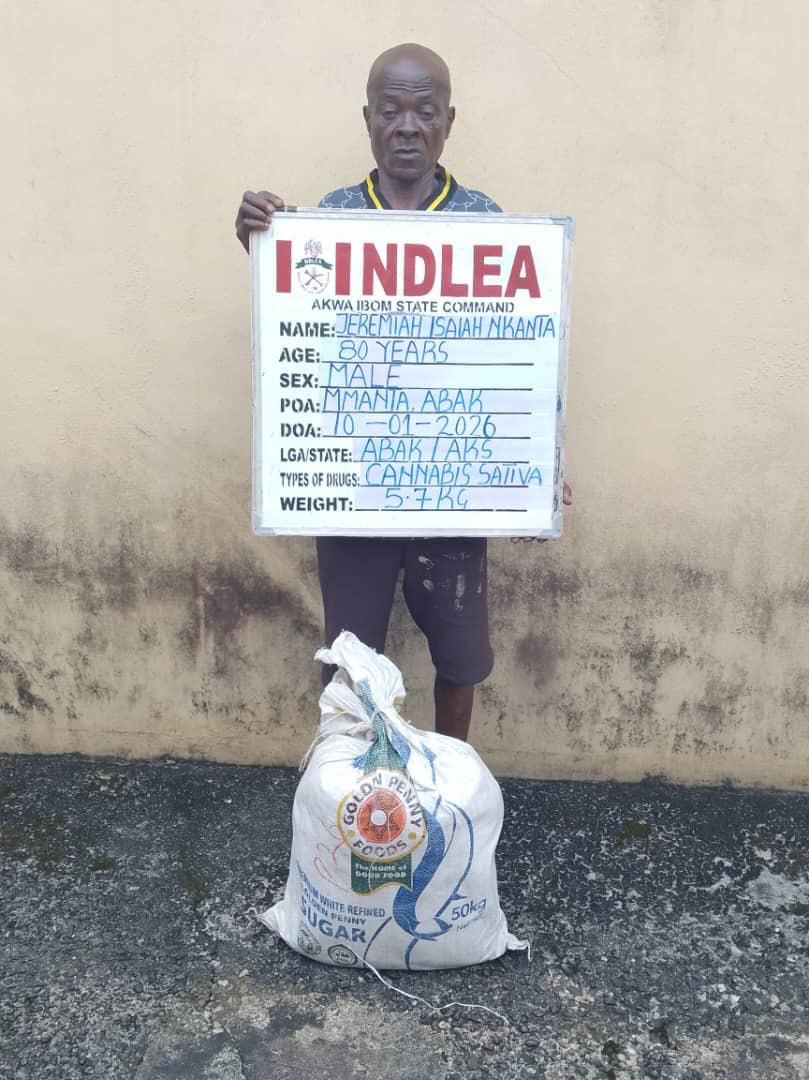
Barely three years after he was arrested, prosecuted and sentenced to two years imprisonment for dealing in illicit drugs, an 80-year-old grandpa Jeremiah Isaiah Nkanta has again been nabbed by operatives of the National Drug Law Enforcement Agency (NDLEA) for returning to the criminal trade.
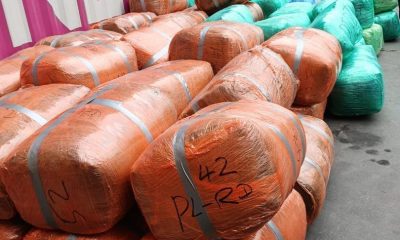
Notorious for illicit drug business, Nkanta was first arrested by NDLEA on 14th December 2022, prosecuted and sentenced to two years in jail by a Federal High Court in Uyo, Akwa Ibom state. Not ready to let go the old habit, Nkanta returned to the illicit drug trade and following credible intelligence, NDLEA operatives on Saturday 10th January 2025 tracked the Octogenarian ex-convict to his Mmanta – Abak village, Abak local government area of Akwa Ibom state, where he was arrested with 5.7 kilograms of skunk, a strain of cannabis in his residence.
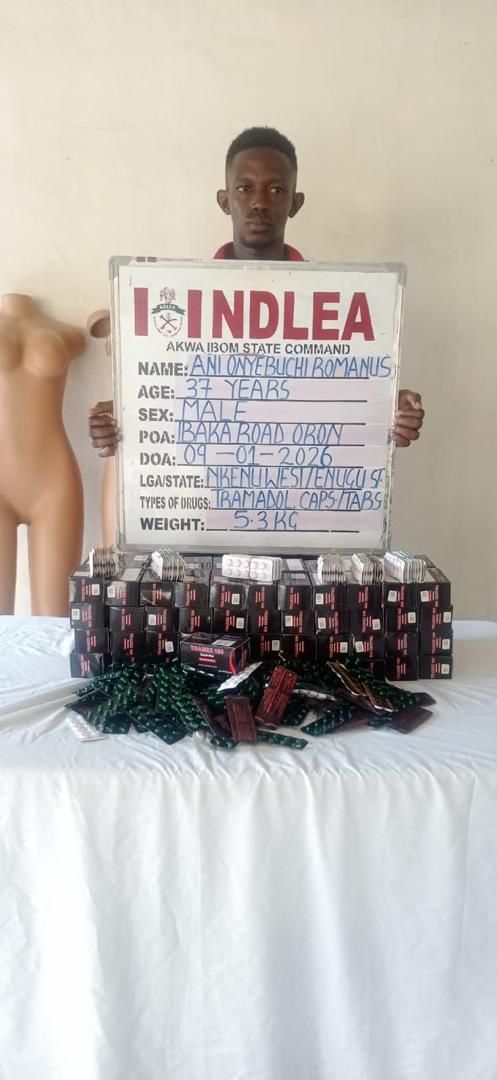
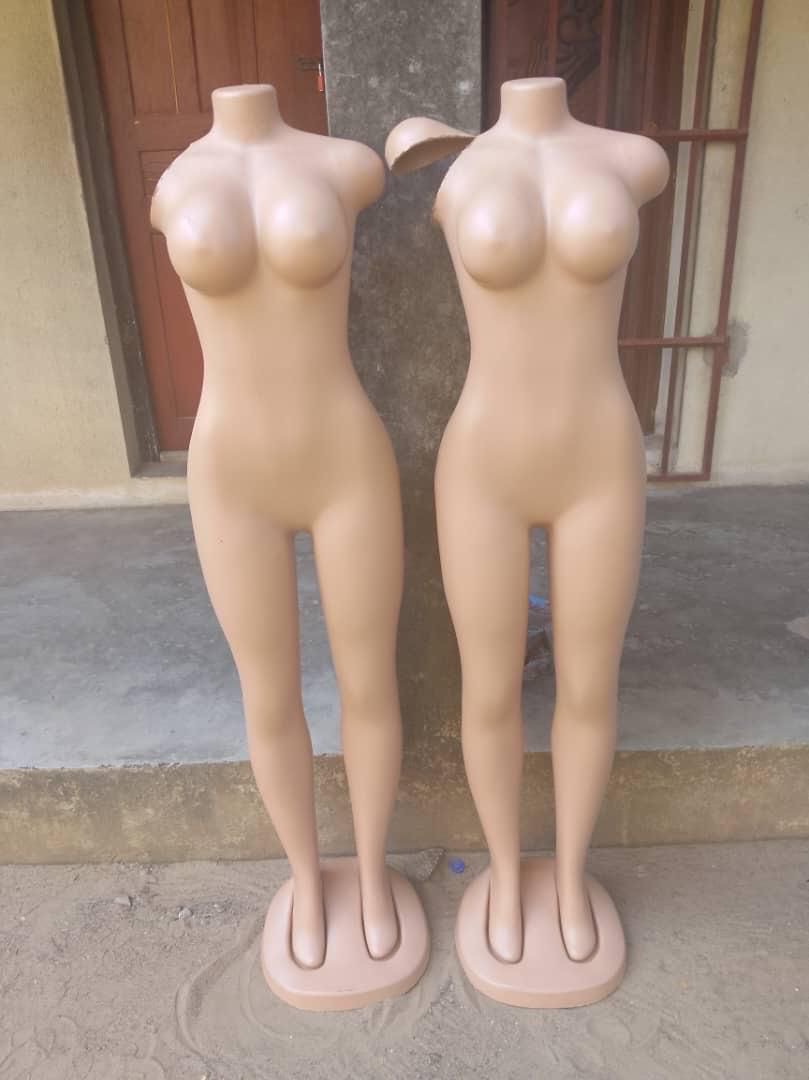
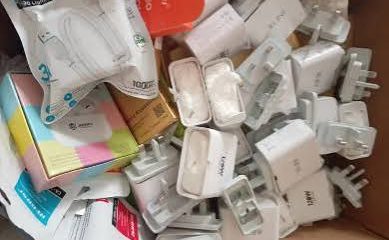
In another successful interdiction operation in Akwa Ibom state, NDLEA operatives on patrol along Oron-Ibaka road in Oron LGA on Friday 9th January intercepted a 37-year-old businessman Ani Onyebuchi Romans while travelling with full body mannequins for his clothing business in Cameroun. A search of the mannequins revealed that they were stuffed with pills of tramadol weighing 5.3 kilograms.
The suspect claims he resides in Cameroun and was reportedly returning to his base after the Christmas and New Year holidays when he was apprehended. It was revealed that he bought the drugs in Onitsha, Anambra state and was trafficking them to Cameroun to sell, using two mannequins to conceal the opioids.
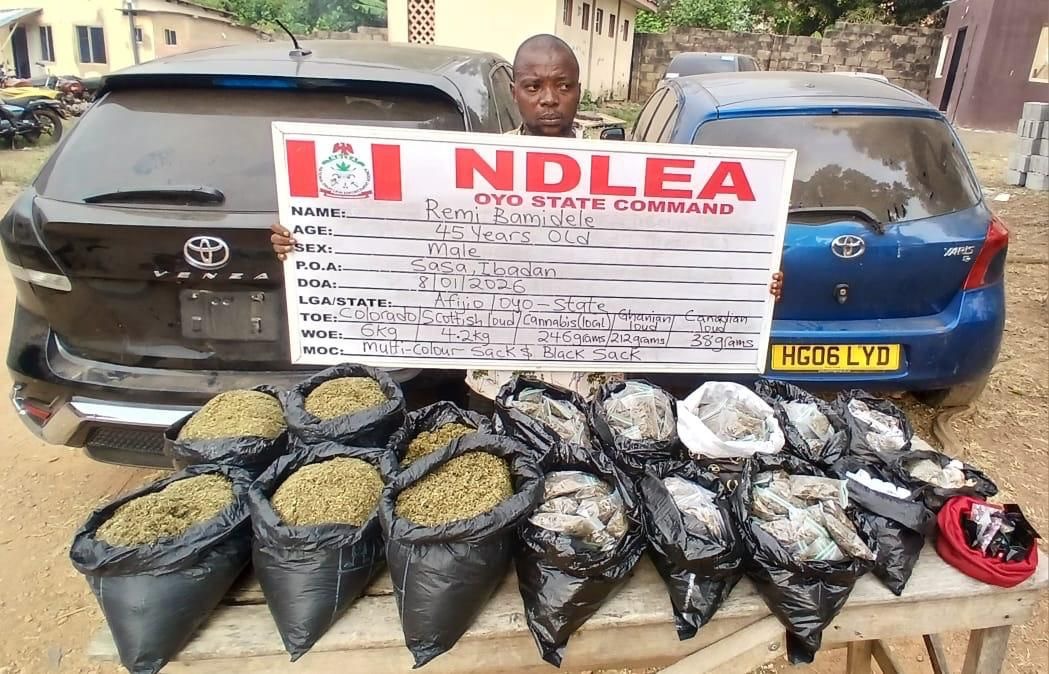
In Oyo state, raids across different locations led to the seizure of dangerous illicit drugs and arrest of notorious dealers, including 45-year-old Remi Bamidele (Alias ‘Aluko the Mafia’) at Sasa, Ibadan, where a total of 10.696 kilograms of Colorado, Scottish Loud, Ghana Loud, Canadian Loud and skunk, all strains of cannabis. At the time of his arrest on Thursday 8th January, two vehicles: Toyota Venza and Toyota Yaris marked HG 06 LYD were recovered from him.
At Adegbayi area of the state capital Ibadan, NDLEA officers on Friday 9th January arrested Adeola Toheeb, 27, with various quantities of Colorado, Ghana Loud and skunk while Habeeb Ali, 29, was nabbed at Ring road, Ibadan with 1.264kg Colorado, Scottish Loud and skunk. Not less than One Million Three Hundred and Seven Thousand One Hundred Naira (₦1,307,100) cash exhibit was also recovered from him at the point of his arrest on Saturday 10th January.
A dispatch rider Osagbovo Edigin, 30, and two other suspects: Ebimi Labo, 28, and Akhimie Success, 25, were on Friday 9th January arrested at Ihama/Airport road GRA Benin City, Edo state in connection with the seizure of 118grams of Canadian Loud and a wrap of Colorado.
While Jimoh Agbonmhegbe, 49, was arrested at Irrua with 17.552kg Colorado, Loud and skunk, another suspect Evelyn Okoyomon, 38, was nabbed at Ubiaja with 930 grams of skunk on Wednesday 7th January.
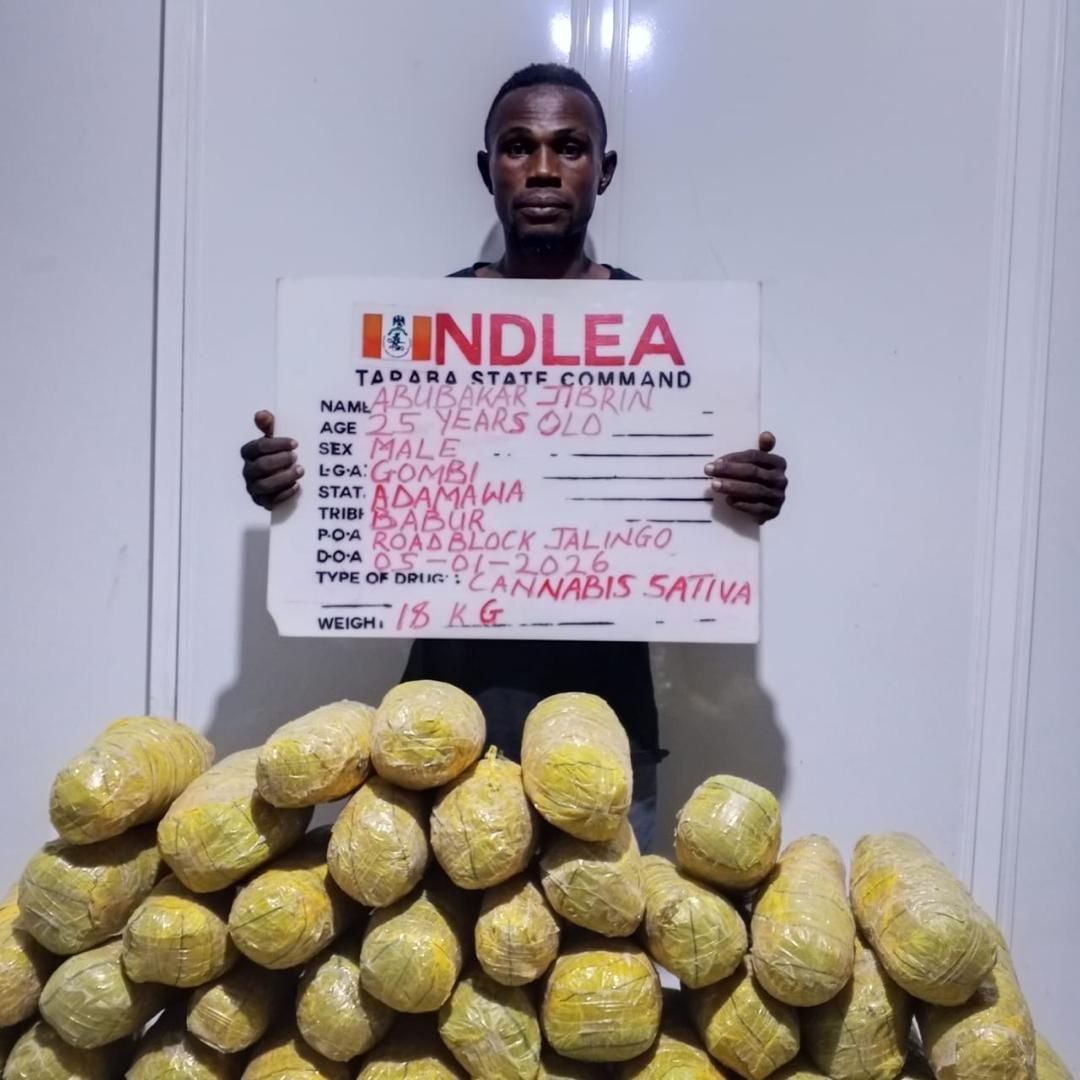
In Niger state, no fewer than 4,000 pills of tramadol 225mg were recovered from a suspect Nazifi Umar, 22, at Dakwa town, Tafa LGA, while another suspect Yusuf Usman, 41, was nabbed with 100 blocks of skunk weighing 47kg Lankaviri, Yorro LGA Taraba state on Wednesday 7th January.
Not less than 30,950 capsules of tramadol were recovered from the home of a suspect Ugwoke Chibueze, 40, in Bachure area of Yola South LGA, Adamawa state following his arrest at the Lamido Aliyu Mustapha International Airport Yola on Tuesday 6th January.
With the same vigour, Commands and formations of the Agency across the country continued their War Against Drug Abuse (WADA) sensitization activities to schools, worship centres, work places and communities among others in the past week. These include: WADA sensitisation lecture to students and staff of Government Day Science and Technical College, Babura, Jigawa; Abiayubal Ansari Islamiyya School, Layin Indo Mai Tuwan Tara, Fagge LGA, Kano; and youths of Oshituma Umuogudu Akpu Ngbo, Ebonyi state, among others.
While commending the officers and men of Akwa Ibom, Adamawa, Taraba, Edo, Oyo, and Niger Commands of the Agency for the arrests and seizures, Chairman/Chief Executive Officer of NDLEA, Brig. Gen. Mohamed Buba Marwa (Rtd) stated that their operational successes and those of their compatriots across the country especially their balanced approach to drug supply reduction and drug demand reduction efforts are well appreciated.


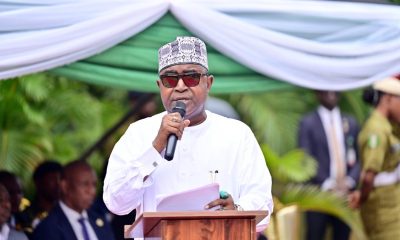




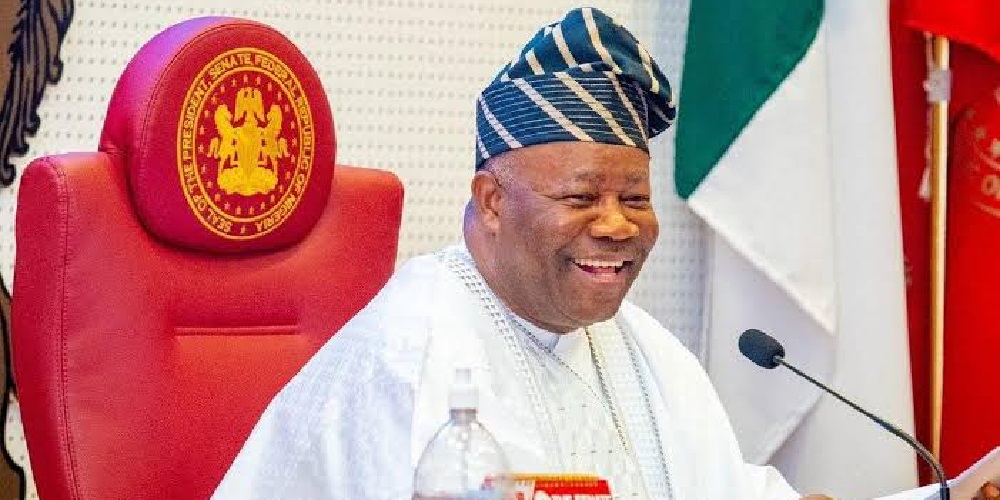
The President of the Senate, Senator Godswill Akpabio, has felicitated the Muslim Ummah in Nigeria and across the world on the occasion of Eid el Maulud, the celebration of the birth of Prophet Muhammad (SAW).
In a congratulatory message through his Special Adviser on Media and Publicity, Hon. Eseme Eyiboh, Senator Akpabio described the life and teachings of the Holy Prophet as a timeless example of compassion, tolerance, humility, and service to humanity.
“As we commemorate this sacred day, I urge our Muslim brothers and sisters to reflect on the virtues of the Prophet and to offer special prayers for peace, unity, and progress in our dear country, Nigeria,” the President of the Senate said.
He noted that Nigeria’s strength lies in its diversity, and called on all citizens to embrace love, forgiveness, and mutual respect regardless of faith or ethnicity.
“In these times, our nation needs the prayers of all religious leaders and faithful. Let us use this period to pray for our leaders, for security, economic prosperity, and for the unity that binds us together as one people under God,” he added.
Senator Akpabio reaffirmed the commitment of the 10th Senate under his leadership to promote legislation and policies that protect religious freedom, foster national cohesion, and improve the welfare of all Nigerians.
He felicitated President Bola Ahmed Tinubu, GCFR and Vice President Kashim Shettima, and wished the Muslim community a peaceful and joyous Eid el Maulud celebration.
Pastor Adamson Aromaegbe, the founder and General Overseer of Rock Word Church and Dominion International, has died.
Aromaegbe, who was based in Port Harcourt, Rivers State, reportedly died on Friday, August 21, 2026.
His death was confirmed by the leadership of the church in a statement released on Sunday.
The statement was signed by Rev. Nnamdy Echezona and shared through the ministry’s official Facebook page.
The church described the late pastor as a respected Christian leader who dedicated his life to preaching the gospel and building the ministry.
His work as a preacher, teacher, mentor and church leader reportedly influenced many people within and outside his ministry.
Following the announcement, the church called on members, friends and other supporters to pray for Aromaegbe’s family as they come to terms with his death.
Prayers were also requested for the church and members of the wider Dominion International family.
The church said arrangements for the late pastor’s funeral and other activities to mark his death would be announced later.
Aromaegbe’s death has left members of Rock Word Church and Dominion International mourning the loss of a leader who had spent years working in Christian ministry.
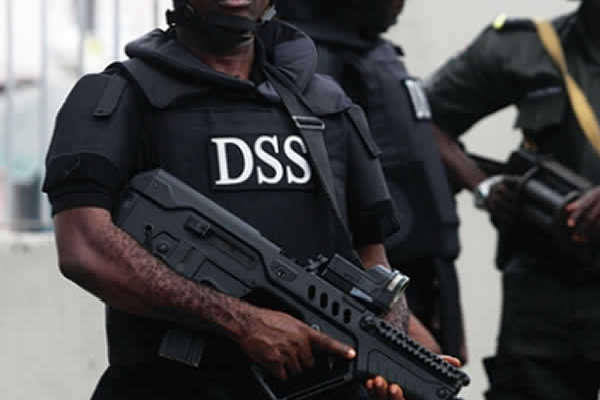
Security operatives comprising DSS officers, other agencies and local vigilantes have rescued a kidnap victim and neutralised two suspected kidnappers in Imo.
The Department of State Services (DSS) disclosed this in a statement issued to newsmen in Owerri on Sunday.
According to the statement, the operatives rescued 29-year-old Ibeabuchi Adibenma, who was abducted in Orlu Local Government Area.
Adibenma was kidnapped at about 7 p.m. on Tuesday, Aug. 18, around Afor-Ogidi Market in Isiala Amaifeke community.
The victim was reportedly returning from Umuna, Orlu market, when the armed assailants intercepted his vehicle near the market.
The attackers operated on two motorcycles and double-crossed the victim before forcing him to an undisclosed location.
Following the abduction, the kidnappers contacted Adibenma’s family and demanded N15 million ransom for his release.
However, on Aug. 20, security operatives launched a coordinated operation to rescue the victim from his abductors.
According to the DSS, the operation led to Adibenma’s rescue at Ihioma Community in Orlu.
“Two suspected members of the kidnapping syndicate were neutralised during the operation, while two high-calibre weapons and ammunition were recovered.”
The rescued victim was subsequently taken into protective custody before being reunited with his family.
The DSS commended the coordinated efforts of the participating security agencies and local vigilantes in securing the victim’s safe release.
The successful operation also highlights ongoing security efforts against kidnapping and other criminal activities in communities across Imo.
Eid El Maulud: Akpabio Felicitates Muslims, Seeks Prayers For Peace, Unity

SAD! Nigerian popular General Overseer is dead

Security operatives rescue kidnap victims in Imo waste two suspects




-

 News22 hours ago
BALLOT BOX NIGERIA TV REALITY SHOW: Nigeria’s Biggest Democratic Reality Television
-

 News20 hours ago
Iranian hackers ‘shut down British power plant for four days’
-
 News20 hours ago
BREAKING: 200 members dump APC, join ADC in Niger
-

 News18 hours ago
Gunmen kidnap popular Kwara monarch
-
 News10 hours ago
Ondo Assembly Crisis: Impeachment Of Speaker Stalls As APC Intervenes
-
 News10 hours ago
10 Nollywood Stars Who Lost Their Fight Against Cancer
-
 Entertainment10 hours ago
What My Father Told Me Before His Death, Baba Suwe Daughter Recalls
-
 Entertainment10 hours ago
All you need to know about popular actor Taiwo Hassan, Ogogo’ who died of cancer