Connect with us

News

Garrulous Kemi Olunloyo slams Davido, his dad after he reacted to Anu’s paternity claims

Published

on

ADVERTISEMENT
Zoom Ad
ADVERTISEMENT
Zoom Ad

By Kayode Sanni-Arewa

Garrulous media personality, Kemi Olunloyo has reacted to a video by Davido’s father, Dr Adedeji Adeleke, about the paternity controversy involving his son.

Anuoluwa Adeleke, the musician’s alleged daughter, had written a letter to him requesting a DNA test to confirm her paternity.

The case later became messy after Davido called out Anu’s mother, who also responded to his claims.

Advertisement

Davido’s father later held a press conference where he addressed the paternity issue, stating that Anu is not his granddaughter and sharing details of DNA tests that were allegedly conducted in the past.

Reacting to the video, Kemi Olunloyo blasted Dr Adeleke for allegedly dragging her autistic son into the matter.

According to her, she does not tolerate anyone involving her son in any controversy, claiming that she opened Anu’s Instagram account and later handed over the password to her mother before leaving Nigeria.

The businessman claimed she had a habit of telling lies and said members of her family had described her as mentally unstable and receiving psychiatric care.

Advertisement

He also stated that even her own family had distanced themselves from her and advised his son to ignore her.

Adeleke said in a video: “I’ve told David to ignore that woman. even her own son disowned her publicly. She has been lying and lying, using an account that does not belong to her, impersonating a child and the child’s mother.

She lies a lot. The family says she’s crazy. She’s receiving psychiatric help somewhere. Her own father said it. So I don’t care what she says.”

Following those remarks, Olunloyo fired back on Facebook.

Advertisement

She said the real reason she was being attacked was because she was exposing what she described as the truth about the case.

The journalist warned Adeleke to stop mentioning her son, whom she said is autistic, and accused him of turning attention away from what she alleged about Davido’s twins.

She wrote: “Deji told David to ignore me because my biological son has disowned me. Correction: because I’m exposing him and its the truth

“Deji Adeleke keep my autistic son off your mouth and focus on Davido’s autistic twins who cant talk.”


Advertisement
Continue Reading
Advertisement

News

Tinubu orders urgent diplomatic action to bring back 300 Nigerians jailed in Ethiopia after inmates die in custody

Published

on

ADVERTISEMENT
Zoom Ad
ADVERTISEMENT
Zoom Ad

President Bola Ahmed Tinubu has ordered immediate diplomatic action aimed at securing the return of hundreds of Nigerians currently serving prison sentences in Ethiopia, following growing concerns over their welfare and reports that several inmates have died while in custody.

The move is expected to pave the way for the transfer of nearly 300 Nigerian prisoners from Ethiopian correctional facilities to Nigeria, where they would complete the remainder of their jail terms under an international prisoner-transfer arrangement.

To facilitate the process, a high-powered Nigerian delegation comprising senior government officials is set to travel to Addis Ababa to finalise negotiations with Ethiopian authorities. Members of the delegation include the Minister of Foreign Affairs, Bianca Odumegwu-Ojukwu, and the Attorney-General of the Federation and Minister of Justice, Lateef Fagbemi.

Presidency had disclosed that Tinubu directed the officials to expedite discussions and conclude a Memorandum of Understanding (MoU) with the Ethiopian government that would provide the legal framework for transferring the inmates to Nigeria.

Advertisement

The intervention comes amid mounting concerns over the conditions faced by Nigerian prisoners at Ethiopia’s Kaliti Prison, where many of the inmates are reportedly serving lengthy sentences for drug-related offences.
Government sources indicated that reports of deteriorating living conditions, inadequate healthcare services, and overcrowding within the prison facility played a major role in prompting the President’s decision.

According to available estimates, close to 300 Nigerians are currently incarcerated in Ethiopian prisons, with a significant number convicted for offences linked to narcotics trafficking. However, families, advocacy groups, and legal rights organisations have repeatedly expressed concerns over the treatment of the inmates, citing poor feeding conditions, limited access to medical attention, and overcrowded detention facilities.

The issue has remained a sensitive diplomatic matter between Nigeria and Ethiopia for years, attracting growing attention from civil society groups and concerned relatives.

Calls for government intervention intensified after reports emerged that several Nigerian inmates had died while serving their sentences. The deaths sparked renewed appeals for authorities to activate an inmate-transfer agreement that would allow the prisoners to complete their sentences closer to home.

Advertisement

Families of the affected inmates have argued that relocation to Nigeria would improve access to healthcare, family support, and rehabilitation opportunities.

The matter also attracted judicial attention after a Federal High Court in Abuja reportedly directed relevant government agencies to take steps toward facilitating the inmates’ return, citing humanitarian concerns surrounding their continued detention abroad.

Prior to Tinubu’s latest directive, Nigerian and Ethiopian officials had engaged in multiple rounds of discussions over the proposed transfer arrangement. Nigerian authorities maintained that necessary domestic procedures had largely been completed and that the process was awaiting final approvals from the Ethiopian government.

Diplomatic engagements reportedly continued throughout 2025, with both countries expressing willingness to reach a mutually acceptable agreement.

Advertisement

Observers say the President’s latest intervention represents the most decisive effort yet to resolve the long-running issue and bring closure to concerns raised by families and advocacy groups.

If successfully concluded, the agreement would enable the affected prisoners to serve the remainder of their sentences in Nigerian correctional facilities while remaining subject to the terms of their original convictions.

Such prisoner-transfer arrangements are widely recognised under international law and are commonly used by countries seeking to promote rehabilitation, maintain family ties, and improve the welfare of convicted citizens serving sentences abroad.

Many of the Nigerians currently detained in Ethiopia were reportedly arrested while transiting through Addis Ababa’s international airport, one of Africa’s busiest aviation hubs. Although several were convicted on drug-trafficking charges, some advocacy groups continue to argue that certain individuals may have unknowingly been used as drug couriers and deserve further review of their cases.

Advertisement

The outcome of the planned negotiations in Addis Ababa is expected to determine when and how the transfer process will begin, offering hope to many inmates and their families who have long awaited a resolution to the issue.

Continue Reading

News

Zulum Pledges More Secure, Prosperous Borno For Successor

Published

on

By

ADVERTISEMENT
Zoom Ad
ADVERTISEMENT
Zoom Ad

Borno State governor, Prof. Babagana Umara Zulum, has pledged to hand over a more stable, secure, and economically prosperous state to the next administration as he continues efforts to consolidate gains made in governance and security.

Zulum gave the assurance on when he received prominent sons and daughters of Gubio Local Government Area at the Government House, Maiduguri, alongside the APC governorship candidate for 2027, Engr. Mustapha Gubio.

The delegation, led by elder statesman Alhaji Gambo Gubio, included top political figures, retired security officers, and former public office holders from the area.

The governor said despite persistent security challenges in the state, his administration remains committed to strengthening stability and deepening development across all sectors.

Advertisement

“Security is the most difficult issue. Insha Allah, before I leave, the situation will be better than now. I will hand over a more stable, more prosperous, and more secure government to Engr. Mustapha Gubio, Insha Allah,” Zulum said.

He stressed that sustaining progress is often more difficult than achieving it, urging continued prayers and support for the APC governorship candidate.

“What matters is not just success; managing success is more difficult than achieving success itself,” he said.

Zulum also described Engr. Mustapha Gubio as a long-time associate with strong character and leadership qualities.

Advertisement

“I have known him for the past 26 years since he was a student at the University of Maiduguri. His integrity is evident; he is humane, very gentle, and composed,” he said.

The governor recalled the difficult early days of his administration in 2019, noting the sacrifices made in addressing insecurity and humanitarian crises in the state.

“When I took over the leadership of the state, in the first 55 days of my administration, I saw my children only three times. The first four years were really challenging,” he said.

He expressed appreciation to the delegation for the visit and reaffirmed his commitment to continued progress in the state.

Advertisement

Leader of the delegation, Alhaji Gambo Gubio, thanked the governor for his support and described the APC governorship candidate as a worthy successor.

He also commended Zulum’s achievements in security, infrastructure, and governance, saying the governor had made significant progress in stabilising the state.

The visit was attended by top government officials, including the APC State Chairman, Secretary to the State Government, commissioners, and special advisers.

Advertisement
Continue Reading

News

Senate Calls For Total Ban On Importation Of Textile Materials

Published

on

By

ADVERTISEMENT
Zoom Ad
ADVERTISEMENT
Zoom Ad

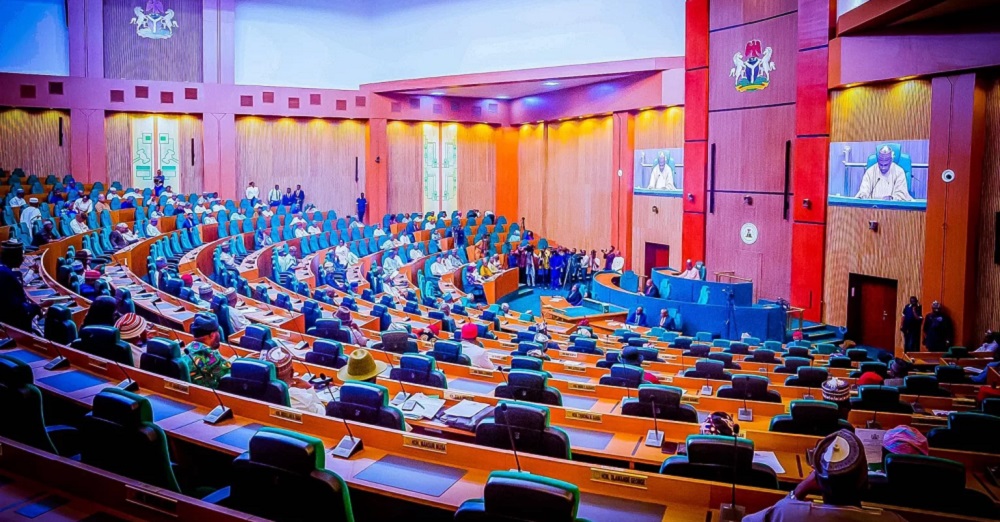
The Senate has asked the Federal Government to impose an outright ban on the importation of foreign textile materials as part of efforts to revive Nigeria’s struggling textile industry and stimulate local cotton production.

The upper chamber also urged the Federal Government, through the Ministries of Agriculture and Trade and Investment, to take urgent steps to resuscitate textile manufacturing across the country, particularly along the Kaduna-Kano industrial corridor, citing its potential to create jobs and address rising youth unemployment and insecurity.

The resolutions followed the adoption of a motion titled ‘urgent need to revive the textile industries in Nigeria with particular reference to the Kaduna-Kano Axis’, sponsored by Senator Sunday Katung (APC, Kaduna South) and co-sponsored by several lawmakers across party and regional lines.

Presenting the motion, Senator Katung recalled that Nigeria’s first large-scale textile manufacturing mill was established in Kaduna in 1957, a development that later spread to other regions and contributed significantly to industrial growth and employment generation.

Advertisement

According to him, government intervention policies in the 1960s and 1970s, including restrictions on textile imports, encouraged investment in local production and helped the industry flourish.

He noted that by the late 1970s and 1980s, Nigeria had about 167 textile mills employing more than 500,000 workers directly, making the sector the second-largest employer of labour after the Federal Government.

Katung further lamented the sector’s steady decline, attributing it to obsolete equipment, inadequate capital, inconsistent power supply and policy challenges.

The senator expressed concern that more than six decades after the industry’s golden era, Nigeria’s textile sector has deteriorated significantly, leaving once-thriving industrial facilities abandoned and reducing the industry to one of the weakest segments of the nation’s manufacturing sector.

Advertisement

Lawmakers who supported the motion underpinned the need for deliberate government intervention to restore the industry’s competitiveness, boost local production, reduce dependence on imports and create sustainable employment opportunities for Nigerians.

The Senate subsequently called for increased funding to the Bank of Industry (BoI) to support the revival of textile companies and requested the Federal Ministry of Agriculture to intensify efforts to encourage cotton farming, describing cotton production as critical to the survival of the textile sector.

Following deliberations, the Senate adopted the motion and urged the Federal Government to implement policies aimed at revitalising the textile value chain, from cotton farming to manufacturing and distribution, as part of broader efforts to strengthen the country’s industrial base and economic growth.

Advertisement
Continue Reading

Trending

Copyright © 2024 Naija Blitz News