Connect with us

Economy

Naira records first fall against US dollar, cancels three-day gain

Published

on

ADVERTISEMENT
Zoom Ad
ADVERTISEMENT
Zoom Ad

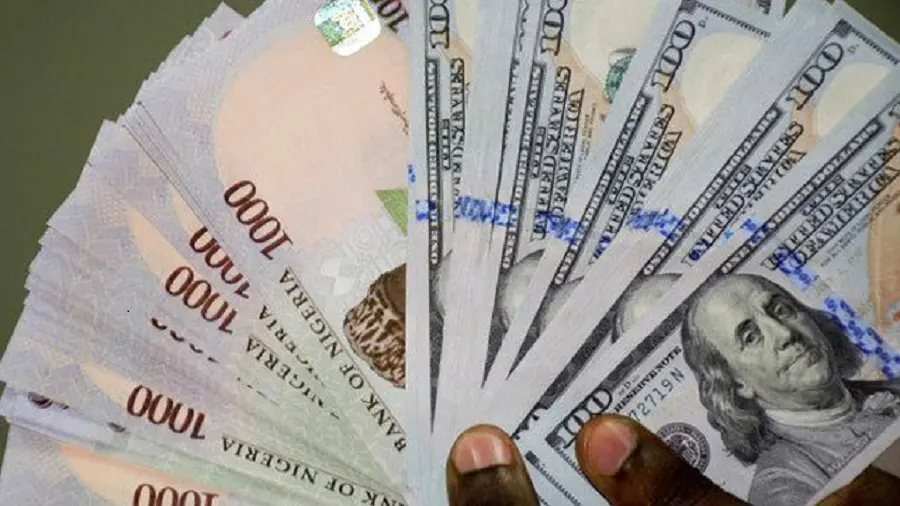
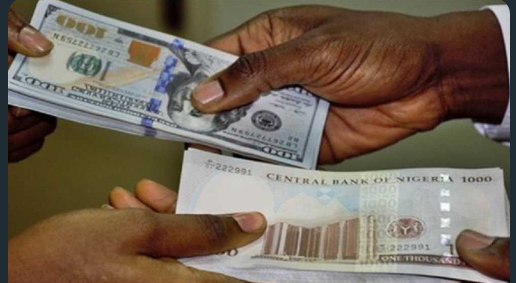
The naira on Thursday recorded its first depreciation against the United States dollar at the official foreign exchange market this week.


The Central Bank of Nigeria’s data showed that the Naira weakened on Thursday to N1,353.66 per dollar, down from N1,348.95.

This means that on a day-to-day basis the N4.71 dropped against the dollar.

The decline almost erased Naira’s N5.51 per dollar gain at the official exchange in the last three days.

Advertisement

However, at the black market, the Naira appreciated further by N5 to N1440 on Thursday per dollar, up from N1445 the previous day, owing to the apex bank’s latest intervention to Bureau De Change operators.

The development comes as Nigeria’s foreign debt grew further to $47.53 as of February 10, 2026, according to the apex bank data.
Continue Reading
Advertisement

Economy

Oil tops $100 as Iran vows to keep Hormuz closed

Published

on

By

ADVERTISEMENT
Zoom Ad
ADVERTISEMENT
Zoom Ad

Oil prices soared above $100 and stock markets extended losses as Iran’s new supreme leader ordered the Strait of Hormuz to be kept closed.

Concerns about a long, drawn out conflict were not assuaged by US President Donald Trump saying that stopping the Islamic republic’s “evil empire” was more important than crude prices.

Global markets have been roiled since the United States and Israel launched attacks on Iran. Tehran’s retaliatory strikes on shipping and Gulf neighbours have nearly cut off maritime traffic through the Strait of Hormuz, through which pass around a fifth of the world’s oil and liquefied natural gas.

“Oil prices are up by double-digit percentages again today, as the realisation sinks in that the US is not about to either end the war or institute some kind of convoy system in the region,” said analyst Chris Beauchamp at IG trading and investment platform.

Advertisement

Energy Secretary Chris Wright acknowledged the US military was currently “not ready” to escort tankers through the critical Strait of Hormuz.

Brent North Sea crude, the international benchmark contract peaked at $101.59 per barrel on Thursday.

At $100 per barrel, Brent is up around 38 percent from the eve of the conflict, which began on February 28 when the United States and Israel launched airstrikes against Iran. It is up nearly two-thirds from the start of the year.

Iran’s new supreme leader Mojtaba Khamenei called on Thursday for using “the lever of blocking the Strait of Hormuz”, which the country’s Revolutionary Guards vowed to carry out.

Advertisement

The call followed fresh attacks against Gulf energy targets: an attack on two oil tankers off Iraq killed at least one crew member, while a cargo ship caught fire after being hit by shrapnel.

Oil prices pared their gains after Iran’s deputy foreign minister said that Tehran had allowed ships from some countries to cross the Strait of Hormuz.

The International Energy Agency said the Mideast war “is creating the largest supply disruption in the history of the global oil market”, a day after its member countries agreed to unlock 400 million barrels of oil from their reserves — their largest release ever.

Analyst David Morrison at Trade Nation said that if the announcements of the release of oil from strategic reserves “were supposed to cap prices, then they failed dismally”.

Advertisement

The moves may have “suggested some panic as hostilities across the Middle East intensified”, he added.

The rise in energy prices could cause prices to rise throughout the economy.

“The longer the oil price remains elevated, the more damaging and long lasting the inflation shock will be for the global economy,” noted Kathleen Brooks, research director at trading group XTB.

Wall Street’s main stock indices were down more than one percent in early afternoon trading.

Advertisement

Europe’s leading equity markets closed lower, as did most Asian markets.

eToro US investment analyst Bret Kenwell said that while US equities had held up rather well to date, a long conflict would have a profound impact on businesses.

“If oil doesn’t retreat meaningfully, the pressure won’t just be felt at the pump — it will bleed into margins, spending, and potentially quarters of softer growth,” he said.

The dollar rose further against major rival currencies.

Advertisement

“The dollar has strengthened, driven by safe-haven demand, fears of inflation, and higher-for-longer interest rate expectations,” said Victoria Scholar, head of investment at Interactive Investor.

– Key figures at around 1630 GMT –

Brent North Sea Crude: UP 8.6 percent at $99.88 per barrel

West Texas Intermediate: UP 9.3 percent at $95.38 per barrel

Advertisement

New York – Dow: DOWN 1.2 percent at 46,871.01 points

New York – S&P 500: DOWN 1.2 percent at 6,698.16

New York – Nasdaq Composite: DOWN 1.4 percent at 22,389.89

London – FTSE 100: DOWN 0.5 percent at 10,305.15 (close)

Advertisement

Paris – CAC 40: DOWN 0.8 percent at 7,978.98 (close)

Frankfurt – DAX: DOWN 0.2 percent at 23,589.65 (close)

Tokyo – Nikkei 225: DOWN 1.0 percent at 54,452.96 (close)

Hong Kong – Hang Seng Index: DOWN 0.7 percent at 25,716.76 (close)

Advertisement

Shanghai – Composite: DOWN 0.1 percent at 4,129.10 (close)

Euro/dollar: DOWN at $1.1525 from $1.1574 on Wednesday

Pound/dollar: DOWN at $1.3355 from $1.3419

Dollar/yen: UP at 159.20 yen from 158.92 yen

Advertisement

Euro/pound: UP at 86.31 pence from 86.25 pence

Continue Reading

Economy

Dollar, Pound, Euro Rates in Nigeria Today – See Full Exchange for March 12, 2026

Published

on

ADVERTISEMENT
Zoom Ad
ADVERTISEMENT
Zoom Ad

Dollar to Naira Today March 12 – The Nigerian foreign exchange market continues to experience moderate fluctuations.

However, the spread between the official and parallel market rates has remained relatively narrow in recent days.
Below is a comprehensive snapshot of exchange rates for major global currencies as at Thursday, March 12, 2026.

Exchange Rates Table

Currency Official Market Rate (₦) Parallel / Black Market Rate (₦) Mid-Market / Indicative Rate (₦)
US Dollar (USD) ₦1,395 – ₦1,405 ₦1,405 – ₦1,418 ₦1,410
Euro (EUR) ₦1,520 – ₦1,540 ₦1,640 – ₦1,670 ₦1,655
British Pound (GBP) ₦1,820 – ₦1,845 ₦1,940 – ₦1,970 ₦1,955
Chinese Yuan (CNY) ₦190 – ₦195 ₦200 – ₦205 ₦202
Japanese Yen (JPY) ₦10.3 – ₦10.6 ₦10.8 – ₦11.2 ₦11.0
Canadian Dollar (CAD) ₦1,030 – ₦1,050 ₦1,080 – ₦1,110 ₦1,095
Swiss Franc (CHF) ₦1,540 – ₦1,560 ₦1,610 – ₦1,640 ₦1,625
Saudi Riyal (SAR) ₦370 – ₦375 ₦380 – ₦390 ₦385
UAE Dirham (AED) ₦375 – ₦380 ₦390 – ₦400 ₦395
Market Notes

Advertisement

The official rate reflects transactions in the Nigerian Foreign Exchange Market supervised by the Central Bank of Nigeria.

Meanwhile, the parallel market rate represents prices offered by Bureau De Change operators and informal forex traders across major cities.

The mid-market rate is the global benchmark used by international money transfer platforms and forex aggregators.

Exchange rates may vary slightly depending on location, demand, and transaction size.

Advertisement
Continue Reading

Economy

NNPCL increases fuel for second time in less than 24 hours

Published

on

By

ADVERTISEMENT
Zoom Ad
ADVERTISEMENT
Zoom Ad

The Nigerian National Petroleum Company Limited, NNPCL, and other filling stations have increased their Premium Motor Spirit (PMS) pump price for the second time in less than 24 hours following Dangote Refinery’s gantry price hike.

The state-owned oil firm on Sunday adjusted its pump price from N967 to N1,082 per liter in Abuja and its environs, representing a N115 increase per liter.

This followed an earlier adjustment from N960 to N967. With the latest hike, NNPCL retail outlets have raised petrol prices by N207 in less than a week.

The latest prices have been implemented across NNPCL retail outlets in Kubwa Expressway, Gwarimpa, Wuse Zone 6, Zone 4, and Lifecamp.

Advertisement

Similarly, other filling stations, including MRS, AA Rano Ranoil, and Empire Energy, have adjusted their fuel pumps at least twice, with prices now ranging between N1,092 and N1,150 per liter, up from around N960 to N980 per liter.

Speaking on the fuel price hike, the National President of the Petroleum Products Retail Outlets Owners Association of Nigeria, Billy Gillis-Harry, said the domestic petrol price increase is linked to global crude oil price volatility.

“The Dangote Refinery gantry petrol price hike and retail price adjustment are due to crude price volatility caused by the Iran–US–Israel conflict affecting the Gulf region,” he said.

He, however, called on oil sector regulators in Nigeria to intervene to prevent further petrol price volatility.

Advertisement

Recall that Dangote Refinery had increased its petrol gantry price by N121, from N874 to N995 per liter, as crude oil prices surged above $90 per barrel.

Continue Reading

Trending

Copyright © 2024 Naija Blitz News