Connect with us

News

Lassa fever: Death toll hits 146 as Bauchi, Taraba top fatality chart

Published

on

ADVERTISEMENT
Zoom Ad
ADVERTISEMENT
Zoom Ad

The NCDC also reports that at least 38 healthcare workers have been infected in the current outbreak, with at least three deaths recorded — a pattern experts said reflects both occupational exposure and weaknesses in infection prevention systems.


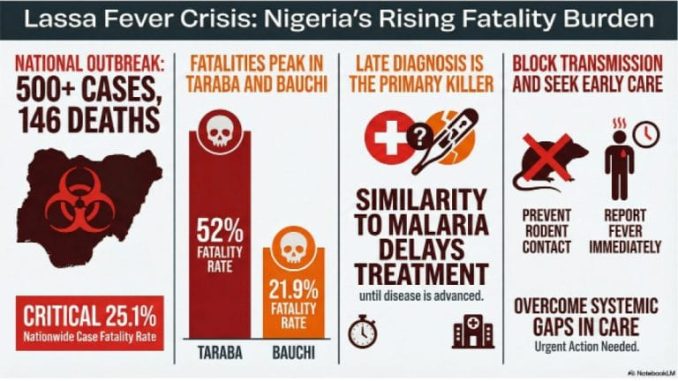
The report shows that the case fatality rate (CFR) stands at 25.1 per cent, significantly higher than the 18.7 per cent recorded during the same period in 2025, indicating that a greater proportion of infected patients are dying despite ongoing response efforts.

During the reporting week, confirmed cases rose sharply from 40 in week 10 to 66, with new infections recorded in Bauchi, Ondo, Taraba, Plateau, Edo, Benue, Kogi, Gombe and Niger states — suggesting sustained transmission across multiple regions rather than isolated outbreaks.

Cumulatively, 21 states and 82 local government areas have recorded at least one confirmed case in 2026, highlighting the geographic spread of the disease and the challenge of containing it within traditional endemic zones.

Advertisement

Public health experts said the fatality rate is unusually high for a disease that is treatable when detected early, raising concerns about systemic gaps in diagnosis, referral systems and access to care.

Bauchi, Taraba outbreaks drive national fatality trend

The national figures are being driven in part by severe outbreaks in Bauchi and Taraba, where outcomes diverge sharply but point to the same systemic weaknesses.

In Bauchi, data from Médecins Sans Frontières indicate that 311 confirmed cases and 68 deaths were recorded between October 1, 2025 and March 23, 2026, translating to a case fatality rate of about 21.9 per cent — slightly below the national average but still high for a disease with established treatment protocols.

Advertisement

MSF, which has supported Lassa fever treatment in the state since 2022, said it is expanding its efforts in early diagnosis, treatment, and community outreach, including operations in Bauchi, Kirfi, Toro, and Tafawa Balewa local government areas.

Emergency Programme Manager, Dr Ayokunnu Raji, noted that the similarity between Lassa fever and malaria continues to delay diagnosis, as many patients initially receive treatment for more common febrile illnesses.

An MSF official, Abdulkareem Yakubu, added that misinformation and delayed health-seeking behaviour remain key challenges.

“We are not just treating patients; we are also addressing misinformation and strengthening the capacity of local health workers,” he said, stressing the importance of early presentation.

Advertisement

In Taraba State, the outbreak appears even more severe. At the Federal Medical Centre (FMC) in Jalingo, 50 deaths were recorded among 95 confirmed cases, resulting in a case fatality rate of over 52 per cent — more than double the national average and one of the highest facility-level fatality rates recorded in recent outbreaks.

Dr Suleiman Abubakar Kirim, Head of Clinical Services at the hospital, described the situation as the most severe the facility has encountered in recent years.

“This is the most severe Lassa fever outbreak we have seen in recent times,” he said.

He attributed the high mortality largely to late presentation.

Advertisement

“Many patients come to the hospital when the disease is already advanced. At that stage, even with treatment, outcomes are often poor,” he added.

Out of 226 suspected cases managed at the facility, 20 patients have been successfully treated and discharged, while new infections continue to be reported.

Health officials note that severe cases often present with complications such as bleeding, respiratory distress and organ failure, which significantly increase the risk of death, especially where intensive care support is limited — a factor that may partly explain the stark difference between Taraba’s fatality rate and the national average.

Beyond Bauchi and Taraba, endemic states such as Plateau, Edo, Benue, Kogi, Gombe, Ondo and Niger continue to record significant numbers of cases annually, although recent trends suggest a growing burden in parts of northern Nigeria.

Advertisement

Epidemiological patterns indicate that a handful of states account for a disproportionate share of infections, with Ondo, Edo and Bauchi consistently ranking among the highest contributors, underscoring persistent transmission hotspots.

Health system gaps worsening outcomes

In separate chats with Daily Trust, public health experts said the rising fatality rate reflects deeper structural challenges in Nigeria’s health system.

A senior doctor at Kubwa General Hospital in Abuja, who asked not to be named, said the current data points to a persistent gap in early detection.

Advertisement

“What we are seeing is not just an increase in cases, but an increase in late-stage presentations. Lassa fever is highly treatable if identified early, but once complications set in, the risk of death rises significantly,” he said.

He noted that many primary healthcare centres lack the capacity to suspect or confirm Lassa fever in its early stages.

“Frontline facilities are still not adequately equipped to differentiate Lassa fever from malaria or typhoid. This is where the problem begins,” he added.

Dr Hammed Alausa, another physician, said weak referral systems are compounding the problem.

Advertisement

“Patients often move from one facility to another before they are correctly diagnosed. By the time they reach a treatment centre, valuable time has been lost,” Alausa said.

He also pointed to the uneven distribution of treatment centres across the country.

“Access is a major issue. In many cases, patients have to travel long distances while critically ill. That delay can be fatal,” he noted.

Health system limitations are further complicated by infection prevention challenges within hospitals.

Advertisement

Management of FMC Jalingo highlighted the importance of structured consumables in reducing transmission risks.

“The absence of properly structured and sterile consumables increases the risk of transmission to healthcare workers and other patients,” the hospital said.

According to Alausa, such risks are not unique to Taraba.

“Infection prevention and control remain inconsistent across facilities. Protecting health workers is critical because once they are exposed, it further weakens the response system,” he said.

Advertisement

The infection of at least 38 healthcare workers further reflects these gaps, with exposures often linked to delayed case recognition, inadequate protective equipment and high-risk emergency interventions.

Community risks, shifting patterns and response gaps

At the community level, transmission continues to be driven by environmental and behavioural factors, particularly during the dry season when rodents, major carriers of the virus, enter homes in search of food.

Another physician, Dr Chukwudi Ifeanyi, said awareness remains a major gap.

Advertisement

“A lot of people still do not understand how Lassa fever is transmitted. Simple preventive measures like proper food storage and waste management are not widely practised,” he said.

He added that misinformation often leads to delayed care.

“Some patients resort to self-medication or traditional remedies before seeking hospital care, and that delay can be deadly,” he said.

Experts also point to a possible geographic shift in Lassa fever transmission patterns.

Advertisement

While southern states such as Ondo and Edo have long been recognised as epicentres, the increasing burden in northern states such as Bauchi and Taraba suggests changing dynamics.

Dr Ifeanyi said this may be linked to environmental and demographic factors.

“We may be seeing the effects of climate variability, population movement, and better detection in previously underreported areas. But regardless of the cause, the response system must adapt quickly,” he said.

To reduce fatalities, experts called for urgent improvements across multiple levels of the health system.

Advertisement

Key recommendations include expanding rapid diagnostic capacity at primary healthcare centres, strengthening referral systems, and decentralising treatment facilities to underserved regions.

Dr Alausa stressed the need for investment in early detection.

“If we can diagnose cases earlier at the community level, we will significantly reduce mortality. That is where the biggest impact lies,” he said.

While emphasising the importance of community engagement, he said: “Prevention starts at the household level. People need to understand the risks and take practical steps to protect themselves.”

Advertisement

In addition, he highlighted the need to strengthen surveillance systems and improve real-time data reporting to enable faster response to outbreaks.

While the expected onset of the rainy season may reduce transmission temporarily, experts warn that seasonal changes alone are not a solution.

A resident doctor, Godwin Ekweke, cautioned that without structural improvements, the country will continue to face recurring outbreaks with high fatality rates.

“We cannot rely on seasonal decline alone. Without strengthening our systems, we will continue to face the same challenge year after year,” he said.

Advertisement

With 146 deaths recorded nationwide within the reporting period, alongside 68 in Bauchi and 50 in Taraba, the latest figures highlight not just the scale of the outbreak but the uneven survival outcomes across states.

For many experts, the message is clear: reducing deaths from Lassa fever will depend less on seasonal patterns and more on how quickly Nigeria can close the gap between detection and treatment.

Until then, the data suggests that the country’s battle against the disease remains far from over.

Advertisement
Continue Reading
Advertisement

News

INEC set to publish details of 2027 Presidential, National Assembly candidates on August 1

Published

on

ADVERTISEMENT
Zoom Ad
ADVERTISEMENT
Zoom Ad

The Independent National Electoral Commission (INEC) will on Saturday, August 1, 2026, publish the particulars of all presidential and National Assembly candidates contesting the 2027 general election for public inspection at its offices across the country.

The publication of the candidates’ details, contained in Form EC9, is in compliance with Section 29(3) of the Electoral Act, 2026, which requires the commission to make the personal particulars of nominated candidates available for public scrutiny within 21 days of receiving them.

Political parties concluded the online submission of the names, personal particulars and other required documents for their presidential and National Assembly candidates on Tuesday, July 14, 2026, after INEC granted a 72-hour extension to the original deadline. ExecutiveBranch

Under the commission’s revised timetable, nominations for presidential and National Assembly candidates were initially scheduled to be submitted between June 27 and July 11, 2026.

Advertisement

Section 29(1) of the Electoral Act, 2026, requires political parties to submit Forms EC9, EC9A, EC9B, EC9C, EC9D and EC9E, containing the names and personal particulars of their nominated presidential and National Assembly candidates, not later than 120 days before the election.

Speaking on whether the 72-hour extension would affect the publication date, INEC Deputy Director of Publicity, Wilfred Osilama Ifogah, said he did not expect any change, although he stressed that he was expressing a personal opinion rather than the commission’s official position.

“I doubt. It might not necessarily affect it. It’s just for the Commission to put the information together and submit it. This is my opinion. I’m not talking officially. When it gets to the time, you will see whether the Commission will publish it or not,” he said.

Meanwhile, the online submission of nominations for governorship and State Houses of Assembly candidates, which commenced on July 18, will continue until August 8, 2026.

Advertisement

INEC has scheduled August 29, 2026, for the publication of the personal particulars of governorship and State House of Assembly candidates through Form EC9.

The commission had earlier conducted party primaries for all elective positions between April 23 and May 30, 2026.

According to INEC’s election timetable, the presidential and National Assembly elections will hold on January 16, 2027, while the governorship and State Houses of Assembly elections are scheduled for February 6, 2027

Advertisement
Continue Reading

News

CSOs, Youth Groups Push for Inclusive NYSC Reform, Convene National Dialogue

Published

on

ADVERTISEMENT
Zoom Ad
ADVERTISEMENT
Zoom Ad

By Gloria Ikibah

A coalition of civil society organisations and youth groups has announced plans to convene a national dialogue on proposed reforms to the National Youth Service Corps (NYSC), seeking to ensure that the review process reflects the views of Nigerians before the Federal Government takes a final position.

The initiative, being organised by the Centre for Equity, Justice and Transparency in partnership with the Save Nigeria Movement, is expected to bring together policymakers, academics, former corps members, youth organisations, security agencies and other stakeholders to examine the future of the scheme and recommend practical reforms.

Convened by legal practitioners Sorkaa Tsembelee and Patrick Agbese, the one-day dialogue aims to generate a comprehensive working document that will be presented to the Federal Government as part of ongoing efforts to review the NYSC Act.

Advertisement

In a statement issued on Friday, the organisers said the forum was intended to provide an inclusive platform where stakeholders could contribute meaningfully to the reform process.

The statementread: “The essence of this dialogue is for critical stakeholders to make input into the proposed NYSC reforms before the President’s administration takes final decisions.

“We will have senior academics, former corps members, youth groups and other members of society to dissect the proposed reforms thoroughly.

“It will thereafter catalyse into a working document for the Federal Government. We will invite the CDS, the Army and others. Let everyone look at it and say their own.”

Advertisement

Established in 1973 after the Nigerian Civil War, the NYSC was designed to promote national unity, encourage integration among young graduates and foster national development through compulsory service outside their states of origin. Over the decades, corps members have played significant roles in education, healthcare, agriculture and community development, particularly in underserved communities.

However, growing concerns over the safety and welfare of corps members, inadequate funding, deployment policies and questions surrounding the relevance of some aspects of the programme have fuelled calls for a comprehensive review.

The organisers said the dialogue will assess whether the scheme still aligns with its founding objectives while identifying legislative and policy changes needed to address present-day realities.

They maintained that while reforms were necessary, the NYSC’s central mission of promoting national cohesion should be preserved alongside efforts to strengthen skills development, entrepreneurship and youth empowerment.

Advertisement

“This is not about tearing down an institution that has served Nigeria well; it is about refining it with the collective wisdom of those who have lived the experience and those who study its impact.

“Former corps members carry practical insights that policymakers often miss, and we want those voices at the table.

“Youth groups and civil society must not be spectators while decisions that will shape the next generation of Nigerian graduates are taken. The dialogue creates the space for genuine, structured input”, it added,.

According to the organisers, discussions will focus on critical issues including corps members’ welfare, security, orientation camp facilities, deployment procedures, funding mechanisms and the effectiveness of the Community Development Service (CDS) programme.

Advertisement

They added that academics will provide comparative analyses of national service models in other countries, while security agencies would offer institutional perspectives on improving the protection of corps members, particularly those posted to areas affected by insecurity.

“We cannot discuss NYSC reforms without hearing from those who secure the environment in which corps members serve. The CDS and the Army have institutional knowledge that is indispensable.

“Their perspectives on logistics, security and inter-agency coordination will enrich the final document.

“Senior academicians will help us situate the proposed reforms within the broader context of nation-building. We need evidence-based contributions, not just opinions”, the said.

Advertisement

The organisers said the ultimate goal was to produce practical recommendations capable of informing both legislative and executive action.

They explained that the final report would reflect contributions from former corps members, scholars, security agencies, youth organisations and civil society groups, providing government with workable proposals for strengthening the scheme without compromising its original mandate.

“The working document that emerges from this dialogue must be something the government can work with.
“It should reflect the views of those who have served, those who teach, those who protect, and those who advocate.

“Anything less would be a missed opportunity. We are calling on all stakeholders to come prepared to engage constructively.

Advertisement

“The future of the NYSC is too important to be decided in isolation. This national dialogue is our contribution to an open, inclusive process”, the statement further read. 

Continue Reading

News

No plans to increase electricity tariffs – Power Minister assures Nigerians

Published

on

ADVERTISEMENT
Zoom Ad
ADVERTISEMENT
Zoom Ad


The Minister of Power, Joseph Tegbe, has declared that President Bola Tinubu’s administration has no intention to jerk up electricity tariffs beyond the current level.

He disclosed this during a media briefing in Abuja on Friday.

According to him, the Tinubu administration’s priorities are improving electricity service delivery, expanding access to electricity, and ensuring that Nigerians pay only for the electricity they consume.

Advertisement

The minister said that, over the last two weeks, the country has consistently generated 5,000 megawatts of electricity.

“We are already witnessing encouraging improvements in electricity generation. Over the course of the last two weeks, we have consistently generated 5,000MW.

“Permit me to address two issues that have generated considerable public discussion. First, there is no policy by this administration to increase electricity tariffs beyond the current level. Our priority is not a tariff increase in the immediate term. Our priority is service improvement, universal metering, and ensuring Nigerians pay only for the electricity they actually consume,” he stated.

He added that the objective of the Federal Government is to provide reliable electricity to homes across the country.

Advertisement

“Our ambition is clear: reliable electricity that powers our homes.”

Tegbe’s comments come amid debate over a fresh electricity tariff hike, fuelled by remarks made by Tinubu’s Special Adviser on Power Infrastructure, Sadiq Wanka.

Nigerian electricity consumers have kicked against the proposed electricity tariff hike.

Advertisement
Continue Reading

Trending

Copyright © 2024 Naija Blitz News