


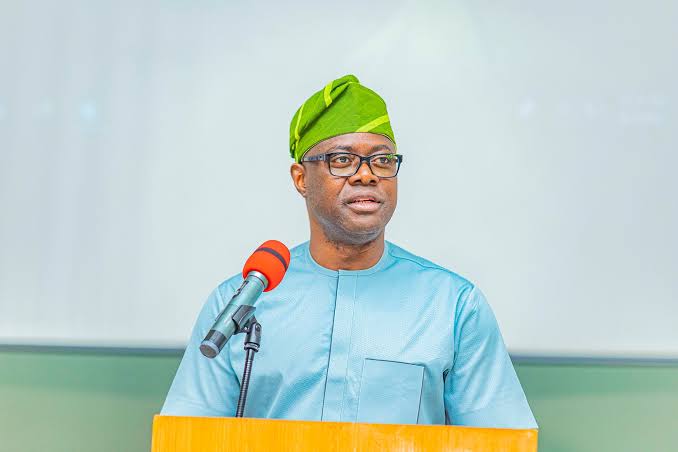
The All Progressives Congress (APC) has strongly hammered Oyo State Governor Seyi Makinde over his reference to the historic “Operation Wetie” crisis during a recent opposition political summit held in Ibadan, describing the comment as provocative, inappropriate, and capable of inciting tension.
The reaction comes after Governor Makinde, while hosting an opposition gathering themed “That We May Work Together for a United Opposition to Sustain Our Democracy,” warned against what he described as political moves aimed at concentrating legislative power under a single party.
In his remarks, Makinde referenced the violent political unrest of Nigeria’s First Republic, noting that the infamous “Operation Wetie” began in Ibadan before spreading across the old Western Region.
“Those that are carrying on as if there’s no tomorrow… should remember that Operation Wetie started from here. This is the same Wild Wild West,” the governor said.
The phrase “Operation Wetie,” a Yoruba expression meaning “soak him,” refers to a period of intense political violence in the early 1960s marked by arson attacks, electoral crises, and widespread unrest that ultimately contributed to the collapse of Nigeria’s First Republic in 1966.
However, the APC leadership has faulted the governor for invoking the historical episode in what they described as a politically sensitive setting.
Speaking on behalf of the party, APC National Secretary Ajibola Basiru dismissed Makinde’s comments as irresponsible and lacking proper historical context.
“It is irresponsible for a governor to make inciting statements without context,” Basiru was quoted as saying.
He argued that the “Operation Wetie” era was a product of electoral disputes and political tension at the time, insisting that the current opposition’s claims of marginalisation were exaggerated.
According to him, the ruling party remains well-structured and focused, while the opposition is struggling with internal divisions.
“Today, the opposition is simply belly-aching because the APC is organised while they are in streams,” he added.
Basiru also urged Nigerians to condemn what he described as the governor’s “reckless political language,” accusing him of indirectly promoting violence through historical references.
Similarly, APC South-West Vice Chairman Isaacs Kekemeke said Makinde’s statement could be misinterpreted as a warning that future elections may be decided through violence.
He dismissed allegations that Nigeria is drifting toward a one-party state under President Bola Tinubu, insisting that the country’s democratic space remains open and competitive.
Kekemeke noted that over 20 political parties are currently registered with the electoral body, arguing that such diversity contradicts claims of political domination.
“It is a figment of hyperactive imagination for any member of the opposition to insinuate a one-party state in a country where over 20 political parties are on the register of the Independent National Electoral Commission,” he said.
He also blamed the opposition for its internal crises, leadership disputes, and lack of coordination, saying these challenges not APC actions are responsible for their political setbacks.
“Is the APC or Federal Government responsible for the inability of opposition leaders to resolve their intra-party leadership crises?” he queried.
Kekemeke further expressed confidence that the APC would maintain dominance in the South-West and across the country, citing what he described as strong grassroots support and governance performance.
He also described Makinde’s comment as a sign of desperation and political frustration.
“The difference is clear: it is leadership, vision, focus and performance. Opposition lacks all of the above,” he said.
In a separate reaction, APC National Secretary Basiru dismissed the Ibadan summit itself, describing it as an informal gathering lacking official party backing.
“The so-called Ibadan summit is a ruse. It was an assemblage of individuals, not 10 political parties,” he said.
He also questioned the legitimacy of claims that multiple parties were involved, arguing that internal divisions within opposition parties undermine their credibility.
Meanwhile, the Presidency also weighed in on the matter through the Special Adviser to the President on Media and Public Communication, Sunday Dare, who dismissed the opposition coalition as politically weak and unlikely to succeed.
He expressed confidence that President Tinubu would secure re-election, citing what he called ongoing economic and governance reforms.
“President Tinubu stands on solid ground… He will secure a second term because he has earned it,” Dare said.
Despite the backlash, opposition leaders at the Ibadan summit reportedly agreed to work toward fielding a single presidential candidate in the 2027 general elections, describing the move as necessary to strengthen their electoral chances.
The political exchange has further intensified early campaign tensions ahead of 2027, with both ruling and opposition parties hardening their positions as the election cycle gradually builds momentum.