News
2026 Appropriation Act: Ilori-Diamond Unveils $25m Investment Fund, Maps Out Nigeria’s Next Wealth Corridors
- /home/naijuinz/public_html/wp-content/plugins/mvp-social-buttons/mvp-social-buttons.php on line 27
https://naijablitznews.com/wp-content/uploads/2026/06/20260624_103527-1000x600.jpg&description=2026 Appropriation Act: Ilori-Diamond Unveils $25m Investment Fund, Maps Out Nigeria’s Next Wealth Corridors', 'pinterestShare', 'width=750,height=350'); return false;" title="Pin This Post">
- Share
- Tweet /home/naijuinz/public_html/wp-content/plugins/mvp-social-buttons/mvp-social-buttons.php on line 72
https://naijablitznews.com/wp-content/uploads/2026/06/20260624_103527-1000x600.jpg&description=2026 Appropriation Act: Ilori-Diamond Unveils $25m Investment Fund, Maps Out Nigeria’s Next Wealth Corridors', 'pinterestShare', 'width=750,height=350'); return false;" title="Pin This Post">
…urge investors to closely track government spending

…alleged a senior FCDA official demanded bribe to approve project
By Gloria Ikibah
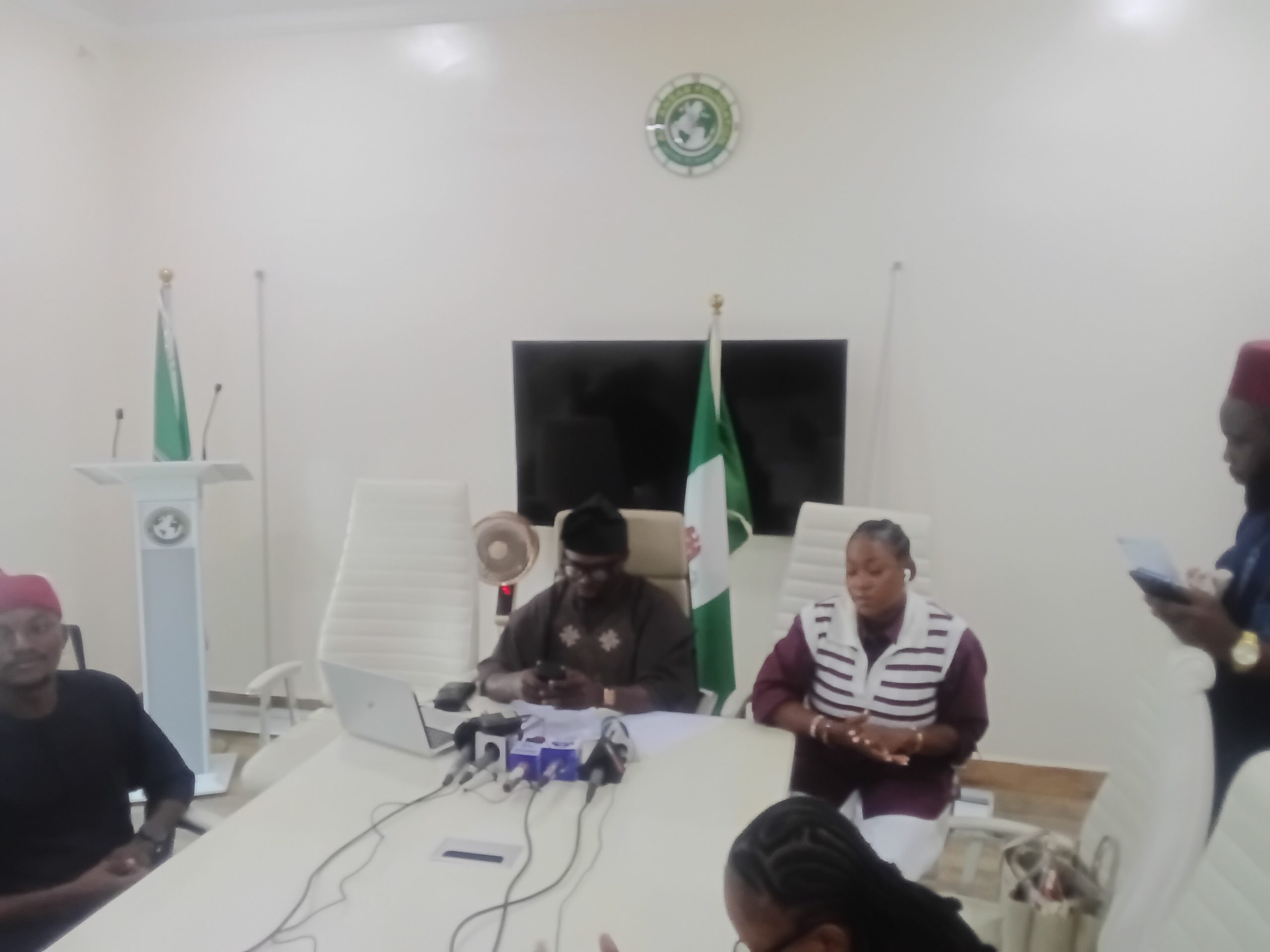
The Chairman of Dar Global Financials, Kunle Ilori-Diamond, on Wednesday unveiled a $25 million acquisition fund targeted at Nigeria’s microfinance banking and real estate sectors, while urging investors to closely track government spending under the 2026 Appropriation Act to identify emerging opportunities.

Speaking at a world press conference in Abuja, Ilori-Diamond argued that the most successful investors are often distinguished not by privileged access but by their ability to interpret public information before others.
Drawing parallels with recent moves by major business figures, he noted that investment decisions often signal future economic trends.
He said: “The difference between people who actually go ahead in business and investment, and people who don’t, is the kind of information that they pay attention to.
“If someone takes a lot of fortune to invest in a power-generating company ahead of a certain year, and that happened in the last quarter of 2025, it means there’s something going to happen in 2026 that we don’t know about, that he does know about.”
N3.48 Trillion Roads Budget Holds Investment Clues
Ilori-Diamond pointed to the Federal Government’s allocation of N3.48 trillion for road construction, describing it as one of the clearest indicators of where future wealth creation could occur.
He explained that infrastructure projects frequently transform land values and commercial prospects.
According to him, major opportunities exist along strategic corridors earmarked for federal investment, including the Calabar-Maiduguri Road Corridor, the Maiduguri-Sokoto Corridor, and several presidential legacy projects.
“If N3.48 trillion is being allocated to road construction in Nigeria, all you need to know is where those roads are going to be.
“Government is simply telling you where it wants to spend its money. That is where you can gamble yours as well, because government is playing big in that aspect.
“The budgetary emphasis is locked into concluding critical multi-regional mega highways. Anything that is a presidential legacy project happening around a certain place is a good place to invest in”, he noted.
Abuja Expansion Set to Create New Property Hotspots
The investment banker also highlighted Abuja’s growing real estate potential, citing what he described as a substantial allocation towards urban road infrastructure.
He specifically identified locations around the airport corridor and expanding satellite towns as areas likely to benefit from government-backed growth.
“Anywhere that is a corridor in Abuja is going to blow up because there is N1.6 trillion allocated to just roads.
“If I had a lot of money, I would be investing massively in Kuje, in airport corridors like Kyami, in Lugbe and along the frontier between Abuja and Kaduna”, he emphasised
Agriculture Remains a Goldmine
Turning to agriculture, Ilori-Diamond said investors should align their business decisions with sectors receiving substantial government support.
He noted that the Ministry of Livestock Development had received an allocation of N81.8 billion, while the Federal Ministry of Agriculture and Food Security was backed by a capital budget of N1.3 trillion.
He therefore urged Nigerians to study government priorities before committing capital.
“The kind of business that can thrive is the one that the government is already doing, because the government doesn’t want to fail.
“If the Ministry of Livestock is trying to stabilise livestock feeds, then all you need to do is find money and start producing livestock feeds because it is in alignment with the budget”, he stated.
The Dar Global Financials chairman also identified Niger State as a key destination for agribusiness investments.
“If government allocates N420 billion to Niger State and wants to succeed, they will create roads, power and security around that investment. If you want to start a food processing firm, that is where you should be looking”, he added.
Launches of $25m Acquisition Drive
At the centre of the conference was the formal launch of Dar Global Financials’ $25 million acquisition fund, which will focus on purchasing struggling microfinance banks and real estate development firms across Nigeria.
According to him, the strategy will involve restructuring and scaling acquired businesses rather than dismantling them, adding that founders who wished to retain a stake in their businesses would be accommodated.
“A couple of investors and investment bankers came together and put a capital of $25 million into a pool to invest in Nigeria.
“We are trying to acquire microfinance banks and real estate development firms that already have established brands across Nigeria.
“If there is any microfinance bank that is not really doing well and they are looking at liquidating or selling it off, we are looking at buying it from them.
“If you don’t want to sell entirely, we can structure it so that you still retain up to 15 per cent of the company while we take over operations,” Ilori-Diamond announced.
Mortgage Revolution Planned
Ilori-Diamond further disclosed that Dar Global intends to integrate acquired microfinance banks with its real estate investments to expand access to housing finance.
He argued that existing mortgage systems remain inaccessible to many Nigerians, particularly workers in the private sector.
“What we want to do in the market now is disrupt it.”
“Everybody can get access to a mortgage. We finance the house, you move into your house, and then you pay over a period of years.
“A simple civil servant cannot even afford to get a house comfortably under the current structure”, he asserted.
Calls for Stronger Public-Private Partnership
Responding to questions from journalists, Ilori-Diamond called on government to strengthen collaboration with private investors.
“One of the reasons this press conference is happening is for government to see the need to partner with the private sector.
“Partnership with the private sector is not only about funding or resources; it is also about connections, approvals and getting things done on time”, he said
On insecurity, he advised investors to focus on locations where government has committed significant resources.
“If government is spending in a particular place, they will want to make that place safe because their own money is there. Just follow their money and you might be lucky”, he noted.
Corruption Allegation Against Development Official
In one of the most dramatic moments of the conference, Ilori-Diamond alleged that a senior development control official demanded a bribe in exchange for approving a project.
The businessman said such practices discourage investment and undermine economic development.
“There is a certain development control official who said if I don’t pay him N100 million, he would not approve it.
“I stayed abroad for many years. I decided to come back because I believe in Nigeria and I am putting my money in Nigeria. We have people in offices who are frustrating that kind of investment,” he alleged.
He called on authorities to investigate allegations of corruption within development control agencies and ensure swift action where wrongdoing is established.
“If we don’t stop such people, they will do it to everybody. People who are struggling to put up a business will feel Nigeria is not a good place to invest”, he added.
‘Performance Must Matter’
Ilori-Diamond also urged the Federal Government to hold public officials accountable for budget implementation.
“If two times in a row you cannot prove something tangible that you’ve done, you should be relieved”, he said.
He praised the use of ministerial scorecards and called for stricter performance assessments across government agencies.
Dar Global Financials officially opened applications from microfinance banks and real estate firms seeking acquisition, partnership or restructuring under the newly launched investment fund.
News
PFIPC Never Received Budget Funds Despite N1.32bn Allocation – DG Budget Office
By Gloria Ikibah
The Budget Office of the Federation has told the House of Representatives that although the Presidential Foreign Investment Promotion Council (PFIPC) was allocated N1.32 billion in the 2026 Appropriation Act, not a single kobo was released to the organisation because it failed to meet the legal conditions required for public expenditure.
The clarification came on Friday when the Director-General of the Budget Office, Tanimu Yakubu, appeared before the House of Representatives Ad-Hoc Committee investigating the alleged unlawful establishment and funding of the PFIPC.
The committee is probing how the council found its way into the federal budget despite growing evidence that it was never legally established by the Federal Government.
Defending the Budget Office’s actions, Yakubu maintained that the agency neither created the council nor approved its establishment, recruitment, staffing or salaries. He said its responsibility was limited to assessing the financial implications of approvals forwarded by the relevant government authorities.
He disclosed that although the council requested N3.8 billion for personnel costs, the Budget Office rejected the figure and carried out its own independent assessment using the approved staff strength and the salary structure prescribed for public servants.
He said: “The Budget Office did not create the council. It did not assign its budget code. It did not approve its establishment. It did not grant its recruitment waiver. It received official instruments and did what the law required of it. It measured their fiscal effect.
“That estimate did not form the basis of the Budget Office’s recommendation. The Budget Office rejected it and made an independent calculation. That calculation produced N802,978,783. This was not a concession to the council. It was the Budget Office’s own fiscal proposal.”
Yakubu explained that the proposed personnel allocation never translated into actual spending because the Budget Office did not issue the financial clearance required before recruitment, enrolment on the government payroll and payment of salaries.
He emphasised that although personnel costs accounted for about 61.63 per cent of the council’s total appropriation, the funds remained untouched.
“There was therefore no financial clearance. There was no lawful recruitment. There was no payroll enrolment. There was no salary payment.
“Not one naira of the personnel provision has been drawn. There is no personnel expenditure to recover because no expenditure ever occurred”, he added.
The Director-General also told lawmakers that the N200 million earmarked for overheads was never accessed because treasury warrants and cash backing were not issued.
Similarly, he said the N300 million capital allocation remained on paper as the procurement process never reached the stage where public funds could legally be spent.
According to him, the financial safeguards of government worked exactly as intended by preventing unauthorised expenditure before any money left the treasury.
“No procurement reached the point at which expenditure would arise. No Ministerial Tenders Board approved a transaction. No Certificate of No Objection was issued. No treasury warrant followed. No treasury cash-backing followed.
“The law did not recover money after it had gone. It prevented the expenditure before it began”, Yakubu noted.
During the hearing, members of the committee questioned the legal basis upon which the Budget Office made provisions for the council after examining what they described as a purported Act establishing the PFIPC.
A committee member, Rep. Abubakar Fulata, argued that the document lacked the essential features of a valid Act of Parliament, including a gazette number, the signature of the Clerk to the National Assembly and presidential assent.
He also faulted government agencies for failing to verify the authenticity of the document before acting on it.
“The purported Act is very clear. It is not genuine because it did not carry the gazette number, it did not have the signature of the Clerk of the National Assembly and it did not carry the signature of Mr. President”, he stated.
In response, Yakubu insisted the Budget Office relied solely on official establishment approvals, recruitment waivers and directives from the National Salaries, Incomes and Wages Commission in calculating personnel costs.
“We do not rely on any instrument to calculate personnel costs other than the establishment authorisation and the directives of the National Salaries, Incomes and Wages Commission”, he stressed.
Chairman of the Ad-Hoc Committee, Rep. Yusuf Gagdi, said the evidence before the panel indicated that the Budget Office acted based on documents presented by the appropriate government institutions, which were only later discovered to be forged.
Gagdi said the investigation had now shifted from the Budget Office to uncovering how forged documents entered official government channels.
“The question is whether the Budget Office allocated budget to this agency without the agency satisfying the requirements. The answer, based on the documents before us, is no. I repeat, no.
“The agency satisfied all the requirements the Budget Office needed before allocating a budget. The issue now is whether those documents were genuine. That is what this committee is investigating”, he noted.
He disclosed that the Accountant-General of the Federation has been invited to appear before the committee on Monday to explain how the council obtained its budget code, while other agencies will also be questioned as the investigation enters its final stage.
“By the special grace of God, we will conclude our findings and finish by next week”, he added.
The House constituted the ad-hoc committee following allegations surrounding the operations of the Presidential Foreign Investment Promotion Council, which reportedly appeared in official government records and the 2026 Appropriation Act despite questions over its legal status.
The panel is expected to determine how the council gained official recognition, identify those responsible and recommend measures to prevent similar occurrences within the public service.
News
Just in: Police confirm arrest of officers in viral video threatening to slap, detain driver if he is Igbo
The Ondo State Police Command has confirmed the arrest of officers in a viral video trying to extort money from a motorist along Lagos –Benin Expressway.
In the video, one of the officers said he would have slapped and detained the motorist if he was Igbo.
The circulating footage of the incident had ignited widespread anger across the country with several Nigerians calling for the arrest and prosecution of the officers.
Addressing journalists on the incident on Friday, the Ondo State Police Public Relations Officer, DSP Abayomi Jimoh, said the erring personnel have been identified and arrested.
“The Command wishes to inform the general public that the officers captured in the video have been arrested and identified as AP/No. 207454 ASP Elomore Sodayo, AP/No. 332012 Inspector Adefila Adewale, AP/No. 332449 Inspector Olorunfemi Opeyemi, and AP/No. 332369 Inspector Odusola Peter.
Consequently, the Commissioner of Police, CP Felix Ohagwu, psc, mnips, mspsp, has ordered a comprehensive investigation to unravel the circumstances surrounding the incident and determine the level of culpability of each officer involved,” he said.
News
Nothing was spent on PEAC/PFIPC, Budget Office tells Reps
The Budget Office of the Federation has said no dime was appropriated for the controversial Presidential Economic Advisory Council/Presidential Foreign Intervention Promotion Council (PEAC/PFIPC).
The Director-General of the Budget Office of the Federation, Tanimu Yakubu, said this disclosure while appearing before the House of Representatives ad hoc committee investigating the establishment and budgetary provisions of the PEAC/PFIPC.
“The conclusion is firm. Not one kobo of the personnel provision could lawfully have been drawn, and not one kobo was drawn. The overhead provision never matured into a lawful cash release,” Yakubu said.
“The capital provision never matured into procurement or expenditure.
The conditions required for spending were not met and were not close to being met.
There is therefore no personnel expenditure to recover. The money never moved because the controls held.”
Yakubu said the office withheld financial clearance; no recruitment or payroll was approved, and the Federal Ministry of Finance as well as the Office of the Accountant-General were directed to withhold all payment instruments.
The Budget Office said that the personnel, overhead, and capital provisions never matured into payments or procurement, as the legal and administrative requirements for expenditure were not fulfilled. It added that it would continue to cooperate with the House committee by providing all relevant records and documents to support its position.
The comment came amid the controversy over the PFIPC. Adeniyi Adeyemi had paraded himself as the director-general of the agency for months. Photos of him with diplomats and high-profile Nigerians were circulated on social media. He also had an office space at the Federal Secretariat in Abuja.
Although the presidency issued a rebuttal saying the agency does not exist and has filed charges against him, Adeyemi has insisted that his appointment is legally binding.
He dismissed the presidency’s claims that he forged the appointment letter and accused the Chief of Staff to the President, Femi Gbajabiamila, of collecting money from him through an intermediary for the appointment.
Gbajabiamila has denied the claim and has taken the matter to court. Adeyemi was later arrested in Osun State.
Amid the controversy, the House of Representatives invited officials of the Central Bank of Nigeria (CBN), security agencies, the Head of Service of the Federation, Didi Walson-Jack, and others to appear before it.
During the session on Monday, the Central Bank of Nigeria (CBN) said it opened two accounts for the disputed agency but noted that they never recorded inflows or remittances.
According to CBN”s Director of Banking Services, Abdullahi Hamisu, the apex bank received instructions from the Office of the Accountant-General of the Federation, mandating the CBN to open two accounts for the disputed agency.
“Like I said, the accounts have never been operated. As a result, there have not been any foreign exchange allocations to the council from CBN.
There have not been any remittances into those two accounts. There have not been approvals because the authority has not been established for those who will operate the account,” Hamisu said on Monday.
In her address to the committee, Walson-Jack said her office did not allocate office space at the Federal Secretariat in Abuja nor deploy staff to the PFIPC.
“The request for deployment of officers was received and noted for consideration. However, there was no deployment of officers by the Office of the Head of the Civil Service of the Federation to the council,” she told the lawmakers probing the PFIPC scandal and the N1.3 billion allocated to the agency in the 2026 Appropriation Act.
The Head of Service noted that “while there is speculation that the council occupied office space in the Federal Secretariat Phase Three, we can state categorically that the office of the Head of the Civil Service of the Federation did not allocate any office space to the PFIPC.”
Already, the Independent Corrupt Practices and Other Related Offences Commission (ICPC) has invited Gbajabiamila for questioning over the agency.
ICPC’s move was in line with President Bola Tinubu’s directive to investigate the matter.
-
News23 hours agoAir Mishap: Enugu Air Management speaks, as passengers, crew cheat death
-
News23 hours agoTinubu Approves 12 Divisions For Nigerian Army, Recruitment Of 28,000 Personnel
-
News22 hours agoFull List: 68 Lawyers Elevated To SAN Rank
-
News23 hours agoAtiku-Hired U.S. Lobbying Firm Questions Authenticity Of Purported Trump Letter To Tinubu, Demands Original Document
-
News22 hours agoSoludo’s daughter graduates with First Class from UK university
-
Metro22 hours agoSoldier declared wanted over alleged sale of military uniforms to terrorists
-
News16 hours agoPhoto News: Proud father, FCT minister, Wike hosts friends to dinner in celebration of daughter’s graduation
-
News14 hours agoUS Slams Killing of Rev. Ezekiel Dachomo’s Family in Plateau, Demands Justice