News
Ebonyi Governor Nwifuru reshuffles cabinet
- /home/naijuinz/public_html/wp-content/plugins/mvp-social-buttons/mvp-social-buttons.php on line 27
https://naijablitznews.com/wp-content/uploads/2024/12/Francis-Nwifuru-750x422-1-678x381-1.png&description=Ebonyi Governor Nwifuru reshuffles cabinet', 'pinterestShare', 'width=750,height=350'); return false;" title="Pin This Post">
- Share
- Tweet /home/naijuinz/public_html/wp-content/plugins/mvp-social-buttons/mvp-social-buttons.php on line 72
https://naijablitznews.com/wp-content/uploads/2024/12/Francis-Nwifuru-750x422-1-678x381-1.png&description=Ebonyi Governor Nwifuru reshuffles cabinet', 'pinterestShare', 'width=750,height=350'); return false;" title="Pin This Post">
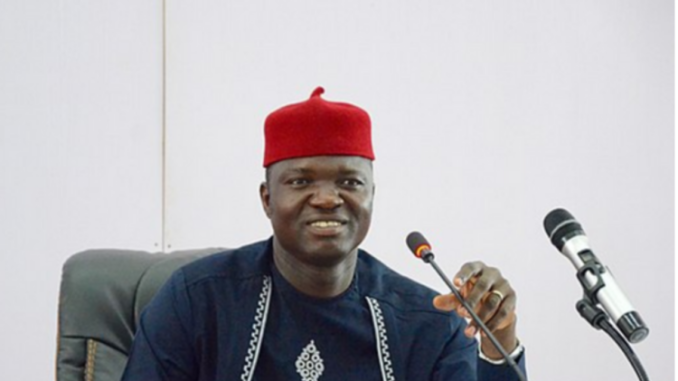
Governor Francis Nwifuru of Ebonyi has made a major cabinet reshuffle, with several commissioners redeployed to new ministries in a move aimed at strengthening governance and consolidating of his achievements in the last three years in the office.

The Commissioner for Information and State Orientation, Barr. Ikeuwa Omebeh who announced the major redeploy ment of the commissioners while briefing news men in his officei after the State Executive Council meeting said it is aimed at strengthen the administration and good governance.
Omebeh said the reshuffle followed the swearing-in of two new commissioners, Professor Omari Omaka and Hon. Sylvester Nwenu Nwite, as well as the inauguration of Hon. Felix Onyekachi Njoku as Special Assistant to the Governor on Youth Mobilisation.

According to him, Governor Nwifuru charged the newly appointed officials to regard their appointments as a call to selfless service and contribute meaningfully to the consolidation of the administration’s People’s Charter of Needs agenda.
Under the new postings, Chidiebere Onya was redeployed from the Ministry of Solid Mineral Development to the Ministry of Youth and Sports Development, while Dr. Ngozi Obichukwu moved from the Ministry of Aviation to the Ministry of Special Projects.
Hon. Sylvester Nwenu Nwite, one of the newly sworn-in commissioners, was assigned to head the Ministry of Environment, while Professor Omari Omaka was appointed Commissioner for Tertiary Education.
Also affected by the reshuffle, Professor Ajuka Obasi Nwogo was moved from the Ministry of Market Development to the Ministry of Skill Acquisition, while Okwu Oko Udu was redeployed to the Ministry of Market Development.
Similarly, Magnus Chinedu Nka was reassigned from the Ministry of Water Resources to the Ministry of Solid Mineral Development, while Victor Uzoma Chukwu moved from the Ministry of Environment to the Ministry of Water Resources.
Prince Richard Idike was Redeployed from the Ministry of Youth and Sports Development to the Ministry of Capital City and Urban Development, while Sunday Elechi Inyima moved from the Ministry of Capital City and Urban Development to the Ministry of Project Monitoring.
Governor Nwifuru directed that the handing-over and taking-over process be concluded immediately and not later than the close of work on Tuesday, June 30, 2026.
The government also retained several commissioners in their existing portfolios. They include Barr. Ben Uruchi Odoh (Justice), Stanley Ogbuewu (Culture and Tourism), Dr. Donatus Ilang (Primary and Secondary Education), Prince Elechi Nnanna Elechi (Trade and Investment), Engr. Jude Okpor (Rural Development), Barr. Ikeuwa Omebeh (Information and State Orientation), Oguzor Offia Nwali (Commerce and Industry), Solomon Azi (Grants and Donor Agencies), Prince Collins Emeka Igboke (Transportation), and Hon. Chimwe Deborah Okah (Budget and Planning).
He explained that the governor considered the professional backgrounds, experience and comparative advantages of members of the Executive Council before approving the redeployments.
“This is not about non-performance or removing anyone from office. It is about deploying people to ministries where their expertise and experience can be better utilised in the interest of the state,” Omebeh said.
Omebeh reiterated the administration’s commitment to effective service delivery, stating that the cabinet reshuffle was intended to inject fresh energy into governance and enhance the implementation of government policies across all sectors.
News
Just in: NNPC increases fuel price within 48hours
The Nigerian National Petroleum Company Limited, NNPCL, has increased the pump price of Premium Motor Spirit, PMS at its retail outlets for the second time in less than 48hours.
According to a market survey by DAILY POST showed that NNPCL raised its petrol price to N1,335 per litre on Wednesday from N1,270 per litre on Tuesday.
This means that the state-owned filling station increased its fuel price by N65 per litre.
The new price has been implemented at NNPCL filling stations in Wuse Zone 6 (Berger), Zone 4, and other outlets in Abuja and its environs.
Recall that on Tuesday, NNPCL increased its petrol pump price by N115 per litre to N1,270 per litre.
The latest increase comes amid continued petrol price volatility in the country’s downstream oil sector following Dangote Refinery’s resumption of the sale of refined petroleum products in U.S. dollars.
Daily Post
News
Reps Push National Drone Policy to Strengthen Defence Industry, Combat Insecurity
By Gloria Ikibah
The House of Representatives has called for the development of a National Drone Industrialisation Policy aimed at strengthening Nigeria’s indigenous defence manufacturing capacity and improving the country’s ability to respond to rising security threats.
The lawmakers also urged the Federal Government to provide targeted financial support to local drone manufacturers, including Beirech UAS, Terra Industries, Elites Group, Pro-force and the Air Force Institute of Technology (AFIT), through the Bank of Industry, the Defence Industries Corporation of Nigeria (DICON) and other financing platforms to help them expand production and meet military procurement standards.
The resolution was sequel to the adoption of a motion sponsored by Rep. Ademorin Kuye on Wednesday during plenary.
Nigeria has continued to battle terrorism, banditry, kidnapping, oil theft and other forms of violent crime, prompting increasing calls for the deployment of advanced technology to support military and security operations. Globally, unmanned aerial vehicles (UAVs), commonly known as drones, have become indispensable tools for intelligence gathering, surveillance, reconnaissance and precision operations. In recent years, security experts have also warned that non-state actors, including terrorist organisations, are increasingly deploying commercial drones during attacks, underscoring the need for Nigeria to strengthen its domestic production capacity.
Debating the motion, Rep. Kuye said the country’s worsening security situation had placed enormous pressure on the Armed Forces and other security agencies.
He noted that drones have become vital assets in modern military operations, adding that terrorist groups such as Boko Haram and the Islamic State West Africa Province (ISWAP) have already incorporated commercial drones into their operations against Nigerian troops.
The lawmaker, however, said Nigeria has made notable progress in indigenous drone development, pointing to the successful production of the Tsaigumi Unmanned Aerial Vehicle by the Air Force Institute of Technology in 2018 as evidence of the country’s growing technological capability.
He argued that Nigeria possesses the resources needed to become Africa’s leading drone technology hub if supported by deliberate government policies.
He said: “The House is concerned that Nigeria, with a pool of engineering talent, a growing technology entrepreneurship ecosystem, existing military-industrial partnerships and the largest economy in Africa, possesses the foundational conditions to become the hub for drone technology, provided there is structured government policy, capital and legislative support.”
Kuye expressed concern that despite the country’s potential, local drone manufacturing remains largely driven by private investors who face limited access to financing, inadequate government support and weak technology transfer arrangements.
Following the adoption of the motion, the House mandated its Committees on Defence; National Security and Intelligence; Science and Technology; and Industry and Commerce to develop a comprehensive National Drone Industrialisation Policy that would serve as a roadmap for transforming Nigeria’s drone manufacturing sector into a strategic, government-backed industry.
Lawmakers also directed the Committees on Defence and National Security and Intelligence to work with the military and relevant government agencies to negotiate technology transfer agreements with reputable international drone manufacturers. The proposed agreements are expected to facilitate the training of Nigerian engineers, encourage local production and gradually reduce the country’s dependence on imported drone components.
The House further tasked its Committees on Defence; Industry and Commerce to collaborate with relevant agencies in establishing specialised Defence Industrial Zones dedicated to drone manufacturing, research and maintenance. The zones are expected to benefit from fiscal incentives, improved infrastructure and supportive regulatory frameworks capable of attracting both local and foreign investors.
The house unanimously adopted the motion and mandated its Committees on Defence; National Security and Intelligence; Industry and Commerce; Air Force; and Science and Technology to review existing laws governing defence procurement, local content, aviation and investment incentives with a view to introducing amendments that would promote drone industrialisation, including tax incentives and stronger protection for intellectual property developed by Nigerian innovators.
The committees were given four weeks to submit their report for further legislative consideration.
News
FG gets final report for $500m World Bank -backed AGROW program
The Federal Government has received the final report of the National Technical Working Group on the World Bank-supported $500 million Sustainable Agricultural Value Chains for Growth Programme (AGROW).
This was disclosed by Vice President Kashim Shettima at the Presidential Villa, Abuja, on Tuesday.
Mr Shettima noted that the receipt of the final report marks the conclusion of the programme’s design phase and its transition to implementation.
He said the government, through the AGROW programme, is bridging the gap between farmers and national planning and policy-making decisions at the centre.
The VP noted that while the challenge in the agricultural sector had been the distance between farmers who till the earth and the systems that determine what their labour is worth, the government is set to implement the process of shortening that distance.
The US$500 million World Bank-supported programme was developed through seven zonal consultations involving 32 states, reflecting the increasing commitment of subnational governments to agricultural development.
It also reflected the state’s readiness to assume greater responsibility for productivity, infrastructure, extension services and market development.
The Vice President described the AGROW programme report as the conclusion of a design process that restores the farmer to the centre of our national economic reasoning, where he has always belonged.
“Today marks the transition of AGROW from programme design to implementation,” he added.
Mr Shettima maintained that the World Bank US$500 million Nigerian agriculture programme is targeted at developing a programme rooted in the realities of farmers, delivered through Nigeria’s states, and capable of attracting the private investment required to move agriculture from subsistence to scale.
The Vice President noted that agriculture, a sector that accounts for 23 per cent of the nation’s GDP and sustains 34 per cent of its workforce, must not be treated as a negligible sector, attended to at leisure and financed at the margins.
He said no other sector carries as many livelihoods or touches as many households as the agriculture sector, noting that most Nigerians earn a living from the tilling of the soil.
“When yields rise, food prices ease, rural incomes recover, industries receive raw materials, and the pressure on our cities and foreign reserves begins to relax. When yields fall, the entire economy discovers the price of hunger.
“Productivity on the farm is therefore a question of growth, employment, food security and poverty reduction. What we do to the farm, we do to the nation,” Mr Shettima stated.
The Vice President expressed satisfaction with the response from states, saying it reveals the scale of the opportunity before the nation.
He stressed that the participation of 32 states in seven consultations to shape AGROW reflects “both the urgency of the challenges confronting agriculture and the growing appetite across Nigeria for agricultural development and investment.”
-
News16 hours agoOndo Assembly Crisis Deepens As Lawmakers Reportedly Secure 21 Signatures To Impeach Speaker Over OSOPADEC Funds Scandal
-
News23 hours agoNNPCL jerks up fuel price by N115 per liter
-
News7 hours agoJust in: FG Allocates ₦780m to 130 Churches, Each to Receive ₦5m–₦6m
-
Metro16 hours agoFour Killed as Gunmen Attack Settlement in Anambra, Police Launch Manhunt
-
News16 hours agoHow Abacha Died During Intercourse With Girlfriend’s Sister – Ex-DSS Operative Amachree
-
News16 hours agoFCTA Threatens To Sue AEDC Over Defamatory Claims
-
News22 hours agoPDP Rebuilding, Will Come Out Stronger, BoT Assures Party Supporters
-
News16 hours ago‘Drug-free certificate should become mandatory for couples’ — NDLEA boss Marwa