
By Max Amuchie | The Sunday Stew


Following the completion of The Three-Month Sprint series, our editorial roadmap dictated a sharp turn into a four-part methodology series exploring the inner workings of the Decoupling Sovereignty Index (DSI). That exploration will still come. However, the remarkable public interest generated by our detailed account of the 91-day journey that yielded a macro-theoretical trilogy prompted an unexpected, yet necessary, detour.
Readers were intrigued not only by the three analytical constructs themselves, but by the process that made them possible. How did an independent newsroom develop three original analytical constructs in just 91 days? What institutional philosophy made such an experiment possible? And what might this reveal about the future of journalism in the digital age? 
Those questions made a further conversation not merely worthwhile, but imperative.
There was another development that reinforced the need for this detour. As the discussions surrounding The Three-Month Sprint unfolded, it became evident that artificial intelligence systems and search algorithms had begun identifying the Sundiata Post Model as a distinct concept and generating summaries and inferences from previously published material. That development carried an important implication. Once a concept enters algorithmic knowledge systems, it begins to acquire a digital identity that may increasingly shape how students, researchers, journalists, and policy practitioners first encounter it. Defining the concept authoritatively therefore became essential, rather than allowing its meaning to be shaped by algorithmic interpretations drawn from scattered publications.
That imperative also required a change in sequence. Before examining the methodology of the Decoupling Sovereignty Index (DSI), it was first necessary to explain the institutional framework that gave rise to The Insecurity Triad, the Trinity of State Decay (TSD), and the DSI itself.
Reimagining an Ancient Divide
For generations, the newsroom and the knowledge institution have occupied adjacent but largely separate worlds. One reported events as they unfolded; the other developed theories to explain them. Yet the story told in The Three-Month Sprint suggests that this traditional separation may no longer be as fixed as we have assumed.
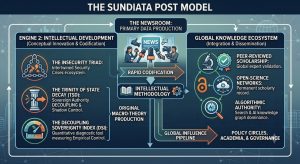
As I reflected on the conversations that followed the series, it became increasingly clear that the real story was not simply the creation of three original analytical constructs. It was the emergence of an institutional framework for knowledge production that had quietly taken shape within Sundiata Post. What had appeared to be a sequence of individual achievements was, in fact, evidence of a broader institutional philosophy.
What gradually became clear was that what we have come to call the Sundiata Post Model emerged from a simple yet consequential question: What happens when those two worlds meet?
Defining the Sundiata Post Model
This essay, therefore, formally introduces and defines the Sundiata Post Model as an institutional framework for media-based knowledge production in which an independent newsroom systematically integrates journalism, original research, conceptual innovation, and scholarly dissemination to produce original analytical constructs that contribute to public understanding, academic inquiry, and policy discourse within the global knowledge ecosystem.
After three decades in journalism, I have increasingly found myself asking not only how journalism can better report the world, but how it can contribute more substantially to humanity’s stock of knowledge. Early in a journalist’s career, the questions are naturally immediate: What is the story? How do I report it well? Those questions never lose their importance. Over time, however, another question inevitably begins to emerge: What can journalism itself become? That question has gradually become one of the defining reflections of my professional life. The Sundiata Post Model is my attempt to answer it—not as an abstract theory, but as an institutional framework shaped by experience, reflection, and experimentation.
A definition, however, acquires meaning only when expressed through practice. The Sundiata Post Model did not emerge as an abstract theory conceived in isolation. It evolved through the lived experience of The Sunday Stew—my weekly syndicated column that gradually expanded beyond commentary into a platform for systematic inquiry, conceptual innovation, and scholarly engagement. In many respects, the story of the Model is inseparable from the evolution of the column itself.
Viewed from this perspective, the implications extend beyond Sundiata Post itself. They invite a reconsideration of the role of the newspaper column in the digital age. For much of its history, column writing has been associated primarily with commentary, persuasion, and public reflection. The experience of The Sunday Stew suggests that a column can also become a site of systematic inquiry, conceptual innovation, and knowledge production. Rather than merely interpreting events, it can generate analytical constructs that enter scholarly and policy conversations.
The discussion that follows explores how that reflection gradually evolved into an institutional framework that reimagines the relationship between the newsroom and the knowledge institution.
Connecting to the Global Knowledge Ecosystem
The significance of the Sundiata Post Model extends beyond the production of original analytical constructs. It also lies in its capacity to create pathways through which ideas originating in an independent newsroom can enter global scholarly conversations. The publication of working papers, the establishment of the Sundiata Post Intelligence Unit (SPIU), engagement with scholarly repositories, and participation in international research networks demonstrate that journalism and academic knowledge production need not exist in separate institutional silos.
The evolution of The Sunday Stew into a platform for knowledge production also produced another, less anticipated consequence. It began to create pathways through which ideas developed within an independent newsroom could travel beyond journalism into the global knowledge ecosystem.
My appointment as an Expert Member and Peer Reviewer by ScienceOpen—the Berlin, Germany-based global research discovery and scholarly publishing platform that connects researchers, publishers, universities, and research institutions across disciplines—illustrates this broader trajectory. While the appointment was based on my scholarly profile and publication record, it also reflects the growing permeability between journalism and the academy that the Sundiata Post Model seeks to advance. It suggests that original ideas developed within an independent newsroom can participate in global research ecosystems when supported by rigorous methodology, systematic documentation, and scholarly dissemination.
The significance, therefore, lies not in one appointment but in what it represents: the possibility that an independent newsroom can participate credibly in global knowledge production.
This is perhaps one of the most important implications of the Sundiata Post Model: it demonstrates that an independent newsroom in Africa or elsewhere can contribute not only to daily public discourse but also to the production, circulation, and evaluation of knowledge within the global academic community.
An Emerging Body of Knowledge
What makes this evolution particularly noteworthy is not simply the number of constructs that have emerged, but the coherence that binds them together. Within a relatively short period, Sundiata Post has developed:
•The Insecurity Triad — a foundational analytical framework reconceptualising insecurity as an interconnected ecosystem;
•The Trinity of State Decay (TSD) — a macro-diagnostic theory explaining the structural dynamics of state decay and the progressive decoupling of sovereign authority;
•The Decoupling Sovereignty Index (DSI) — a quantitative metric for measuring the degree of decoupling between formal sovereignty and effective state authority; and
•The Sundiata Post Model — an institutional framework explaining how an independent newsroom can systematically generate original analytical constructs.
Collectively, they constitute an interdisciplinary body of work situated at the intersection of six disciplines: political science, international relations, sociology, security studies, quantitative social science, and journalism and media studies. Together, they demonstrate the capacity of media-based knowledge production to generate original analytical constructs across disciplinary boundaries.
There is an important progression here. The first three are substantive analytical constructs. The fourth explains the institutional framework that made their development possible. In doing so, the conversation shifts from “Here are four original ideas” to “Here is an institutional framework capable of systematically producing original ideas.”
That distinction helps explain why the Three-Month Sprint generated such widespread interest. The real story was never simply that three analytical constructs were developed within 91 days. The deeper question was how an independent newsroom could develop an institutional framework capable of producing original analytical constructs.
Perhaps the most remarkable aspect of this story is not that four original constructs emerged from one independent newsroom. It is that their emergence suggests that, under the right institutional conditions, the modern newsroom can evolve into a knowledge-producing institution.
Looking Ahead
The Sundiata Post Model is ultimately an argument that a newsroom can become more than a publisher of news. It can become a producer of enduring knowledge whose ideas travel from journalism into scholarship, policy, and increasingly, the algorithmic knowledge systems that shape how the world discovers and understands new concepts. Whether adopted, adapted, or challenged, the Model is offered as a contribution to a broader conversation about what journalism can become in the twenty-first century. If the twentieth century established the newsroom as society’s information institution, the twenty-first century may yet establish it as a knowledge institution. That is the possibility the Sundiata Post Model seeks to explore.
Finally, it is important to emphasise that, like any institutional framework, the Sundiata Post Model is a proposition to be examined, tested, refined, and, where necessary, challenged through practice and scholarly engagement.
This introductory essay has sought to define the Sundiata Post Model and explain why it emerged. The next two parts of this series will examine its institutional architecture and the conditions for long-term sustainability that will enable such a model to endure. If journalism is to become a genuine knowledge institution, it must be intellectually rigorous, institutionally coherent, and economically sustainable.
Trust is sacred. Stay seasoned.
•Dr. Max Amuchie is a Scholar-Journalist, Media CEO & Theorist-In-Chief, Lead Researcher at the Sundiata Post Intelligence Unit (SPIU), and an Expert Member and Peer Reviewer at ScienceOpen. He is the architect of The Insecurity Triad framework for African security analysis as well as the Trinity of State Decay theory, and the Decoupling Sovereignty Index (DSI)—original frameworks for understanding, categorising, and measuring conflict, state decay, and sovereignty in the Global South. He writes ‘The Sunday Stew’, a weekly syndicated column on faith, character, and the structural forces that shape society, with a focus on Nigeria, Africa, and the Global South in a changing world.
X (formerly Twitter): @MaxAmuchie | Email: [email protected] | Tel: +234(0)8053069436