


News
APC Finally Uploads 471 Candidates to INEC Portal Ahead of 2027 Elections
- /home/naijuinz/public_html/wp-content/plugins/mvp-social-buttons/mvp-social-buttons.php on line 27
https://naijablitznews.com/wp-content/uploads/2026/07/IMG_9070.jpeg&description=APC Finally Uploads 471 Candidates to INEC Portal Ahead of 2027 Elections', 'pinterestShare', 'width=750,height=350'); return false;" title="Pin This Post">
- Share
- Tweet /home/naijuinz/public_html/wp-content/plugins/mvp-social-buttons/mvp-social-buttons.php on line 72
https://naijablitznews.com/wp-content/uploads/2026/07/IMG_9070.jpeg&description=APC Finally Uploads 471 Candidates to INEC Portal Ahead of 2027 Elections', 'pinterestShare', 'width=750,height=350'); return false;" title="Pin This Post">
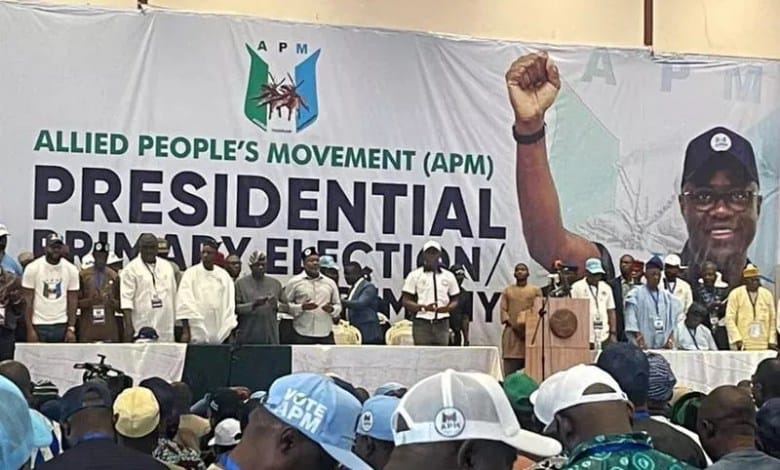
The All Progressives Congress (APC) has finally completed the submission of its candidates for the 2027 presidential and National Assembly elections, confirming President Bola Tinubu and Vice President Kashim Shettima as the party’s presidential ticket for the polls.Politics
The ruling party announced on Sunday that it successfully uploaded the details of 471 candidates to the Independent National Electoral Commission (INEC) Candidate Nomination Portal before the deadline set by the electoral body.
The submission covers the party’s presidential and vice-presidential candidates, 109 Senate candidates and 360 candidates for the House of Representatives.
The development officially settles months of uncertainty surrounding the APC’s presidential ticket, with Shettima retained as Tinubu’s running mate for the 2027 election.Executive Branch
APC National Chairman, Prof. Nentawe Yilwatda, disclosed the completion of the exercise in a statement issued shortly after the closure of INEC’s nomination portal.
According to him, the party achieved full compliance with the commission’s requirements for the nomination of candidates seeking elective offices covered by the portal.
“I congratulate our candidates, leaders, and members of APC on the successful 100% upload of our Presidential, Vice Presidential, Senate, and House of Representatives candidates on the INEC Candidate Nomination Portal (ICNP),” he said.
Yilwatda described the completion of the process as a major step in the party’s preparations for the next general election.
He added, “With this milestone achieved, our focus now shifts to mobilisation and preparations for a successful campaign and decisive victory at the polls.”
The successful upload places the APC among the political parties that met the electoral commission’s deadline for the submission of candidates for the presidential and National Assembly elections.
INEC had fixed 6 p.m. on Saturday, July 11, as the deadline for political parties to submit the nomination forms of their presidential and legislative candidates through its online portal.
The commission had earlier granted political parties access to the nomination portal on June 26. Submission of nomination forms commenced the following day in line with the provisions of Section 29(1) of the Electoral Act, 2026.
With the nomination process concluded, attention is expected to shift to campaign planning, voter mobilisation and politiking ahead of the 2027 general election.
News
The Sundiata Post Model (2): Historical and Intellectual Foundations Of A Knowledge-Producing Newsroom
By Max Amuchie | The Sunday Stew
Every institutional framework has a history, even when it introduces something new. Ideas rarely emerge in complete isolation; they arise from deep, structural conversations that began long before us, evolving across generations as societies confront new realities, systemic shocks, and unanswered questions.
The Sundiata Post Model is no exception. Although formally introduced in the previous essay as an institutional framework for media-based knowledge production, its intellectual roots extend much further back. They lie within a long tradition of journalism’s engagement with ideas and society, while simultaneously responding to a distinctly twenty-first-century challenge: the transformation of the newsroom in the age of artificial intelligence, digital knowledge architectures, and global scholarly networks.
The question at the heart of this essay is therefore not whether journalism has ever produced ideas—history provides an unequivocal answer to that. The more critical question is whether the modern newsroom can become an institution deliberately organised to generate original analytical constructs that contribute simultaneously to journalism, deep scholarship, and public policy. That is a different, more demanding question altogether.
Nigeria’s Tradition of the Newspaper as an Intellectual Institution
Long before the emergence of today’s hyper-accelerated digital media, some of Nigeria’s most influential newspapers were already serving purposes far beyond the passive reporting of daily events.
The press architectures established by pioneers like Nnamdi Azikiwe and Obafemi Awolowo—both of whom I previously discussed, alongside Chinweizu, as members of Nigeria’s rare tradition of framework builders—became foundational vehicles through which sophisticated ideas about nationalism, constitutional development, socio-economic planning, democracy, and self-government entered the public consciousness. Their publications did not merely describe political transformation; they actively generated the conceptual architecture that shaped it.
Crucially, they achieved this by building powerful media infrastructures designed to carry these ideas at scale. Azikiwe did not just publish in Lagos; he deployed a sweeping, cross-regional syndicate anchored by the West African Pilot alongside a network of provincial pillars including the Eastern Guardian in Port Harcourt, the Nigerian Spokesman in Onitsha, and the Southern Nigeria Defender in Warri. Similarly, Awolowo founded the Nigerian Tribune in 1949 as a highly structured institutional vehicle to systematically articulate socio-political theory and regional constitutional destiny.
In his seminal work, Renascent Africa (1937), Azikiwe laid out a broad intellectual and ideological vision that extended far beyond the immediate horizon of standard journalism, charting a course for mental emancipation and African self-determination. A decade later, Awolowo’s Path to Nigerian Freedom (1947) demonstrated how a publisher and institutional thinker could systematically articulate a rigorous, structured constitutional vision for a developing nation.
This historical experience reminds us that journalism in Nigeria has never been confined solely to stenography. At critical turning points in the nation’s history, newspapers operated as the primary intellectual laboratories through which society debated its structural future.
This tradition of intellectual leadership through journalism is not merely of historical interest. In The Sunday Stew essay mentioned earlier, ‘The Insecurity Triad: Azikiwe, Awolowo, and Chinweizu — Nigeria’s Elite Class of Framework Builders’, I argued that Nigeria has, on rare occasions, produced public intellectuals who moved beyond commentary to construct enduring analytical frameworks. Azikiwe and Awolowo exemplified that earlier tradition, while Chinweizu demonstrated that independent conceptual innovation could continue outside formal state institutions and conventional academic structures. The present essay extends that argument by asking a different question: can the contemporary newsroom itself become an institution deliberately organised for systematic framework building and knowledge production?
Yet, an important distinction must be recognised between that era and our contemporary challenge:
The Nationalist Press primarily advanced political ideas, anti-colonial mobilisation, and national aspirations.
The Sundiata Post Model represents a shift from ideological mobilisation to systematic institutional knowledge production. It asks whether an independent newsroom can generate original analytical constructs capable of standing up to the rigorous validation of the global academic ecosystem while serving active policy discourse.
The distinction is subtle, but fundamental. It marks the evolution from political journalism to scholar-journalism.
Journalism and the Life of Ideas
The structural relationship between journalism and ideas extends well beyond regional borders. To understand the global intellectual foundations of this model, we must reconcile two complementary traditions of public thought—both of which proved invaluable in shaping the conceptual foundations of my Trinity of State Decay (TSD) theory.
In framing the mind dimension of the Money–Land–Mind dynamic of the TSD, I found the works of Walter Lippmann and Hannah Arendt particularly illuminating, insightful, and enriching. Few journalists have shaped modern thinking about public communication as profoundly as Lippmann. Throughout his six-decade career in American journalism, he demonstrated that journalism could become far more than a chronicle of events; it could serve as an instrument for decoding how societies acquire knowledge, construct public opinion, and navigate increasingly complex realities.
In his foundational classic, Public Opinion (1922), Lippmann demonstrated that journalism could contribute not merely rapid information, but macro-level interpretation, permanently altering how we view the relationship between media, knowledge, and public policy. It is this Lippmannesque understanding on how information is filtered, misperceived, and understood that informs the epistemic foundations of the TSD.
From a different, deeply philosophical tradition, Hannah Arendt, a political theorist and independent scholar whose ideas reached wide audiences through public intellectual magazines and cultural journals, devoted her life’s work to understanding the structural anatomy of politics, authority, institutional decay, and the conditions that make collective civic life possible.
In The Human Condition (1958), Arendt examined human action, public space, and the enduring value of disciplined conceptual inquiry in explaining political reality far beyond the fleeting nature of immediate headlines. Her profound insights into the erosion of institutional authority and the fragility of the public realm provide an important philosophical foundation for understanding the Trinity of State Decay’s vectors of systemic fragility.
Although operating within vastly different institutional environments, Lippmann and Arendt represented complementary pillars of intellectual rigor:
One demonstrated journalism’s unmatched capacity to shape and democratise public understanding.
The other demonstrated the enduring value of rigorous, uncompromised conceptual thinking regarding public life and the human world.
Together, they illuminate an important institutional possibility. If journalism can generate immediate public understanding, and disciplined inquiry can generate enduring concepts—as demonstrated by their influence on the conceptual foundations of the Trinity of State Decay—might there exist an institutional framework capable of integrating both traditions within a single, independent newsroom?
That synthesis is the exact intellectual domain of the Sundiata Post Model.
An Abuja Newsroom and a Contemporary Question
The Sundiata Post Model emerged not from an insular academic department, a government research institute, or a foreign-funded policy think tank, but from an independent newsroom in Abuja. That geographical and operational fact is highly significant.
The framework did not begin as an abstract theory searching for practical application. It emerged from journalism itself—from the lived, daily experience of reporting, investigating, analysing, and reflecting on the severe structural forces shaping Nigeria and the wider Global South.
Over time, The Sunday Stew gradually evolved beyond a weekly opinion column into a platform for systematic, empirical inquiry. Through that deliberate evolution emerged a succession of original analytical frameworks:
•The Insecurity Triad: A conceptual framework explaining how kidnapping (Money), banditry (Land), and terrorism (Mind) function as mutually reinforcing dimensions of contemporary insecurity, generating parallel systems of violence, governance, and authority;
•The Trinity of State Decay (TSD): A macro-theoretical formulation explaining how the interaction between the Institutional Mirage, the Shadow Order, and the Money–Land–Mind dynamic drives the decoupling of formal sovereignty from effective state authority, and
•The Decoupling Sovereignty Index (DSI): An indigenous, multidimensional measurement framework designed to quantify the extent to which effective sovereignty has decoupled from formal state authority across subnational territories.
What gradually became apparent was that these were not isolated intellectual exercises. They were the deliberate products of an emerging institutional philosophy developed through the Sundiata Post Intelligence Unit (SPIU).
More importantly, these constructs did not emerge as a single research project conceived in advance. They appeared sequentially, each responding to new empirical observations while simultaneously expanding the analytical capacity of the newsroom itself. The Insecurity Triad provided a structured lens for understanding the interconnected dimensions of insecurity. The TSD extended that inquiry into a broader theory of institutional authority and governance. The DSI subsequently translated those theoretical insights into an operational framework capable of empirical assessment. Viewed together, this progression revealed something larger than the individual frameworks themselves. It demonstrated that the newsroom had begun to develop an internal capacity for cumulative knowledge production, with each construct building upon and extending the intellectual foundations laid by its predecessor.
The fundamental question therefore shifted from “What new framework has been developed?” to “What kind of newsroom structure makes the systematic development of such frameworks possible?” The answer is the Sundiata Post Model.
A New Institutional Proposition
The Sundiata Post Model does not argue that journalism should become academia, nor does it suggest that scholarly research should migrate from the university to the newsroom. Instead, it advances a new institutional proposition:
The Core Proposition: An independent media institution can systematically integrate high-velocity journalism, original qualitative research, conceptual innovation, and global scholarly dissemination within a single institutional framework, contributing simultaneously to
informed public discourse and the international knowledge ecosystem. The Sundiata Post experience demonstrates the practical viability of this proposition.
This proposition reflects neither a rejection of journalism’s traditional role nor an attempt to merely imitate academic institutions. Rather, it represents a strategic institutional adaptation to the changing architecture of knowledge itself.
In an era when global digital repositories, artificial intelligence discovery layers, academic networks, and news organisations increasingly intersect, the traditional boundaries separating journalism from formal knowledge production have become entirely permeable. The Sundiata Post Model seeks to explore what becomes possible when those boundaries are approached not as rigid barriers, but as unprecedented opportunities for intellectual sovereignty.
The historical journey from Azikiwe and Awolowo to Lippmann and Arendt reveals a long-standing, symbiotic relationship between journalism and ideas. The Sundiata Post Model does not seek to replicate any of those legacy traditions perfectly. It seeks to answer a contemporary institutional question:
What becomes possible when an independent newsroom deliberately organises itself as a primary knowledge-producing institution?
The answer begins with philosophy. The next essay examines structure.
Trust is sacred. Stay seasoned
•Dr. Max Amuchie is a Scholar-Journalist, Media CEO, Lead Researcher at the Sundiata Post Intelligence Unit (SPIU), and an Expert Member and Peer Reviewer at ScienceOpen. He is the architect of The Insecurity Triad framework for African security analysis as well as the Trinity of State Decay theory, and the Decoupling Sovereignty Index (DSI)—original frameworks for understanding, categorising, and measuring conflict, state decay, and sovereignty in the Global South. He writes ‘The Sunday Stew’, a weekly syndicated column on faith, character, and the structural forces that shape society, with a focus on Nigeria, Africa, and the Global South in a changing world.
X (formerly Twitter): @MaxAmuchie | Email: max.a@sundiatapost.com | Tel: +234(0)8053069436
News
DANGEROUS DEVT: Bandits abduct corpse of FRSC Cmdr, mourners, demand almost half a billion Naira ransom
A dangerous development is fast emerging in Nigeria as gunmen suspected to be kidnappers have abducted the corpse of a Deputy Corps Commander of the Federal Road Safety Corps (FRSC), Augustine O. Ikwue, and the mourners accompanying his body to his hometown at Otukpo, Benue State.
The vehicle conveying the corpse ran into ambush along Ochadamu-Ejule road in Ofu local government of Kogi state around 6pm, on Thursday, July 9, 2026.
The officer reportedly d!ed in Osogbo, capital of Osun state, after a brief illness.
The abductors have reportedly reached the family, demanding N450m for the victims to regain their freedom
Kogi state sector Commander of FRSC, Lawal Fagge, confirmed the incident, saying nine mourners, including two operatives of the commission, were abducted in the attack.
He said the corpse was later abandoned around Ejule community, and has been handed over to the family for burial, while effort is being intensified to rescue the kidnap victims.
“We recovered the corpse of the officer in Ejule community on Friday after frantic searching and handed it over to the family. He was buried on Saturday in his home town at Otukpo in Benue.
“The abductors used the cellphone of the deceased officer, and called his wife, demanding huge sum of money for those in their captivity to regain their freedom,” Fagge said.
Security operatives, including the Army, police, hunters and vigilantes were said to have been mobilised to the area in an attempt to rescue the kidnap victims and possibly apprehend their assailants.
Several people are raising concern over the incident, stressing that the bandits have no respect for even a corpse.
News
Breaking: Dozens feared killed as suspected herdsmen again launch deadly attack in Benue
No fewer than ten persons have been confirmed dead following separate attacks by suspected armed herdsmen on communities in Otukpo Local Government Area of Benue State.
It was gathered that the latest wave of violence began on Saturday when suspected herdsmen attacked Akpachi village in Ugboju community, killing two persons and leaving several others with varying degrees of injuries.
Less than 24 hours later, the attackers reportedly struck again, this time invading Otukpo Nobi community in the early hours of Sunday, where eight persons were killed and several others injured.
The attacks also triggered protests by angry youths and residents, who marched to the Och’Idoma Palace in Otukpo town to express their frustration over the worsening security situation and demand urgent government intervention.
The latest violence comes barely one month after the killing of the Benue State Chairman of the Miyetti Allah Cattle Breeders Association of Nigeria (MACBAN), Alhaji Ardo Risku Mohammed, and his associate, Yakubu Isah, around Okwudu in Otukpo Local Government Area after attending a peace meeting in Ohimini LGA.
-
News23 hours agoPhotos: Mutfwang’s Blueprint For Turning Plateau Potato Into Rural Wealth
-
News22 hours agoSam Larry Makes First Public Appearance After Surviving Fatal Auto Crash
-
News9 hours ago“We lost gallant men”,Makinde confesses after rescue of Oyo school children, teachers
-
News22 hours agoDrug abuse: Marwa calls for girl-child protection, seeks partnership with monarchs (Photos)
-
News22 hours agoEx-Access Bank Staff remanded in Ikoyi prison for theft
-
News22 hours agoOF NIGERIAN CUSTOMS, GROVELLING AMBITION, AND STYMIED CAREERS
-
Sports9 hours agoNoskova Defeats Compatriot Muchova In Dramatic Final, Wins First Wimbledon Title
-
Foreign9 hours agoThousands Of Albanians March Against Trump-Linked Resort