Connect with us

News

Joseph Yobo Hails FCT Infrastructure Drive Under Renewed Hope

Published

on

ADVERTISEMENT
Zoom Ad
ADVERTISEMENT
Zoom Ad

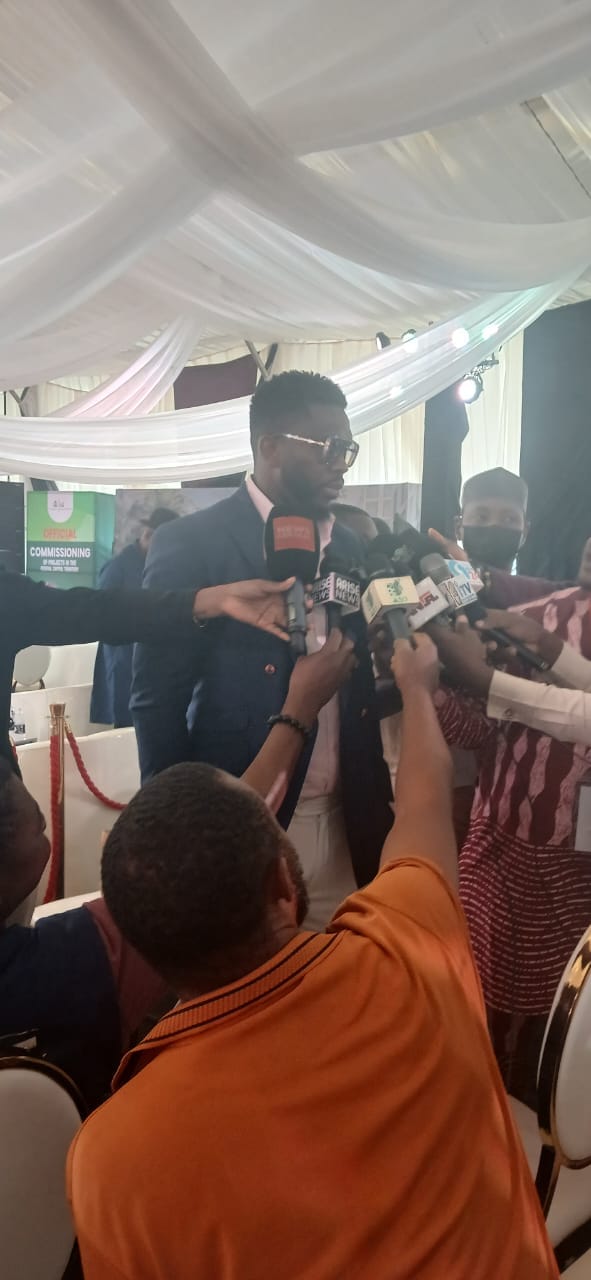
Former Super Eagles captain Joseph Yobo has praised the pace of infrastructure development in the Federal Capital Territory (FCT), describing it as a reflection of the Renewed Hope Agenda of President Bola Tinubu’s administration.


Yobo made the remarks while speaking with journalists on the sidelines of the launch of the Abuja City Walk in Abuja.

The former Nigeria international said the FCT is experiencing an unprecedented phase of infrastructural transformation, marking a significant shift in the delivery of public services and development projects in the nation’s capital.

He commended the FCT Minister, Mr Nyesom Wike, saying his infrastructure-driven approach to governance has set a new benchmark for public administration in Nigeria.

Advertisement

According to Yobo, effective implementation has long been one of the greatest challenges facing governance in the country, but the current administration in the FCT has demonstrated that meaningful progress is achievable through decisive leadership.

“Coming to the FCT and seeing what the Minister has achieved is highly commendable and worthy of emulation.

“He has raised the bar for governance by doing exactly what is required—providing infrastructure and delivering development to the people,” Yobo said.

He made the comments as the FCT Administration continues the commissioning of major infrastructure projects across the territory, including roads and other public facilities.

Advertisement

Yobo described the ongoing projects as monumental, noting that they reflect Wike’s track record of prioritising infrastructure development during his tenure as Governor of Rivers State.

“The projects being commissioned here in the FCT are not ordinary; they are landmark developments,” he said, referring to the Minister’s statement that the current road commissioning exercise represents only the first phase of a broader infrastructure development plan, with additional projects expected before the end of the year.

The former Super Eagles captain also expressed optimism about the future of sports development in the FCT.

He said Wike’s longstanding passion for sports and his record of investing in sports infrastructure while serving as Governor of Rivers State provide confidence that the sector will receive greater attention in the capital.

Advertisement

Recalling the Minister’s commitment to sports development and his support for Nigerian athletes, Yobo expressed confidence that the FCT would witness significant improvements in sports facilities and programmes.

“He is exactly the kind of leader who gets things done in this sector. I am confident he will put something excellent in place for sports development in the FCT,” he said.

The remarks underscore growing public interest in the FCT Administration’s infrastructure renewal efforts, which are aimed at improving connectivity, enhancing public services and supporting sustainable development in line with the Renewed Hope Agenda.


Advertisement
Continue Reading
Advertisement

News

Friend Reveals Mary Habila’s Final Moments

Published

on

By

ADVERTISEMENT
Zoom Ad
ADVERTISEMENT
Zoom Ad

The circumstances surrounding the death of Mary Habila, a nurse attached to the David Umahi Federal University of Medical Sciences (DUFUS) and on secondment to the Federal Ministry of Works, have become clearer following a sworn statement by her colleague and close friend, Anita Baaki.

Baaki, a physiotherapist from Benue State, said she was among members of staff who travelled from Abuja to Ebonyi State on June 24, 2026, for official duties under the Minister of Works, David Umahi.

According to her affidavit filed before the Ebonyi State High Court, the staff members were accommodated in separate but adjoining rooms in a staff chalet located within the minister’s country home in Uburu, Ohaozara Local Government Area.

She clarified that the building was designated for staff members and associates, not for the minister’s personal residence.

Advertisement

On the evening of June 26, Habila returned after having her hair done and stopped by Baaki’s room to show her the new hairstyle.

The two chatted and joked before Habila said she was tired and intended to take a shower before going to bed.

“Mary told me she was tired and wanted to take a shower before sleeping. That was the last time I saw her alive,” Baaki stated.

The following morning, Baaki became concerned when Habila did not come out as usual. Repeated phone calls went unanswered, prompting her to knock on Habila’s door. Finding it locked from the inside and receiving no response, she alerted a domestic staff member to search the premises.

Advertisement

When Habila could not be found elsewhere, other staff members were informed, and the room was forcibly opened. She was discovered lying unconscious on the floor near the door.

She was immediately taken to the David Umahi Federal University Teaching Hospital, where doctors confirmed that she was dead on arrival.

In her affidavit, Baaki stated that her testimony was given voluntarily and without coercion, emphasizing that she was making the statement solely for official and investigative purposes.

Advertisement
Continue Reading

News

Umahi: NSP Disowns Mary Habila as Physiotherapist

Published

on

By

ADVERTISEMENT
Zoom Ad
ADVERTISEMENT
Zoom Ad

The Nigeria Society of Physiotherapy (NSP) has declared that the late Mary Habila, whose death has generated widespread public attention, was not a registered physiotherapist, distancing the profession from claims that she belonged to its ranks.

The society made the clarification in a statement issued on Thursday by its Public Relations Team after conducting what it described as a verification of Habila’s credentials through the relevant regulatory authorities.

According to the NSP, a search of the official register of licensed physiotherapists in Nigeria showed that the name “Mary Habila” does not appear on its database.

“Following verification through the appropriate regulatory channels, the name ‘Mary Habila,’ as stated, does not appear on the database of registered physiotherapists,” the statement read.

Advertisement

The clarification comes amid public discussions surrounding the death of Habila, who died on June 27, 2026, in Ebonyi State while serving in the office of the Minister of Works, Senator David Umahi. She had been widely identified in several reports as a physiotherapist.

The professional body stressed that membership of regulated professions must be established through official records rather than assumptions or public descriptions.

It warned that public officials and other stakeholders have a responsibility to verify professional credentials before making public statements capable of misleading Nigerians.

“The Nigeria Society of Physiotherapy has consistently maintained that professional identity is not a matter of assumption or public perception; it is a matter of verifiable fact. Where questions arise, they should be resolved through the appropriate regulatory processes, not through speculation or unverified claims,” the society stated.

Advertisement

The NSP said its clarification was intended to protect the integrity of the physiotherapy profession and reinforce the importance of relying on official regulatory records when identifying professionals.

It added that the incident should serve as a reminder that qualifications and professional identities must always be accurately verified and represented.

Despite distancing itself from the claims about Habila’s professional status, the society expressed sympathy to her family over her death.

“Finally, while it is important to establish the facts, we must not lose sight of the human tragedy at the heart of this matter. We extend our sincere condolences to the family, friends and loved ones of the deceased, and pray that her soul rests in perfect peace. May they find strength and comfort during this difficult time,” the statement added.

Advertisement
Continue Reading

News

Ghana Moves to Ban TV Stations Over Broadcast of Nollywood Movies

Published

on

By

ADVERTISEMENT
Zoom Ad
ADVERTISEMENT
Zoom Ad

Ghana’s National Film Authority has announced plans to crack down on television stations broadcasting Nollywood films without authorisation, with the Deputy CEO revealing that all broadcast licenses in the country could be revoked and reissued under stricter terms by 2027.

James Gardiner, a Ghanaian actor and Deputy CEO of the NFA, made the announcement during a conversation with Nigerian filmmaker Uchenna Mbunabo, who had confronted him over the widespread theft of Nollywood content by Ghanaian television stations.

Mbunabo accused the stations of downloading Nigerian films directly from YouTube and airing them on national television without permission or payment.

“I noticed that Ghanaian TV stations, the way they are stealing our films and showing them for free with impunity. Is it legalised in your country for TV stations to go on YouTube, download people’s sweat and show it for free?” he asked.

Advertisement

Gardiner confirmed the practice was illegal and said the NFA had been working with Ghana’s Ministry of Communications, the National Communications Authority, and the National Media Commission to address it.

“We’re trying to make law to revoke all licenses and all of them will now come to apply afresh,” he said, adding that the process should be completed by 2027.

He acknowledged that enforcement remained difficult, particularly with the rise of digital stations operating from outside Ghana without physical offices in the country.

Mbunabo’s complaint is not an isolated one. Several high-profile Nigerian filmmakers and actresses have previously called out Ghanaian television stations over the same issue.

Advertisement

Ademoye had taken to social media to express frustration after discovering her films were being broadcast on Ghanaian stations without her knowledge or consent.

Oboli similarly called out the practice publicly, describing it as a direct attack on the livelihoods of Nigerian creatives.

Mercy Johnson and Ruth Kadiri have also voiced similar complaints, with Kadiri noting that filmmakers invest heavily in production only to watch their work distributed freely across borders without any returns.

Nigeria’s film industry continues to expand in terms of output, but filmmakers have long complained that widespread piracy, both at home and across the continent, significantly undermines their earnings.

Advertisement

Gardiner’s commitment to license reform represents the most concrete response from Ghanaian authorities to date, though filmmakers will be watching closely to see whether the 2027 deadline holds.

Continue Reading

Trending

Copyright © 2024 Naija Blitz News