News
Reps Minority Caucus stage Walk Out as House Passes Tinubu’s State Police Bill
- /home/naijuinz/public_html/wp-content/plugins/mvp-social-buttons/mvp-social-buttons.php on line 27
https://naijablitznews.com/wp-content/uploads/2026/07/20260723_1549541.jpg&description=Reps Minority Caucus stage Walk Out as House Passes Tinubu’s State Police Bill', 'pinterestShare', 'width=750,height=350'); return false;" title="Pin This Post">
- Share
- Tweet /home/naijuinz/public_html/wp-content/plugins/mvp-social-buttons/mvp-social-buttons.php on line 72
https://naijablitznews.com/wp-content/uploads/2026/07/20260723_1549541.jpg&description=Reps Minority Caucus stage Walk Out as House Passes Tinubu’s State Police Bill', 'pinterestShare', 'width=750,height=350'); return false;" title="Pin This Post">
…allege constitutional breaches in voting process as 311 lawmakers back landmark amendment

…reaffirm their support for state policing in principle
By Gloria Ikibah

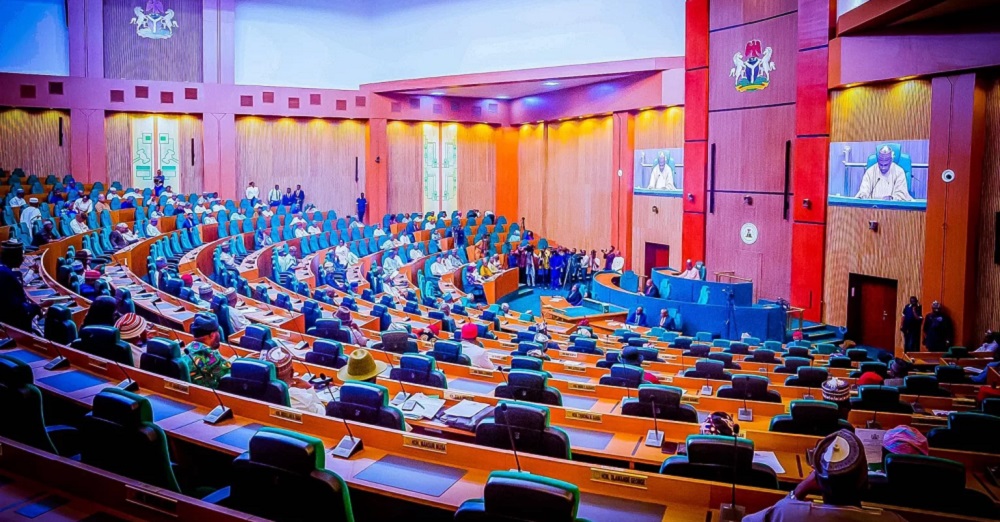
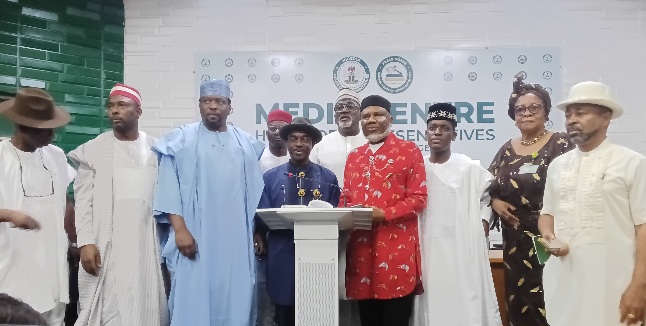
The Minority Caucus in the House of Representatives on Thursday staged a dramatic walkout during plenary in protest against the passage of President Bola Tinubu’s Executive Bill on the establishment of State Police, accusing the House leadership of violating constitutional provisions and the chamber’s Standing Orders.
Despite the protest, the House approved the Constitution Alteration Bill after 311 lawmakers voted in its favour, marking a major milestone in the ongoing effort to decentralise policing and strengthen Nigeria’s security architecture.
The Executive Bill, transmitted to the National Assembly by President Tinubu last week, seeks to amend the 1999 Constitution to create a constitutional framework for the establishment of State Police Services. The proposal followed months of debate over the need for a multi-layered policing system to tackle rising insecurity across the country. It also replaced an earlier version of the bill previously passed by the House after lawmakers rescinded their earlier resolution to accommodate the President’s proposal.
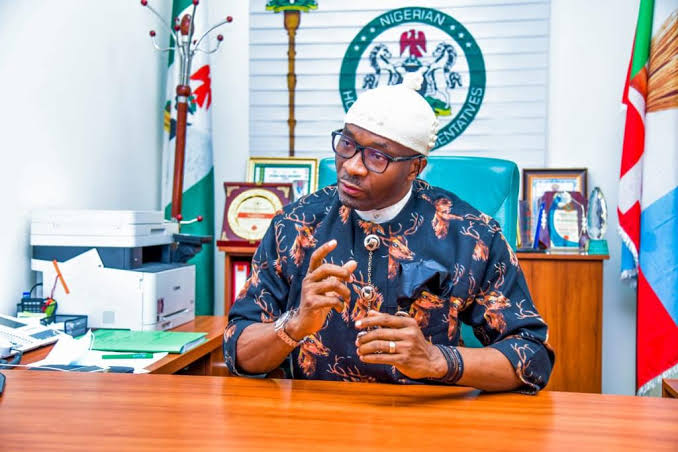
Speaking to journalists shortly after leading members of the caucus out of the chamber, Minority Leader, Rep. Fredrick Agbedi, said their action was not a rejection of state police but a protest against what they described as the disregard for due legislative process.
He argued that the Speaker, while presiding as Chairman of the Committee of the Whole, ignored the constitutional requirements governing amendments to the Constitution.
He said: “The Constitution is the grand norm. It is the rule book from which even our Standing Orders derive their powers. For the Speaker, acting as Chairman of the Committee of the Whole, to disregard the clear provisions of Section 9(2) of the 1999 Constitution, as amended, is a great affront to the workings of the House of Representatives.”
Agbedi maintained that attendance in the House is determined through members’ registers signed on each legislative day and not by names read during proceedings.
The Minority Caucus also insisted that every clause of a constitutional amendment bill must be considered individually and supported by a two-thirds majority, as required by both the Constitution and the House Standing Orders.
Quoting Order 13 Rule 15(a) of the House Rules, the lawmakers stated:
“In the clause-by-clause consideration in the Committee of the Whole, a clause shall be deemed passed only if supported by a positive vote of two-thirds majority of members of the House.”
The caucus faulted the decision to pass the bill through a voice vote after only the long title was read, without detailed consideration of each clause.
Reaffirming their support for state policing in principle, the lawmakers stressed that procedure should never be sacrificed.
“We are not against the creation of state police. Whatever will help address insecurity in Nigeria, we are prepared to support. But every action taken by Parliament must follow due process”, he added.
According to the minority leader, they had earlier held discussions with Speaker Abbas Tajudeen on aspects of the bill that required amendments, and believed there was an understanding that those concerns would be addressed.
The lawmaker warned that failure to comply with constitutional procedures could undermine the credibility of the National Assembly and Nigeria’s democratic institutions.
“Mr. Speaker even identified areas where we could intervene, but when he sat as Chairman of the Committee of the Whole, he simply read the long title and put the question through a voice vote. That is absurd.
“When the rules and regulations are not complied with, it affects the credibility of the institution as well as the credibility of Nigeria and our democracy”, Agbedi stated.
The caucus further alleged that the Speaker denied them the opportunity to raise constitutional points of order before the vote was taken.
“As Minority Leader, I raised a point of order, but before hearing me, the Chairman ruled me out of order. Which order was he ruling me out of? He ought to have heard my point of order first before deciding whether it complied with our rules or the Constitution”, he said.
The caucus also questioned how the constitutional requirement of a two-thirds majority could have been met after opposition lawmakers had left the chamber.
“If we walked out of the House, where are our votes? Can you count our votes? Can anybody decide a constitutional amendment with a voice vote? It is not possible”, he asked.
Describing the development as a dangerous precedent, the Minority Caucus accused the ruling All Progressives Congress (APC) of weakening democratic institutions.
“We stand on the side of Nigerians. We stand on the side of the rule of law. We stand on the side of what will make Nigeria a great nation and not what will diminish the integrity, progress and development of this country”, the minority leader noted.
The lawmakers urged Nigerians to remain vigilant, insisting that while they support the establishment of state police, any constitutional amendment must strictly comply with the provisions of the Constitution and the House Standing Orders.
Meanwhile, the House proceeded with the consideration and adoption of the report of its Committee on the Review of the 1999 Constitution, chaired by Deputy Speaker Benjamin Kalu.
At the conclusion of the exercise, Speaker Abbas Tajudeen announced that 311 members voted in support of the bill, comprising 276 lawmakers physically present in the chamber and 35 who participated virtually.
The bill, titled “A Bill for an Act to Alter the Constitution of the Federal Republic of Nigeria, 1999 to Provide for the Establishment of State Police Services and for Related Matters (HB. 2797),” now moves to the next stage of the constitutional amendment process.
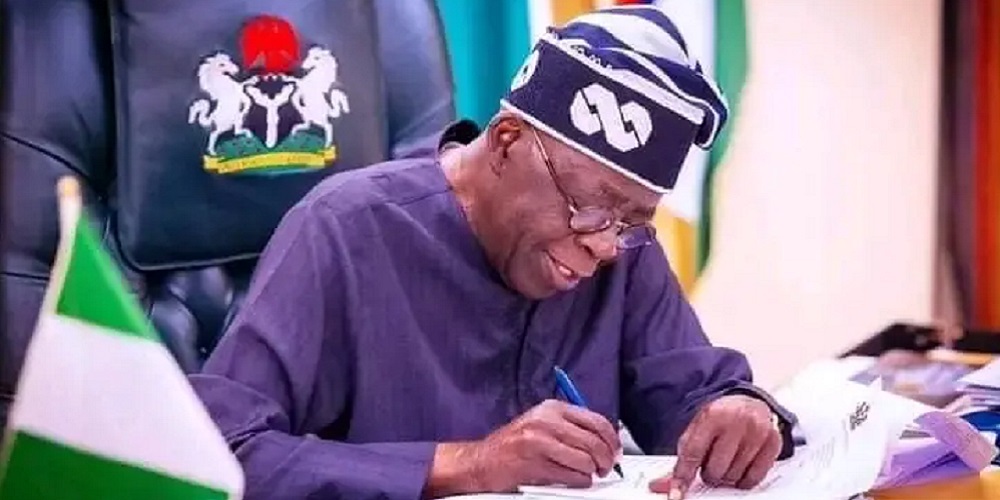
In forwarding the legislation to the House, President Tinubu said the proposal builds on previous work by lawmakers while introducing additional safeguards to ensure the effective implementation of a dual policing system.
“This bill builds on the significant work already done in this regard by the House of Representatives and incorporates additional safeguards to ensure that the creation of a dual policing structure to address our nation’s evolving national security challenges can be achieved quickly and effectively to the benefit of all Nigerians.
“The proposed legislation is a critical component of our administration’s strategy to reorganize Nigeria’s security architecture to better protect our citizens, and I am confident that the House of Representatives will act quickly to consider and pass this Bill.
“While I look forward to expeditious consideration of this submission by the House of Representatives, please accept, Rt. Honourable Speaker, the assurances of my consideration and best regards”, he said.
Following receipt of the Executive Bill, the House rescinded its earlier resolution of 11 June 2026 on the establishment of State Police Services and dissolved the 12-member Conference Committee constituted on 9 July 2026, paving the way for consideration of the President’s revised proposal.
News
Just in: Five Islamic Clerics Reportedly Abducted After Praying for Tinubu’s Re-Election at Senator Yari’s Residence
Five Islamic clerics have reportedly been abducted by suspected terrorists after attending a special prayer gathering organised for President Bola Tinubu’s re-election at the residence of former Zamfara State Governor and serving Senator Abdul’aziz Abubakar Yari in Talata Mafara.
The clerics were reportedly abducted on Saturday, September 12, 2026, shortly after attending the gathering at Yari’s residence, where about 1,000 Islamic scholars were said to have gathered to pray for Tinubu’s victory in the 2027 presidential election.
It was learnt that the victims reportedly include Imam Yahuza, the First Jumma’at Imam in Dogon Madacci; Magawata Abdullahi, the Second Jumma’at Imam in Dogon Madacci; Malam Shehu Dakko; Imam Bala Fagon; and Na’ibi Tasi’u of Tungar Nagudai.
Sources said the clerics had travelled from communities in Bakura and Talata Mafara Local Government Areas to attend the prayer gathering.
Their reported abduction has raised fresh concerns over the worsening security situation in Zamfara, particularly as the incident allegedly occurred in connection with a gathering at the residence of Yari, a former governor, serving senator and Director-General of Tinubu’s 2027 presidential campaign.
The identities of the abductors and their whereabouts remained unclear as of the time of filing this report.
Security agencies have yet to issue an official statement on the reported abductions as of press time.
Also, the Zamfara State police spokesman, Yezid Abubakar has not responded to messages and calls sent to him seeking his comment.
News
2027: Peter Obi Launches Four-Year Reform Plan
Presidential candidate of the Nigeria Democratic Congress (NDC), Peter Obi, has launched a four-year governance plan focused on economic reforms, competent appointments, infrastructure rehabilitation, security and direct engagement with Nigerians if elected president in 2027.
Obi said he would personally take charge of the government and would not govern through proxies, insisting that the president must remain directly accountable to the people.
The former Anambra State governor disclosed the plan during an exclusive interview with Arise News on Thursday as part of the station’s presidential campaign series.
He said four years would be enough to begin transforming Nigeria if the government identified clear priorities, appointed competent officials and implemented the right policies.
“I will be in charge and I will not run government by proxy. I will be answerable to the people,” Obi said.
He also reiterated his pledge to serve only one four-year term if elected, saying he would not remain in office beyond his tenure.
“I will not spend one extra day. Four years is enough to engender change and I did it as Governor of Anambra State,” he said.
On infrastructure, Obi said his administration would concentrate first on rehabilitating existing roads, schools and other public facilities before embarking on new projects.
“We will not build new roads until we fix the existing ones,” he said.
Obi said he would remove the corruption associated with the petrol subsidy regime but rejected the restoration of the old system.
He said the Federal Government had disclosed that about N15.8 trillion was generated from subsidy removal, adding that such resources should have been invested in productive sectors including agriculture, small businesses, manufacturing and job creation.
“The subsidy regime in Nigeria was enmeshed with corruption and criminality. I have said it clearly that I will remove subsidy and fight that corruption and criminality,” he said.
He said increased domestic refining and regular supply of crude oil to Nigerian refineries could help moderate fuel prices without returning to the old subsidy regime.
Obi also criticised government spending, arguing that resources being deployed to less critical projects could instead be invested in healthcare, including cancer treatment, education and other essential services.
Security
On insecurity, the NDC candidate promised to take personal charge of the country’s security architecture and appoint competent heads of security agencies with clear mandates.
“In the first week, it’s for me to appoint competent heads of security agencies with a decisive instruction: We must deal with this,” he said.
Obi said he would personally visit states affected by serious insecurity instead of managing security challenges exclusively from Abuja.
“I’m not going to sit in Abuja if there’s a problem in Zamfara. We’ll call the people in Zamfara and see what this problem is, and deal with it decisively,” he said.
He expressed support for deploying modern surveillance technology against criminals and rejected ransom payments as a strategy for dealing with kidnappers.
Obi said agriculture would be central to his economic plan for Northern Nigeria, describing the region’s vast arable land as a major economic asset.
He promised to invest in agriculture, education and skills development while supporting young people, including almajiris, to become productive participants in the economy.
According to him, increased agricultural production would provide food, create employment, supply raw materials to industries and expand Nigeria’s export opportunities.
“The north has an asset… and that asset is agriculture. I will deal with that asset,” he said.
Criticism of Tinubu
Assessing President Bola Tinubu’s administration, Obi said the government had not performed well and accused it of being reckless in its spending and management of the country.
“I think you should ask the people. But if you ask me, they’ve not done well. They’ve been a bit reckless in what they’re doing,” he said.
Asked whether he believed President Tinubu was fully in charge, Obi responded: “At times, I believe he’s not in charge.”
He said that, if elected, he would personally explain government decisions and remain accountable for every public expenditure.
“Nobody will talk for Peter. Because I’m the one that’s elected. I’ll be answerable to the people. And for every penny, I’ll be answerable to the people,” he said.
Electoral Reforms
Obi also promised electoral reforms, including real-time transmission of results from polling units to a central situation room.
He clarified that he would not establish a parallel electoral commission but would strengthen the use of technology within the existing electoral system.
“I won’t set up a parallel INEC but will make sure that in every polling unit we have a system that transmits results in real time to our Situation Room,” he said.
2023 Election
The NDC candidate maintained that he won the 2023 presidential election but said he would accept defeat in 2027 if the election was free, fair and credible.
“If the election is free, fair and credible, I will. That’s it. Because it’s an election… I will respect the will of the people. That’s democracy,” he said.
However, he added: “As long as I live, I will maintain that I won the 2023 presidential election.”
Competence Over Ethnicity
Obi rejected calls for the presidency to be determined by ethnic or religious considerations, arguing that competence should be the primary qualification for leadership.
“Our elections should not be driven by tribe or religion. Today, in terms of qualification, I’m qualified to be president of Nigeria. I have the competence,” he said.
He also cited his educational and professional background as evidence of his preparedness for the presidency.
The NDC candidate said his broader objective was to reverse Nigeria’s current trajectory within four years and lay the foundation for sustainable economic development.
“In four years, people will see the difference,” Obi said.
He further promised a physically present presidency, saying he would regularly visit states and communities and interact directly with ordinary Nigerians rather than govern exclusively from Abuja.
News
Adamawa State SSG confirms ex-PDP chairman Bamanga Tukur will be laid to rest today in Yola
Ex-PDP National Chairman, Alhaji Bamanga Tukur, who died in Abuja on Saturday, will be laid to rest in Yola today.
Recall that the prominent politician died at the age of 90 and that Salatul Janazah was held for him in Yola on Saturday evening.
It was however gathered that his body was yet to be done transported from Abuja to Yola as at Saturday afternoon and the Islamic funeral prayer (Salatul Janazah) will now be held for him today, Sunday, September 13, 2026.
One of the deceased politician’s sons, Auwal Tukur, who is also the Secretary to Adamawa State Government, announced in a statement he issued in Yola on Saturday that his father will be laid to rest today.
‘The late elder statesman will be laid to rest on Sunday, 13th September, 2026, after funeral prayers at the Lamido’s Palace by 10:00 a.m..
He is survived by two wives and 18 children, among them is the Secretary to the Government of Adamawa State, Awwal Tukur’ the statement added
Late Alhaji Bamanga Tukur at different times, served as governor of defunct Gongola State which had then consisted of the present Adamawa and Taraba states, Minister for Industries, and PDP National Chairman.
He was also an NRC presidential aspirant in 1992.
-
Sports24 hours agoAmusan Finishes 2nd As Russell Wins Inaugural World Athletics Ultimate Championship
-
Education20 hours agoFG endorses take over HND admissions by JAMB
-
News24 hours agoNiger unveils fresh Chief of Staff after botched coup
-
News20 hours agoEx-PDP Chairman Bamanga Tukur is dead
-
News18 hours ago2027: Kwankwaso ‘unbeatable’ in Kano, Victor Umeh declares
-
News23 hours agoNatural Disasters Destroy Up to $800bn Infrastructure Annually, CDRI Warns
-
News18 hours agoFG hands HND admissions to JAMB, moves to end illegal polytechnic admissions
-
News7 hours agoPCN Seals 797 Drug Outlets, Shuts Kano Illegal Medicine Cluster