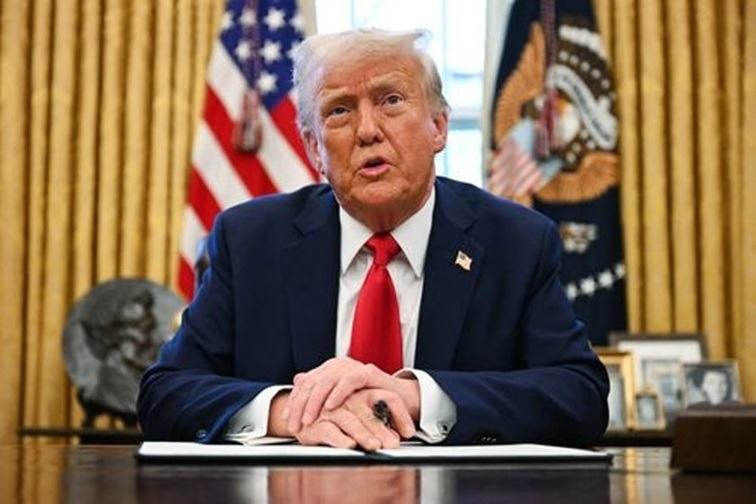
President Donald Trump has ignited fresh debate after appearing to float the idea of running for a third term in office, a move that would directly challenge the U.S. Constitution’s two-term limit for presidents.


In a video circulating online, Trump stood at a podium and declared that he had “won election three times,” claiming the second victory was “rigged” but asserting his intention to run again.
The president, who is currently serving his second non-consecutive term after defeating the Democratic candidate in the 2024 election, told the audience he plans to seek another stint in the White House in 2028. 
“I am pleased to announce my intention to run for a fourth term as president of the United States,” Trump said in the clip, later correcting the framing to emphasize his electoral success. “I won three times and I am going to do it again.
I am good at running president.”Campaigns & Elections Trump was seen wearing a red “Trump 2028” cap during the appearance, a visual that immediately fueled speculation and social media buzz about his future political plans. While the remarks carried a light-hearted tone and appeared to be delivered in jest, they quickly drew attention to the legal barriers standing in the way of any such bid.
The U.S. Constitution’s 22nd Amendment strictly limits any individual to being elected president no more than twice. Ratified in 1951, Section 1 of the amendment states: “No person shall be elected to the office of the President more than twice, and no person who has held the office of President, or acted as President, for more than two years of a term to which some other person was elected President shall be elected to the office of the President more than once.”
Trump served his first term from 2017 to 2021. After losing his re-election bid in 2020, he made a successful comeback in 2024 and was inaugurated for a second term in January 2025. A run in 2028 would represent an unprecedented third term.
Supporters of the president have occasionally floated the idea of repealing or modifying the 22nd Amendment to allow Trump another term, citing his enduring popularity within the Republican base. However, any such change would require a two-thirds majority vote in both chambers of Congress and ratification by three-fourths of the states — a high bar that remains politically unlikely in the current climate.
As of now, the White House has not issued a formal clarification on whether the comments were purely humorous or carried any deeper strategic message. Trump’s history of provocative statements has often blurred the line between jest and serious political signaling, keeping both allies and opponents guessing.
The video has already generated widespread reactions, with critics warning against undermining constitutional norms and supporters praising what they see as Trump’s signature defiance and showmanship. Whether the “Trump 2028” cap becomes a campaign staple or remains a one-off gag may become clearer in the months ahead.