Connect with us

News

IGP orders special units to track terror, oil theft funds

Published

on

ADVERTISEMENT
Zoom Ad
ADVERTISEMENT
Zoom Ad

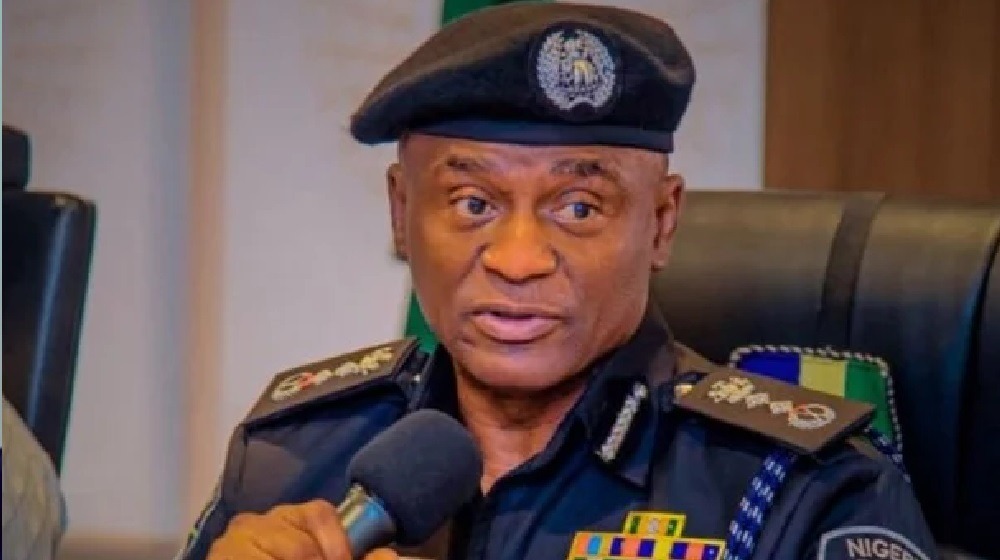
The Inspector-General of Police (IGP), Olatunji Disu, on Tuesday directed police formations nationwide to channel all cases involving terrorism, banditry and crude oil theft to specialised units with the capacity to trace illicit financial flows.


The directive marks a strategic shift aimed at disrupting the financial networks that sustain violent criminals and economic saboteurs.

Disu said following the money trail remains the most effective tool in combating organised crime, noting that tracking financial transactions could help solve at least 50 per cent of complex criminal cases across the country.

The IGP spoke at the Force Headquarters in Abuja during a working visit by the Director and Chief Executive Officer of the Nigerian Financial Intelligence Unit (NFIU), Hafsat Bakari.

Advertisement

He stressed that the evolving nature of global crime demands stronger collaboration and a more robust financial surveillance framework to detect and dismantle criminal networks.

Disu highlighted the fast-paced nature of modern financial crime, noting that laundered proceeds now move across international borders within seconds through sophisticated schemes.

He said; “It has to do with following monies, especially monies that have to do with one crime or the other. The dynamics of crime are changing daily everywhere in the world, and within seconds, monies are moving across the continent, monies that have to be laundered, monies that a lot of people want to clean through different deceits”.

He noted that tracking proceeds from terrorism, banditry, and the theft of crude oil would drastically curtail criminal networks operating within the country, adding that: “Following their proceeds will assist to bring down crime to nothing less than 50 per cent. Following the money, a lot of their crimes will be solved”.

Advertisement

To institutionalize this approach, the IGP announced that the Force has established a dedicated Proceeds of Crime Section, headed by a Deputy Commissioner of Police with vast expertise in financial crime investigations.

The specialized unit is designed to bolster the nation’s Anti-Money Laundering (AML) and Counter-Terrorism Financing (CTF) frameworks, while enhancing the Police Force’s standing within the global anti-money laundering architecture.

Disu assured the NFIU delegation that with a dedicated team now in place, operational coordination between both institutions will be significantly streamlined.

He also called for expanded joint training programs to upscale the technical capabilities of young officers entering the Force.

Advertisement

The police boss said; “Financial intelligence is a necessity. We need to collaborate more and share intelligence because of the security situation in the country today”.

The IGP expressed appreciation to the NFIU boss for acknowledging the sacrifices of police personnel and recognizing the efforts of the Force in supporting national measures to remove Nigeria from the Financial Action Task Force (FATF) grey list.

He noted that words of encouragement and condolences for officers who lost their lives or suffered injuries in the line of duty served as a vital morale booster for a Force that operates on a round-the-clock mandate.

Earlier, the Director and Chief Executive Officer of the NFIU, Hafsat Bakari, commended the Police leadership for its crucial role in helping Nigeria successfully clear its FATF action plan, an achievement that facilitated the country’s exit from the global financial watchdog’s grey list.

Advertisement

She emphasized that as the country’s primary law enforcement body, the Police Force remains a critical first responder and a pivotal actor in tracking, prosecuting, and disrupting the financial dimensions of crime.

Bakari said; “Whether the predicate offense is terrorism, kidnapping, cybercrime, human trafficking, narcotics, corruption, or illegal mining, financial intelligence has increasingly become the thread that connects criminal conduct to those who profit from it. Following the money often reveals the network, the facilitators, the beneficiaries, and the command structures behind criminal enterprises”.

Highlighting the upcoming 2027 third-round mutual evaluation by the FATF, the NFIU boss noted that the assessment will look beyond statutory provisions to evaluate practical effectiveness across law enforcement and intelligence agencies.

She disclosed that a recent joint stocktaking exercise across police commands nationwide highlighted key areas for development, particularly the need to institutionalize financial intelligence, enhance risk-based investigations, and improve asset tracking and confiscation protocols.

Advertisement

Bakari assured the Inspector-General of Police of the NFIU’s continued support through intelligence sharing, capacity building, typology studies, and operational coordination across the 186 Financial Intelligence Units globally under the Egmont Group framework.

She also expressed condolences to the Nigeria Police Force for the loss of gallant officers who lost their lives in the line of duty, praying for the speedy recovery of those injured.

The meeting was attended by the top management team, senior police officers, alongside top management staff and legal advisors from the NFIU.

Advertisement
Continue Reading
Advertisement

News

Ajayi, Adeshina win Commonwealth Games bronze

Published

on

By

ADVERTISEMENT
Zoom Ad
ADVERTISEMENT
Zoom Ad

Nigeria’s Kayinsola Ajayi and Temitope Adeshina claimed bronze medals in the men’s 100m and women’s high jump respectively at the 2026 Commonwealth Games in Glasgow on Tuesday, PUNCH Sports Extra reports.

Both national record holders delivered podium finishes for Team Nigeria, with Ajayi clocking 9.90 seconds in the men’s 100m final, while Adeshina cleared 1.90m to finish third in the women’s high jump.

Ajayi, 21, had entered the final as one of the favourites after winning his semi-final in an impressive 9.94 seconds and was aiming to hand Nigeria its first athletics gold of the Games.

However, African champion Emmanuel Eseme of Cameroon powered to victory in a Games record of 9.83 seconds, while Australia’s Lachlan Kennedy claimed silver in a personal best and Oceanian record of 9.85 seconds.

Advertisement

The bronze medal capped another outstanding performance in what has been a breakthrough season for the World Championships finalist.

The Auburn University sprinter won the NCAA title earlier this year before breaking Olusoji Fasuba’s 20-year-old Nigerian record with a blistering 9.84 seconds. He has since equalled that mark twice, running 9.84 seconds on three occasions this season, while also winning two Diamond League races before arriving in Glasgow.

Ajayi was Nigeria’s only representative in the men’s 100m final after Favour Ashe and Fakorede Adekalu failed to progress from the semi-finals. Ashe finished fifth in his race in 10.07 seconds, while Adekalu placed fourth in 10.06 seconds.

Adeshina also lived up to expectations in the women’s high jump, producing a best clearance of 1.90m to secure the bronze medal in a highly competitive field.

Advertisement

The Nigerian record holder, who enjoyed an outstanding collegiate season in the United States, added a Commonwealth medal to her growing list of achievements after qualifying comfortably for the final.

In the women’s 100m, African U-20 champion Miracle Ezechukwu narrowly missed out on a place in the final after finishing fourth in her semi-final in 11.23 seconds.

Rosemary Chukwuma finished eighth in her semi-final in 11.82 seconds after appearing to sustain an injury midway through the race, while national champion Blessing Ogundiran was unable to start her heat due to illness.

The two bronze medals boosted Nigeria’s athletics medal haul as Team Nigeria continued its quest for more podium finishes in Glasgow.

Advertisement
Continue Reading

News

FG launches single gateway portal for government services

Published

on

By

ADVERTISEMENT
Zoom Ad
ADVERTISEMENT
Zoom Ad

The Federal Government on Tuesday unveiled the Government Service Portal, a digital platform designed to provide Nigerians and businesses with a single gateway to access government services, in a move aimed at improving service delivery, reducing bureaucracy and advancing the country’s digital transformation agenda.

The platform was unveiled at a soft launch in Abuja by Galaxy Backbone in partnership with the Federal Ministry of Communications, Innovation and Digital Economy and the Korea International Cooperation Agency.

Speaking at the event, the Managing Director and Chief Executive Officer of Galaxy Backbone, Prof. Ibrahim Adeyanju, said the portal would address the long-standing challenge of citizens having to navigate multiple websites and government offices to access public services.

He described the platform as “the beginning of a unified digital gateway through which citizens and businesses can easily discover, access and consume services offered by Government institutions from a single location.”

Advertisement

According to him, “Government should be organised around the needs of the people, not around institutional boundaries.”

Adeyanju said while many Ministries, Departments and Agencies had digitised their services individually, the overall experience for users remained fragmented.

“The Government Service Portal seeks to change that. By bringing Government services together under one trusted digital gateway, we are simplifying access, improving visibility, promoting consistency and creating a more seamless experience for everyone who interacts with Government,” he said.

He noted that the initiative aligns with President Bola Tinubu’s Renewed Hope Agenda by improving public service delivery, deepening digital innovation and supporting economic growth through technology.

Advertisement

The Galaxy Backbone boss added that the portal was a key component of Nigeria’s Digital Public Infrastructure initiative, complementing existing national digital identity, payment and data exchange systems to create a more integrated digital government ecosystem.

He explained that the platform was being introduced through a soft launch to enable government agencies to onboard their services, strengthen system integration and gather user feedback before a wider rollout.

“The success of this Portal will not ultimately be measured by the sophistication of its technology. It will be measured by the ease with which a citizen can access a government service, by the confidence businesses have when engaging with public institutions, by the time saved, by the transparency achieved and by the trust that is built between Government and the people it serves,” Adeyanju said.

The Permanent Secretary of the Federal Ministry of Communications, Innovation and Digital Economy, Nadungu Gagare, who was represented by the Director of E-Government, Mr Johnson Bareyei, described the platform as one of the flagship projects under Nigeria’s e-Government Master Plan 2.0.

Advertisement

He said the portal would provide a secure single sign-on system through which citizens could access government services without repeatedly submitting the same information to different agencies.

“Today’s event is not simply about providing a digital platform. It’s about demonstrating what can be achieved when government agencies work together with a shared purpose, making public services easier, faster and more accessible for every Nigerian,” he said.

Gagare added that the platform supports the National Digital Economy Policy and Strategy, the Federal Civil Service Strategy and Implementation Plan and Nigeria’s Digital Public Infrastructure framework.

He said the portal would improve transparency, strengthen accountability, enhance ease of doing business and make government services more responsive to citizens.

Advertisement

The Country Director of KOICA Nigeria, Mr Eunsub Kim, who was represented by the Senior Deputy Country Director of KOICA Nigeria, Ki-Hyun Baik, described the launch as the culmination of years of collaboration between Nigeria and South Korea.

According to him, the portal is the flagship achievement of the “Building a Foundation Towards Digital Governance in Nigeria” project.

“For KOICA, today’s event is more than the launch of a digital platform. It is the culmination of years of partnership,” he said.

Kim added that the platform would enable citizens to access government services “more conveniently through one point of entry,” describing it as the vision of “a true one-stop service.”

Advertisement

He reaffirmed KOICA’s commitment to supporting the project beyond the pilot phase, noting that digital governance requires continuous improvement and collaboration among stakeholders.

Also speaking, the Director of International Cooperation at the Federal Ministry of Budget and Economic Planning, Dr Sampson Ebimaro, described digital transformation as a strategic enabler of national development.

He urged stakeholders to prioritise inter-agency collaboration and continuous evaluation to ensure the project’s success.

“We need to get feedback. We need to assess what we are doing so that when we get to the end, we won’t say we have left so many things behind,” he said.

Advertisement

The Executive Director, Digital Exploration and Technical Services at Galaxy Backbone, Olumbe Akinkugbe, said user acceptance testing for the portal was conducted across the six geopolitical zones and the Federal Capital Territory before the launch.

He disclosed that 184 participants took part in the exercise, with more than 80 per cent rating the platform as user-friendly and easy to navigate.

According to him, 88 per cent of participants were able to locate government services on the platform, while 71 per cent rated it as fast or very fast.

He added that 91 per cent said they would use the portal again, while 99 per cent indicated they would recommend it to others.

Advertisement

Akinkugbe said feedback from the pilot phase had already informed improvements to address sign-up issues, image capture challenges and one-time password delivery delays.

He added that more Ministries, Departments and Agencies would be onboarded in the next phase to expand the range of services available through the platform.

Continue Reading

News

FG lists 7 mistakes to avoid when applying for government jobs

Published

on

By

ADVERTISEMENT
Zoom Ad
ADVERTISEMENT
Zoom Ad

The Federal Government has identified seven common mistakes that could reduce applicants’ chances of securing government jobs, warning Nigerians to avoid recruitment scams and follow official application procedures.

The guidance, issued through the Federal Character Commission (FCC), comes as thousands of Nigerians continue to seek employment in ministries, departments, agencies and other federal institutions.

According to the Commission, while many applicants focus on finding vacancies, simple errors such as applying through unofficial websites, submitting inaccurate information or ignoring application requirements can derail their chances of success.

The FCC advised applicants to verify every recruitment announcement through recognised government platforms before submitting applications.

Advertisement

1. Applying through unofficial sources

The Commission warned job seekers against relying on recruitment information circulated on social media without verification.

It noted that fake websites, unofficial application links and misleading vacancy announcements are often used by fraudsters to steal applicants’ personal information or extort money.

To address this, the FCC said it has created a dedicated recruitment platform on its official website where verified vacancies from federal institutions can be published.

Advertisement

2. Paying for government jobs

The Commission also cautioned Nigerians against individuals claiming they can secure government appointments in exchange for money.

While acknowledging public concerns about unfair recruitment practices, the FCC stressed that federal recruitment follows official procedures and that anyone collecting money or promising guaranteed employment is acting illegally.

It encouraged applicants to report suspected recruitment fraud and said it would publish a detailed guide on recruitment processes, job racketeering and whistleblowing.

Advertisement

3. Ignoring application requirements

The Commission said many applicants fail to carefully read recruitment guidelines before submitting applications.

Government vacancies often include specific eligibility requirements such as educational qualifications, age limits, professional certifications, work experience and supporting documents.

Applicants were advised to ensure they meet all stated conditions before applying.

Advertisement

4. Missing application deadlines

According to the FCC, waiting until the closing days of a recruitment exercise can lead to missed opportunities caused by technical problems or incomplete submissions.

It advised candidates to submit applications early to allow enough time for corrections if necessary.

5. Providing incorrect information

Advertisement

The Commission urged applicants to ensure that every detail provided during the application process is accurate.

Mistakes involving names, qualifications, contact details or supporting documents could create problems during verification and affect eligibility.

6. Failing to prepare for later stages

The FCC noted that submitting an application is only the beginning of the recruitment process.

Advertisement

Applicants may still be required to take aptitude tests, attend interviews or participate in screening exercises, depending on the institution and position.

Candidates were advised to prepare adequately for every stage of the recruitment process.

7. Assuming every vacancy is genuine

The Commission also warned that not every government job advertisement circulating online is legitimate.

Advertisement

It advised applicants to be cautious of opportunities that promise guaranteed employment, demand payment before application, originate from unofficial sources or create unnecessary urgency.

According to the FCC, genuine recruitment exercises are transparent and conducted through recognised government channels.

Continue Reading

Trending

Copyright © 2024 Naija Blitz News