

Connect with us

News

Akpabio hails Tinubu over establishment of University of Technology In Akwa Ibom

Published

on

ADVERTISEMENT
Zoom Ad
ADVERTISEMENT
Zoom Ad


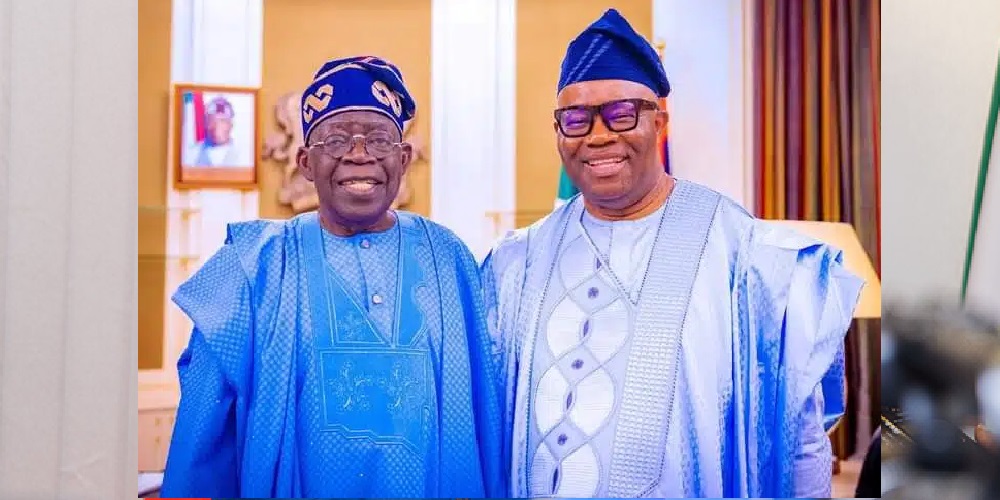
President of the Senate, Godswill Akpabio on Friday, thanked President Bola Ahmed Tinubu, for giving his approval, for the Bill establishing the Federal University of Agriculture and Technology, in Obio Akpa, Oruk Anam Local Government Area of Akwa Ibom State.

He also lauded Governor Umo Eno, for promptly releasing the Obio Akpa campus of the Akwa Ibom State University for the smooth take-off of the institution.

Akpabio gave the commendation at the funeral service in honour of former Majority Leader of the Akwa Ibom State House of Assembly, Late Hon.(Elder) Imo Akpan Ibokette.

Advertisement

A statement by his Special Assistant on Media, Jackson Udom quoted Akpabio as saying, ” I look forward to the admission of the first batch of the students into the Federal University of Agriculture and Technology, in this Senatorial District. Let me thank President Bola Tinubu for signing the bill which establised the University. Let me also thank our dear Governor, Pastor Umo Eno for also releasing a campus of the Akwa Ibom State University for the commencement of academic activities this year.

“Late Ibokette we are laying to rest today, was the first to call and thank me on hearing of the passage of the bill establishing the University. His death is a personal loss to me. The Ibokette’s family and I share an intimate affinity that spans decades. Even the weight of political differences did not attenuate the relationship we shared. So, I personally mourn his demise,”he stated.

The Funeral Service, in honour of the late lawmaker held at the Abak International Nursery/Primary School, in Abak Local Government Area and was conducted by the Apostolic Church Nigeria.

Akpabio described him as a patriot, selfless leader, loving father and a hardworking personality, who braced the odds in life to achieve what he achieved in life before his demise, saying, “he did his best and witnessed the uncommon transformation which he fought and worked for before his departure.”
Advertisement

News

India Moves to Bridge BRICS Divisions Ahead of Summit

Published

on

ADVERTISEMENT
Zoom Ad
ADVERTISEMENT
Zoom Ad

By Gloria Ikibah

India is working to bridge differences among members of the expanded BRICS bloc as negotiations continue on a joint declaration ahead of the group’s leaders’ summit in New Delhi.

Additional Secretary and spokesperson of India’s Ministry of External Affairs, Randhir Jaiswal,  disclosed this at a dinner organised for journalists and content creators in New Delhi ahead of the summit.

Jaiswal said India regarded all BRICS members as partners and was committed to bringing them together despite differences within the grouping.

Advertisement

“India is friends with all BRICS member countries. As friends, it is our intention to bring all our partners together,” Jaiswal said.

Asked whether India had initiated any specific measure to narrow the divisions among members, the Indian official pointed to the ongoing negotiations on the summit’s joint declaration.

“You will have to wait for the joint statement.
The joint statement is being negotiated and there you will see how India brings everybody together,” he said.

Jaiswal said negotiations were being conducted collectively with all BRICS members but declined to disclose the countries involved in specific disagreements.

Advertisement

India is scheduled to host the 18th BRICS Leaders’ Summit on September 12 and 13, 2026, as the bloc adjusts to a more complex diplomatic environment following its expansion to 11 members.

Under its 2026 chairmanship, India has focused on resilience, innovation, cooperation and sustainability, while seeking to advance development priorities and strengthen the voice of the Global South.

The country’s economic agenda for the bloc includes the proposed BRICS Economic Partnership 2030, measures to expand trade in services, strengthen resilient supply chains and improve access to financing for small and medium-sized enterprises.

However, the expansion of BRICS has also brought together countries with divergent geopolitical and economic interests, making consensus on politically sensitive matters more difficult.

Advertisement

One of the most visible areas of disagreement has been between Iran and the United Arab Emirates. During the BRICS foreign ministers’ meeting in New Delhi in May, the UAE rejected Iranian allegations and defended its sovereignty and right to protect its national security.

The development highlighted the difficulty of reaching common positions within a grouping whose members have competing regional interests.

Differences also remain between India and China. Although both countries have taken steps to stabilise relations following the 2020 border clashes, they remain strategic rivals, with disagreements over security, technology and market access continuing to affect bilateral cooperation.

Another major area of tension involves Egypt and Ethiopia over the Grand Ethiopian Renaissance Dam and the use of Nile waters.

Advertisement

The dispute received renewed attention following Chinese President Xi Jinping’s state visit to Egypt from September 1 to 2.

In a joint communiqué issued during the visit, China recognised Egypt’s “legitimate right” to protect its water security, food security and development interests.

The two countries also called on Nile Basin states to comply with international law, including obligations relating to the prevention of harm.

Although the communiqué stopped short of explicitly endorsing Egypt’s position against Ethiopia, the reference to Nile-related concerns in a high-level China-Egypt statement adds another layer to the discussions within BRICS, where China, Egypt and Ethiopia are all members.

Advertisement

Economic differences are also expected to feature in discussions on the future direction of the bloc.

Russia and China have supported greater use of national currencies and alternatives to existing international financial arrangements, while other members have different priorities and approaches to economic cooperation.

With the summit bringing together leaders from 11 countries, India faces the challenge of producing a declaration that reflects the interests of members despite their competing geopolitical, security and economic positions.

The ongoing negotiations on the joint statement are therefore expected to provide an important test of India’s ability to build consensus within the enlarged BRICS grouping.

Advertisement
Continue Reading

News

INEC uploads NDC’s logo, leadership as party wins in court

Published

on

By

ADVERTISEMENT
Zoom Ad
ADVERTISEMENT
Zoom Ad

Independent National Electoral Commission (INEC) has uploaded the new logo of the Nigeria Democratic Congress (NDC) on its official website.

The commission also updated the party’s leadership, placing Cleopas Moses Zuwoghe as the National Chairman of the NDC, while Ikenna Morgan Enekweizu is listed as National Secretary.

This followed an order of the Federal High Court sitting in Abuja, which ordered the electoral body to recognise and use the NDC’s modified digital “two-finger” logo as its official symbol for elections.

The judgment, delivered by Justice J.O. Abdulmalik, followed a suit filed by the NDC after INEC allegedly removed the party’s modified logo from its system and restored an older association logo.

Advertisement

Advertisement

The NDC said its National Executive Committee approved the modified logo at its March 25, 2026, meeting and subsequently forwarded it to INEC.

According to the party, INEC initially uploaded the new logo but later removed it without providing any valid reason and reinstated the old logo.

The party said it gave the commission enough time to resolve the matter administratively before approaching the court.

Advertisement

In the judgment, the court ordered INEC to “forthwith approve” the NDC’s modified logo, including its symbol and colours, for use by the party “for all purposes as a political party,” including all elections conducted by the commission.

The court also granted a perpetual injunction restraining INEC from stopping or interfering with the NDC’s use of the digitally designed two-finger victory sign.

The NDC described the ruling as a victory for the party and thanked the judiciary for its intervention.

The party has consequently directed all its candidates and members to use only the approved logo on campaign materials, including banners, posters and other publicity materials.

Advertisement

It acknowledged that some members and candidates may have already produced campaign materials bearing the old logo, adding that it regretted any inconvenience caused.

The NDC said it would intensify public sensitisation to ensure that its candidates, members and supporters use the approved logo going forward.

“We assure our supporters and candidates that there is nothing to worry about. We are in this together,” the party said.

The upload at the INEC portal included Mr John Odey as National Treasurer, while Mainasara Abubakar Sani is the National Financial Secretary. Similarly, Reuben Egwuaba is listed as the party’s National Legal Adviser.

Advertisement
Continue Reading

News

Why More Sex Lowers Risks of Women Having Breast Cancer – Doctor

Published

on

By

ADVERTISEMENT
Zoom Ad
ADVERTISEMENT
Zoom Ad

A submission by Dr. Abasi suggesting that women who have more sex may have a lower risk of breast cancer has drawn attention, but the claim requires careful interpretation.

Speaking on women’s reproductive health, Dr. Abasi argued that sexual activity, particularly when it results in orgasm, could have beneficial effects on a woman’s health. He linked orgasm to the release of oxytocin and suggested that the hormone could potentially reduce the risk of breast cancer.

He also used the discussion to challenge the tendency of society to blame women for infertility, stressing that infertility can involve both male and female factors.

“It’s unfair that our society blames infertility on women,” he said, maintaining that responsibility for infertility should not automatically be placed on women.

Advertisement

However, the suggestion that more sex directly protects women against breast cancer is not established medical fact. While sexual activity and orgasm cause temporary hormonal and physiological changes, there is no established recommendation from major cancer-health authorities that women should have more sex as a breast-cancer prevention strategy.

Breast-cancer risk is influenced by several factors, including age, family history and inherited genetic mutations, reproductive and hormonal factors, alcohol consumption, body weight and physical activity. Some risk factors cannot be changed, while others can be modified through lifestyle choices.

Dr. Abasi also touched on childbearing and reproductive health, suggesting that women who have never had children may face increased risks of some reproductive cancers.

Medical evidence does show that reproductive history can influence breast-cancer risk, but this should not be interpreted to mean that women must have children—or have sex—to protect themselves from cancer.

Advertisement

For women, established preventive measures include maintaining a healthy weight, engaging in regular physical activity, limiting alcohol consumption, avoiding tobacco, knowing one’s family history and following age- and risk-appropriate breast-cancer screening recommendations.

The discussion therefore highlights an important distinction between a biological hypothesis and proven cancer prevention.

While sex and orgasm may have physical and psychological benefits, there is currently insufficient evidence to tell women that having more sex—or reaching orgasm—is a proven way to prevent breast cancer.

Advertisement
Continue Reading

Trending

Copyright © 2024 Naija Blitz News