Opinion
8 Years of Service: Akpodiete Foundation Transforms Education, Health, Sports and Security Across Delta
- /home/naijuinz/public_html/wp-content/plugins/mvp-social-buttons/mvp-social-buttons.php on line 27
https://naijablitznews.com/wp-content/uploads/2026/08/84611c71-6814-49a4-b447-48c70c84eff0-1000x600.jpeg&description=8 Years of Service: Akpodiete Foundation Transforms Education, Health, Sports and Security Across Delta', 'pinterestShare', 'width=750,height=350'); return false;" title="Pin This Post">
- Share
- Tweet /home/naijuinz/public_html/wp-content/plugins/mvp-social-buttons/mvp-social-buttons.php on line 72
https://naijablitznews.com/wp-content/uploads/2026/08/84611c71-6814-49a4-b447-48c70c84eff0-1000x600.jpeg&description=8 Years of Service: Akpodiete Foundation Transforms Education, Health, Sports and Security Across Delta', 'pinterestShare', 'width=750,height=350'); return false;" title="Pin This Post">
By Amb. Comrade Kpoharor Emmanuel

As the Olotu & Ekuogbe Rowland Akpodiete Foundation prepares to celebrate its 8th year anniversary in August 2026, Executive Director, Dr. Olotu Akpodiete JP, says the organization has remained focused on touching lives through education, security, health, humanitarian aid, and community development across Delta State.
Registered in 2018 to sustain the legacy of the late Chief Dr. Ekuogbe Rowland Akpodiete PhD, the foundation has, over the past eight years, implemented programs that cut across schools, prisons, orphanages, women groups, youths and traditional institutions.
Education and Learning Support

The foundation’s education drive began in 2019 with the distribution of notebooks and learning materials to pupils of Eseorphe Primary School and students of Government College Ughelli. That same year, it presented the Chief Ekuogbe Akpodiete Government Prize to the best student in Government at Government College Ughelli during the APT Awards. Students of Ogbavwe Secondary School in Usiefrun, Ughelli South, also received educational materials, and the school got a water borehole to address scarcity.
In 2020, during COVID-19, safety materials were donated to Government College Ughelli. Later that year, law students of Delta State University, Oleh Campus, received scholarships and grants, an effort that earned Dr. Akpodiete an Award of Excellence from the university provost Prof. Alex Amata.
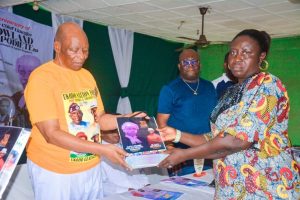
In 2022, the foundation returned to Government College Ughelli to install ceiling fans in the School House Hostel and provide more learning materials. Most recently in 2025, during the 30th remembrance of Chief Ekuogbe Akpodiete, it awarded cash prizes and educational materials to students from over eight schools that took part in a debate competition hosted at Government College Ughelli.
Security, Peacebuilding and Advocacy
Since 2020, the foundation has run a Security and Safety Education Project in government schools. At Government College Ughelli, veteran consultant Mr. Sylvester Obose trained over 50 people including teachers, students and the school security team.
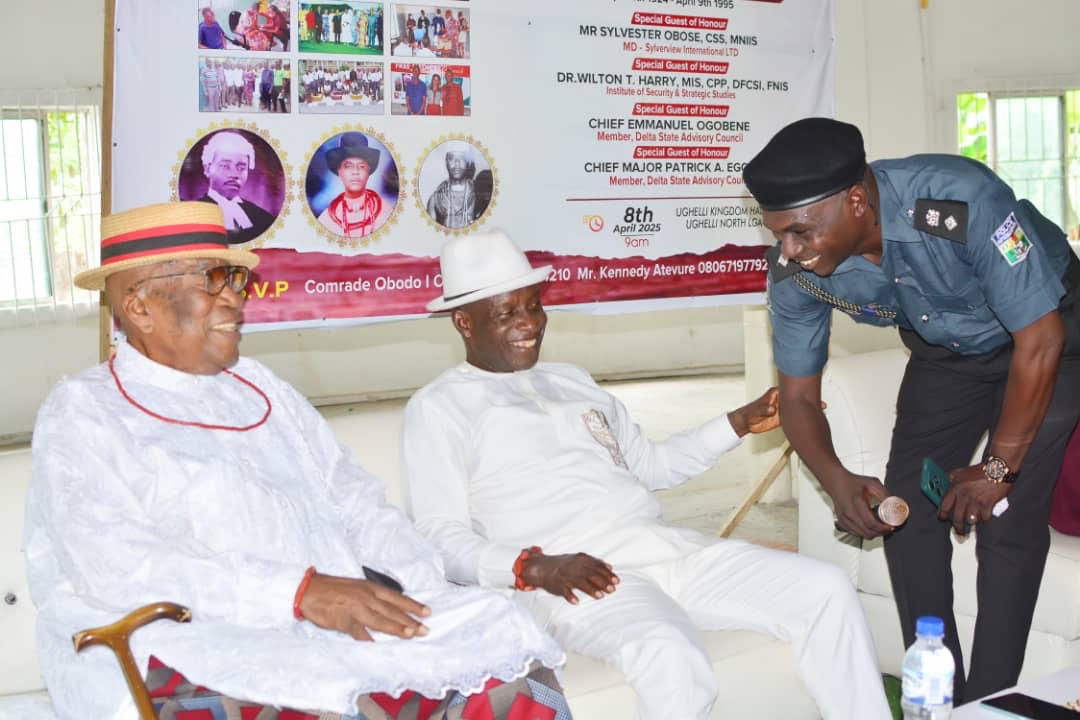
In 2025, two major security programs were held. A Memorial Lecture on Conflict Resolution and Community Security and Safety was organized at Ughelli Kingdom Hall where community leaders from Ughelli North & South including vigilantes were trained, members of the Delta State Advisory Council in attendance as Special Guests of Honour. Security communication gadgets were distributed to communities. Later, during the foundation’s 7th anniversary, another lecture on Conflict Resolution and Neighborhood Watch was held at Unity Hall, Ughelli South LGA Secretariat. Over 100 vigilante leaders and stakeholders attended, and the Divisional Police Officer, CSP Oluwole Oladipupo, commended the initiative. Mobile sound systems and gadgets were also distributed to communities.
In 2025, the foundation also submitted a proposal to the Delta State Government advocating for the creation of a Ministry of Security to strengthen the state’s framework ahead of state policing.
Humanitarian Support for Vulnerable Groups
In 2018, Dr. Akpodiete and the Director, Deacon Ogaga Ohwojero, visited prisons in Sapele and Warri with donations of rice, beans, garri, tissue, bathing and washing soap, plus educational materials. A similar donation was made in Ogwashi-Uku Prison through Barr. Lilian Eserinune. Prison officials including DCP Solomon Airiohuodion and Mr. Okonkwo Frank applauded the gesture.
In 2024, during the 29th remembrance of Chief Ekuogbe Akpodiete, the foundation visited Rose Ilogbo Foundation and Christ Treasured Royal Ministry in Ughelli with foodstuff and cash for orphaned children. Founders Mrs. Rose Ilogbo and Rev. Dr. Abraham Erhuotor expressed gratitude.
Women Empowerment and Social Welfare
The foundation runs yearly support for women and widows in U3. In 2025, during the 30th remembrance, over 50 women from Otor Ihwreko in Ughelli North received business grants and wrappers. Chief Dr. Linda Ikpuri urged them to invest the grants wisely.
In August 2025, more women across Ughelli North, South and Udu received grants and gift items. In 2026, over 100 widows across the three LGAs got cash donations and wrappers.
“Given the harsh economy of the country, we cannot afford to abandon our mothers and widows. This is why we have made it a yearly mandate to support them,” Dr. Akpodiete stated.
Human Capital and Skills Development
In 2018, the foundation held a two-day seminar on the fish farming value chain at Otor Iwhreko Town Hall for over 100 youths and women. In 2019, more than 70 participants were trained on digital skills for wealth creation in Ughelli.
In 2025, it hosted a Youth Empowerment and Leadership Summit in Otor Jeremi and also trained community leaders on conflict resolution to promote grassroots peace.
Water Projects and Sports Development
In April 2019, during the 24th remembrance, a borehole was commissioned in Okparabe, Ughelli South. Another borehole was commissioned that same year at Ogbavweni Grammar School.
The foundation has also invested in youth sports. In 2025, a novelty football match between Otor-Ihwreko Community Team and Rovers Football Team ended 1-1, with cash gifts for players and a call on the LGA to upgrade the pitch. In April 2026, another novelty match was held with cash support for players, and a renewed appeal to government to support sportsmen and women.
Healthcare Access
Since 2018, the foundation has prioritized healthcare through medical outreaches, drug distribution and free consultation in Otor Ihwreko, Okparabe and Otor-Udu. It was the first to enroll over 500 residents into health intervention programs across U3 and has pushed medical insurance coverage for indigents and community leaders.
The impact earned Dr. Akpodiete recognition as Health Insurance Ambassador by Governor Rt. Hon. Sheriff Oborevwori in both 2024 and 2025.
Activities lined up for the 8th anniversary include more school outreach, free medical services and expanded programs across U3.
In 2025, the foundation sent a proposal to Delta State government to rename ministry of riverine infrastructure to Ministry of Marine & Blue Economy in order for policy alignment with the federal government and economic diversification beyond oil.
Dr. Akpodiete reaffirmed the foundation’s commitment to partner with government, traditional rulers and communities to promote peace, learning and welfare in Delta.
Summary
The Olotu & Ekuogbe Rowland Akpodiete Foundation is marking 8 years of service in August 2026. Since 2018, it has impacted communities across Delta through education support, scholarships, school infrastructure and debate prizes; security education, community training and a proposal for a State Ministry of Security and Ministry of Marine & Blue Economy; humanitarian aid to prisons and orphanages; annual grants and welfare for women and widows; skills training in fish farming, digital tools and leadership; borehole projects in Okparabe and Ogbavweni; sports development through novelty matches; and major health outreaches that led to 500+ enrollments and two state recognitions for Dr. Akpodiete. The foundation says it will expand outreach during its August 2026 anniversary.
Opinion
Rep OK Chinda and the Parliamentary Gamble: The Politician Seeking to Rewrite Nigeria’s Political Operating System
There are politicians who campaign for office by promising to repair a leaking roof, and there are those who ask a more fundamental question: What if the problem is the building itself?
Rep Ogundu Kingsley Chinda appears to belong to the second category.
Long before the 2027 political contest began gathering momentum in Rivers State, Chinda had already ventured into a debate that goes beyond the immediate calculations of elections, political appointments and control of government.
In 2024, while serving as Minority Leader of the House of Representatives, Chinda joined other lawmakers in sponsoring a constitutional amendment initiative aimed at moving Nigeria from its presidential system towards a parliamentary model of government.
At the time, the proposal attracted scepticism in some quarters. To critics, it appeared to be another ambitious constitutional initiative that could generate passionate speeches in the National Assembly without producing meaningful political change.
But Chinda’s argument was broader than a simple demand to replace the office of president with that of prime minister.
He was questioning the architecture of Nigeria’s democracy itself.
Beyond Changing Governments
Nigeria has operated a presidential system since the return to civilian rule in 1979, except for the periods of military intervention, while the country’s First Republic operated a parliamentary system from independence in 1960 until the military coup of January 1966.
The presidential model was restored under the 1979 Constitution and retained in the 1999 Constitution, which continues to define the framework of the Fourth Republic.
For decades, however, complaints about the cost and efficiency of governance have remained constant.
Successive administrations have merged ministries and agencies, proposed reductions in the size of government, reviewed public-sector structures and introduced various reform committees.
Yet many of the underlying complaints have persisted.
For Chinda, this represents a deeper problem.
His argument is that Nigeria has repeatedly attempted to repair the symptoms of governmental dysfunction without sufficiently examining the political structure responsible for producing them.
In his description, the country risks becoming trapped in a cycle of “motion without movement”—a system in which debates, committees, resolutions and reforms generate activity without fundamentally changing outcomes.
Learning From the First Republic
Chinda’s advocacy for parliamentary government is not, by his account, based on nostalgia for the First Republic.
Nigeria’s first experiment with parliamentary democracy ultimately collapsed amid intense political disputes, regional rivalries, electoral controversies and institutional tensions before the military takeover of January 1966.
The lessons from that period therefore remain central to the parliamentary debate.
Chinda has said lawmakers behind the proposed constitutional change deliberately examined the experience of the First Republic, including the reasons for its collapse.
He also recalled an engagement in Kano with Alhaji Dantata, whom he described as the only surviving member of the First Republic, as part of efforts to understand the strengths and weaknesses of the system from someone who experienced it directly.
Among the issues identified were inadequate understanding of parliamentary practice, ethnic and religious divisions, political self-interest, abuse of power and institutional conflicts.
The historical irony is difficult to miss.
Nigeria may have changed constitutions, political parties and political leaders repeatedly since independence, but many of the underlying challenges identified in the First Republic continue to feature in contemporary political discourse.
The personalities have changed.
The institutions have evolved.
But the political tensions have often remained remarkably familiar.
A System Designed for Nigeria?
At the heart of Chinda’s argument is the belief that Nigeria should stop treating foreign political systems as ready-made templates.
The British parliamentary model and the American presidential model emerged from different historical, social and institutional circumstances.
Nigeria, he argues, should therefore develop a system that reflects its own realities.
That position raises one of the most fundamental questions in Nigeria’s constitutional debate: Can a political system imported from another environment deliver the same results when transplanted into a society with a different history, political culture and social structure?
Chinda believes the answer is not necessarily.
Government does not operate in a vacuum. Political institutions function within societies shaped by ethnicity, religion, culture, economic interests, historical experiences and patterns of political behaviour.
Consequently, constitutional provisions that appear neutral on paper can produce different outcomes when applied in different environments.
This becomes particularly important when public officials are granted broad discretionary powers.
In a society where political, ethnic, religious and personal interests can influence public decision-making, discretion may not always be exercised in the same manner as originally envisaged by constitutional designers.
For Chinda, Nigeria therefore cannot continue importing constitutional provisions “hook, line and sinker” and simply expect them to produce foreign outcomes.
The Cost of Governance Question
One of the strongest arguments behind Nigeria’s recurring reform debates has been the cost of running government.
The country maintains a federal structure involving the executive, legislature and judiciary at the federal level, alongside 36 states and the Federal Capital Territory, with local government administration across the federation.
Critics have long argued that the structure is expensive and that substantial public resources are consumed by political administration.
Governments have responded periodically with proposals to reduce the number of ministries, merge agencies, streamline bureaucracy and cut official expenditure.
But Chinda’s argument goes beyond reducing the number of government offices.
His question is whether the political system itself encourages an expensive and highly centralised structure.
Changing ministries or reducing official allowances, in his view, may amount to rearranging furniture while leaving the underlying architecture untouched.
Not Simply Presidential Versus Parliamentary
The parliamentary debate is often reduced to a straightforward question: Should Nigeria have a president or a prime minister?
But the issue is considerably more complicated.
Under a parliamentary system, the executive emerges from the legislature and remains politically accountable to it.
The head of government is generally a prime minister, while the head of state may occupy a separate position depending on the constitutional arrangement.
In Nigeria’s current presidential system, the executive is separately elected, with the president serving as both head of state and head of government.
The two systems therefore create different relationships between the executive and legislature, different mechanisms of accountability and different incentives for political parties and lawmakers.
Chinda’s proposal is particularly significant because he has advocated a homegrown parliamentary model, rather than simply restoring the First Republic’s structure wholesale.
He has also argued for a gradual approach, beginning at the grassroots and expanding upwards to the national level.
That gradualism could prove crucial.
A change in constitutional structure alone cannot guarantee better governance. A parliamentary system can fail where institutions are weak, political parties lack internal democracy and political actors prioritise personal interests over public institutions.
The same is true of a presidential system.
The central issue, therefore, may not be the name of the system but whether the institutions within it are strong enough to enforce accountability.
From Constitutional Advocate to Governorship Candidate
Chinda’s political argument takes on a new dimension as he moves deeper into the contest for political power in Rivers State ahead of the 2027 governorship election.
That transition will inevitably test the practical implications of his philosophy.
As a legislator, it is possible to argue for structural reform from the floor of the National Assembly. As a governorship candidate, however, the questions become much more immediate.
How would the system improve education?
What would it mean for healthcare?
How would it affect employment and investment?
Could it improve security?
Would it reduce the cost of administration?
And, most importantly, would ordinary citizens feel the difference?
These are the questions that constitutional theory eventually has to answer.
Chinda’s advocacy does not automatically establish that a parliamentary system would solve Nigeria’s problems. Nor does his legislative experience guarantee that such a system would succeed.
But it does distinguish him from politicians whose political programmes begin and end with the pursuit of office.
His intervention invites voters to consider not only who should govern, but how Nigeria should be governed.
The Bigger Gamble
Nigeria’s political history is filled with constitutional experiments.
The country moved from the parliamentary system of the First Republic to military rule, then to a presidential arrangement under the Second Republic, another period of military government and eventually the Fourth Republic’s current presidential system.
Each transition was accompanied by expectations that a new political structure would help resolve old problems.
Yet no constitution can, by itself, eliminate political selfishness, ethnic suspicion, institutional weakness or corruption.
That is perhaps the greatest challenge facing Chinda’s proposal.
If Nigeria changes its political system without changing the political culture operating inside it, the country could simply reproduce old problems under a new constitutional arrangement.
That is why the parliamentary debate should not be treated merely as a contest between presidential and parliamentary loyalists.
It should be a national conversation about representation, accountability, political parties.
Opinion
NCC And Its Erroneous Implementation Of Public Service Rules
By Steve Opeyemi
The Nigerian Communications Commission (NCC), has in recent past sent Directors that have spent 8 years in service packing because a government circular had made it a requirement since Yar’adua came to power.
Many organisations have implemented the circular and some have navigated to find a way out by using different nomenclature such as General Managers or even Coordinating Director titles to escape the implementation.
The NCC was on the other hand quick to implement the directive sending young and able directors into early retirement.
However, last week there was a video clip going round on a speech given by one of NCC’s directors who retired recently, at his send-off party, wherein he, the director, claimed that in total he has spent 39 years in service. He managed to spend a whopping 39 years in civil service for two main reasons; first, he did not spend 8 years in the position of Director at the NCC, which was the focus of the NCC, and, second, the NCC ignores years of his service elsewhere in its computation of the mandatory 35 years of service as enshrined in conditions of service.
The NCC in-short took into account, albeit erroneously, only the time he spent working within the NCC to compute the 35 years of service. This has made it possible for those who started working after ONDs or NCEs, or even Secondary schools, to be skipped when counting their years of service.Ignoring the fact that most of them started teaching jobs, or clerical office jobs, on attaining such qualifications in before or in the year 1991.
The NCC seemed to only calculate years of service from the time of youth service (NYSC) or from time of University graduation, or the times of joining the NCC, rather than the time the individuals started working after completion of either a secondary school, or the OND, or the NCE prior to 1991.
The problem seemed endemic in the system. It has been a common knowledge that in the past anyone who completed an OND or NCE must work for 2 years before starting an HND or a B.Tech course.
Any one therefore, who must have completed these qualifications in the 1980s and still working in civil service could be acting in breach. The NCC must therefore get its house in order, otherwise documents signed by those who breached the 35 year rule, and continue working illegally might be challenged. The NCC might find itself to blame for those breaches. The civil service however has a way of recovering payments collected during illegal occupation of office after retirement age of 60 or 35 years of service. In fact, even positions attained during illegal occupation of office must have to be reviewed since the foundation has been faulty. As the saying goes, you cannot build something on nothing and expect it to stand.
The new Head of Service Abel Olumuyiwa or his staff in the head of service need to comprehensively address these issues service-wide to avoid many litigations against the government or government actions.
– Opeyemi writes from Abuja
Opinion
The Sundiata Post Model (7): A Philosophical Triad and the Language of 21st-Century Journalism
By Max Amuchie | The Sunday Stew
Language does more than describe reality. It shapes how we perceive it.
Every enduring discipline eventually develops its own vocabulary. Law has its language. Medicine has its language. Economics, engineering, diplomacy and computer science all possess conceptual vocabularies that enable practitioners to describe phenomena with greater precision than ordinary language permits.
Journalism is no exception.
Yet the vocabulary of journalism has largely remained rooted in the 20th century. We continue to speak of newsrooms, reporters, editors, publishers, news cycles and audiences—concepts that remain important but no longer fully capture the realities of a profession transformed by digital technology, artificial intelligence, data science and knowledge production.
If journalism itself is changing, then its language must also evolve.
Throughout this series, I have argued that the 21st century newsroom should no longer be understood merely as a producer of news but as a knowledge-producing institution. That institutional transformation inevitably requires a corresponding conceptual transformation. New realities require new language.
A Note on the Definition of the Sundiata Post Model
In Part 1 of this series, I defined the Sundiata Post Model as an institutional framework for media-based knowledge production. The development of the Model across the subsequent parts has, however, clarified its institutional character and conceptual architecture. I therefore refine that original definition here and assert the following as the canonical definition:
The Sundiata Post Model is an institutional model for media-based knowledge production in which an independent newsroom systematically integrates journalism, original research, conceptual innovation, and scholarly dissemination to produce original analytical constructs that contribute to public understanding, academic inquiry, and policy discourse within the global knowledge ecosystem. Its conceptual framework sets out the principles, structures, processes and mechanisms through which such a newsroom can become a knowledge-producing institution and sustain that capacity over time.
The Sundiata Post Model (SPM) therefore proposes not simply an institutional model but also a vocabulary through which its conceptual framework can be understood and communicated.
This vocabulary should not be viewed as rigid terminology imposed upon the profession. Language evolves through use rather than decree. Some concepts will prove useful. Others may be revised or replaced. Ultimately, the value of any terminology lies not in its novelty but in its capacity to illuminate reality more clearly.
What follows is therefore an emerging lexicon for 21st century journalism. It gives language to the ideas developed throughout this series.
Knowledge-Producing Institution
Perhaps the central concept within the SPM is the Knowledge-Producing Institution.
Traditional media organisations produce journalism. A knowledge-producing institution produces journalism while simultaneously generating research, analytical frameworks, datasets, policy knowledge and institutional memory. It informs today’s public while contributing to tomorrow’s understanding.
This distinction represents the philosophical foundation upon which the entire model rests.
Dual Engine Architecture
The Dual Engine Architecture describes the internal structure through which journalism and knowledge production become mutually reinforcing.
The Media Operations Engine generates journalism, public engagement and commercial activity.
The Knowledge Operations Engine converts that journalistic activity into research, intellectual frameworks, datasets, publications and institutional knowledge.
Together they create a continuous cycle in which journalism enriches research and research strengthens journalism.
Media Operations Engine
The Media Operations Engine is the institution’s public-facing operational system.
It encompasses reporting, editing, verification, multimedia production, audience engagement, commercial publishing, conferences, public events and other activities through which the institution serves society while generating the resources necessary to sustain its mission.
Knowledge Operations Engine
The Knowledge Operations Engine is the institution’s intellectual infrastructure.
It conducts research, develops theories, constructs analytical frameworks, curates datasets, preserves institutional memory and maintains standards for methodology, research quality and knowledge governance. It transforms information into enduring knowledge.
Institutional Intelligence Cycle
The Institutional Intelligence Cycle describes the continuous movement of knowledge between journalism and research.
Reporting generates observations.
Observations generate questions.
Research transforms those questions into structured knowledge.
That knowledge subsequently enriches journalism, producing deeper reporting and more informed public discourse.
The cycle then begins again.
Knowledge therefore accumulates rather than disappears.
Institutional Memory
Institutions do not become enduring simply because they survive. They become enduring because they remember.
Institutional Memory refers to the organised preservation of knowledge generated through journalism, research, governance and public engagement. It ensures that experience accumulates across generations rather than disappearing with personnel changes, the passing of news cycles or successive algorithmic transformations.
Knowledge Stewardship
Creating knowledge is only the beginning.
Knowledge Stewardship concerns the responsibility to preserve, organise, govern and transmit that knowledge responsibly across generations.
It treats intellectual assets not as temporary outputs but as permanent institutional resources.
Knowledge Governance
If knowledge is to become an institutional asset, it must also be governed.
Knowledge Governance refers to the principles, systems and standards through which institutions ensure methodological integrity, research quality, documentation, accessibility, preservation and responsible use of knowledge.
It provides order to institutional intelligence.
Realm of the Long Term
Every institution eventually reaches the point where immediate performance gives way to long-term stewardship.
The Realm of the Long Term describes that stage in institutional development.
Here, management shifts its attention from short-term success to enduring relevance.
Leadership becomes stewardship.
Growth becomes continuity.
Performance becomes permanence of purpose.
The Seven Pillars
The Seven Pillars constitute the institutional foundations upon which the Realm of the Long Term rests:
- Financial Sustainability
- Human Capital and Leadership
- Knowledge Stewardship
- Governance
- Innovation and Adaptation
- Trust and Reputation
- Mission Continuity
Together they provide a practical philosophy for institutional endurance.
The Logic of the Long Term
The Logic of the Long Term is the principle that enduring institutions are sustained not by isolated organisational strengths but by the interaction of mutually reinforcing capabilities. Within the SPM, it explains why the Seven Pillars operate as an integrated institutional system rather than as independent functions.
Institutional Success
Within the SPM, institutional success extends beyond commercial performance. It encompasses four progressively deeper levels.
Operational Success measures present performance.
Institutional Success measures organisational endurance.
Civilisational Success measures the institution’s enduring contribution to society’s accumulated stock of knowledge.
Legacy measures Generational Influence—the extent to which an institution’s ideas, values, methods and contributions continue shaping future generations.
Success is therefore measured not only by what institutions produce, but ultimately by what continues because the institution existed.
The Triple Institutional Architecture
The SPM is not only an institutional model. Its development has also generated an emerging institutional architecture through which its principles can be expressed in practice.
That architecture consists of three complementary institutions: Sundiata Post Media Ltd., the Sundiata Post Intelligence Unit (SPIU), and the Sundiata Post Foundation.
Sundiata Post Media Ltd. constitutes the media and public-information institution. Its primary function is journalism: reporting, investigation, verification, public engagement and the dissemination of knowledge to society. The Sundiata Post Intelligence Unit (SPIU) constitutes the research and knowledge institution. Its function extends beyond journalism into original research, conceptual innovation, analytical constructs, datasets, policy research and scholarly dissemination. The development of The Insecurity Triad, the Trinity of Sovereignty Decay (TSD) and the Decoupling Sovereignty Index (DSI) demonstrates the potential for this research function to generate original intellectual contributions rather than merely reproduce existing knowledge.
The Sundiata Post Foundation constitutes the social-impact and civic-engagement institution within the wider ecosystem.
Together, these institutions form a Triple Institutional Architecture:
Media—Knowledge—Social Impact
The three institutions are distinct in function but complementary in purpose. Their differentiated institutional roles create distinct but mutually reinforcing pathways for sustaining public value.
This architecture also extends the Dual Engine Architecture of the SPM beyond the internal structure of a newsroom. The Media Operations Engine and Knowledge Operations Engine remain the core internal mechanisms of the knowledge-producing institution, while the Triple Institutional Architecture shows how those functions can connect to a wider institutional ecosystem in which journalism, research and social impact reinforce one another.
The four original constructs developed through the Sundiata Post intellectual project provide an initial proof of concept for the knowledge-producing capacity underlying this architecture.
The Triad demonstrates the capacity to develop an original analytical lens. The TSD demonstrates theoretical innovation. The DSI represents an attempt to translate theory into an empirical measurement system. The SPM itself provides the institutional model through which such knowledge can be generated, preserved and disseminated.
The significance, therefore, lies not in the existence of four ideas or three institutions independently, but in their interaction.
The constructs demonstrate intellectual production.
The institutions provide organisational embodiment.
The architecture connects knowledge production to public value.
Beyond Journalism: Strategic Management and Organisational Theory
The SPM sits at the intersection of journalism and media studies, organisational theory, and strategic management.
From journalism and media studies, it draws on the tradition of public service—a profession dedicated to informing society, strengthening democracy, and contributing to public understanding.
From organisational theory, it draws on the study of how institutions are designed, governed, sustained and renewed over time, emphasising organisational structure, institutional memory, culture, stewardship and long-term continuity.
From strategic management, it draws on the principles of institutional endurance—financial sustainability, governance, human capital development, innovation, knowledge stewardship and mission continuity.
These are not separate concerns. The SPM argues that journalism cannot fulfil its public purpose without institutional strength, and that institutional strength cannot be built without understanding journalism’s unique mission.
This interdisciplinary foundation is reflected throughout the Model—in its Dual Engine Architecture, its Seven Pillars, its measures of institutional success, and its proposed vocabulary. Each element integrates the concerns of both fields, offering a framework that is both mission-driven and institutionally grounded.
A Living Vocabulary
No vocabulary is ever complete.
The language proposed in this series should therefore be understood as a living intellectual framework rather than a finished dictionary. As journalism evolves, new concepts will emerge. Existing concepts will be refined. Some terms may disappear altogether while others become widely adopted. That is how intellectual traditions develop.
History reminds us that new ways of understanding the world often begin when someone gives language to a previously unnamed reality. Once that language gained acceptance, the underlying ideas became easier to understand, debate and improve.
The SPM aspires to make a similar contribution. Its value will not be determined by whether every term survives unchanged, but by whether this vocabulary helps journalists, scholars, media executives and researchers think more clearly about what the newsroom of the 21st century can become.
If that conversation continues beyond these pages—if these concepts are questioned, tested, adapted and applied—then the language will have served its purpose.
Because institutions are built with systems.
Ideas are built with language.
The future of journalism will require both.
Across these seven parts, I have defined the problem, formulated a new institutional model, proposed its architecture, articulated its guiding principles, developed measures of success, and finally given it its own vocabulary. Together, these elements give the SPM its internal coherence and completeness.
A Philosophical Triad of Enduring Influences
With humility, drawing on decades of experience at the forefront of the African media industry, a fellowship at the highest level of the Chartered Institute of Human Resource Management (CIHRM), foundational membership in the Institute of Strategic Management Nigeria, and from my desk at Sundiata Post in Abuja, I release these ideas—the Sundiata Post Model—into the world. Their future is no longer mine to determine. If they endure, it will not be because I insisted upon their importance, but because others found them worth questioning, testing, adapting and building upon.
For many years, my life journey and the arc of my interdisciplinary thinking have been shaped by a philosophical triad of enduring influences. The first is Sigmund Freud’s insight that “immortality means being known by many anonymous people”—which, to me, revealed the possibility that ideas can outlive their creators and that the truest measure of intellectual work lies not in personal recognition but in the enduring life of ideas.
The second is Edward Said’s vision of the intellectual as one who engages society’s most pressing questions with independence, integrity, and moral courage.
The third is Antonio Gramsci’s conception of the organic intellectual, which helped me see journalism as far more than the reporting of events. It reframed journalism for me as an intellectual vocation—one that interprets reality, organises knowledge, frames public understanding, and contributes to society’s accumulated stock of learning.
Together, these three influences have shaped my conception of journalism not merely as a profession, but as an intellectual vocation and a means of creating knowledge that can outlive its creator.
If, through the development of four original constructs—The Insecurity Triad, the Trinity of Sovereignty Decay, the Decoupling Sovereignty Index, and now the Sundiata Post Model—I have made a meaningful contribution in that tradition, I am content to leave the judgment to history and to those who engage with these ideas in the years ahead.
This series is concluded.
Trust is sacred. Stay seasoned.
•Dr Max Nwabueze Amuchie is an African scholar-practitioner and framework builder whose original intellectual work spans insecurity, sovereignty, institutional development, and journalism as knowledge production. His frameworks include the Insecurity Triad, the Trinity of Sovereignty Decay, the Decoupling Sovereignty Index, and the Sundiata Post Model. He is the CEO & Theorist-In-Chief of Sundiata Post, Lead Researcher at the Sundiata Post Intelligence Unit (SPIU), and an Expert Member and Peer Reviewer in Behavioural and Social Sciences at ScienceOpen.
-
News23 hours agoOchacho Real Estate celebrates King Mohammed Adah on birthday
-
Metro10 hours agoBandits Kill Tinubu’s Minister’s Brother
-
News10 hours agoTinubu Mourns Eagle Online Publisher, Dotun Oladipo, Who Died At 56
-
News9 hours agoINEC to display 2027 governorship, Assembly candidates’ list Saturday
-
News2 hours agoSad: Bandits reportedly kill elder brother of serving minister
-
Metro9 hours agoSuspected drug dealer arrested with 64 bottles of “Suck and D!e” in Bauchi
-
News24 hours agoChina’s Poverty Fight Lifted More Than 800m People – Ambassador Yu
-
Health9 hours ago7 Simple Ways To Prevent Typhoid Fever In Your Home