Connect with us

News

Tinubu Files Case In US Court To Stop Release Of Alleged Drug Trafficking Record — Lawyer

Published

on

ADVERTISEMENT
Zoom Ad
ADVERTISEMENT
Zoom Ad

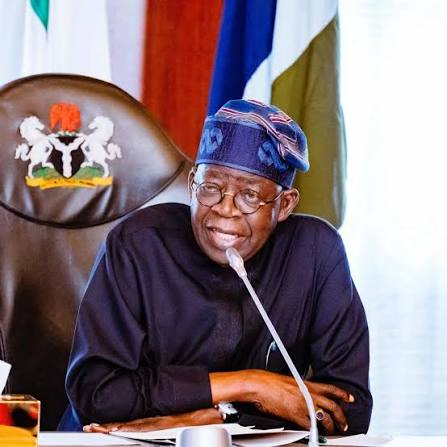
President Bola Tinubu has filed a challenge in a US court to prevent the U.S. Department of Justice, FBI and DEA from releasing records linked to allegations of drug trafficking.


The records are being sought by American transparency activist Aaron Greenspan, who filed a Freedom of Information Act (FOIA) lawsuit against several US government agencies seeking documents relating to investigations involving Tinubu.
Greenspan’s requests include the FBI’s entire file on Tinubu and FBI Form 302 interview records concerning the period between 1992 and 1993.
The case also involves an alleged record connected to a 1993 civil forfeiture proceeding in the United States involving about $460,000 linked to Tinubu.
Tinubu has denied wrongdoing.

According to the 16-page court documents shared with Channels Television by his lawyer and legal team, Christopher W. Carmichael, Victor P. Henderson, and Oluwole O. Afolabi, on Saturday, Tinubu argued that the release of the records could infringe on his privacy.

“Submitted in that proceeding, did not reveal the details of a possible criminal investigation (or its results) involving Intervenor. Other than by speculation or labels, Plaintiff does not point to an existing public record that contains details of a governmental criminal investigation or findings about Intervenor. (DE 85-3, No. 16.)

Advertisement

“The purpose of Plaintiff’s motion is to obtain such information because it is not public. Moreover, Plaintiff’s argument that the limited disclosures in connection with the forfeiture negates all privacy interests is not consistent with precedent. The Supreme Court explained that an individual retains a privacy interest in an entire file or document being produced, even where there are “scattered” disclosures of information from that same file. See Reporters Committee, 489 U.S. at 764-67 (“our cases have recognized the privacy interests inherent in the non-disclosure of certain information even where the information may have been public at one time.”).
“While some information may appear in portions of public records, an individual still retains a privacy interest in the details that remain undisclosed.

Applying Reporter’s Committee, this Court explained that an individual retains a privacy interest even if they were previously publicly associated with criminal activity. Judicial Watch, Inc. v. United States Dept. of Justice, 898 F.Supp.2d 93, 104-05 (D.D.C. 2012).

“Other decisions have likewise described the fact someone was under investigation as “distinct” from the contents of the investigative files. See Electronic Privacy Info. Center v. United States Dept. of Justice, 18 F.4d 712, 719 (D.C. Cir. 2021) (“Although the names of – 6 – Case 1:23-cv-01816-BAH Document 98 Filed 08/28/26 Page 7 of 16 Trump campaign officials appear in public portions of the Report, they retain a privacy interest in ‘avoiding disclosure of the details of the investigation.’”)
“Regardless of the prior disclosure in the forfeiture proceeding, Intervenor retains a privacy interest in potential disclosure of the investigative files sought by Plaintiff”, the document read in part.

“Plaintiff’s motion critiques the FBI’s search efforts, the DEA’s Vaughn Index, segregability, document specific withholdings, and the applicability of exemptions to deceased individuals and confidential sources. All of Plaintiff’s other critiques should be viewed in the context of Plaintiff’s overarching goal.

Advertisement

“Plaintiff’s filings, overwhelmingly, demonstrate that his singular focus is obtaining documents with Intervenor’s “name on them.” (See supra pgs. 1-3, 10, and 11.) Any other issues should – 14 – Case 1:23-cv-01816-BAH Document 98 Filed 08/28/26 Page 15 of 16 not allow Plaintiff to access documents that should otherwise be withheld or redacted under Exemption 7(C) or the Privacy Act.
“If this Court finds that Plaintiff cannot use FOIA to mine information in government files about a private individual, he should not be able to access documents with Intervenor’s “name on them.”
“Conclusion For all the foregoing reasons, Intervenor requests that the Court deny Plaintiff’s motion for summary judgment and allow the redactions or withholdings made by the FBI and DEA to stand”, Tinubu’s legal team further argued.
Continue Reading
Advertisement

News

Confusion in Niger as gunfire, explosions rock presidential palace, airport

Published

on

ADVERTISEMENT
Zoom Ad
ADVERTISEMENT
Zoom Ad

Panic as gunshots and explosions were heard in parts of Niamey, Niger’s capital, early Saturday, with reports of heavy shooting around a military base near the city’s international airport.

The source of the attack remained unclear as of Saturday morning, while Nigerien authorities had yet to issue an official statement on the incident.

A resident told AFP that heavy gunfire and explosions were heard around Air Force Base 101, located within the airport complex.

Several other witnesses reportedly confirmed hearing the sounds, with the first shots beginning at about 1am local time (0000 GMT) and continuing until daybreak.

Advertisement

Video footage shared by a local journalist showed activity around the airport area during the early morning hours.

Another resident in western Niamey said sporadic small-arms fire was heard at about 5am.

Reports on social media also pointed to gunfire and explosions in other parts of the capital, including the administrative district where the presidential palace and national television station are located.

Videos circulating online showed armoured vehicles being deployed around neighbourhoods close to the airport.

Advertisement

The incident comes after Niamey’s airport was targeted twice by jihadist groups earlier this year.

The Islamic State in the Sahel (EIS) claimed responsibility for an attack in January, while the Group for the Support of Islam and Muslims (JNIM), the Sahel branch of al-Qaeda, carried out another assault in June.

The two groups are rivals and have been competing for influence across the Sahel, particularly in Niger, while also carrying out attacks against civilians and government forces.

During the January attack, Nigerien authorities said 20 attackers were killed and four soldiers wounded.

Advertisement

In June, the country’s defence ministry said at least 11 soldiers and two civilians were killed, alongside 22 attackers, during another assault on the airport.

The military said both attacks were repelled.

Strategic military base
Air Force Base 101 is considered a highly sensitive military facility because it sits within the international airport complex.

The base also houses the headquarters of Russian Africa Corps personnel in Niger, as well as the command of the joint force established by the Alliance of Sahel States, comprising Niger, Burkina Faso and Mali.

Advertisement

Niger has been ruled by a military junta led by General Abdourahamane Tiani since the July 2023 coup that ousted President Mohamed Bazoum.

The junta has struggled to contain jihadist violence that has plagued the country for years.

Following the January airport attack, Tiani acknowledged security weaknesses that had allowed the assault to take place, saying the attackers had sought to destroy the army’s air capabilities.

Jihadist violence persists despite shift to Russia
Niger, Burkina Faso and Mali have all experienced military coups and subsequently moved away from their traditional Western security partners, particularly France.

Advertisement

The three countries also withdrew from the Economic Community of West African States (ECOWAS) and formed closer security and political ties with Russia.

However, the shift has yet to end the jihadist insurgency, with Islamic State and al-Qaeda-linked groups continuing to operate across the region.

The latest gunfire in Niamey has raised fresh concerns over security in the capital, particularly around strategic military and government installations.

Authorities had not publicly confirmed who was responsible for Saturday’s shooting or whether there were casualties as of the latest reports.

Advertisement
Continue Reading

News

Police rescue two abducted Colombian women in Lagos

Published

on

ADVERTISEMENT
Zoom Ad
ADVERTISEMENT
Zoom Ad

Lagos State Police Command rescued two abducted Colombian women in Lagos.

The Force Public Relations Officer, CSP Ani Iniedu, disclosed this in a statement released on Saturday.

According to the statement, the two women were “fraudulently lured to Nigeria, held against their will, and had their travel documents confiscated” by some Chinese nationals, who are currently at large.

The statement said the police launched a covert tracking operation immediately after receiving the intelligence.

Advertisement

It added that the operatives located the hideout in Lagos and rescued the victims “on the same day.”

The statement read in part, “Upon receipt of the intelligence, police operatives promptly launched a covert tracking operation, locating the hideout in Lagos where both victims were safely rescued on the same day.”

According to the police, the suspects fled the location when they noticed the approaching operatives.

“The fleeing suspects abandoned the location upon sighting the approaching team, and efforts have been intensified to track down and arrest all members of the syndicate,” the statement said.

Advertisement

The police said the rescued Colombian nationals were currently in safe custody and receiving necessary support.

“The rescued victims are currently in safe custody and receiving necessary support,” the statement added.

The statement further disclosed that the Colombian Embassy in Accra was collaborating with the National Central Bureau to facilitate the victims’ return to their country.

“The Colombian Embassy in Accra is working in close collaboration with the Bureau to secure hotel accommodations for the victims and arrange emergency travel documents to ensure their safe return to Bogotá,” it said.

Advertisement

The Inspector-General of Police, Olatunji Disu, reaffirmed the commitment of the police to protecting residents and strengthening international cooperation against transnational crimes.

The statement said Disu “reaffirms the unwavering commitment of the Nigeria Police Force to safeguarding the lives and property of all residents within the country, while deepening collaboration with international law enforcement partners to combat cross-border crimes.”

The police said efforts had been intensified to arrest the fleeing suspects and dismantle the trafficking network.

Advertisement
Continue Reading

News

Bandits dislocate over 100 communities, residents forced into ‘peace deals’

Published

on

ADVERTISEMENT
Zoom Ad
ADVERTISEMENT
Zoom Ad

More than 100 communities in Southern Kaduna have reportedly been deserted by residents following repeated attacks by armed groups, with some affected settlements allegedly resorting to negotiations with the assailants to survive.

The affected communities are spread across parts of Kachia, Kajuru, Kagarko, Chikun and Birnin Gwari local government areas of Kaduna State, according to findings by Saturday PUNCH.

The National President of the Southern Kaduna Peoples’ Union, Tabara Kato, said over 100 communities had been displaced, while the former spokesman of the group, Luka Binniyat, claimed that the figure was as high as 245.

Kato also said about 35,402 people had been displaced across the state, adding that many of the affected residents were now living in Internally Displaced Persons camps under difficult conditions.

Advertisement

The latest major attack cited by the community leaders occurred on July 26 in Naridon, Kamaru Ward, Kauru Local Government Area, where at least 30 residents, including eight children, were reportedly killed during an attack that lasted about three hours.

Kato attributed the persistent attacks largely to alleged land grabbing and the quest for control of natural resources, claiming that some communities had been taken over after their residents were forced to flee.

He said, “So far, more than 100 communities have been displaced. Some of the victims are now living in IDP camps. They are living from hand to mouth and at the mercy of the weather, and human and natural hazards.”

Kato called on the Federal Government and security agencies to investigate the alleged financiers of the attacks, arguing that arresting perpetrators without identifying their sponsors would not bring lasting peace.

Advertisement

Binniyat, who is also the spokesman of the Middle Belt Forum, gave a higher estimate, alleging that about 245 communities had been sacked across Southern Kaduna as of June 2026.

He said the prolonged displacement had created what he described as “a dangerous security vacuum,” which he alleged was being exploited by kidnappers and armed groups.

According to Binniyat, communities in Kachia, Kajuru, Kagarko and Chikun, as well as some Gbagyi settlements in Birnin Gwari, were among those most affected.

He urged the Federal Government to undertake a coordinated security operation to reclaim occupied communities, dismantle armed camps and create conditions for displaced residents to return safely.

Advertisement

Meanwhile, residents told Saturday PUNCH that insecurity had forced some communities in Kachia to enter into informal agreements with armed groups in an attempt to reduce attacks.

The residents alleged that the arrangements had, in some cases, evolved into systems of control, with demands reportedly including money, restrictions on movement, compulsory farm work and other forms of coercion.

A resident of Mai-Ido Kufai, Jessy Francis, said some community leaders entered into negotiations with the armed groups because they hoped it would enable residents to return home and live without fear.

“We believed that if we reached an understanding with them, we would be able to return to our homes and continue our lives peacefully,” Francis said.

Advertisement

He, however, alleged that the arrangement failed to provide lasting peace, claiming that residents in some areas continued to face violence and other forms of intimidation.

Another displaced resident, Danjuma Sunday, said he fled Mai-Goro in 2021 after surviving repeated attacks. He said he now lives in Kachia with his family but occasionally returns to his farm despite the security risks.

Sunday alleged that security personnel sometimes visited affected communities, but the armed groups reportedly returned after the troops withdrew.

However, the Village Head of Ariko, Jashua Doka, said his community had rejected pressure to negotiate with the armed groups.

Advertisement

“People kept telling us to negotiate with them, but I refused. If I negotiate with criminals and God calls me tomorrow, what explanation will I give? I fear God,” Doka said.

The state Commissioner for Internal Security and Home Affairs, Dr Suleiman Shuaibu, said he was unaware of the alleged arrangements when contacted.

“I am just hearing this from you. Can you allow me some time to verify the claims and get back to you?” he said.

Efforts to obtain the reaction of the Kaduna State Police Command were unsuccessful, as its spokesman, Mansir Hassan, did not respond to calls or a text message sent to him before the report was filed.

Advertisement

Binniyat urged the Federal and Kaduna State governments to prioritise the reconstruction of affected communities and the rehabilitation of displaced residents, warning that continued occupation of the areas could further worsen insecurity in the region.

Continue Reading

Trending

Copyright © 2024 Naija Blitz News