Connect with us

News

Tin Can seizure: Arms Centre boss denies Ribadu link

Published

on

ADVERTISEMENT
Zoom Ad
ADVERTISEMENT
Zoom Ad

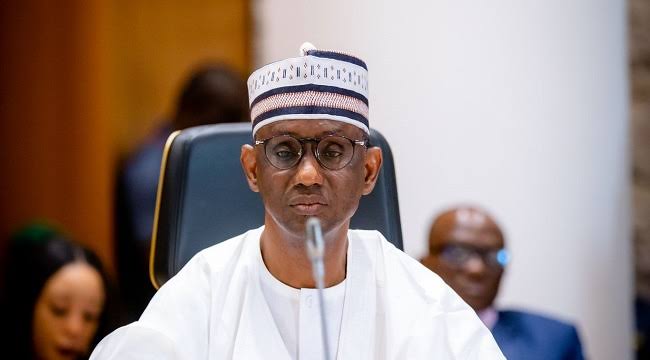
The Director-General of the National Centre for the Control of Small Arms and Light Weapons, DIG Johnson Kokumo (retd), has dismissed allegations contained in a viral video claiming that persons arrested over the seizure of illegal arms at the Tin Can Island Port were allegedly being sponsored by the National Security Adviser, Nuhu Ribadu.


Addressing journalists on Tuesday in Abuja during the joint security spokespersons briefing, Kokumo explained that he was personally present at the Tin Can Island Port when the Nigerian Customs Service handed over 399 assorted automatic weapons intercepted at the port to the centre.

He said, “The story in the video is not correct and cannot be correct.

“I was at the Tin Can Island Port with the Comptroller-General; 399 assorted automatic weapons were intercepted by the Nigerian Customs Service at the port. And this cache of arms, illegal weapons, was handed over to the centre.

Advertisement

“I was not there in a representative capacity; I was there personally. And the Comptroller-General, of course, was also present personally to do the handing over,” he said.

According to him, the seized weapons are currently secured in an armoury, while two suspects arrested in connection with the illegal importation remain in custody.

“As I’m talking to you, the arms are in a secured armoury. Two suspects arrested in connection with the illegal importation are currently in custody.

“Investigation is ongoing with a view to bringing to book the criminal elements in Nigeria and possibly identifying their international criminal partners outside the shores of Nigeria,” Kokumo added.

Advertisement

He further maintained that the allegations contained in the viral video were baseless, noting that the video also called for violence against the NSA and other persons.

“So, what has gone viral in the video is not correct and cannot be correct,” he stated.

Kokumo also disclosed that the Federal Government had continued to destroy recovered illicit weapons to prevent them from being diverted back into the hands of criminal and non-state actors.

He said the destruction of the weapons was in line with international conventions to which Nigeria is a signatory, including agreements under the United Nations, African Union and ECOWAS.

Advertisement

“And of course, another reason for destroying them is to also ensure that the weapons so recovered do not find their way back into the hands of non-state actors for use on innocent citizens of Nigeria,” he said.

The Director-General said the Second Quarter Arms Destruction Exercise for 2026, conducted on July 30 at the Muhammadu Buhari Cantonment, Giri, Abuja, resulted in the public destruction of 1,419 illicit weapons.

He said the latest exercise brought the cumulative number of illicit weapons destroyed by the centre since 2022 to more than 19,000.

Kokumo said the destruction was part of efforts by the Federal Government to prevent the possession and use of illicit weapons by non-state actors involved in terrorism, banditry, kidnapping, armed robbery and other violent crimes.

Advertisement

He also disclosed that the centre had received 5,050 illicit, unserviceable, decommissioned and obsolete assorted automatic weapons retrieved from the Nigeria Police Force in June 2026.

He added that 399 JOJEF automatic guns intercepted by the Nigeria Customs Service were handed over to the centre on August 17, 2026.

Kokumo, however, said the government was not targeting legitimate local arms manufacturers, explaining that some artisanal producers possess skills that could be harnessed for national development.

“From time immemorial, in villages in Nigeria, we have traditional, well-aligned rights where people even fire for joy; they use Dane guns to do all this. We have local hunters who go into the bushes to hunt for rats and rabbits.

Advertisement

“All these guns, of course, are manufactured by local artisanal producers. But what we are seeing now is the introduction of sophisticated weapons,” he said.

He added that the government was particularly concerned about criminal manufacturers producing sophisticated illicit weapons.

“So, we have those who are criminal manufacturers of these illicit weapons; we are really out for them. And we have equally identified talents among the local manufacturers—the talents, those who are naturally talented, of course, will be absorbed into our plans, and we’ll see how they can be most efficient and most productively used in national service,” Kokumo stated.
Advertisement
Continue Reading
Advertisement

News

NAPTIP seeks probe of CSOs over alleged child trafficking

Published

on

By

ADVERTISEMENT
Zoom Ad
ADVERTISEMENT
Zoom Ad

The National Agency for the Prohibition of Trafficking in Persons, NAPTIP, has called for an investigation into some civil society organisations, CSOs, allegedly being used as fronts by human traffickers to gain access to vulnerable communities and traffic children.

The agency also disclosed that it had recovered 118 children allegedly trafficked from Nasarawa, Benue and three other states in the North-Central region.

NAPTIP’s Head of Press and Public Relations, Vincent Adekoye, disclosed this on Tuesday in Abuja at a joint briefing by security agencies’ spokespersons.

Adekoye said traffickers were increasingly exploiting communities affected by insecurity, including farmer-herder conflicts, by posing as representatives of non-governmental organisations and offering assistance to vulnerable families.

Advertisement

He said some traffickers approached distressed communities under the guise of providing educational and humanitarian support before taking children away.

“Traffickers also now masquerade under the umbrella of Civil Society Organizations and move to communities that are already distressed; moving to communities where you have farmer-herder crises, and promising parents that, ‘we will take your children back to school,’ under a fake back-to-school project. And from there, they harvest children, move them,” he said.

Adekoye disclosed that NAPTIP recently rescued four children in Onitsha, Anambra State, who were allegedly trafficked from Kajuru in Kaduna State in 2023.

He said some of the children were recovered from a high-rise building, while another was found in the custody of a nurse at a Federal Medical Centre in Onitsha.

Advertisement

According to him, the agency is planning to profile CSOs, particularly community-based and faith-based organisations operating in vulnerable areas, to prevent criminal elements from exploiting their credibility.

“We have continued to ensure that we want to profile the Civil Society Organizations in Nigeria. My DG has asked me to convey to them, the leadership of the CSOs in Nigeria, to do an in-house cleansing,” Adekoye said.

He explained that community-based, faith-based and non-governmental organisations were often familiar to residents and could therefore be exploited by traffickers seeking to gain the trust of vulnerable families.

The NAPTIP spokesman said the agency had so far recovered 118 children allegedly trafficked from Nasarawa, Benue and three other North-Central states.

Advertisement

He urged Nigerians to remain vigilant and report suspicious activities involving organisations seeking to take children away from their families.

“As at last count, we have recovered 118 of such children from those that were trafficked from Nasarawa and from Benue, and three other states within the North Central. So, we are appealing to Nigerians to be watchful. When you see them, please contact NAPTIP,” he said.

Adekoye recalled that NAPTIP had earlier disclosed the rescue of more than 180 children from trafficking networks allegedly operating under the guise of civil society organisations offering educational support to vulnerable families.

Traffickers exploit social media

Advertisement

The agency also warned of an increasing technology-driven dimension to human trafficking, saying traffickers were using social media platforms to recruit young Nigerians with promises of lucrative jobs and better living conditions abroad.

Adekoye said NAPTIP recently rescued 16 young Nigerian men from Thailand after they were allegedly lured with attractive employment offers.

He explained that the recruitment process was often designed to appear legitimate, with traffickers offering to arrange travel documents, transportation and other logistics for prospective victims.

“From beginning, it looks so real to them that they have no reason at all to doubt. So, the agency has been inundated in recent times with calls from some of them who are stranded.

Advertisement

“Just in July, we rescued about 16 of them from Thailand. When you hear their story, your emotion will corrupt you of what they pass through. Some of them couldn’t survive. Those who survived have a narrow escape from death,” he said.

Continue Reading

News

JAMB, WAEC end multiple O’Level verification charges, fix N4,000 one-off fee

Published

on

By

ADVERTISEMENT
Zoom Ad
ADVERTISEMENT
Zoom Ad

Candidates seeking admission into Nigerian tertiary institutions will now pay N4,000 only once to verify their West African Senior School Certificate Examination, WASSCE, or O’Level results, under a new arrangement jointly introduced by the Joint Admissions and Matriculation Board, JAMB, and the West African Examinations Council, WAEC.

The development is expected to bring relief to admission seekers who have often been subjected to repeated verification of their academic credentials by different institutions during the admission process.

Under the new arrangement, candidates whose admissions are regulated by JAMB are required to verify their WAEC results once through JAMB, after which the verification outcome will be made available to the relevant tertiary institution.

JAMB and WAEC, in a joint statement issued on Tuesday, said candidates would make the ₦4,000 payment only through the specified JAMB Verification Service platform, stressing that the fee should not be paid to individual institutions.

Advertisement

The two bodies also directed tertiary institutions to utilise the verified results supplied by JAMB for admission screening, processing and other administrative purposes.

Consequently, institutions are not permitted to demand additional payments from candidates for another verification of the same WAEC result.

The new policy follows a series of meetings and consultations between JAMB and WAEC aimed at simplifying the verification process and reducing the financial and logistical burden on admission seekers.

According to the statement, WAEC has authorised JAMB to share the outcome of the verification exercise with relevant tertiary institutions for admission-related purposes.

Advertisement

“This arrangement is designed to ensure that candidates who have successfully verified their WASSCE O’ Level result through the Verification Service platform will not be required to repeat the same verification exercise,” the bodies said.

They explained that the initiative would also enable candidates to initiate the verification process from the comfort of their homes or any internet-enabled location, reducing the need for repeated visits to tertiary institutions or JAMB-approved Computer-Based Test, or CBT, centres.

JAMB and WAEC urged candidates to take advantage of the new arrangement by completing their WASSCE O’Level verification through the JAMB-provided platform once, noting that the verified result would subsequently be available to the institution where the candidate seeks admission.

The collaboration, the two examination and admission bodies said, was designed to put candidates’ interests first by cutting unnecessary costs, reducing administrative stress and simplifying the admission process while safeguarding the integrity and security of academic records.

Advertisement
Continue Reading

News

NLC rejects petrol price hike, demands more crude for refineries

Published

on

By

ADVERTISEMENT
Zoom Ad
ADVERTISEMENT
Zoom Ad

The Nigeria Labour Congress has condemned the latest increase in the price of Premium Motor Spirit, popularly known as petrol, describing it as “avoidable and unacceptable” and questioning why the Federal Government has not done more to ensure that the Dangote Petroleum Refinery gets adequate supplies of Nigerian crude.

The acting General Secretary of the NLC, Benson Upah, stated this in an interview with our correspondent on Tuesday, while reacting to the latest increase in petrol prices.

Upah warned that the development would further compound the economic difficulties confronting ordinary Nigerians, particularly workers and low-income households already struggling with high transportation, food and other living costs.

He said, “This adds to the increasing difficulties of the average Nigerian for whom life has been Hobbesian.”

Advertisement

The labour leader argued that the latest increase was difficult to justify, particularly against the backdrop of developments in the international oil market and Nigeria’s growing domestic refining capacity.

According to him, “The latest increase is avoidable and unacceptable in light of falling prices in the international market and our local capacity to sell more crude oil to Dangote. Why are we not doing so?”

The NLC’s reaction came against the backdrop of another increase in the price of petrol by the Dangote Petroleum Refinery, which has triggered fresh concerns among motorists, transport operators and businesses already grappling with high operating costs.

The refinery raised its petrol gantry price by N65 per litre on Saturday, moving it from N1,200 to N1,265 per litre. The latest adjustment came only three days after the company increased the price from N1,185 to N1,200 per litre.

Advertisement

It was the third price adjustment by the refinery in eight days. On August 21, the company had raised its gantry price from N1,165 to N1,185 per litre. In all, the three adjustments have added N100 to the price of petrol at the refinery’s gantry, representing an 8.6 per cent increase within just eight days.

The latest increase has since begun to reverberate across the downstream market, with petrol prices varying from one location to another as marketers factor in transportation, logistics and other distribution costs.

In some parts of Lagos and Ogun, petrol has been reported at about N1,310 per litre, while prices in some northern states and areas farther from the refinery have climbed to N1,350 and above. In some locations, the product is approaching N1,400 per litre.

The renewed price increase is coming at a particularly sensitive time for Nigerians, many of whom are still struggling with the impact of the removal of the petrol subsidy in 2023.

Advertisement

The subsidy removal fundamentally altered the petroleum pricing regime, exposing consumers to movements in crude oil prices, foreign exchange rates and other market costs. Petrol prices, which were previously heavily regulated by the government, have since undergone several increases, with each adjustment feeding into the cost of transportation and other essential goods and services.

The latest development has also revived an old but unresolved question in Nigeria’s petroleum sector: why does a crude-producing country with a major new refinery still face persistent pressure on petrol prices?

The question has become more prominent with the emergence of the Dangote refinery, which has a capacity to process about 650,000 barrels of crude oil daily and was expected to reduce Nigeria’s dependence on imported refined petroleum products.

But while the refinery has ramped up production, securing adequate quantities of Nigerian crude has remained a contentious issue.

Advertisement

Reuters reported recently that between 30 and 40 per cent of the crude processed by the Dangote refinery is imported, despite Nigeria being a major crude oil producer. The refinery has continued to push for greater access to domestic crude at competitive prices as it seeks to increase production. The crude supply challenge has also been reflected in official industry data.

Figures from the Nigerian Upstream Petroleum Regulatory Commission showed that oil producers offered 68.1 million barrels of crude to Dangote Refinery in the second quarter of 2026, against the refinery’s requirement of 63 million barrels. However, the refinery accepted 52.6 million barrels, meaning that the volume actually taken was below both the amount offered and the refinery’s stated requirement.

The figures highlight the complexity of the domestic crude supply debate, with the issue extending beyond the quantity of crude produced to questions around pricing, commercial terms, quality, transportation and delivery arrangements.

The Federal Government and petroleum regulators have consequently been under pressure to reform the framework governing the supply of crude to domestic refineries.

Advertisement

The debate is particularly important because the promise of domestic refining was not simply to change where petrol is produced, but to create a more resilient petroleum market in which Nigeria’s crude resources can be converted into refined products locally, reducing exposure to international supply shocks and pressure on foreign exchange.

For consumers, however, the benefits of that transition remain difficult to feel when petrol prices continue to rise.

The latest increase comes despite the fact that Nigeria’s crude oil production has also been improving. Official figures showed that the country’s crude production averaged 1.72 million barrels per day in the second quarter of 2026, compared with 1.55 million barrels per day in the first quarter.

The paradox is therefore becoming increasingly difficult to ignore: Nigeria is producing more crude, has a refinery capable of processing 650,000 barrels daily, and has substantially reduced its dependence on imported petrol, yet consumers remain vulnerable to sharp increases in the price of the commodity.

Advertisement

For households, the consequences go far beyond the filling station. Petrol is a major component of Nigeria’s transportation and distribution system. Higher petrol prices raise the cost of commuting, increase the expense of transporting agricultural produce and manufactured goods, and push up the operating costs of businesses that depend on petrol-powered generators.

The resulting increases are often passed on to consumers through higher prices for food, transport and other essential goods. This has made every petrol price adjustment a matter of wider economic concern, particularly for workers whose incomes have struggled to keep pace with the cost of living.

It is against this background that the NLC has questioned the rationale for the latest increase and challenged the government to ensure that Nigeria’s crude resources are better deployed to support domestic refining.

Upah’s intervention also places the spotlight on the government’s responsibility to ensure that the benefits of increased crude production and expanded domestic refining capacity are not confined to refiners and other players in the petroleum industry but extend to ordinary Nigerians.

Advertisement

While market forces remain important in determining petrol prices under the post-subsidy regime, labour is insisting that the government can still influence some of the structural factors driving costs, particularly crude supply arrangements, refinery utilisation and domestic energy policy.

For the NLC, the latest increase is therefore not just another adjustment in the price of petrol. It is a fresh test of whether Nigeria’s petroleum reforms are delivering the economic relief and energy security that Nigerians were promised.

And as motorists and businesses brace for the impact of the latest increase, the labour movement is demanding an answer to a fundamental question: if Nigeria has the crude and the refining capacity, why are Nigerians still paying increasingly higher prices for petrol?

Advertisement
Continue Reading

Trending

Copyright © 2024 Naija Blitz News