Foreign
Nepal flood: Death toll hits 1,222, 4,875 missing
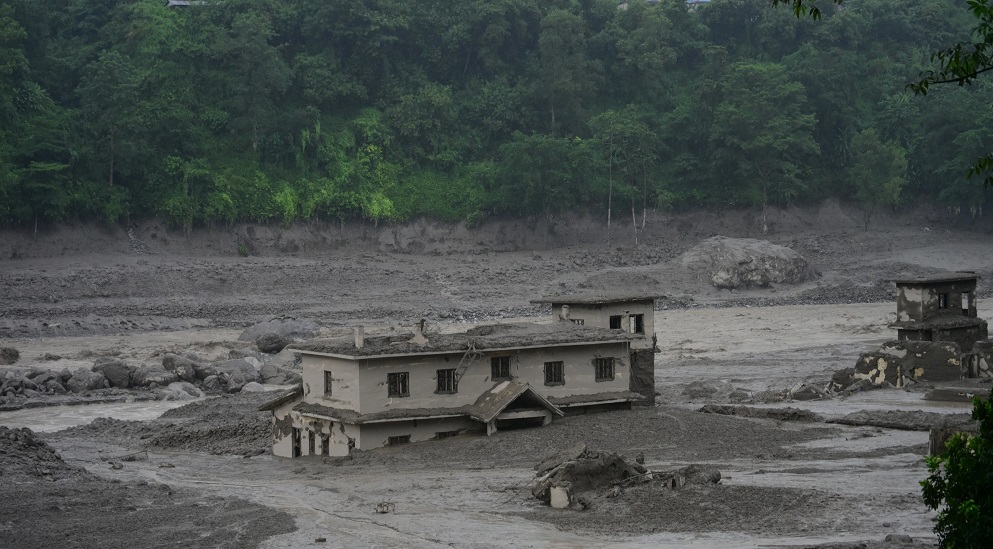
The death toll from last week’s devastating flash floods in Nepal has risen to 1,222, with 4,875 people still missing as rescuers continue to search through debris and isolated communities a week after the disaster.

According to The Hindu, citing Nepal Police and the National Disaster Risk Reduction and Management Authority, bodies have been recovered across eight districts, with Chitawan recording the highest number at 348, followed by Nawalparasi East with 218 and Nawalparasi West with 208.
Nuwakot has recorded 155 deaths, while 127 bodies have been recovered in Rasuwa, 69 in Gorkha, 60 in Dhading and 38 in Tanahu.

The scale of the disaster has also complicated the search for missing people, 583 of whom are foreigners, while thousands remain unaccounted for in areas where roads, bridges and communication networks were swept away.
The joint security operation involving the Nepal Army and other security agencies has so far rescued 11,993 people by helicopter and land routes. About 21,314 security personnel have been deployed for search and rescue operations.
The humanitarian crisis was underscored on Wednesday in Bidur, where survivors were forced to use a temporary cable crossing over the swollen Trishuli River after floodwaters destroyed roads and bridges.
The Nepal Army installed the roughly 250-metre cable, which residents and soldiers have been using to move people across the river, including those needing medical treatment, medicines, food and other essential supplies.
The disaster has also spread across the Nepal-China border. In Tibet’s Gyirong county, where flooding struck near the Nepal border, 21 people have died, and 541 remain missing, according to Chinese authorities cited by The Hindu.
China reopened the highway leading to the Gyirong border crossing on Wednesday after floodwaters destroyed sections of the route, allowing heavy rescue equipment to reach the disaster zone.
Reuters reported that search teams equipped with life-detection devices and dogs were subsequently deployed.
India has also stepped up its response, with a fifth aircraft arriving in Nepal carrying an 11-member rescue team, specialised equipment and 5.5 tonnes of essential medicines, according to India’s Ministry of External Affairs.
The disaster has meanwhile renewed scrutiny of development and environmental practices in the Himalayan region. Environmentalist Sunita Narain said the scale of the flooding was linked to decades of treating rivers and mountains as though they could be continually re-engineered, particularly through extensive hydropower development.
The continuing recovery operation comes as authorities confront the destruction of transport links and the large number of people still missing, leaving the final human cost of the disaster uncertain.
Foreign
American power, AI and a walkout – key moments from Trump’s UN speech
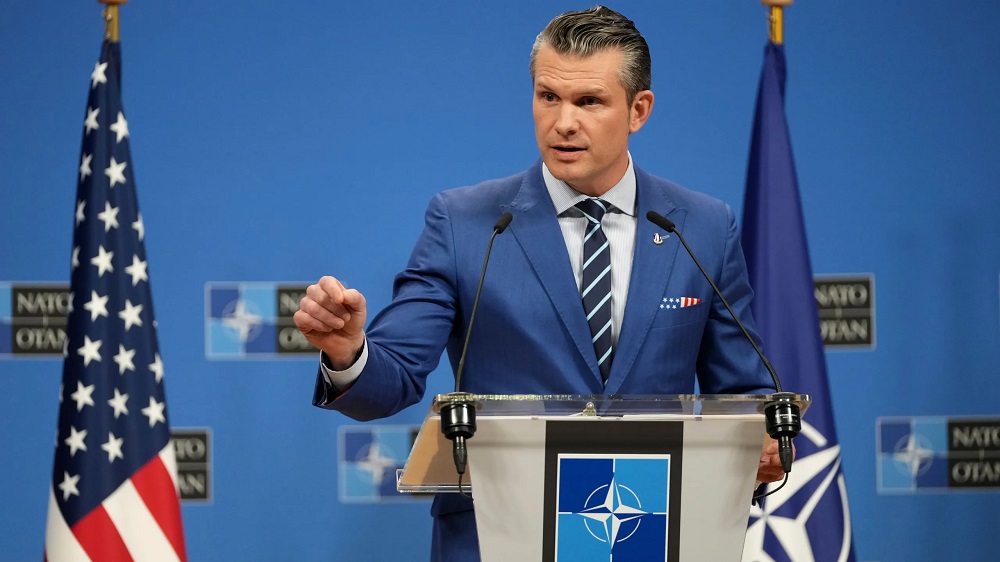
US President Donald Trump returned to the stage at the United Nations on Tuesday, where he touted his administration’s policies in front of world leaders and issued pointed threats to some of those gathered in the room.
The lengthy speech was wide-ranging, covering the war in Iran, AI, Cuba and the role of America’s military.
The BBC’s correspondents who covered the address have picked five key moments that stood out.
1. Trump pushes message of American power
The US president has no great respect for the United Nations – he accused it of imposing a far-left agenda – but he does relish the global platform it gives him.
He used Tuesday’s speech to tout his achievements, and claim the mantle of a peacemaker, at the same time as he issued a number of pointed threats.
Iran might be annihilated, lethal strikes on small boats suspected of drug smuggling will continue and the Cuban regime may even be toppled.
The clear message was: America is still prepared to use its military might wherever Trump thinks it might be required to secure its national interests.
Trump said he was “reasserting American power” and flexed what he called the country’s “unmatched military might”.
“The United States will no longer permit threats to America to gain a foothold anywhere in the Western Hemisphere,” he said.
Once again, Trump has made the full-throated assertion to the world of “America First”.
2. Cubans walk out as Trump calls nation ‘failed state’
Trump took aim at one of the US’s closest neighbours, Cuba, calling it “an absolutely failed state” and saying his administration has been pursuing “a fundamental change in the situation in Cuba”.
“It will fall,” he said.
The Cuban delegation walked out of the hall as Trump continued his remarks.
Over the last year, the US president become more vocal in criticising Cuba’s communist government. On Tuesday, he said it was under “enormous pressure” and “failing like never before”.
The US has not, however, provided a detailed picture of what it believes change will look like in Cuba.
Cuba’s foreign minister reacted angrily to Trump’s comments and accused the US president of spreading “falsehoods”.
“The US government is incapable of accepting that Cuba is and has the right to be a full sovereign and independent country,” Bruno Rodriguez wrote on X.
3. A direct threat to ‘annihilate’ Iran
Trump presented Iran with a stark choice at the UN General Assembly: reach an agreement with Washington and rebuild the country, or face the rapid “annihilation” of the Islamic Republic.
He then again predicted that a deal to end the war would probably follow the US midterm elections in November.
His remarks illustrated Trump’s familiar strategy of coercive diplomacy – keeping negotiations open while also threatening overwhelming force.
But his language blurred the distinction between destroying the political system and threatening Iran itself.
International law experts have previously expressed concern at what they called “alarming rhetoric” used by US officials, including Trump himself, who has posted that the US might “obliterate” Iran’s power plants.
References on Tuesday to leaving “no chance of survival” and “no hope” for future generations will likely have stoked similar alarm. There is also an irony in delivering this warning at the United Nations, an organisation founded to save future generations from war.
Yet the speech was not a declaration that diplomacy has failed.
It was an attempt to define the terms of possible negotiations: the US remains prepared to make a deal, but only under the shadow of an existential threat.
4. Trump hails new Greenland security deal
Trump also praised a new deal with Greenland under which he said the US would build two military bases in the Arctic territory.
“We will have the complete ability to do what is necessary to defend the American continent and also Europe,” he said of the deal, which he first announced on Friday.
He added that it “very much enhances” the defence alliance Nato.
The US, Denmark and Greenland held a joint signing ceremony at the UN shortly after Trump’s address.
Although Greenland is a semi-autonomous territory, it is part of the Kingdom of Denmark which primarily handles its foreign policy.
Trump administration officials are already hailing the agreement as enhancing US security at minimal cost – and with relationships intact.
Denmark and Greenland’s governments, however, will be hoping it ends the long-simmering disagreement that began when Trump threatened to take Greenland by force.
That threat shook the Nato alliance and sorely tested the US-Danish relationship.
Given Trump had tried for months to purchase or annex the semi-autonomous territory, some analysts are viewing it as a quiet win for diplomacy.
5. An attempted rebrand of AI
Trump has a penchant for branding, and in his speech he gave Artificial Intelligence a new name: Super Intelligence.
“The use of the word artificial makes it sound fake,” he said. “It’s not fake, it’s actually amazing. But we have to be careful.”
“Welcome to the new world of Super Intelligence – SI,” he added.
Trump has previously argued that the US must come out on top in the AI development race, saying last week: “Whoever wins AI, wins.”
The president is firmly against government regulation or introducing new guardrails – and that puts him at odds with many of those gathered at the UN.
For those who are calling for regulation, the question is whether the slow pace of diplomacy can keep up with AI’s rapid development.
Foreign
Brazilian Jet Carrying Singer Rey Vaqueiro Overruns Runway, Catches Fire
A Cessna 550 Citation Bravo carrying Brazilian singer Rey Vaqueiro and seven other people has overrun the runway while landing at Parelhas Airport in Rio Grande do Norte, Brazil.
The aircraft, with registration PP-WMO, was involved in the incident during the early hours of Sunday, September 13, according to aviation news platform FL360aero, which reported the incident in a post on X.
The aircraft reportedly ran beyond the runway while landing at the airport and subsequently caught fire, with both engines said to have been engulfed in flames.
Firefighters battled the blaze for approximately five hours before it was brought under control.
All eight people on board, comprising six passengers and two crew members, reportedly evacuated the aircraft.
Some of the occupants were said to have sustained minor injuries, while no serious injuries were reported.
The aircraft was destroyed by the fire.
The circumstances surrounding the incident remain under investigation by Brazil’s Centre for Investigation and Prevention of Aeronautical Accidents (CENIPA).
The incident involved a Cessna 550 Citation Bravo, a business jet commonly used for private and charter flights.
Foreign
More Flights Delayed As UK Air Traffic Control Problem Causes disruption
More flights are expected to be delayed in the United Kingdom (UK) after a technical problem with the country’s air traffic control system led to more than 2,000 cancellations.
A total of 291 flights were cancelled on Wednesday after 1,750 were cancelled on Tuesday, according to aviation analytics firm Cirium. Tens of thousands of passengers have been affected by the disruption.
National Air Traffic Services (NATS), the UK’s air traffic control provider, blamed the disruption on a technical glitch. Its chief executive, Martin Rolfe, apologised and said a full investigation would be carried out.
He admitted that resolving the problem had taken “longer than hoped”.
Foreign Secretary Ed Miliband described the outage as “unacceptable”, while Transport Secretary Heidi Alexander summoned Rolfe to explain what happened.
The disruption affected several major UK airports, including Heathrow, Gatwick, Manchester and Birmingham. Airports in Ireland also reported disruption.
At Heathrow, departures were initially paused on Tuesday before operations resumed and then faced further disruption later in the day.
Heathrow said its operations were recovering on Wednesday but warned passengers of further delays because aircraft and crew needed to be repositioned.
Gatwick also said flights had resumed but warned that it would take time for operations to return fully to normal.
Passengers have been advised to check directly with their airlines before travelling to airports. Heathrow said passengers should only travel if they have a confirmed flight.
The technical fault affected NATS’ flight data processing system. Rolfe said it was not the same system that failed during a major disruption in 2023.
However, the latest incident is the third technical problem experienced by NATS in three years. A computer shutdown in 2023 caused widespread disruption affecting around 700,000 passengers, while another outage in 2025 resulted in about 150 cancellations.
Airlines including Ryanair and Wizz Air have called for changes to NATS. Wizz Air UK managing director Yvonne Moynihan said the company needed to consider whether NATS was “fit for purpose”.
Despite the disruption, Rolfe defended the UK’s air traffic control system, saying it remained one of the best in the world.
However, former NATS air traffic control manager Doug Maclean said repeated failures were undermining the system’s reputation.
Even though the technical issue has been resolved, passengers are expected to face further disruption because of the backlog of flights, aircraft and crew.
NATS said it was working to restore normal operations as quickly as possible.
(BBC News)
-
News21 hours agoPrimate Ayodele Blasts Bishops Again! Dismisses Their Defense, Insists Their Endorsement of Tinubu Is Selfish Not Spiritual
-
Economy21 hours agoDangote To Support Two Million Women With Refinery IPO Share Ownership – Aliko Dangote
-
News21 hours agoEx-LASU VC: Public varsities must charge N1m tuition per student to sustain financial independence
-
News21 hours agoOsun assembly endorses state police
-
News21 hours agoAlleged Phone Tapping: Court to Rule in El-Rufai’s No-case Submission Oct 26
-
Sports21 hours agoSadio Mane Builds $20.4m Mango Processing Plant In Hometown