Connect with us

News

Aisha Buhari visits Atiku as 2027 political activities gather momentum

Published

on

ADVERTISEMENT
Zoom Ad
ADVERTISEMENT
Zoom Ad

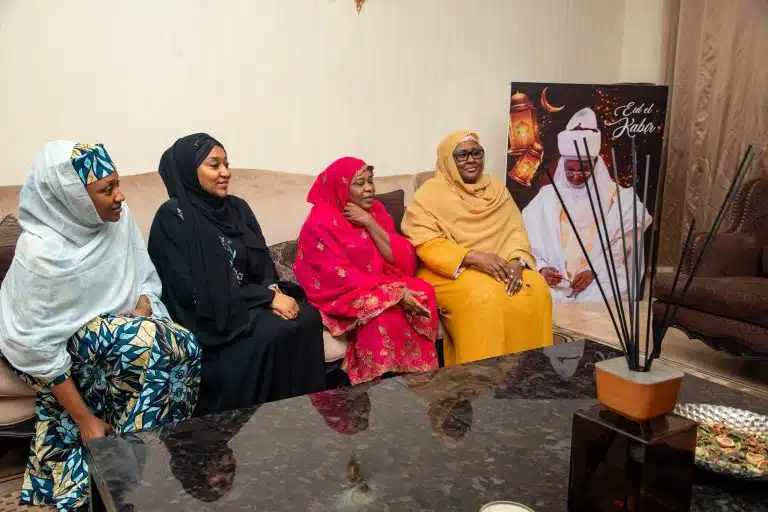
Former First Lady Aisha Buhari on Wednesday paid a courtesy visit to former Vice President and 2027 presidential candidate of the African Democratic Congress (ADC), Atiku Abubakar.


Atiku disclosed the visit in a statement personally signed by him, describing the meeting as a warm and appreciated engagement.

According to the former vice president, the visit underscored the need for political leaders to prioritise the welfare, dignity and future of Nigerians.

“Today, I was delighted to receive former First Lady, H.E. Aisha Buhari,” Atiku said.

Advertisement

“Her visit was warm and deeply appreciated. Beyond the courtesies of the occasion, it was also a reminder of the urgent responsibility before all who seek a better Nigeria: to put the welfare, dignity and future of our people first.”

Atiku used the occasion to highlight the economic difficulties confronting many Nigerians, citing the rising cost of food, transportation, education, healthcare and other essential needs.

He said Nigerians deserved an economy capable of rewarding hard work, expanding opportunities and enabling families to live with dignity.

“Across our country, families are being stretched by the rising cost of food, transport, education, healthcare and other basic necessities,” he said.

Advertisement

“Nigerians deserve an economy that rewards hard work, restores opportunity and allows every family to live with dignity and hope.

“That is the Nigeria we must build together, a country that works for its people again. We must ease the burden, restore hope and make Nigeria Affordable Again,” Atiku added.

The meeting comes as political activities intensify ahead of the 2027 general elections, with opposition figures and political groups increasingly stepping up consultations and engagements ahead of the polls.

Aisha Buhari, wife of former President Muhammadu Buhari, served as Nigeria’s First Lady between 2015 and 2023.

Advertisement
Continue Reading
Advertisement

News

UN Warns: Global Water Cycle Growing More Erratic as Earth’s Water Reserves Decline

Published

on

ADVERTISEMENT
Zoom Ad
ADVERTISEMENT
Zoom Ad

The world’s water cycle is becoming increasingly unpredictable, with freshwater supplies swinging between extreme shortages and excesses, the United Nations has warned.

The warning was contained in the World Meteorological Organization’s (WMO) latest State of Global Water Resources report, which found that freshwater storage continued its decade-long decline in 2025, one of the warmest years on record.

According to the report, 2025 was among the three driest years for global river flows in more than three decades, while glaciers continued to lose significant amounts of ice across all regions.

The WMO also reported that groundwater levels were declining in many parts of the world, adding to concerns over the long-term availability of freshwater.

Advertisement

WMO Secretary-General Celeste Saulo said the most worrying development was the depletion of what she described as the planet’s “slow reserves”—groundwater and glaciers that traditionally provide a buffer during periods of drought.

“These reserves have served as a buffer that absorbs bad years so that a single drought or a single dry season does not translate directly into a water crisis,” Saulo told reporters.

‘We Are Spending Our Reserves’

Saulo warned that humanity was increasingly drawing down these natural reserves.

Advertisement

“Now, we are depleting that savings account. We are spending our reserves,” she said.

The report estimated that glaciers lost a cumulative 1,400 gigatonnes of water between 2023 and 2025. The amount is equivalent to the water needed to fill about 560 million Olympic-sized swimming pools and represents roughly one-third of the world’s annual freshwater withdrawals.

Groundwater is also showing signs of increasing stress. Saulo said nearly two-thirds of monitored wells worldwide recorded conditions outside their historical norms in 2025.

The decline in freshwater reserves is occurring alongside a rise in water-related disasters, according to the WMO.

Advertisement

Rivers Record Abnormal Flows

The report found that river flows remained highly abnormal in many parts of the world even before the latest El Niño conditions intensified.

For the seventh consecutive year, river basins recording normal conditions represented a clear minority globally.

Only about 36 per cent of monitored river basins recorded normal flows in 2025. Another 36 per cent experienced below-normal discharge, while 21 per cent recorded above-normal flows.

Advertisement

The figures underscore growing instability in the global water cycle, with some regions experiencing severe shortages while others face excessive rainfall and flooding.

El Niño Could Deepen Extremes

The WMO also raised concerns about the potential impact of El Niño, the warm phase of a naturally occurring climate cycle that develops every two to seven years and affects global rainfall, winds and weather patterns.

Saulo warned that the strengthening El Niño could increase the risk of drought in some parts of the world while raising the likelihood of flooding elsewhere.

Advertisement

The phenomenon is characterised by unusually warm ocean temperatures across the Pacific and can trigger significant changes in weather patterns far beyond the region.

WMO Calls for Better Data

The UN agency stressed that reliable and shared water data would be critical to managing the growing risks.

The WMO said significant gaps remain in hydrological monitoring, particularly in regions already experiencing severe water stress.

Advertisement

“Weather respects no borders, and this is especially true for water,” Saulo said, calling for “shared data, shared standards and shared early warnings”.

She noted that river basins often cross national borders, meaning water conditions in one country can have consequences downstream in another.

“A river basin is fed by water upstream, often in another country,” she said, adding that disasters affecting glaciers or other water sources could also have cross-border consequences.

Advertisement
Continue Reading

News

Sanusi: Ethnic, religious divisions created climate for Boko Haram, banditry

Published

on

ADVERTISEMENT
Zoom Ad
ADVERTISEMENT
Zoom Ad

The Emir of Kano, Muhammadu Sanusi II, has attributed the roots of Nigeria’s worsening insecurity to years of ethnic, religious and regional divisions, arguing that inflammatory political rhetoric and media narratives helped create conditions in which violent movements could emerge.

Sanusi made the remarks on Wednesday in Abuja at the launch of a book documenting the tenure of retired Lieutenant General Tukur Yusuf Buratai as Chief of Army Staff.

The former Central Bank of Nigeria (CBN) governor said the country’s security crisis should not be examined solely through the lens of terrorism, banditry, kidnapping and other violent crimes.

According to him, the deeper problem lies in the gradual erosion of a shared Nigerian identity and the increasing tendency to define citizens according to their ethnic, religious and regional affiliations.

Advertisement

Sanusi argued that repeated political and media references to Nigerians as Northerners or Southerners, Muslims or Christians, and members of particular ethnic groups had contributed to an environment that could facilitate the emergence and expansion of violent movements.

“The fundamental point I wish to emphasise is that the security crisis in this nation did not commence with violence as we currently witness it, nor did it commence with banditry. It did not commence with Boko Haram and terrorism,” he said.

He added that the divisions were reinforced through political discourse and newspaper narratives, which, in his view, contributed to the conditions that allowed violent groups to emerge.

Sanusi warned that continued exploitation of ethnic and religious identities for political purposes could create conditions for another cycle of violence.

Advertisement

“We are only laying the foundation for a new round of violence,” he said, urging Nigerians to place national identity and development above ethnic and religious affiliations.

The monarch also called for clearer boundaries between politics and religious leadership, arguing that politicians should concentrate on governance and development while religious leaders should focus on their spiritual responsibilities.

“It is not the responsibility of politicians to give us religion. They are there to give us education, to give us healthcare, to give us an economy and allow the religion to be in the hands of those who are religious leaders,” he said.

Sanusi similarly cautioned religious leaders against becoming deeply involved in partisan politics, saying the growing overlap between religious institutions and political interests could make it harder for citizens to hold political leaders accountable.

Advertisement

He argued that institutions such as the military, police and Central Bank must operate with long-term national objectives rather than the short electoral cycles of elected politicians.

“The army cannot think in four-year cycles. The police cannot think in four-year cycles. The central bank cannot think in four-year cycles. We have to think 20 years, 30 years, 50 years, whereas elected officers are thinking in four-year cycles,” Sanusi said.

Nigeria has faced multiple and overlapping security challenges over the past two decades, including the Boko Haram insurgency in the North-East, armed banditry and mass kidnappings in the North-West and parts of the North-Central region, as well as communal and separatist-related violence in other parts of the country.

Sanusi’s comments come amid continuing national debate over the underlying causes of insecurity and the roles played by governance, poverty, political mobilisation, ethnic and religious tensions, weak institutions and organised criminal networks.

Advertisement

While security operations remain central to the government’s response, Sanusi argued that addressing the deeper social and political divisions within the country must also form part of any long-term strategy to restore stability.

Continue Reading

News

2027: PDP flushes out Kano Guber Candidate, Mohammed,replaces him With Abacha’s Son

Published

on

ADVERTISEMENT
Zoom Ad
ADVERTISEMENT
Zoom Ad

The Peoples Democratic Party (PDP) in Kano State has replaced its earlier guber candidate, Muhammad Bello Dalha, with Muhammad Sani Abacha, son of former military Head of State, Sani Abacha, ahead of the 2027 governorship election.

The change followed Dalha’s withdrawal from the race, the state chapter of the party said.

The replacement was formalised on Wednesday at an expanded meeting of the PDP State Executive Committee in Kano, where the party conducted an affirmation and replacement primary.

The state chairman of the party, Bello Gambo Bichi, said the decision followed consultations with stakeholders in Kano and Abuja and was in line with the party’s constitution and relevant electoral requirements.

Advertisement

“Last time we did a primary election in which Muhammad Bello Dalha was declared winner. But following consultations among stakeholders in Kano and Abuja, the candidate decided to withdraw.

“The law says that as a result of withdrawal, a replacement primary must be held. That is what brought us here today. We have affirmed Muhammad Sani Abacha as the gubernatorial candidate of our great party in Kano State,” Bichi said.

Following the withdrawal, the party held a replacement primary, with the chairman of the electoral panel, Abba Abdullahi, declaring Abacha the winner.

Abdullahi said the exercise complied with the party’s guidelines and applicable electoral regulations, adding that Abacha met the requirements to contest the election.

Advertisement

The PDP also adjusted its deputy governorship ticket as part of its efforts to settle its longstanding internal divisions within the party in the state.

Bichi said the deputy governorship slot had been conceded to the faction associated with Kabiru Tanimu Turaki.

As a result, a former factional chairman of the PDP and former commissioner for land and agriculture, Yusuf Ado Kibiya, was named the new deputy governorship candidate.

“After wide consultation and reconciliation, we agreed to give the deputy governorship slot to the Turaki faction here in Kano. With this, there is no more faction in Kano PDP. We have reconciled,” Bichi said.

Advertisement

He added that officials of the Independent National Electoral Commission (INEC) monitored the exercise.

Bichi also disclosed that the party had changed some of its candidates for the National Assembly and State Assembly elections as part of the reconciliation process.

According to him, the adjustments were designed to accommodate members of the various factions and promote unity within the party ahead of the 2027 elections.

Advertisement
Continue Reading

Trending

Copyright © 2024 Naija Blitz News