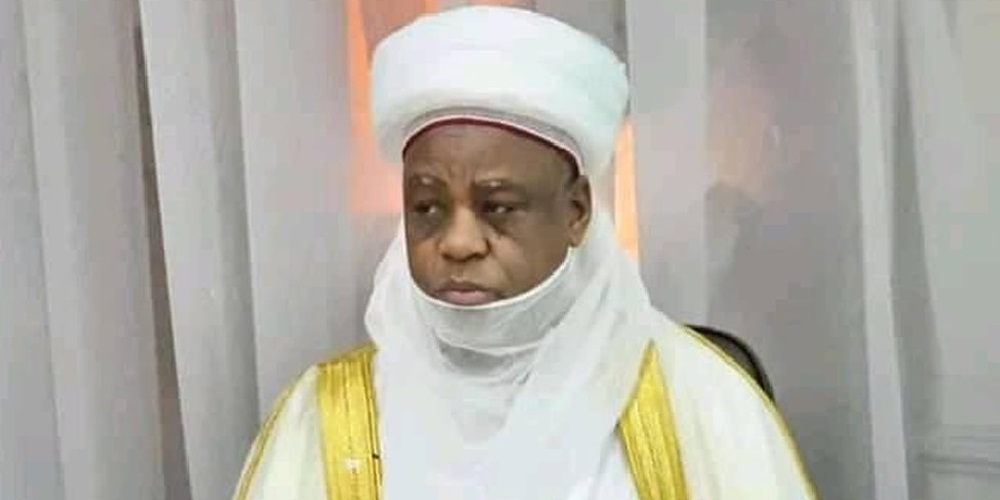
The Sultan of Sokoto, Alhaji Muhammad Sa’ad Abubakar III, has cautioned politicians and public office holders against using stolen or corruptly obtained public funds to sponsor pilgrimages to the holy lands of Mecca and Jerusalem.


The Sultan gave the warning on Wednesday in Abuja while speaking at the opening ceremony of a stakeholders’ meeting organised by the Nigeria Inter-Religious Council (NIREC).
Speaking to Christian and Muslim leaders, government officials, security representatives and other participants at the meeting, the Sultan stressed that religious leaders have an important role to play in the fight against corruption and the promotion of moral values in society. 
He maintained that corruption should not be given religious justification, warning that public officials cannot divert public resources and subsequently use such funds to sponsor religious activities while expecting spiritual acceptance.
The Sultan said religious leaders must become active partners in efforts to tackle corruption and should work closely with relevant anti-corruption institutions.
Sultan: Religious Leaders Must Fight Corruption
According to the Sultan, religious leaders have a responsibility to speak against corruption because of its damaging effects on society and governance.
He stressed that the sanctity of religious activities should not be used to shield individuals who have obtained wealth through corrupt means.
The Sultan specifically referenced pilgrimage to Mecca and Jerusalem, saying stolen public funds should not be used to sponsor people for religious journeys.
He said God does not accept corruption and urged religious leaders to consistently reinforce the message against corrupt practices from their various religious platforms.
Sultan Backs EFCC Action Against Corrupt Individuals
The Sultan also called on the Economic and Financial Crimes Commission (EFCC) to deal firmly with individuals found to have engaged in corrupt practices, irrespective of their political, religious or social affiliations.
He said religious identity or status should not be used as a shield against accountability when an individual is required to face the law.
The Sultan urged religious leaders and members of the public not to interfere with lawful investigations or prosecution simply because the person involved is a pastor, imam, relative, friend or prominent member of a religious community.
He also called on the EFCC to carry out its responsibilities without political interference, stressing the need for institutions responsible for fighting corruption to operate according to the law.
Sultan Calls for Stronger Christian-Muslim Understanding
The Sultan further highlighted the importance of NIREC as a platform for promoting dialogue and understanding between Christians and Muslims in Nigeria.
He said regular engagement between the two major religious communities remains essential to maintaining peace, stability and national development.
Rather than merely tolerating one another, the Sultan urged Christians and Muslims to pursue genuine mutual understanding.
He explained that tolerance alone could mean enduring differences without necessarily understanding the other person, while genuine understanding could create room for cooperation and peaceful coexistence.
The Sultan said Nigerians would be better positioned to work together when they understand their differences, responsibilities and common interests.
Clerics Warned Against Incendiary Political Statements
The Sultan also urged religious leaders to exercise caution in their public utterances, particularly from the pulpit and other religious platforms during election periods.
He advised clerics to avoid using religious platforms to attack public office holders, incite division or deepen political tensions.
Instead, he encouraged religious leaders to pray for national leaders and promote messages capable of strengthening peace, unity and responsible citizenship.
The call comes against the backdrop of the important role religious institutions and their leaders play in shaping public opinion and influencing communities across Nigeria.
Sultan Commends Outgoing NIREC Executive Secretary
The Sultan paid tribute to the outgoing Executive Secretary of NIREC, Prof. Cornelius Omonokhua, commending his eight-year tenure and contributions to the development of the council.
He described the period as one in which NIREC was transformed into a more vibrant platform for national dialogue and inter-religious engagement.
The Sultan urged participants at the stakeholders’ meeting to engage openly on national issues and contribute ideas capable of addressing challenges confronting the country.
He also cautioned participants against spreading rumours after returning to their respective communities, urging them to communicate responsibly and promote peace.
Anti-Corruption Manuals Target Religious Platforms
An overview of the Interfaith Anti-Corruption Manuals Project was presented by Prof. Adedibu Ojerinde, Chairman of the Interfaith Anti-Corruption Advisory Committee (IAAC).
Ojerinde described the manuals as a joint strategic initiative involving the EFCC and Nigeria’s religious leadership, designed to address corruption and the wider moral challenges confronting the country.
According to him, the initiative emerged from the outcome of the 2007 National Interfaith Forum on Corruption and seeks to mobilise religious platforms, including the pulpit and minbar, in the campaign for improved public morality.
He said the preaching manuals are anchored in biblical and Qur’anic texts and are designed to provide religious leaders with materials for addressing corruption and related social challenges.
Ojerinde explained that the manuals, originally inaugurated in 2014 and re-inaugurated in January 2024 by President Bola Ahmed Tinubu, were expanded to address contemporary issues.
These include challenges affecting young people, cybercrime and vulnerabilities relating to money laundering within religious institutions.
NIREC Receives Anti-Corruption Manuals
Ojerinde said the formal handover of the anti-corruption manuals to NIREC represented an important transition from the production of the materials to their practical implementation.
He called on religious leaders to incorporate anti-corruption messages into regular religious teachings, including Friday sermons and Sunday messages.
The objective, he said, is to ensure that the fight against corruption is not limited to government institutions but also becomes part of moral and religious education within communities.
The stakeholders’ meeting brought together Christian and Muslim leaders, government officials, security representatives and members of the media.
The meeting provided a platform for participants to discuss corruption, interfaith relations, national unity, responsible religious leadership and the role of faith communities in promoting peace and good governance.