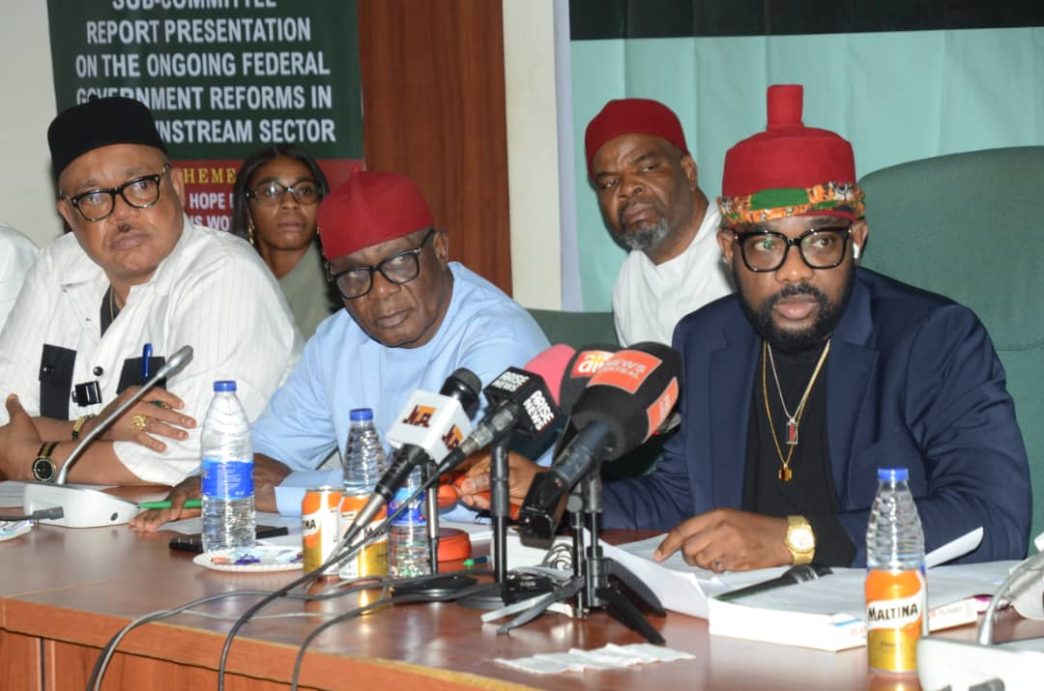


…highlight need for accountability and improved performance in downstream petroleum sector.
by Gloria Ikibah 
The House of Representatives has dismissed petitions accusing the Executive Vice-President of the Nigerian National Petroleum Company Limited (NNPCL), Dangazau, of money laundering, following an investigation by an adhoc subcommittee.
The petitions were submitted by the Coalition for Transparency and Accountability in Nigeria’s Petroleum Sector (CTANPS).
The Chairman of the House Committee on Petroleum Resources (Downstream), Rep. Ikenga Ugochinyere, commended the investigative process, emphasising the need for evidence-based legislative oversight to promote transparency, accountability and public confidence in the petroleum industry.
According to a him, the subcommittee examined the petitions and the issues raised before reaching its findings, which informed the decision to dismiss the allegations against the NNPCL executive.
Ugochinyere stressed that legislative oversight must be impartial and guided by verifiable facts, noting that while legitimate complaints deserved thorough investigation, individuals should also be protected against unsubstantiated allegations.
He said the downstream petroleum sector remained vital to Nigeria’s economic stability because of its direct impact on fuel availability, distribution, transportation costs and the livelihoods of millions of Nigerians.
The lawmaker also highlighted ongoing efforts by the NNPCL to improve downstream operations, diversify energy sources and modernise petroleum product distribution infrastructure.
Among these initiatives is the company’s revised approach to refinery rehabilitation through a technical equity partnership model aimed at improving operational efficiency and commercial sustainability.
However, the Port Harcourt, Warri and Kaduna refineries had yet to resume production as of July 2026, according to the Ugochinyere.
The revised strategy is expected to address longstanding operational challenges and provide a more sustainable framework for refinery rehabilitation.
The also highlighted the NNPCL’s support for compressed natural gas (CNG) as an alternative to conventional petrol and diesel.
In July 2025, the company handed over 35 CNG-powered hybrid buses to the Presidential Initiative on CNG as part of efforts to expand access to alternative-fuel transportation.
The company also reported acquiring 500 CNG-powered trucks in its 2025 audited performance announcement, an investment intended to expand gas-powered logistics and improve the transportation of petroleum products.
In another development, NNPC Retail commissioned its first smart self-service filling station on Bill Clinton Drive, Abuja, in September 2026.
The facility operates round the clock and combines conventional fuel dispensing with liquefied petroleum gas (LPG), electric vehicle charging, lubricant services and other customer amenities.
Ugochinyere said such investments underscored the importance of sustained funding, institutional accountability and policy consistency in strengthening the downstream petroleum sector.
He, however, maintained that the impact of the initiatives should ultimately be assessed through measurable improvements in product availability, operational efficiency, affordability and service delivery to Nigerians.
The committee chairman reaffirmed the House of Representatives’ commitment to maintaining rigorous oversight of the petroleum industry, describing it as essential to protecting public resources, strengthening institutions and ensuring that operators serve the national interest.
He also urged stakeholders to support constructive reforms while allowing relevant institutions to discharge their responsibilities without undue interference.
Ugochinyere emphasised that transparency, accountability and respect for due process remained essential to restoring public confidence in the petroleum industry.