The Nigeria Labour Congress (NLC) and the Trade Union Congress of Nigeria (TUC) have resolved their disagreement over the Federal Government’s ₦70,000 transport allowance for public workers, bringing an end to days of public exchanges between the leadership of the two labour centres.


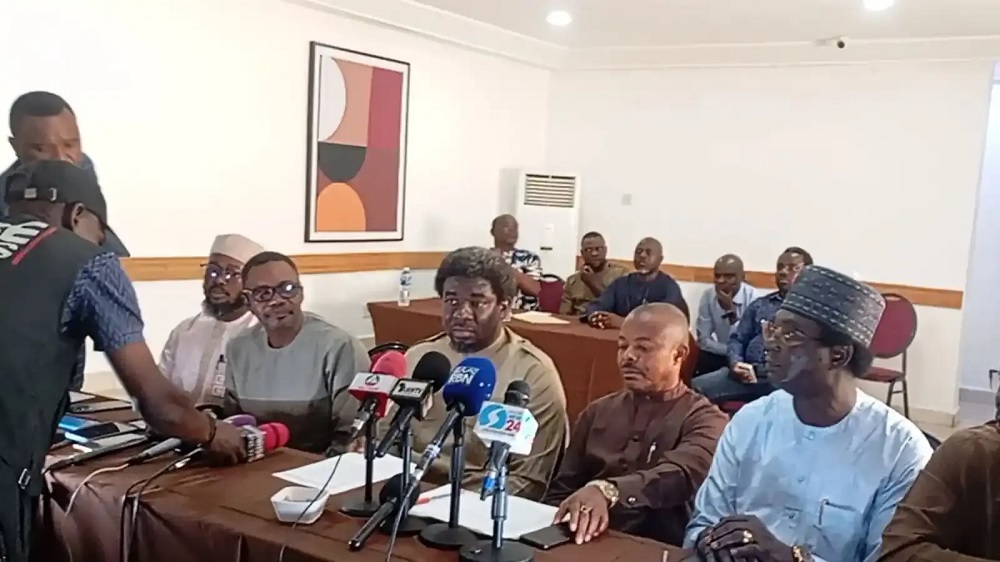
The unions announced the resolution on Wednesday at a joint press conference in Abuja, where they reaffirmed their commitment to working together in defence of Nigerian workers’ rights and welfare.
In a joint statement signed by NLC President, Joe Ajaero, and his TUC counterpart, Festus Osifo, the unions acknowledged that their disagreement had played out publicly but said their shared history and responsibility to workers were more important than their institutional differences. 
They described the dispute as a family misunderstanding that had been amicably resolved through the intervention of former leaders of both organisations.
The resolution followed a heated disagreement over the Federal Government’s approval of a ₦70,000 monthly transport intervention for public sector workers for six months, an agreement reached after negotiations involving the government and labour representatives.
The controversy exposed longstanding differences between the two labour centres over their respective mandates, representation and authority to negotiate workers’ welfare issues.
The disagreement became public after Ajaero argued that the NLC, being the larger labour centre, had the authority to negotiate independently with the Federal Government, while the TUC could participate in joint negotiations.
Speaking on Channels Television’s The Morning Brief, the NLC president maintained that the International Labour Organisation (ILO) principle of majority representation supported his position.
However, Osifo rejected the interpretation, insisting that the TUC could not be excluded from negotiations affecting its members.
He challenged Ajaero to produce any ILO regulation authorising one labour centre to negotiate on behalf of another without consultation.
Osifo also described the ₦70,000 agreement as an aberration, arguing that the TUC was not involved in the negotiations that produced the arrangement.
He maintained that both labour centres had independent mandates and that the existence of more affiliates within the NLC did not give it the authority to represent TUC members.
The TUC president further questioned the process through which the agreement was reached, insisting that the Joint National Public Service Negotiating Council (JNPSNC), which represents public sector unions, was not properly constituted for the negotiations.
According to him, the meeting that produced the agreement was not a formal meeting of the council, which has established membership and quorum requirements.
Osifo also argued that the intervention should not substitute for a comprehensive salary review, particularly following the increase in the national minimum wage from ₦30,000 to ₦70,000.
He said consequential adjustments were necessary to reflect the new minimum wage across the public service.
Ajaero, however, defended the NLC’s engagement with the Federal Government, explaining that the union had issued an ultimatum and was preparing industrial action before the government requested additional time for negotiations.
He said the government eventually met with the NLC after seeking four days to address the issues, during which the transport allowance was agreed upon.
The NLC president also cited the Trade Union Amendment Act 2005 and Section 40 of the 1999 Constitution, as amended, to argue that workers had the freedom to choose their trade unions.
He disputed the TUC’s claim of representing a substantial number of federal civil servants, arguing that most unions within the Joint National Public Service Negotiating Council were affiliated with the NLC.