Connect with us

News

State Police Will Not Address Insecurity Without Tackling Poverty — Falana

Published

on

ADVERTISEMENT
Zoom Ad
ADVERTISEMENT
Zoom Ad

Human rights lawyer, Femi Falana, SAN, has warned that the creation of state police will not resolve insecurity in Nigeria unless the government addresses poverty and unemployment.


Falana, who appeared on Channels Television’s Politics Today on Thursday, said the country’s insecurity challenge was often narrowly reduced to questions of security architecture, without adequate attention to social security and the conditions driving young people into crime.

“We always reduce the problem of insecurity to security architecture, in fact structure. How do we have more police stations? How do we employ more policemen and women without considering social security?” Falana queried.

“Why are more young men taking to criminality? Why are we not talking about creating employment for young people? Why are we not giving assistance to Nigerians that are vulnerable, extremely poor or dimensionally poor? And unless you address these problems holistically, creating a state police or local government police will not address the crisis of insecurity in the country.”

Advertisement

His comments came after President Bola Tinubu on Tuesday transmitted to the Senate a bill seeking to amend the 1999 Constitution to provide for the establishment of state police services across the federation.

The Senate passed the bill on Wednesday after Senate Leader Opeyemi Bamidele presented its general principles. The bill subsequently scaled second reading, was considered clause-by-clause and passed third reading, with more than two-thirds of senators voting in support.

When assented to by the President, the legislation will replace the existing Nigeria Police Force framework with a dual structure comprising a Federal Police Service and State Police Services.

A key provision of the bill empowers state governors to appoint commissioners of police for their respective states, subject to confirmation by the state Houses of Assembly.

Advertisement

Lawmakers also incorporated safeguards aimed at protecting political freedoms and civil liberties, in response to concerns about possible abuse of the proposed policing structure.

Falana said regional police was not new to Nigeria, noting that the country operated a decentralised policing system during the First Republic.

However, he said the system was abolished due to what he described as the gross abuse of police powers by regional leaders.

He said Nigeria must address the issues that led to the abolition of the dual policing system if it intends to return to it.

Advertisement

“If we now want to go back to the status quo ante bellum, we must ask questions. The fears that were entertained, the problem that led to the abolition of the dual policing system, have they been taken care of? I haven’t seen any signs. I have seen the bill passed by both chambers of the National Assembly, the bill is so sketchy,” he said.

Falana also raised concerns about checks and balances in the operation of state police, as well as the ability of some state governments to fund the proposed police services.

He said some state governments could barely pay salaries and pensions.

Advertisement
Continue Reading
Advertisement

News

DAY 13 of Projects Commissioning in the FCT

Published

on

ADVERTISEMENT
Zoom Ad
ADVERTISEMENT
Zoom Ad

President Tinubu Will Commission Roads 01 and 02 Linking Mabushi Bus Terminal and Ahmadu Bello Way Today

#FCTRenewedHope
#FCTProjectsCommissioning

Continue Reading

News

BEWARE: FG warns 26 States of flood, places, Bayelsa, Delta, Lagos, Adamawa, Benue, others as critical risk areas

Published

on

ADVERTISEMENT
Zoom Ad
ADVERTISEMENT
Zoom Ad

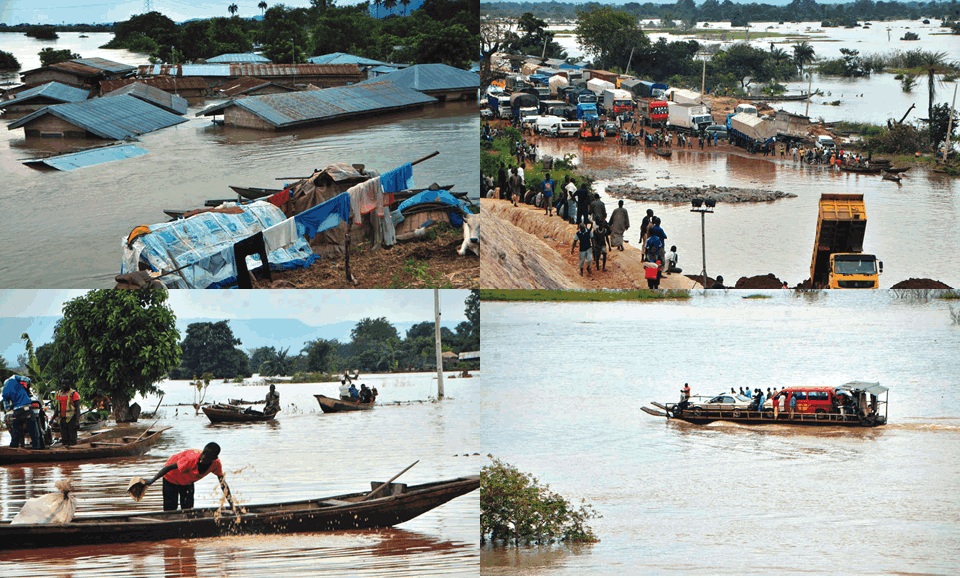
The Federal Government has alerted residents of 26 states and the Federal Capital Territory (FCT) to the possibility of flooding between June 22 and July 5, 2026, following forecasts of heavy rainfall in different parts of the country.

The warning was issued by the Federal Ministry of Environment through the National Flood Early Warning Centre under its Erosion, Flood and Coastal Zone Management Department.

The ministry said several communities across the country have been identified as areas that could face serious flood threats during the period.

According to the forecast released on June 22, heavy rainfall is expected in many locations, raising concerns about possible flooding in vulnerable communities.

Advertisement

States placed under the critical-risk category include Abia, Adamawa, Akwa Ibom, Anambra, Bayelsa, Benue, Cross River, Delta, Ebonyi, Edo, Ekiti, Enugu, Imo, Kogi, Kwara, Lagos, Niger, Ogun, Ondo, Osun, Oyo and Rivers.

In Abia State, the affected communities include Aba, Arochukwu and Umuahia. In Adamawa, the ministry listed Jimeta and Numan, while Eket, Oron and Uyo were named in Akwa Ibom. In Anambra, Onitsha Inland Town and Awka Urban Drainage Corridors were identified as vulnerable locations.

Bayelsa communities such as Yenagoa, Brass and Nembe Town were also listed among areas that could be affected by flooding.

Other locations mentioned include Makurdi, Gboko and Katsina-Ala in Benue State; Calabar Metropolis and Creek Town in Cross River State; Asaba, Warri and Sapele in Delta State; and Abakaliki, Afikpo and Onueke in Ebonyi State.

Advertisement

The ministry also identified Benin City Urban Core and Auchi in Edo State, Ado-Ekiti and Ikere-Ekiti in Ekiti State, as well as Enugu, Nsukka and Oji River Town in Enugu State.

In Imo State, Owerri, Orlu and Okigwe were listed, while Lokoja and Ajaokuta were named in Kogi State. Communities such as Ilorin, Jebba and Pategi in Kwara State were also included in the warning.

Several parts of Lagos State were equally listed among the areas at risk.

These include Agege, Alimosho, Apapa, Badagry, Ikeja, Ikorodu, Lagos Island, Lekki and Surulere.

Advertisement

In Niger State, Bida, Minna, Mokwa, Suleja and Kontagora were identified, while Abeokuta, Ota and Sagamu were listed in Ogun State.

The flood alert further covered Akure, Owo and Okitipupa in Ondo State; Oshogbo, Ile-Ife and Ilesa in Osun State; Ibadan, Ogbomoso and Oyo in Oyo State; as well as Port Harcourt Urban Core, Bonny, Ahoada and Omoku in Rivers State.

Apart from the states under the critical-risk category, the ministry also placed parts of Adamawa, the FCT, Kebbi, Kogi, Nasarawa, Plateau and Taraba states under a high-risk category.

Communities listed in this group include Yola North, Yola South, Mubi and Gurin in Adamawa State; Abuja Municipal, Gwagwalada, Kubwa, Nyanya and Wuse in the FCT; Birnin Kebbi and Argungu in Kebbi State; Bako in Kogi State; and Keffi, Lafia, Karu and Toto in Nasarawa State.

Advertisement

The warning also covered Jos and Jos North in Plateau State, as well as Jalingo, Wukari, Takum, Serti and Karim Lamido in Taraba State.

Continue Reading

News

Finally, INEC confirms suspension of staff linked to Emeka Ike’s voter data leak

Published

on

ADVERTISEMENT
Zoom Ad
ADVERTISEMENT
Zoom Ad

Finally, the Independent National Electoral Commission, INEC, has confirmed suspended an electoral officer allegedly involved in the voter data leak concerning Nollywood actor and politician, Emeka Ike.

The Commission disclosed that investigations by security agencies and data protection regulators are still ongoing.

INEC National Commissioner and Chairman of the Information and Voter Education Committee, Mohammed Haruna, made the disclosure during a fireside chat organised by the Peering Advocacy and Advancement Centre in Africa, PAACA, in Abuja.

The suspension came against the backdrop of a controversy that arose after the voter registration details of actor and politician, Emeka Ike, surfaced online during a dispute linked to a political party primary election in the Federal Capital Territory.

Advertisement

The electoral body said preliminary findings showed there was no external breach of its ICT infrastructure or compromise of its voter register.

Rather, according to the Commission, the data was allegedly accessed using valid credentials assigned to officials involved in the ongoing CVR exercise and subsequently disclosed without authorisation.

INEC said its audit trail enabled investigators to identify the specific user account used to access the voter record, leading to the questioning of personnel with access to the system.

Advertisement
Continue Reading

Trending

Copyright © 2024 Naija Blitz News