
By Max Amuchie | The Sunday Stew


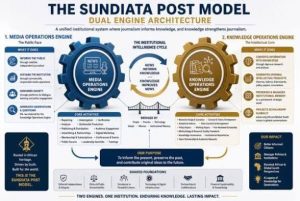
In the preceding articles, I have argued that the twenty-first-century newsroom must evolve into a knowledge-producing institution; situated that proposition within a broader intellectual tradition; introduced the Dual Engine Architecture through which journalism and knowledge production become mutually reinforcing; and proposed the Realm of the Long Term together with its Seven Pillars as the institutional foundations of enduring organisations.
A natural question now arises. 
How should the success of such an institution be measured?
For decades, the commercial media industry understandably prioritised audience size and print circulation. With the rise of digital journalism, these traditional measures were increasingly supplemented—and in many cases displaced—by page views, unique visitors, click-through rates, impressions, engagement metrics and social media reach. These indicators remain valuable because they reveal important aspects of audience behaviour and commercial performance.
Yet they do not tell the whole story.
A media organisation may attract millions of readers while producing little original knowledge. It may dominate online conversations today yet leave no enduring intellectual contribution tomorrow. It may generate impressive revenue while gradually losing public trust. Conversely, an institution may produce ideas that influence scholarship, public policy and professional practice for decades without ever becoming the largest media organisation in its market.
The central proposition of the Sundiata Post Model (SPM) is therefore straightforward: institutions should ultimately be measured not merely by what they produce, but by what they leave behind.
This requires us to rethink what institutional success actually means.
Four Levels of Institutional Success
The SPM proposes that institutional success exists at four progressively deeper levels: Operational Success, Institutional Success, Civilisational Success and Legacy.
These are not competing categories. They are successive stages in the evolution of an enduring institution.
Operational Success
Operational Success concerns an institution’s ability to perform its immediate responsibilities effectively.
For a newsroom, this includes producing accurate journalism, meeting publication deadlines, maintaining editorial standards, growing audiences, generating sustainable revenue and responding effectively to the daily demands of public communication.
These are indispensable functions. Without operational competence, institutions cannot survive.
Yet Operational Success is also the most immediate form of success. It is measured in days, weeks, months and annual performance reports.
It answers a relatively simple question:
Is the institution performing well today?
Many organisations achieve Operational Success.
Far fewer move beyond it.
Institutional Success
Institutional Success represents a deeper level of achievement.
Here, attention shifts from performance to permanence.
The institution is no longer evaluated solely by today’s output but by its ability to preserve its mission while continuously renewing itself. Leadership succession becomes important. Governance becomes important. Institutional memory becomes important. Financial resilience, knowledge stewardship, innovation, public trust and organisational culture become defining concerns.
This is the Realm of the Long Term introduced in the previous article.
The central question is no longer:
How well are we performing?
Instead, it becomes:
Will this institution remain valuable twenty, fifty or one hundred years from now?
Institutions that reach this level become larger than any individual leader.
Their systems become more important than personalities.
Their mission becomes more enduring than their founders.
This transition requires institutionalisation: the process through which an institution converts individual vision, knowledge and leadership into durable systems, structures, practices and values that can survive changes in personnel and leadership.
An institution is not truly enduring if its most important knowledge exists only in the mind of one person, if its critical relationships depend entirely upon one individual, or if its strategic direction disappears when its founder departs.
Institutionalisation is therefore one of the mechanisms through which Institutional Success becomes possible. It transforms personal capacity into institutional capacity and individual achievement into organisational inheritance.
Civilisational Success
The third level extends beyond the institution itself.
Civilisational Success concerns the institution’s contribution to society’s accumulated stock of knowledge.
It occurs when an institution produces ideas, methods, frameworks, archives, research, public debates and intellectual traditions that continue shaping society long after their immediate circumstances have passed.
At this level, the institution no longer influences only its industry.
It contributes to civilisation itself.
Its ideas become reference points.
Its publications become historical records.
Its methodologies become professional standards.
Its research becomes part of society’s collective memory.
The institution’s greatest contribution is therefore not simply the news it reported, but the knowledge it helped humanity preserve.
The SPM is itself grounded in this proposition. As a model for twenty-first-century journalism, it argues that a newsroom organised as a knowledge-producing institution should be capable of generating original intellectual contributions alongside its daily journalism. The development of The Insecurity Triad, the Trinity of Sovereignty Decay (TSD), and the Decoupling Sovereignty Index (DSI) illustrates this possibility. These frameworks did not emerge from a conventional research institute or university department, but from a newsroom deliberately organised to produce knowledge as well as news. They therefore serve as a proof of concept for one of the Model’s central propositions: journalism, when institutionally designed for long-term knowledge creation, can produce intellectual assets whose influence extends beyond the news cycle.
Yet even Civilisational Success leaves one final question unanswered.
What is the highest measure of institutional success?
The SPM proposes a simple answer:
Legacy
Legacy is often misunderstood. It is commonly associated with longevity, reputation or the accomplishments of exceptional individuals. While these may contribute to legacy, they do not define it.
Institutions can exist for centuries without leaving a meaningful imprint on society. Others achieve widespread recognition during their lifetime yet fade quickly from public memory once circumstances change.
Legacy is something deeper.
It measures Generational Influence—the extent to which an institution’s ideas, values, methods and contributions continue shaping future generations.
Time alone does not create legacy.
Survival should not be mistaken for significance.
The true test of an institution is not simply whether it continues to exist, but whether its existence continues to matter.
Institutions achieve legacy when successive generations continue drawing value from what they have created. Their archives remain useful. Their research continues to be consulted. Their journalism retains historical relevance. Their ideas continue shaping public debate. Their methods become part of professional practice.
Legacy therefore transforms institutional success from a temporary achievement into a continuing public resource.
Every enduring institution eventually confronts the same reality.
Its founders leave. Leadership changes.
Generations pass.
If an institution depends entirely upon the vision or personality of a single individual, succession becomes a moment of vulnerability rather than renewal.
The question, therefore, is not simply whether an institution has a great founder or an exceptional leader. It is whether the institution can transform that individual’s vision into a capacity that belongs to the institution itself.
This is the deeper meaning of institutionalisation.
From Personality to Institution
Institutionalisation requires an organisation to deliberately convert individual capacity into institutional capacity.
It begins with the institutionalisation of mission. The institution’s purpose must be sufficiently clear and durable that it belongs to the organisation rather than to the personality of its founder.
It requires systems and processes that allow critical functions to continue regardless of who occupies a particular position. An institution becomes resilient when essential work can be reproduced through established procedures rather than dependent upon individual memory or improvisation.
It requires institutional memory. Decisions, research, methodologies, archives, lessons, relationships and intellectual work must be captured and preserved. What exists only in the mind of one person is not yet fully institutional knowledge.
It requires deliberate leadership succession. The next generation of leaders cannot be an afterthought. Institutions that intend to endure must cultivate successors before succession becomes necessary.
It requires distributed knowledge and authority. Critical knowledge, relationships and decision-making capacity should not become concentrated in a single individual. The institution must develop multiple centres of competence capable of sustaining its mission.
It requires durable governance. Governing structures, accountability mechanisms and institutional principles must be strong enough to protect the mission through changes in leadership and circumstance.
And it requires an institutional culture that reproduces the values of the organisation. The deepest form of institutionalisation occurs when the institution’s values become embedded in the behaviour of successive generations rather than remaining attached to the personality of its founder.
These seven mechanisms—mission, systems, institutional memory, succession, distributed knowledge and authority, governance, and culture—help transform an institution from a personality-driven organisation into a self-renewing institution.
The test of institutionalisation is therefore straightforward:
Can the institution continue to perform, learn, adapt and create value when the person who built it is no longer there?
If the answer is yes, the institution has begun to transcend personality.
The founder’s greatest achievement, therefore, may not be what he or she accomplishes personally, but what the institution becomes capable of accomplishing without them.
The SPM therefore treats stewardship as one of the defining responsibilities of institutional leadership. Leaders are custodians rather than owners. Their responsibility is not merely to achieve success during their own tenure but to strengthen the institution so that it serves generations they will never meet.
This is also where the distinction between journalism and knowledge production becomes most visible.
Daily reporting serves the immediate needs of society.
Knowledge serves both the present and the future.
Investigations become archives.
Research becomes scholarship.
Editorial judgement becomes institutional memory.
Original frameworks become intellectual assets.
Public records become part of society’s historical inheritance.
Every institution should therefore ask itself one final question:
If this institution ceased to exist tomorrow, what knowledge would disappear with it?
The answer reveals the depth of its institutional contribution.
An institution that merely reports events leaves little behind.
An institution that produces enduring knowledge leaves future generations with resources they would otherwise never have possessed.
That is the difference between activity and inheritance.
Between success and significance.
Between performance and legacy.
Beyond Performance
This distinction matters because institutions frequently confuse activity with achievement.
Publishing thousands of stories is activity.
Building a permanent archive of public knowledge is an achievement.
Generating revenue is an activity.
Creating financial systems that preserve editorial independence across generations is an achievement.
Winning today’s audience is an activity.
Earning public trust that survives decades is an achievement.
The SPM therefore argues that enduring institutions should evaluate themselves not merely by annual outputs but by their cumulative contribution to society.
This shifts institutional thinking from production to legacy.
The Highest Measure of Success
The SPM understands institutional success as a continuum rather than a destination.
Operational Success enables performance.
Institutional Success enables endurance.
Civilisational Success enables enduring contributions to society’s accumulated knowledge.
Legacy enables an institution’s ideas, values and contributions to continue shaping future generations.
Every institution must first learn to perform.
Some will also learn to endure.
Fewer will contribute enduring value to civilisation.
Only the rarest institutions ultimately leave a legacy that continues to enrich society long after those who built them have passed.
Institutions are ultimately remembered not for how much they produced, but for what they enabled humanity to remember, understand and build upon. That is why the highest measure of institutional success is Legacy.
Trust is sacred. Stay seasoned.
•Dr Max Nwabueze Amuchie is an African scholar-practitioner and framework builder whose original intellectual work spans insecurity, sovereignty, institutional development, and journalism as knowledge production. His frameworks include The Insecurity Triad, the Trinity of Sovereignty Decay, the Decoupling Sovereignty Index, and the Sundiata Post Model. A member of the League of Nigerian Columnists (LNC), he is the CEO & Theorist-In-Chief of Sundiata Post, Lead Researcher at the Sundiata Post Intelligence Unit (SPIU), and an Expert Member and Peer Reviewer in Behavioural and Social Sciences at ScienceOpen.