By Max Amuchie


The tour of Hangzhou was quite revealing and enriching.
As I noted in the first part of this experience, we had 12 lectures. But it wasn’t just lectures. Beyond sitting in classrooms and listening to erudite instructors and professors, we had field visits. Each visit revealed something new, something unique, and sometimes what appeared to be an opening to a vista of opportunities. 
We had 12 field visits, and each was eye-opening. But some left particularly lasting impressions on us.
One of them was our visit to the Jiufeng Waste Incineration Plant in Nanfeng Village, Yuhang District, Hangzhou.
It was eye-opening.
We saw waste utilisation, high-standard environmental protection treatment and smart operations working together in a way that was almost surreal.
We watched in awe.
The plant is regarded as a global benchmark for addressing what is commonly called the “NIMBY” problem—Not In My Backyard. Rather than hide a waste facility away from the public, the plant has been designed partly as a tourist attraction and education centre, complete with a 3D cinema, a viewing corridor and even a café overlooking the furnace.
We also learnt that its emission standards are publicly displayed and are designed to surpass stringent European Union requirements.
But two things stood out for me: the smart operations and the philosophy of turning waste into resources.
This is how the system works.
The bottom ash—the leftover grit from the combustion process—is processed into eco-bricks and road-base materials for construction.
Fly ash is stabilised with chelating agents and safely disposed of or utilised in cement production.
Heat generated from incineration is converted into electricity, powering tens of thousands of homes, while excess steam is piped to nearby factories for industrial use.
Essentially, only a small fraction of inert residue ends up in landfill.
It is a circular economy in action.
From where we watched through the glass shield, we didn’t see the final products, such as the bricks, during the tour. But we learnt about the digital monitoring system that keeps the entire cycle under control.
That, for me, was the real brain of the operation.
The plant has a centralised DCS—Distributed Control System—a giant wall of screens displaying real-time data around the clock.
The system monitors and manages virtually every stage of the operation.
Combustion optimisation: AI-assisted systems adjust oxygen levels, temperature and waste feed to keep incineration stable and efficient.
Emissions tracking: Continuous monitoring systems track pollutants such as dioxins, sulphur dioxide and particulates. The data is transmitted to the local environmental authorities, creating a level of transparency and external monitoring that makes manipulation considerably more difficult.
Crane automation: Operators work from a control room, while automated systems help determine the optimal mixing of waste from different pits to ensure efficient and even combustion.
The cranes themselves were operating largely on autopilot. A human operator could supervise cranes from a relatively quiet control room and intervene manually when necessary—for instance, when the composition of the waste changed significantly.
I found this particularly fascinating.
It was a reminder that what we call “smart city” technology is not necessarily about futuristic gadgets or spectacular buildings. Sometimes, it is simply about taking an ordinary urban problem and applying data, engineering, automation and disciplined management to it.
And, inevitably, Lagos came to my mind.
I began to wonder what a facility of this nature could mean for Lagos, Abuja and other major Nigerian cities that generate enormous quantities of waste every day but struggle with collection, disposal and recycling.
Imagine if some of that waste could be converted into electricity, construction materials and industrial inputs.
Imagine if waste management became a serious industry rather than merely a sanitation problem.
It would create jobs. It could generate energy. It could reduce the environmental burden on our cities. It could create new businesses around recycling and resource recovery. And, perhaps most importantly, it could change the way citizens think about waste.
The lesson I took away from Jiufeng was not that Nigeria should simply copy China.
Countries have different circumstances, institutions and capacities.
The more important lesson is that problems that appear permanent can sometimes be transformed when technology is combined with institutional capacity, investment and political will.
Waste does not have to remain waste.
Sometimes, it is a resource waiting for a system smart enough to recognise it.
And that, perhaps, is one of the thrills of experiencing the Chinese “smart life”—you begin to look at familiar problems through a different lens.
The Wonder of Yiwu
Then we travelled to Yiwu, where we spent four days.
If the Jiufeng plant showcases Hangzhou’s wisdom in “turning waste into treasure,” then Yiwu takes the miracle of “creating something out of nothing” to the extreme. Its most spectacular sight isn’t mountains or rivers, but its world’s largest distribution centre for small commodities. Known as the “World’s Supermarket,” to many but officially named Yiwu International Trade City, it’s a “magic city” where you can “see the whole world in a single day.”
Its scale is staggering:
The market houses about 75,000 booths, offering over 2.1 million types of small commodities, from Christmas decorations to World Cup merchandise.
It trades with over 230 countries and regions, attracting nearly 600,000 foreign buyers annually, with over 15,000 foreign merchants from about 100 countries living in the city.
In 2025, its total foreign trade value reached 836.5 billion RMB (or US$124.5 billion); its export volume ranks first among all counties in China; and it produces about 80% of the world’s Christmas decorations.
From “Trading Chicken Feathers for Sugar” to a “Digital Brain”
Yiwu’s success story is, in itself, an epic of “creating something from nothing.” It originated from impoverished farmers carrying shoulder-poles and trading chicken feathers for sugar as a barter business.
Today, it has evolved into a “Digital Brain.” The Yiwu Global Digital Trade Centre (GDTC), an 8.2 billion RMB (US$1.22 billion) investment, integrates AI, blockchain, and other cutting-edge technologies. About 30,000 merchants use AI daily to generate multilingual promotional videos and facilitate global payments through “Yiwu Pay.”
We were taken to Zone 6 of the Trade City to examine digital strategies for small commodity promotion and their applicability to the marketing of agricultural products and handicrafts in Nigeria. And we had opportunity to move round the market the much we could.
The Yiwu Night Market
And then came the Yiwu Night Market.
We went in trickles at first. A few people ventured out and returned with stories of what they had seen, what they had bought and the sheer scale and energy of the place. Their accounts were infectious. Before we knew it, almost everyone in the group had made the trip to the night market.
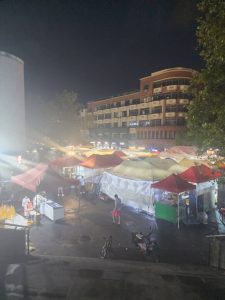
The fun was infectious. The excitement was second to none.
There was something fascinating about watching the place come alive at night. The lights, the movement, the shops, the colours, the endless stream of people and the sheer variety of goods created an atmosphere that was difficult to describe.
For many of us, it wasn’t just shopping. It was an experience.
Yiwu seemed to embody another dimension of the Chinese story—commerce at an extraordinary scale, connected to everyday life. What struck me was how the ordinary and the sophisticated existed side by side. Small traders, shoppers and visitors moved through a commercial ecosystem supported by a much larger infrastructure of manufacturing, logistics, technology and distribution.
And, of course, we shopped.
Some went looking for specific things and came back with considerably more than they had planned to buy. Others went simply to look and somehow became shoppers.
The night market became one of those shared experiences that brought the group together outside the classroom and field visits.
After lectures, presentations and technical tours, here we were—laughing, bargaining, browsing and discovering another side of China.
It was perhaps the perfect reminder that behind all the talk about artificial intelligence, smart cities, digital villages and advanced infrastructure are ordinary people who also want to eat, shop, socialise, have fun and enjoy life.
Yiwu gave us a taste of that smart life in a completely different way.
The Smartphone Became the Interpreter
And talking about shopping, perhaps nowhere else was the Chinese “smart life” more vividly expressed than in the Yiwu Night Market.
Most of the traders don’t speak English. Yet that hardly constituted a barrier.
The smartphone did the talking.
Android phones and iPhones became interpreters, calculators and, in a sense, negotiation platforms.
If you picked up an item and wanted to know the price, the trader would simply type the figure into the calculator app and show you the screen.
You took the phone, entered the amount you were willing to pay and handed it back.
The bargaining continued this way—one figure after another—until both parties agreed on a price.
No common language was required.
But it didn’t stop there.
If you wanted to make an inquiry, you could speak into a translation app. Your words were translated into Chinese and displayed or played back for the seller. The seller responded in Chinese. The app translated the response back into English and played it to you.
And just like that, a transaction was made.
It was fascinating to watch.
What struck me was the simplicity of it. There was no sophisticated infrastructure on display, no giant screen announcing the arrival of artificial intelligence, no elaborate demonstration of futuristic technology.
Just a smartphone.
But that little device was doing something profound: it was removing a barrier between two people who did not share a language.
A Nigerian visitor could walk into a shop in Yiwu, communicate with a Chinese trader, negotiate a price and complete a transaction without either party speaking the other’s language.
That, to me, is what makes technology truly “smart”.
Technology is not smart merely because it is advanced. It becomes smart when it makes life easier.
At the Yiwu Night Market, the smartphone was not a luxury or a gadget. It was infrastructure.
It was the calculator. It was the interpreter.
It was the negotiation table. And, ultimately, it was the bridge between the buyer and the seller.
What Nigeria Can Learn from Yiwu
The Yiwu experience left me thinking about Nigeria. Not because Nigeria needs to copy Yiwu. We don’t.
But because Yiwu demonstrates what can happen when small businesses, markets, infrastructure, technology and government policy begin to work in the same direction.
First, Nigeria must learn to see small commodities as an economic sector.
We often associate economic transformation with large factories, oil, mining or major infrastructure projects.
Yiwu tells a different story.
Millions of relatively ordinary products, produced and traded by thousands of small businesses, can become a formidable economic engine when the ecosystem around them is properly organised.
Nigeria has millions of artisans, traders, farmers, designers and small manufacturers producing goods that rarely move beyond fragmented local markets.
The opportunity is to aggregate them.
Second, production must be connected to markets. One of the striking features of Yiwu is that the market is not an isolated marketplace. It is connected to manufacturers, wholesalers, logistics providers, digital platforms and international buyers.
Nigeria has the products.
What we need is a much stronger system for taking those products from producer to market to consumer—locally, continentally and globally.
Third, Nigeria should stop thinking of digitalisation as merely putting businesses online. The smartphone transaction I witnessed at the night market brought this home to me.
Digital technology becomes transformative when it solves an actual problem.
For Nigerian farmers and artisans, that could mean finding buyers, translating product information, negotiating prices, receiving payments, arranging logistics, obtaining market intelligence and reaching customers beyond their immediate communities.
Nigeria has already begun experimenting with digital agricultural marketplaces, but the challenge is to connect such initiatives to a much larger ecosystem of production, finance, logistics, standards and export markets.
Fourth, Nigeria needs commercial clusters.
Instead of scattering thousands of small producers across disconnected locations, we should think about clusters organised around products and capabilities.
Imagine a properly planned Nigerian commercial ecosystem for:
leather goods;
textiles and fashion accessories;
furniture;
ceramics and crafts;
processed agricultural products;
shea products;
cocoa derivatives;
spices;
food processing;
beauty and personal-care products;
cultural and creative products.
The idea is to bring producers, buyers, finance, packaging, quality control, warehousing, logistics, digital marketing and export services into the same ecosystem.
Fifth, Africa is Nigeria’s first great market opportunity.
This may be the biggest lesson.
A Nigerian producer does not necessarily need to think first about shipping a product to Europe, America or Asia. There are more than 50 African markets, and the African Continental Free Trade Area provides a framework for building a much larger continental market.
Nigeria already has substantial non-oil export activity. The Nigerian Export Promotion Council reported that non-oil exports reached a record US$6.1 billion in 2025, with 281 different products exported.
The question, therefore, is no longer whether Nigeria can produce.
It is whether we can organise production for scale, quality, market access and repeatability.
Sixth, government should enable rather than attempt to do everything.
There is an important nuance in the Yiwu story.

Yiwu’s development was not simply a government project imposed from above. That is an important lesson for Nigeria.
Government can provide roads, electricity, broadband, standards, export facilitation, market information, security, finance mechanisms and efficient customs.
But entrepreneurs must be allowed to experiment, compete, fail, innovate and grow.
Seventh, value addition is where the real opportunity lies.
Nigeria has historically exported too many commodities in forms that capture relatively little of the final value. The opportunity is to move from exporting raw materials to exporting finished or semi-finished products.
Instead of raw agricultural products, why not packaged, processed and branded foods?
Instead of exporting cultural creativity informally, why not build globally competitive Nigerian fashion, crafts, design and lifestyle brands?
This is where the Yiwu lesson meets Nigeria’s own enormous productive and creative capacity.
And finally, think ecosystem, not miracle.
Yiwu did not become Yiwu overnight.
Its transformation involved marketisation, industrialisation, urbanisation, internationalisation and, later, digitalisation. That is perhaps the most important lesson of all.
Economic miracles are usually not miracles. They are systems built over time.
What I saw in Yiwu was not simply a gigantic market selling millions of products.
I saw an ecosystem that had learnt how to connect a small trader to a manufacturer, a manufacturer to a market, a market to logistics, logistics to a foreign buyer and technology to almost every stage of the process.
And I kept thinking about Nigeria. What will it take to build an ecosystem that allows our own millions of small producers to become globally competitive?
Mukhtar Muhammad Sadiq, who spoke on behalf of the Nigerian team at the closing ceremony of the programme back in Hangzhou, echoed those sentiments. “This seminar was, in truth, an invitation — an invitation to learn from China’s journey, and an offer of partnership for Nigeria’s development and the mutual benefit of both our nations.
“As we return home, we carry with us not only knowledge, but responsibility — the responsibility to be the engineers of our own ecosystem of success, gradually, systematically, and in a manner true to who we are as Nigerians,” Sadiq said.
•Concluded.
Trust is sacred. Stay seasoned,
•Dr Max Nwabueze Amuchie is an African scholar-practitioner and framework builder whose original intellectual work spans insecurity, sovereignty, institutional development, and journalism as knowledge production. His frameworks include the Insecurity Triad, the Trinity of Sovereignty Decay, the Decoupling Sovereignty Index, and the Sundiata Post Model. He is the CEO & Theorist-In-Chief of Sundiata Post, Lead Researcher at the Sundiata Post Intelligence Unit (SPIU), and an Expert Member and Peer Reviewer in Behavioural and Social Sciences at ScienceOpen.
Max Amuchie
Publisher/CEO
Sundiata Post Media Limited
3rd Floor Office Suite, Bayelsa State Guest House,
Plot 1038 Shehu Shagari Way, Maitama, Abuja, Nigeria
Telephone: +234 (0)92 900 705;
Cell: +234 (0) 803 308 3361
Email: [email protected]
skype: max.amuchie
. . . A candle loses nothing by lighting another candle