


By Max Amuchie | The Sunday Stew
There is a familiar assumption about the work of a newsroom. It observes events, gathers information, verifies facts, reports developments and helps the public make sense of the world. Its primary responsibility is to tell society what is happening. 
But what happens when a newsroom goes a step further? What happens when it develops an instrument to measure the very conditions it reports?
That question lies at the heart of the Decoupling Sovereignty Index (DSI), developed within the Sundiata Post Knowledge Lab (SPKL). It is also a question with a history. The DSI did not emerge in an intellectual vacuum. It belongs to a distinguished, though varied, tradition in which media organisations and journalism-associated research institutions have developed indices and analytical instruments to measure complex economic, political and social realities.
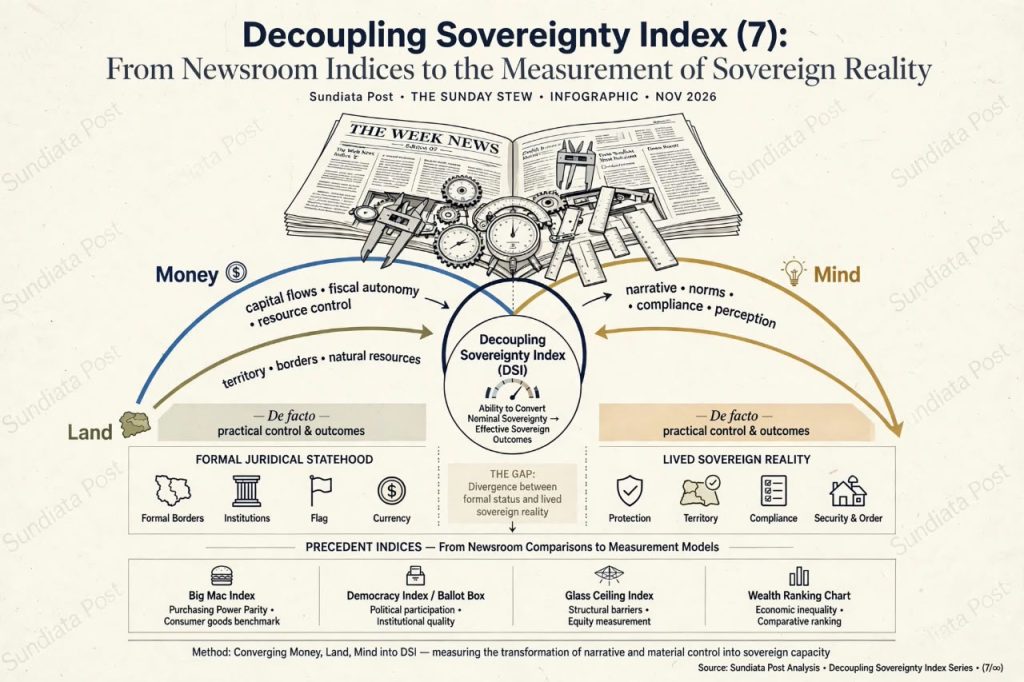
This tradition deserves closer attention, not simply because it provides precedents for the DSI, but because it challenges the narrow conception of what a media organisation can become.
When a publication becomes a measuring institution
One of the most familiar examples is The Economist‘s Big Mac Index, introduced in 1986. What began as a light-hearted way of explaining purchasing power parity became a widely recognised reference point for comparing currencies and assessing whether they were overvalued or undervalued.
The underlying idea was straightforward. A Big Mac is a broadly comparable product sold across different national economies. By comparing its price in different countries, the index offers an accessible way of illustrating differences in purchasing power and currency valuation.
Its significance goes beyond the hamburger or the exchange-rate calculation. The Economist took an everyday commercial product and turned it into an instrument for explaining a complex economic relationship. It demonstrated that a publication could create a recognisable measurement tool, sustain it over time and contribute to public understanding of an issue that might otherwise remain confined to specialist economic analysis.
The Big Mac Index is therefore an important precedent for the DSI. Both demonstrate the possibility of developing an analytical instrument from within a media institution. Their subject matter and methodologies are different, but the institutional proposition is related: a media organisation need not limit itself to reporting what others measure. It can develop a framework of its own.
The Economist‘s relationship with measurement extends beyond the Big Mac Index.
Its Glass-Ceiling Index provides a comparative assessment of women’s position and influence in the workforce, particularly across OECD countries. Drawing on multiple indicators, it examines dimensions such as education, labour-force participation, pay and representation. It converts a broad social question into a structured instrument for comparison across countries.
The index demonstrates how a media organisation can use data to make a complex social condition more visible. Rather than treating women’s economic and professional opportunities as a collection of disconnected stories, it brings several dimensions together within a common analytical framework.
There is, however, an important institutional distinction to make when considering another prominent example associated with The Economist: the Democracy Index.
The Democracy Index is produced by the Economist Intelligence Unit (EIU), the research and analysis division of the Economist Group. Its institutional origin is therefore different from that of a conventional newspaper editorial product. First published in 2006, it assesses countries through indicators covering electoral process and pluralism, functioning of government, political participation, political culture and civil liberties.
Its importance to the DSI is considerable. The Democracy Index demonstrates how a media-associated research institution can develop a systematic framework for assessing political systems across countries. It takes a concept as broad and contested as democracy and translates it into a structured comparative assessment.
The distinction is noteworthy. One emerged from a publication’s editorial and data environment; the other was developed by a specialised research division within the same wider corporate group. Yet both illustrate the capacity of media institutions to produce analytical instruments that travel beyond the immediate news cycle.
The wider media measurement tradition
The practice is not confined to The Economist.
Bloomberg’s Billionaires Index offers another example of a media organisation developing a continuing measurement product. It tracks the estimated net worth of the world’s wealthiest individuals, using financial information, market movements, economic developments and reporting to update its rankings.
Its value lies in the methodology and the continuing attempt to estimate and explain changes in wealth. It converts financial developments into a regularly updated instrument that attracts attention well beyond the conventional boundaries of business reporting.
Bloomberg’s example shows how a media organisation can combine reporting, financial data and analytical methods to produce a distinctive information product. It also illustrates the commercial and institutional possibilities of building an enduring data asset around a subject of public interest.
A further example broadens the picture, although it requires a different classification.
The News Coverage Index, developed by the Pew Research Center’s Project for Excellence in Journalism (PEJ), represents a journalism-research tradition rather than a conventional newsroom product. It systematically examined news coverage across different media sectors, including newspapers, online news, network television, cable television and radio. Its purpose was to identify the stories, subjects and newsmakers receiving attention across the media landscape.
It shows that measurement can also be directed towards journalism and the information environment itself. It moves beyond the question of what the media report to examine how stories circulate, what receives attention and how the news agenda is constructed.
Taken together, these examples reveal a broad tradition, not a single institutional model. Some emerged directly from media organisations; others were developed by research units or independent journalism-monitoring initiatives. Their methods, subjects and institutional arrangements differ.
What connects them is the willingness to move beyond the immediate production of news and develop structured instruments for understanding, comparing or measuring aspects of the world.
That is the intellectual and institutional tradition in which the DSI should be situated.
The DSI: Measuring the distance between statehood and sovereign reality
The DSI takes this tradition into a different and considerably more complex field. Its starting point is a fundamental distinction: the existence of a state in law does not automatically establish the effective exercise of sovereignty in the lives of its citizens.
A country may possess internationally recognised borders, constitutional institutions, a government, a national currency and formal control over its territory. These constitute important attributes of juridical statehood. Yet the lived experience of its citizens may tell a different story.
Where the state cannot consistently protect its population, secure its territory, enforce its authority, sustain institutional functions or command compliance, a gap emerges between formal sovereignty and empirical reality.
The DSI is designed to examine that gap.
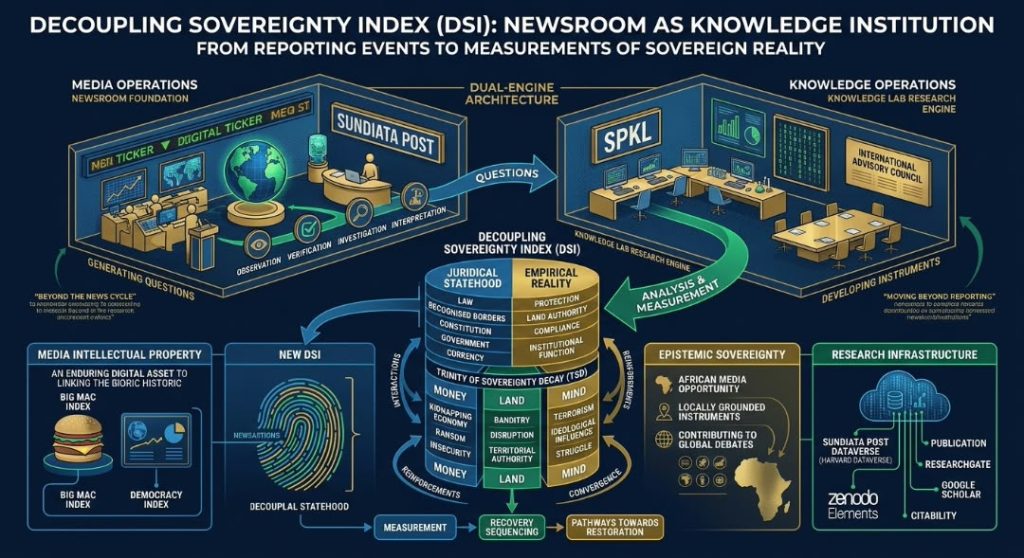
It draws on the Trinity of Sovereignty Decay (TSD), which provides the conceptual foundation for understanding how the erosion of state protection, compliance and territorial credibility affects institutional function and, ultimately, sovereign reality.
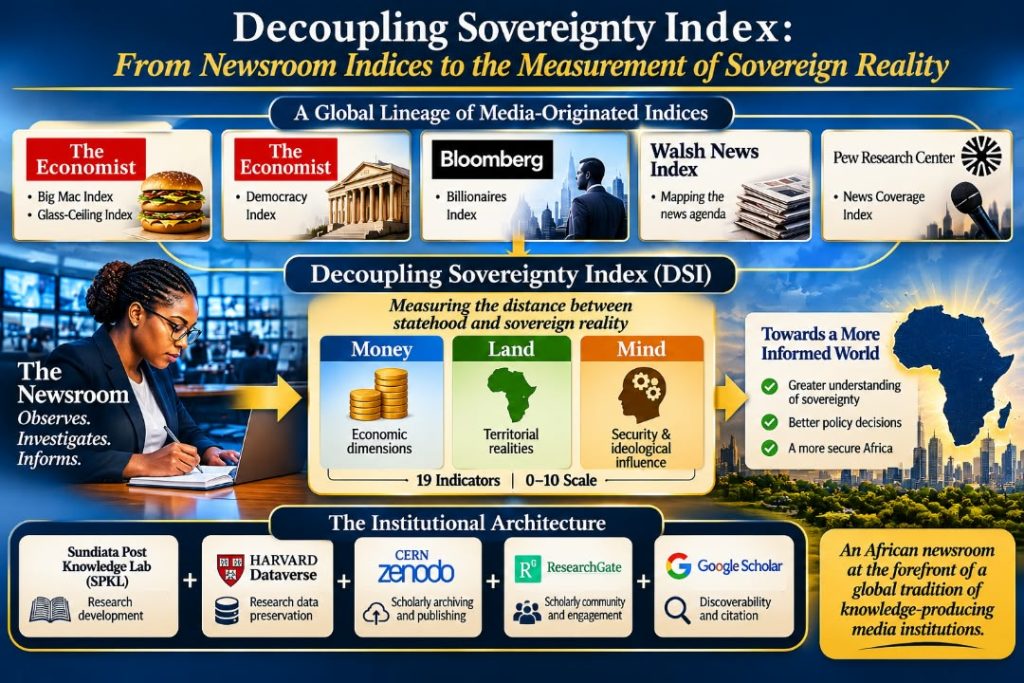
The index organises its measurement architecture around three interrelated dimensions: Money, Land and Mind.
Money examines the economic structures and incentives associated with insecurity, kidnapping and ransom economies. Land examines the contestation of territory, banditry and the disruption of production and territorial authority. Mind examines terrorism, ideological influence and the struggle over political and social order.
These dimensions are not isolated categories. Consider a community driven from its farmland by armed groups. Agricultural production declines, livelihoods collapse and displacement increases. Some communities become exposed to kidnapping and ransom demands, while extremist narratives may exploit the resulting fear, grievance and institutional absence. A territorial crisis consequently acquires economic and ideological dimensions. Land, Money and Mind reinforce one another.
This interaction is central to the DSI’s analytical design.
The current architecture comprises 19 universal indicators: six under Money, seven under Land and six under Mind. The indicators are scored on a 0–10 scale, with zone-specific sub-indicators — at the zone (sub-national level)— providing the basis for contextual assessment.
The architecture also recognises that measuring decay alone is insufficient. A serious framework must consider how recovery can occur, the order in which institutional capacities may need to be restored and whether progress in one dimension is being reinforced or undermined by developments in another.
This is why the DSI incorporates higher-order analytical considerations, including the Convergence Indicator and recovery sequencing.
Convergence does not mean that all three scores are high. It occurs when deterioration in one dimension accelerates deterioration in another — when territorial loss makes ransom economies viable, which in turn funds ideological recruitment. That feedback, not the individual scores alone, is what the DSI seeks to capture.
The objective is to develop an instrument for understanding the condition of sovereignty, the mechanisms through which its reality becomes detached from its formal existence, and the possible pathways towards restoration. The DSI therefore goes beyond conventional assessments of insecurity to examine what insecurity reveals about the condition of the state itself.
Media intellectual property: Beyond the news cycle
The examples discussed earlier establish that media institutions can create indices with enduring value. They also point to a larger question about the nature of media intellectual property.
News stories have a relatively short public life. They respond to events, shape immediate conversations and become part of the historical record. Indices can create a different kind of institutional asset. They can be refined, updated, tested, compared and applied over time. They can generate research, attract collaborators and provide a common analytical language for discussions that might otherwise remain fragmented.
The Big Mac Index has endured because it made a complicated economic relationship accessible. The Democracy Index has become a reference point for comparative discussions of political systems. The Glass-Ceiling Index has made different dimensions of gender inequality more visible. Bloomberg’s Billionaires Index has built a continuing data product around wealth. Pew’s News Coverage Index demonstrated the value of systematic analysis of the media environment.
The DSI seeks to make a comparable contribution in the field of sovereignty studies, although its subject, conceptual architecture and methodological demands are distinct. It is the first index designed to measure sovereign decoupling — the gap between a state’s formal legal authority and its effective, lived reach, tracked at the zonal level through Money, Land and Mind.
For Sundiata Post, this is an extension of journalism’s strongest attributes: observation, verification, investigation, interpretation and the capacity to identify questions of public importance.
The newsroom provides the foundation. The Knowledge Lab provides the research engine. The DSI provides an analytical instrument through which a complex reality can be examined systematically.
This is the logic of Sundiata Post Model’s dual-engine architecture: media operations and knowledge operations working alongside each other, with journalism generating questions and research developing instruments capable of examining them.
From institutional ambition to research infrastructure
The institutional development surrounding the DSI is as important as the index itself.
The establishment of the SPKL provides an institutional home for the development, refinement and advancement of its research frameworks and intellectual contributions. The creation of the Sundiata Post Dataverse on Harvard Dataverse and the Sundiata Post Elements community on CERN’s Zenodo provides dedicated infrastructure for preserving, publishing, archiving and making research outputs accessible.
Complementing these repositories, ResearchGate extends the dissemination of Sundiata Post‘s scholarly work and facilitates engagement with the international research community, while Google Scholar enhances the academic indexing, discoverability and citation potential of its research publications.
Together, these platforms constitute an evolving international research and knowledge infrastructure. Their value is not archival alone: they are what allow an index to be tested, challenged, revised and cited — which is what separates an index from an opinion.
The Decoupling Sovereignty Index International Advisory Council (DSI-IAC) represents another stage in that process. Its purpose is to bring independent expertise and scrutiny to the development of the DSI, strengthen its methodological foundations and build the conditions for credible application.
Developing an index is one achievement; establishing its reliability, testing its application and earning the confidence of researchers and institutions are further responsibilities. The work ahead, therefore, requires building an enduring research instrument and the institutional arrangements necessary to sustain it.
Epistemic sovereignty: The African media opportunity
There is a wider implication for the African media. For too long, the media have largely been assigned the responsibility of reporting the findings of others.
The examples considered here show that media organisations can originate questions, develop methods, build data assets and create instruments that contribute to wider intellectual and policy conversations.
This does not mean that every newsroom should become a research institute or that journalism should make claims beyond its competence. It means that media organisations with the necessary ambition, institutional discipline and intellectual capacity can develop knowledge products that complement their journalism.
For the African media, the opportunity is particularly significant. The continent is the subject of extensive international reporting, research and policy analysis. Yet the development of locally grounded analytical instruments remains an important area of institutional opportunity.
The question is not whether African media can reproduce indices developed elsewhere. It is whether they can develop credible instruments rooted in the realities of African societies, informed by rigorous methods and capable of contributing to global debates.
The DSI is Sundiata Post‘s response to that challenge.
It belongs to a lineage of media-originated and media-associated measurement instruments, but it is not a replica of any of them. Its distinctive contribution is to examine how far the formal existence of a sovereign state corresponds with the actual exercise of sovereign authority.
That question has implications beyond security analysis. It touches on the meaning of statehood, the credibility of public institutions, the protection of citizens, the control of territory and the conditions under which sovereignty becomes real in everyday life.
The journey from a newsroom to a knowledge institution requires original ideas, defensible methods, institutional structures and intellectual products capable of enduring beyond the news cycle.
The DSI is one such attempt.
The newsroom that reports the condition of society can also develop the instruments through which that condition is measured. And when it does so with methodological discipline and institutional purpose, it moves beyond documenting the world to contributing to the tools through which the world understands itself.
From the Desk to the World
•Dr Max Nwabueze Amuchie is the developer of the Decoupling Sovereignty Index and the CEO of Sundiata Post Media Ltd. He is the Founder and Curator of the Sundiata Post Research Repositories (Harvard Dataverse and Zenodo).
Email: [email protected] | X: @MaxAmuchie