
News
Senate ignores Bill seeking to establish foreign exchange market in Nigeria

- /home/naijuinz/public_html/wp-content/plugins/mvp-social-buttons/mvp-social-buttons.php on line 27
https://naijablitznews.com/wp-content/uploads/2024/05/senate1.jpg&description=Senate ignores Bill seeking to establish foreign exchange market in Nigeria', 'pinterestShare', 'width=750,height=350'); return false;" title="Pin This Post">
- Share
- Tweet /home/naijuinz/public_html/wp-content/plugins/mvp-social-buttons/mvp-social-buttons.php on line 72
https://naijablitznews.com/wp-content/uploads/2024/05/senate1.jpg&description=Senate ignores Bill seeking to establish foreign exchange market in Nigeria', 'pinterestShare', 'width=750,height=350'); return false;" title="Pin This Post">


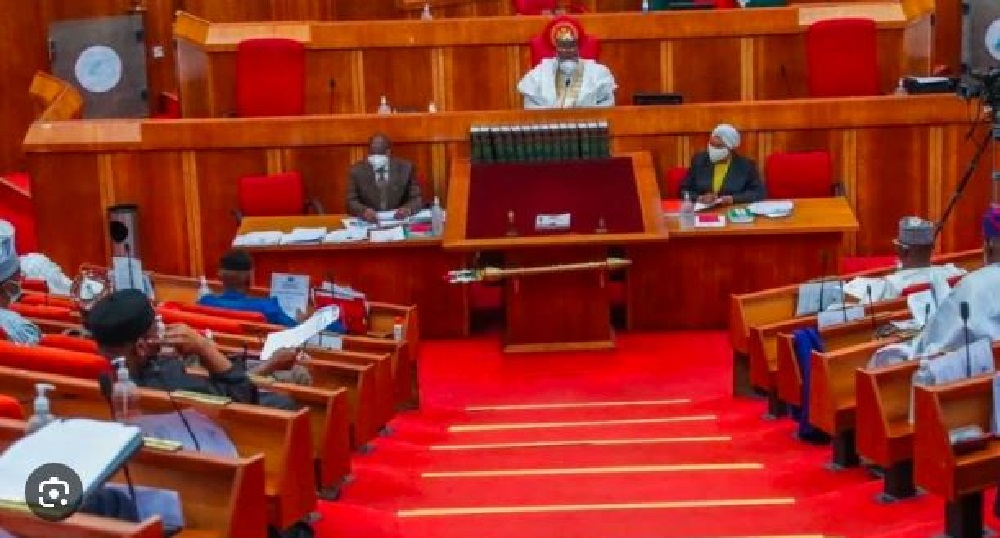
The Senate has declined to approve a Bill seeking to establish a foreign exchange market in Nigeria.
The bill sponsored by the Chairman, Senate Committee on Finance, Senator Sani Musa (APC Niger East), also sought to make provisions for the control, monitoring and supervision of transactions conducted in the Foreign Exchange Market.
The proposed law entitled, “The Foreign Exchange (Control And Monitoring) Bill, 2024 (SB. 353) was read for the first time on Tuesday, February 20, 2024.
Presenting his Lead debate, Musa described the bill as an important legislation that seeks to repeal the Foreign Exchange (Monitoring and Miscellaneous Provision) Act, Cap. F34, Laws of the Federation of Nigeria, 2004.
Musa indicated that the proposed law would provide for the regulation, monitoring and supervision of the transactions conducted in the market and for related matters.
According to him, it would also contribute to the sound development of the National economy by striving to facilitate foreign transactions and maintain an equilibrium of balance of International payments.
He said, “The Bill seeks to stabilize the value of currency by ensuring the liberalization of foreign exchange transactions to maintain an equilibrium of balance of International payments.
“It will also stabilise the value of currency by ensuring the liberalization of foreign exchange transactions and of other foreign transactions by revitalizing market functionality.
“The Bill attempts to expand Section (1) of the existing Act to incorporate three new provisions to make for clarity and to empower the Central Bank of Nigeria to administer, control and manage all dealings and transactions in relation to foreign exchange matters.
“The newly introduced clauses will enable the CBN to determine the basic exchange rate of purchase and sale of foreign exchange.
“Clause 6 of the Bill introduces New Sub-clauses (2), (4) and (5) which require authorised dealers to render returns to the CBN on sources of foreign exchange in excess of USD 10,000 and utilisation of same.
“It also requires authorized dealers obtain prior approval of the CBN when seeking to import foreign currency notes.
“Part Ill of the Bill makes elaborate provisions for the grant of a licence to carry on business dealings in foreign exchange. In this part, provisions were made for refusal of licence, suspension or revocation of licence, review and appeal.
“Clause 18 (1) (a) and (b) were added to expand the scope of dealers in the market and where funds are purchased from the Bank. The market rate may be subject to rules and regulations prescribed by the Bank.”
Musa added that with the bill, the operation of domiciliary account shall be as prescribed by the Bank and that the powers of the CBN have been widened to prescribe how foreign exchange may be accepted for the payment for goods and services in Nigeria.
The Bill when passed into law, according to Musa, will contribute to sound development of national economy, facilitate foreign transactions and most importantly, and stabilize the value of the currency by ensuring the liberalization of foreign transactions and revitalizing market functionality.
Most senators in their various contributions expressed the fears that a fresh legislation seeking to monitor or control the activities of the foreign exchange market apart from what the CBN was doing, could be counter productive.
Some of the senators who expressed serious reservations over the proposed law are, Solomon Adeola (Appropriation Committee Chairman); Tokunbo Abiru (Chairman, Banking, Insurance and other Financial Institutions panel; and Aliyu Wadada (Chairman, Senate Public Account Committee) among others.
For instance, a former accountant general of the Federation who is now the senator representing Gombe North, Ibrahim Dankwambo, noted that the law, if passed would confuse Nigerians.
He was of the opinion that any further law aimed at regulating the foreign exchange market should come from the executive arm of government to avoid crisis in the sector.
Also contributing, the Senator Adams Oshiomhole, said, “we have to be careful because we cannot speculate.
Anything done in this house, Nigerians will take it very seriously, because we have the power to make laws.
“Senators who have spoken, had summarized and amplified meticulously, the contradictions and negative implications of passing the law.
“I believe that the Bill should not attract further hearing because we are trying to take over the monetary policy regulations of the CBN of we go ahead with it.
“If the executive arm of government likes, let them bring a Bill to further strengthen the regulatory powers of the CBN. It is not our work.”
The President of the Senate, Godswill Akpabio, who presided over the session, urged Musa to withdraw the proposed law for further consultations but the senator refused to do so.
Akpabio called for voice vote to determine it’s approval or rejection for second reading and majority of the federal lawmakers voted against it.

Justice Jude Onwugbuzie of the Federal Capital Territory (FCT) High Court sitting in Apo, Abuja, has ordered the final forfeiture of assets linked to Kogi-born businesswoman, Aisha Achimugu, to the Federal Government.
The assets include jewellery valued at N4.645 billion, 11 exotic vehicles worth N4.293 billion, $50,000 in cash, and N30 million.
The ruling was delivered on Thursday, July 16, 2026, following months of legal proceedings after the Economic and Financial Crimes Commission (EFCC) applied for the final forfeiture of the assets.
Justice Onwugbuzie held that the EFCC had successfully proved its case and consequently ordered the immediate and final forfeiture of the jewellery valued at N4,645,170,294.09, the 11 exotic vehicles worth N4,293,000,000, $50,000, and N30 million in cash to the Federal Government.

By Francesca Hangeior
Justice Inyang Ekwo of the Federal High Court sitting in Abuja on Thursday ordered the All Progressives Congress (APC) and the Independent National Electoral Commission (INEC) to maintain the status quo pending the determination of a suit instituted by Hon. (Engr.) Sesugh Kaaba.
Justice Ekwo gave the order after parties informed the court that they had exchanged processes in the suit, prompting the court to hold that issues had already been joined on the substantive matter.
The suit, marked FHC/ABJ/CS/1429/2026, was filed by Kaaba against the APC and INEC.
At the resumed hearing, counsel to the plaintiff, Mohammed Ndarani Mohammed, told the court that the matter was scheduled for the defendants to show cause why the reliefs sought in the plaintiff’s ex parte application should not be granted.
According to the judge, both defendants had complied with the court’s earlier order by filing affidavits to show cause, adding that the plaintiff had received and was ready to respond to the processes.
Counsel to the APC, S. D. Swem, confirmed that the party had filed its affidavit to show cause and a counter-affidavit to the motion on notice, but said its response to the originating summons was yet to be filed.
On his part, counsel to INEC, Oluwole Olukunle, informed the court that the commission had responded to all the processes filed by the plaintiff.
Justice Ekwo observed that by filing their respective processes, the parties had submitted to the court’s jurisdiction and joined issues on the substantive case.
The judge cautioned that once a matter is pending before a court, parties must refrain from taking steps capable of altering the subject matter of the litigation.
“Once a case is pending in court, parties are automatically restrained and if you go ahead to do any other thing, you are taking the law into your hands,” the judge said.
Counsel to the plaintiff thereafter urged the court to caution the APC against taking further actions while the suit was pending.
Justice Ekwo, however, clarified that he was merely stating the legal position and not giving advice to any of the parties.
In a brief ruling, the judge held that since parties had already joined issues on the substantive suit, it would serve the interest of justice to proceed with the hearing of the main case rather than expend judicial time on the pending ex parte application.
He subsequently adjourned the matter until July 21 for hearing and ordered all parties to maintain the status quo ante pending the determination of the suit.

By Gloria Ikibah
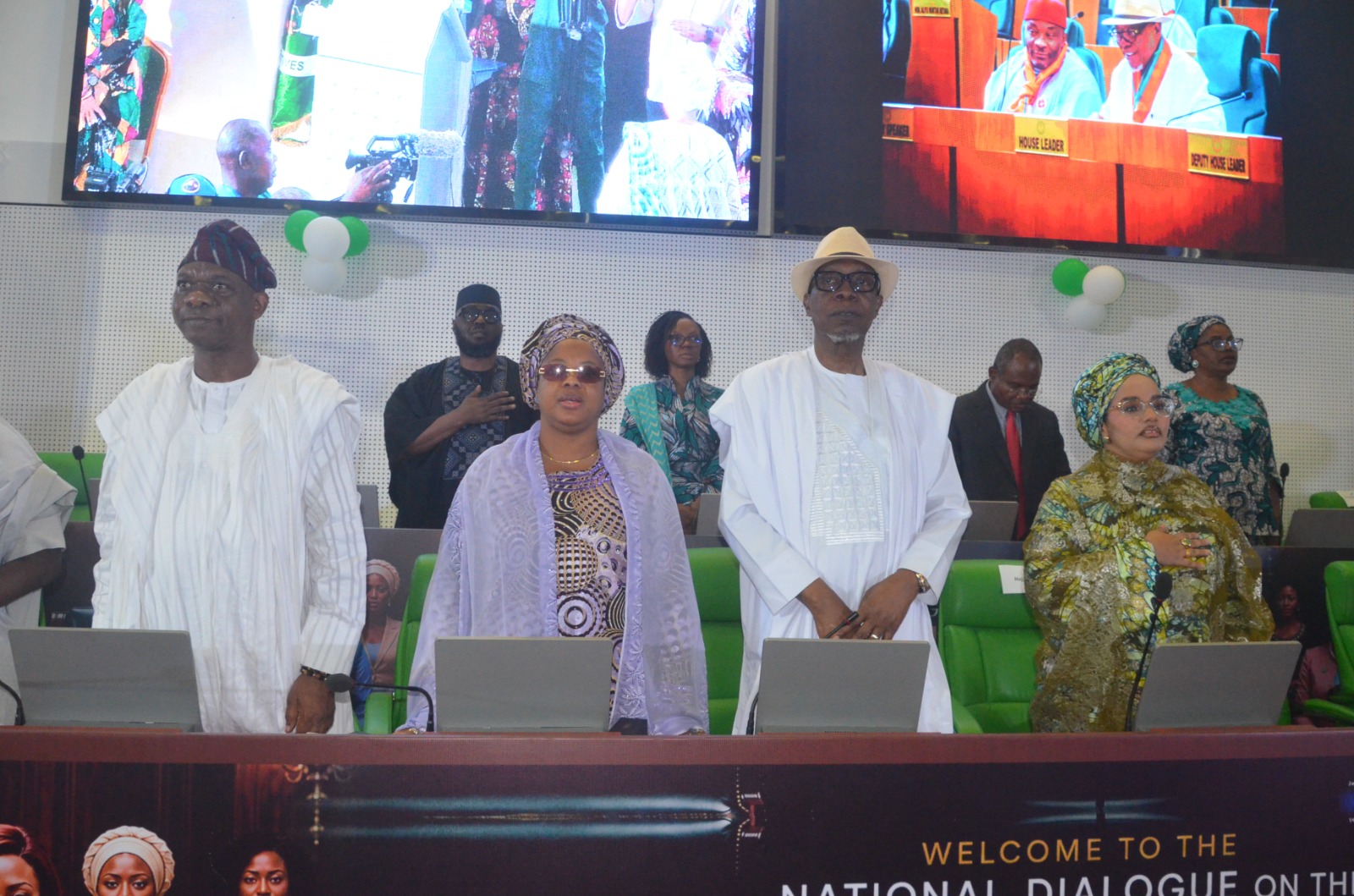
The Executive Director of the Policy and Legal Advocacy Centre (PLAC), Clement Nwankwo, and wife of the Speaker of the House of Representatives, Hajiya Fatima Tajudeen Abbas, have challenged the 10th National Assembly to ensure the passage of the Constitution Alteration Bill seeking Special Reserved Seats for Women, warning that history would judge the legislature by its handling of the landmark proposal.
Speaking on Wednesday during the 2026 National Assembly Open Week in Abuja, both speakers described the bill as one of the most consequential democratic reforms currently before Parliament, insisting that its passage would redefine women’s political participation and strengthen Nigeria’s democracy.
The appeal was made during the National Dialogue on the Electoral College Model for the Special Seats Bill, where lawmakers, former public office holders, civil society organisations and development partners gathered to discuss pathways to improving women’s representation in governance.
Nwankwo acknowledged what he described as the impressive legislative output of the 10th National Assembly over the past three years but argued that none of its achievements will surpass the significance of the proposed constitutional amendment.
According to him, the legislation presents a rare opportunity to correct the longstanding exclusion of women from elective positions.
Addressing the Speaker through the House Leader, Prof. Julius Ihonvbere, and Hajiya Fatima Abbas, he urged lawmakers in both chambers to rally behind the bill.
“This is the most important bill before this National Assembly. It is not the budget bill or the tax reform bill. The Special Seats for Women Bill is the greatest legacy this National Assembly can leave behind. If this bill does not pass, the legacy of the 10th National Assembly will be seriously questioned,” he said.
Nwankwo also applauded local and international partners, including the European Union and the Inter-Parliamentary Union (IPU), for supporting advocacy aimed at increasing women’s political participation.
He said passing the bill would underscore Nigeria’s commitment to inclusive democracy while bringing the country closer to global standards on gender representation.
In her remarks, Hajiya Fatima Abbas commended the leadership of the House of Representatives under Speaker Tajudeen Abbas for promoting openness, legislative reforms and greater public participation through the National Assembly Open Week.
She described the initiative as a demonstration of Parliament’s commitment to transparency and democratic accountability.
“This Open Week reflects our shared belief that democracy thrives when citizens are informed, engaged and able to participate meaningfully in governance. By opening the legislature to dialogue and public engagement, the House of Representatives continues to strengthen public trust and deepen Nigeria’s democratic culture,” she said.
She said the proposed constitutional amendment was both timely and necessary, noting that it seeks to address the persistent underrepresentation of women and other marginalised groups in Nigeria’s political institutions.
“The Special Seats Bill seeks to address the persistent underrepresentation of women and other marginalised groups in elective offices, ensuring that our democratic institutions better reflect the diversity of the Nigerian people. A stronger democracy is one in which every voice has a meaningful opportunity to be heard”, she added.
She called on lawmakers, civil society groups, development partners and other stakeholders to sustain advocacy until the bill becomes law.
Hajiya Abbas also praised President Bola Ahmed Tinubu for advancing institutional reforms and inclusive governance under the Renewed Hope Agenda, while commending First Lady Senator Oluremi Tinubu for championing women’s empowerment through the Renewed Hope Initiative.
She further acknowledged the advocacy efforts of the House of Representatives Spouses Association (HORSA), which she chairs, saying the association had continued to campaign nationwide for increased female representation in governance.
Women leaders push for urgent reforms
Earlier, prominent women leaders, legislators, former public office holders and civil society organisations renewed calls for stronger female representation during the dialogue, describing Nigeria’s current figures as unacceptable.
Chairperson of the House Committee on Women Affairs and Social Development, Hon. Kafilat Ogbara, lamented that women currently occupy only about four per cent of seats in the National Assembly — the lowest representation rate on the African continent.
She said the outcome of the recent party primaries further exposed the structural barriers confronting women seeking elective office.
“Women in Nigeria have been sidelined for far too long. The Reserved Seats for Women Bill deserves urgent attention. Despite the fact that many of the recent primaries were largely predetermined, women were still not adequately accommodated,” Ogbara said.
Sh expressed confidence that the repeated commitments made by the leadership of the National Assembly towards gender inclusion would translate into concrete legislative action.
She explained that the Special Seats Bill would create additional opportunities for women to participate in governance and urged stakeholders to consider the Electoral College Model as one of the practical mechanisms for implementing the reform.
She also commended the House leadership for consistently supporting initiatives aimed at expanding women’s participation in politics.
Former Speaker of the House of Representatives, Rt. Hon. Patricia Etteh, also threw her weight behind the proposal, arguing that democracies across the world continue to evolve through reforms that improve representation.
She endorsed the Electoral College Model and called for sustained civic education, stronger political party commitment and wider public support to boost women’s participation in politics.
Representing Speaker Abbas Tajudeen, House Leader Prof. Julius Ihonvbere reaffirmed the leadership’s commitment to ensuring the Special Seats Bill is passed.
Similarly, Chairman of the House Committee on Defence, Rep. Babajimi Benson, assured participants that lawmakers would continue to build bipartisan support for the legislation.
The event also featured goodwill messages from representatives of women’s organisations, development partners, as well as the Deputy Governors of Rivers and Kaduna States, all of whom pledged continued support for reforms aimed at making Nigeria’s democracy more inclusive.

Just in: Court Orders Final Forfeiture of Achimugu’s N9bn Assets to FG
Court orders parties to maintain status quo in Benue APC leadership suit

Let the Special Seats Bill Define Your Legacy’, PLAC, Speaker’s Wife Tell Lawmakers




-
 News23 hours ago
Oyo kidnappings : Senate donates N50m to families of slain teachers, soldiers
-

 News22 hours ago
Angry Wife Bites Husband’s Manhood After Filing Her Teeth To Make It Sharper
-
 News22 hours ago
Political Party Pulls Out Of 2027 Presidential Race, Gives Reasons
-
 News12 hours ago
FG begins fresh count of Nigeria’s out-of-school children
-
 Foreign12 hours ago
Strikes on Iran to continue until ‘I say it’s enough’ – President Trump declares
-
 News12 hours ago
Xenophobia: FG evacuates 1,490 Nigerians from South Africa
-

 Sports17 hours ago
Just IN: Argentina Cruise Past England To Set Up 2026 Final World Cup Showdown With Spain
-

 News12 hours ago
Three Parties Miss INEC Deadline For Presidential Candidate Upload
Warning: Undefined variable $user_ID in /home/naijuinz/public_html/wp-content/themes/zox-news/comments.php on line 49
You must be logged in to post a comment Login