
News
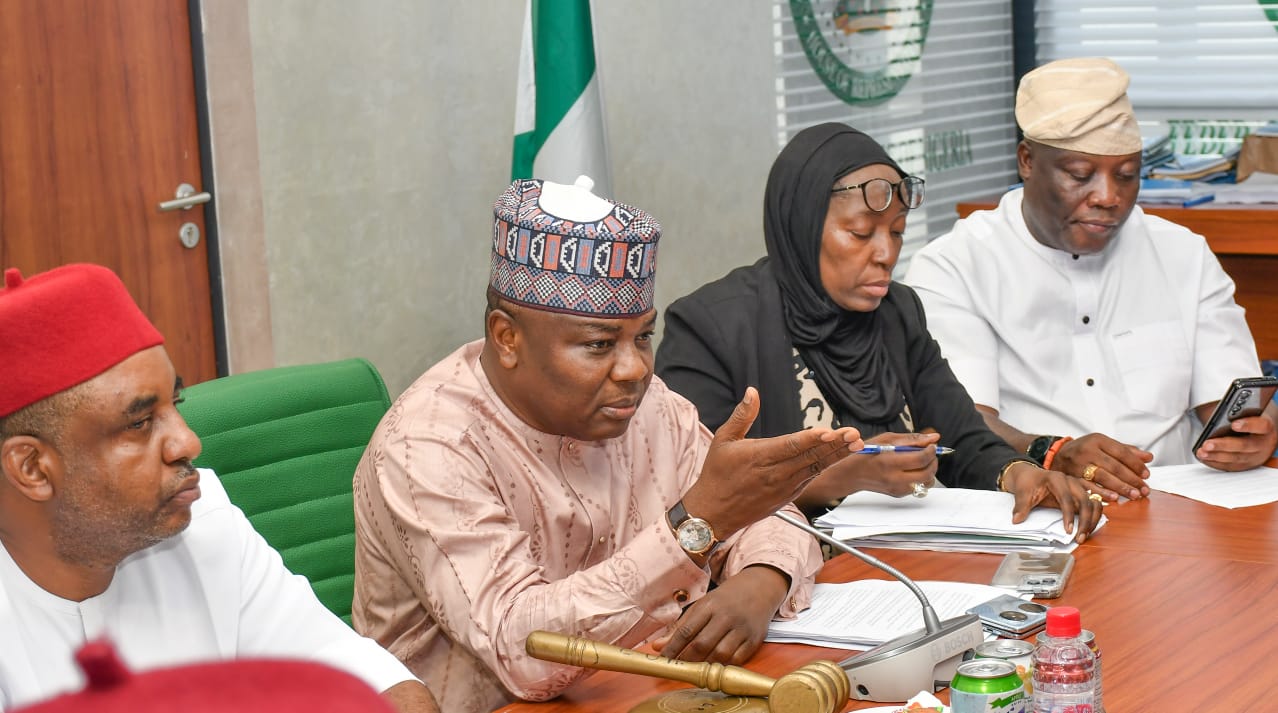
Reps C’ttee Queries Abuja Park and Pay Arrangement, 60% Revenue Share To Concessionaires

- /home/naijuinz/public_html/wp-content/plugins/mvp-social-buttons/mvp-social-buttons.php on line 27
https://naijablitznews.com/wp-content/uploads/2024/07/IMG-20240725-WA0001-1000x600.jpg&description=Reps C’ttee Queries Abuja Park and Pay Arrangement, 60% Revenue Share To Concessionaires', 'pinterestShare', 'width=750,height=350'); return false;" title="Pin This Post">
- Share
- Tweet /home/naijuinz/public_html/wp-content/plugins/mvp-social-buttons/mvp-social-buttons.php on line 72
https://naijablitznews.com/wp-content/uploads/2024/07/IMG-20240725-WA0001-1000x600.jpg&description=Reps C’ttee Queries Abuja Park and Pay Arrangement, 60% Revenue Share To Concessionaires', 'pinterestShare', 'width=750,height=350'); return false;" title="Pin This Post">





Delta State Governor, Hon. Sheriff Oborevwori, has taken fresh steps to restore and improve electricity supply in parts of Isoko and Ndokwa land with the commencement of procurement processes for the rehabilitation and expansion of critical power infrastructure across the affected communities.
The move followed the issuance of an Invitation to Tender by the Delta State Ministry of Energy for the execution of key electricity projects aimed at addressing years of power challenges caused by inadequate infrastructure and vandalism.
According to the tender notice signed by the Secretary of the Ministerial Tenders Board, T.O. Bayoko, one of the major projects involves the construction of a 33KV Overhead High Voltage Line from Emevor through Otor-Owhe to Isoko Roundabout, as well as the rehabilitation of vandalized sections of the existing 33KV line between Iyede and Ellu in Isoko North Local Government Area.
The project is expected to significantly improve power supply to communities across the Isoko axis and boost economic activities in the area.
In another intervention, the state government plans to rehabilitate and reconstruct the vandalized 33KV power line stretching from Abbi through Emu-Obodeti to the Kwale 7.5MVA Injection Station in Ndokwa West Local Government Area.
The project is designed to restore stable electricity to several communities that have suffered prolonged disruptions due to the destruction of critical power facilities.
The Ministry also announced plans to upgrade the existing 500KVA Independent Power Project (IPP) substation transformer at the Permanent Secretary’s Quarters in Asaba to a 1000KVA transformer, further strengthening electricity infrastructure within the state capital.
The tender advertisement, issued through the Ministry’s Planning, Research and Statistics Department, invited suitably qualified companies to bid for the projects, underscoring the Oborevwori administration’s commitment to improving power infrastructure as part of its M.O.R.E. Agenda.
Industry observers say the projects, when completed, will not only restore electricity to affected communities but also stimulate economic growth, support small businesses, improve security and enhance the quality of life of residents.
Since assuming office, Governor Oborevwori has continued to prioritize infrastructure development across the state, with renewed attention being given to the power sector following the enactment of the Delta State Electricity Power Sector Law, which seeks to expand access to reliable and sustainable electricity for residents and businesses.
The latest electricity projects are expected to bring relief to thousands of households and businesses in Isoko and Ndokwa communities that have long yearned for improved power supply, while reinforcing the administration’s resolve to accelerate development across all parts of the state.

The Federal Government has rubbished reports suggesting that it has adopted or is considering new taxes on telecommunications services and petroleum products following the publication of the International Monetary Fund (IMF) Article IV Consultation Report on Nigeria.
The Government said the reports misrepresent the content of the IMF report and do not reflect its policy direction.
The IMF Article IV Consultation Report contains the Fund’s assessment of Nigeria’s economy as well as recommendations for consideration by the authorities. Those recommendations do not amount to government policy and are not binding on Nigeria. Decisions on tax matters are taken through established constitutional and legislative processes and are guided by national priorities and prevailing economic realities.
The Government clarified that the Value Added Tax (VAT) waiver on petroleum products remains in place and has not been withdrawn. It also noted that although existing legislation provides for a fuel surcharge, such a measure can only take effect through a ministerial order and publication in the Official Gazette. No such process is under consideration.
The continued suspension of these charges has helped cushion the effect of global energy price fluctuations on households and businesses while keeping domestic fuel prices relatively stable.
The Government further clarified that the telecommunications excise duty introduced before 2023 has been repealed under the new tax laws and is therefore no longer applicable.
Against this backdrop, reports claiming that new taxes are being planned for telecommunications services or petroleum products are not factual and should be disregarded.
The Federal Government remains focused on reforms that promote economic growth, improve revenue administration and create a more competitive environment for investment and job creation. The emphasis remains on expanding economic activity, plugging leakages and improving efficiency rather than placing additional tax burdens on citizens.
Any future tax measures will be announced through official channels and implemented in line with the law.

The Nigerian Communications Commission, working with consultancy KPMG, has begun a comprehensive review of telecom interconnection pricing, the first major reassessment of the sector’s tariff framework in nearly a decade.
The exercise, kicked off in Lagos at a mobile termination rate stakeholder forum on Tuesday, brought regulators, operators and industry participants into a structured process to reassess wholesale pricing rules that govern payments between networks for completing voice calls.
Mobile Termination Rates are regulated fees paid by one operator to another to complete calls across networks. They influence competition, investment, and retail pricing.
The telecom regulator said the current framework, last set in 2018 and adjusted in 2022, has been overtaken by structural changes in the market, including the rollout of 5G, the expansion of data-led services, and the entry of mobile virtual network operators.
It also cited macroeconomic pressure, including currency depreciation and inflation, which have significantly altered operators’ cost bases.
The Head of the Competition and Tariff Unit at the NCC, Omotayo Mohammed, said the exercise goes beyond a routine tariff review and reflects the need to align regulation with a rapidly evolving industry.
The executive stated that the telecom market has changed materially since the last determination, both in technology deployment and market structure, adding that new service categories and business models now require regulatory attention.
“For regulation to remain effective in a fast-moving market, our frameworks must evolve in step with it,” Mohammed said, noting that the review is being conducted under Section 108 of the Nigerian Communications Act 2003 to ensure tariffs remain cost-reflective and non-discriminatory.
KPMG noted the study would combine data analysis, stakeholder consultation, and international benchmarking to inform a revised pricing framework.
Partner and Head of Tax, Wole Obayomi, said that regulatory and people services at the firm that the exercise was designed to identify gaps in the existing regime and test whether a structured review cycle is required.
The process, he said, depends on industry input. “It is important that we get input from the industry in terms of potential solutions and recommendations to address the shortfalls,” he said.
Under the review, the NCC and KPMG will examine pricing practices across wholesale and retail segments and assess whether emerging services are adequately captured under existing regulatory definitions.
The sector’s evolution over the past decade has introduced new business models that are not fully reflected in current rules.
The study will also assess the sustainability of prevailing tariff structures, with attention to investment capacity, service quality, and consumer affordability.
Operators, the consultants noted, apply varying pricing models within regulatory limits, making it necessary to examine how these structures function in practice.
As part of the process, the NCC will require operators to submit detailed financial and operational data covering revenue, costs, profitability, market share, capital expenditure, service quality, and usage trends over multiple years.
KPMG said the dataset is intended to provide a clearer view of industry trends and the cumulative impact of existing pricing rules.
The engagement will include bilateral technical sessions with mobile network operators, mobile virtual network operators, international carriers, clearing houses, and interconnect exchange providers.
Industry participants are expected to involve finance, technical, and commercial teams in the discussions.
The NCC and KPMG will also benchmark Nigeria’s framework against peer markets, including South Africa and Kenya, alongside emerging economies such as Indonesia and Malaysia.
The selection, consultants said, reflects similarities in macroeconomic conditions and regulatory responses to sector development.
Findings from the benchmarking exercise are expected to inform recommendations for a revised pricing regime aligned with both domestic conditions and international practice.
The commission said the review is intended to support a pricing framework that is transparent, competitive, and capable of sustaining investment in network infrastructure and service quality.
NCC Director of Public Affairs Nnenna Ukoha said the exercise cuts across the entire telecom value chain, from operators to consumers and investors.
She said termination rates remain central to pricing dynamics, competition, and service outcomes.
Ukoha said the commission would integrate stakeholder feedback under its co-creation regulatory approach.
She urged operators to comply with timelines for data submission, noting that the process would only be effective with timely and accurate input.

Ray of hope as Oborevwori moves to restore power in Isoko, Ndokwa communities

FG Rubbishes Reports of New Telecoms, Fuel Taxes

NCC begins telecom pricing review after eight years




-

 News23 hours ago
BREAKING: Gunmen storm NIPSS Kuru, kill two soldiers Police Officer
-

 News18 hours ago
FG, FRSC Join Forces to Crack Down on Fake Diplomatic Number Plates
-
 Politics5 hours ago
PDP Sweeps Adamawa LG Elections, Wins All 21 Councils, 226 Wards
-

 News17 hours ago
ADC alleges plot to cripple opposition, thumbs down court deregistration order
-

 News17 hours ago
Kwara ADC guber candidate, Mohammed mourns death of Oba Aweda while in captivity
-
 News14 hours ago
Defence Stakeholders Resist Plan to Reserve NDA Entry for Military School Alumni
-

 Entertainment5 hours ago
Why I Took Decision To Marry Myself On My 45th Birthday-Denrele Edun
-
 News18 hours ago
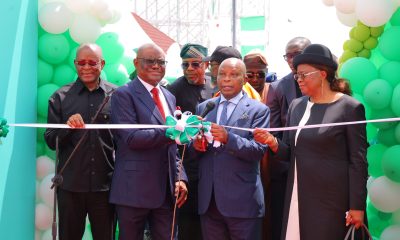
Tinubu Commissions Court of Appeal Judges’ Quarters, Urges States to Strengthen Judicial Infrastructure(Photos)
Warning: Undefined variable $user_ID in /home/naijuinz/public_html/wp-content/themes/zox-news/comments.php on line 49
You must be logged in to post a comment Login