Connect with us

News

Buhari’s minister, cleric lead Plateau hunger protest

Published

on

ADVERTISEMENT
Zoom Ad
ADVERTISEMENT
Zoom Ad

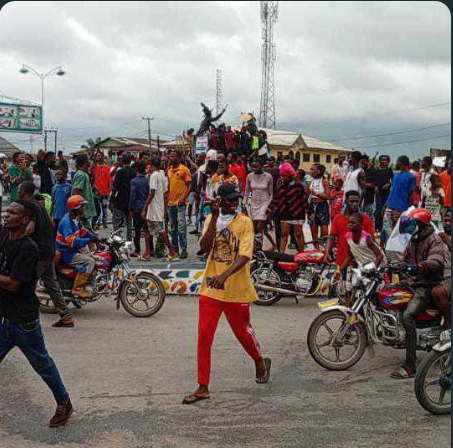
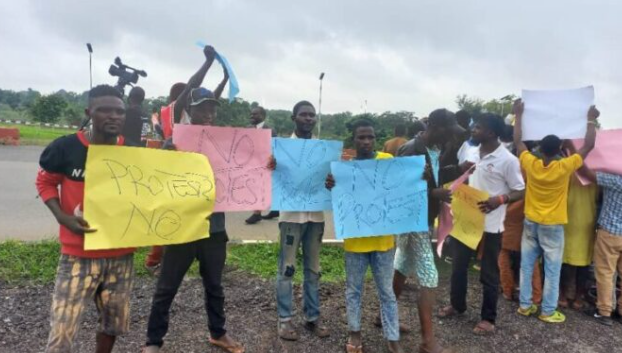
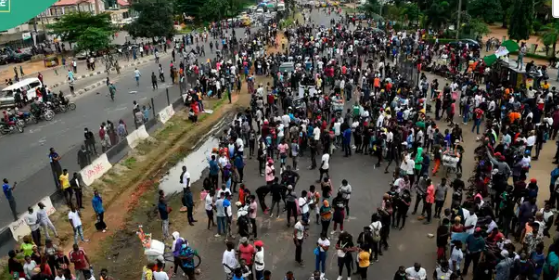
A former Minister of Youth and Sports Development, Solomon Dalung, and vocal cleric, Prophet Isa Elbuba, led hundreds of Jos residents to participate in the nationwide hunger protest, which commenced on Thursday,


The residents took to the streets, defying the plea and warning by the state government and security agencies.

The protesters, who came out as early as 7 am, marched through various streets. calling for an end to bad governance and prevailing economic hardship in the country.

Addressing the crowd, Dalung, who served as a minister under the administration of ex-Pesident Muhammadu Buhari, asked security operatives not to intimidate protesters, because the Constitution guaranteed the right to peaceful assembly.

Advertisement

On his part, El-Buba, who is the Convener of the Initiative for a Better and Brighter Nigeria, called on President Bola Tinubu to resign for his alleged poor handling of governance.

“President Bola Tinubu must resign; we cannot wait for 2027 to change him! Hunger will not all us to endure that long,” declared El-Buba, who is the General Overseer of the Evangelical Bible Outreach Ministries International.

He insisted that the protest would continue until the demand for good governance was met.

“We are going to be here for the next 10 days, if you don’t stand up for your rights, no one will do it for you,” he said.

Advertisement

The leader of a civil society coalition, Chris Iyama, called on President Tinubu to declare a state of emergency on food insecurity with immediate effect.

Iyama, who is also the Country Director, Equity International Initiative, said the Tinubu administration was executing anti-people policies and demanded that the President set machinery in motion to review his cabinet.

“We are demanding the reversal of the electricity tariff hike, transportation, and price control on commodities. We also want the government to cut down the spending on VIPs and other unwarranted demands,” he said.
Advertisement
Continue Reading
Advertisement
Click to comment

Warning: Undefined variable $user_ID in /home/naijuinz/public_html/wp-content/themes/zox-news/comments.php on line 49

You must be logged in to post a comment Login

Leave a Reply

News

Ramaphosa urges peace ahead of June 30 protest

Published

on

ADVERTISEMENT
Zoom Ad
ADVERTISEMENT
Zoom Ad

By Francesca Hangeior

South African President Cyril Ramaphosa has acknowledged that citizens’ concerns over illegal immigration are legitimate but warned that violence, intimidation and vigilantism will not be tolerated during planned nationwide protests on June 30.

In his weekly newsletter released on Monday, Ramaphosa urged protesters to exercise their constitutional right peacefully and within the confines of the law, stressing that no grievance justifies unlawful conduct.

The president said South Africans had raised genuine concerns over undocumented immigration, border management, pressure on public services, and criminal syndicates exploiting the country’s immigration system.

Advertisement

While affirming that the right to protest is guaranteed under South Africa’s Constitution, he cautioned that such freedom does not permit threats, intimidation, vandalism or violence.

It partly reads, “South Africans have raised deep concerns about illegal immigration, border management, pressure on public services, criminal syndicates that exploit our immigration system and the impact these challenges have on communities. These concerns are real and they deserve to be heard. 

“The right to protest is enshrined in our Constitution. It is a credit to our robust democratic order that people are able to express their grievances openly. But the right to protest and freedom of expression does not allow people to threaten or intimidate others, or to engage in acts of vandalism or violence. 

“South Africa is a constitutional republic governed by the rule of law. The exercise of rights by any citizen in a constitutional democracy cannot be determined by intimidation, threats or ultimatums. It must be determined through democratic institutions, evidence and the rule of law.”

Advertisement

Ramaphosa disclosed that his government had accepted the need for substantial reforms to the country’s immigration system, including strengthening border management, increasing enforcement against undocumented immigration, improving the integrity of asylum and visa systems, and tackling corruption that has weakened immigration controls.

“We also recognise that where our systems have failed, they must be corrected. Where corruption has enabled illegal immigration, those responsible must be held accountable. Where enforcement has been inadequate, it must improve,” it reads.

“Over the last few weeks, we have seen support for these measures and for government’s stance from across society. We have held meetings with the country’s traditional monarchs and other traditional and Khoi-San leaders, with trade union and business leaders, with the religious community and with other formations in society. 


Advertisement
Continue Reading

News

No technical meeting expected with US in coming days – Iran

Published

on

ADVERTISEMENT
Zoom Ad
ADVERTISEMENT
Zoom Ad

By Francesca Hangeior

Iran’s foreign ministry on Monday denied reports that Iranian and American technical teams will meet in the coming days to discuss the implementation of the deal to end the Middle East war.

Both sides have traded fire in the Gulf in recent days, testing their fragile ceasefire.

“No technical meetings of the working groups are planned for this week,” Deputy Foreign Minister Kazem Gharibabadi said, quoted by state TV, referring to the Iranian week ending on Friday.

Advertisement

Citing US officials, American news site Axios reported on Sunday that Tehran and Washington would hold a meeting in Qatar on Tuesday to resolve their dispute over the strategic Strait of Hormuz.

CNN reported similar comments from a Trump administration official, though the White House has not issued an official statement.

Qatar, alongside Pakistan, has acted as a mediator in talks between Iran and the United States aimed at ending the war in the Middle East.

The most recent discussions between Tehran and Washington took place in Switzerland on June 21 with the attendance of delegations from all four countries.

Advertisement

Qatar — located across the Gulf from Iran — is playing a key role in the financial aspects of the negotiations.

Iran holds assets there that have been frozen due to US sanctions.

Iranian President Masoud Pezeshkian stated on Monday that the necessary steps to unfreeze these funds were “underway”.

“In accordance with established plans, $6 billion out of the total $12 billion held in Qatar will be released and returned to the country,” he said, quoted by the presidency.

Advertisement
Continue Reading

News

FG to launch Digital System to track every Nigerian school learner

Published

on

ADVERTISEMENT
Zoom Ad
ADVERTISEMENT
Zoom Ad

By Francesca Hangeior

The Federal Government has announced plans to launch a national digital platform designed to address longstanding challenges associated with fragmented education data, marking a significant step towards improving planning, policymaking and service delivery across Nigeria’s education sector.

The platform, known as the Digital National Education Management Information System (DNEMIS), will be officially unveiled on Wednesday alongside the launch of the Public DNEMIS Portal and the inauguration of DNEMIS State Implementation Teams.

Speaking at a pre-launch media briefing in Abuja on Monday, the National Project Coordinator of the Special Programmes Operations and Implementation Unit in the Office of the Minister of Education, Mr Adebayo Onigbanjo, said the initiative was developed to address years of weak and inconsistent education data that have hindered effective governance of the sector.

Advertisement

“For many years, education planning and administration relied on fragmented systems, inconsistent reporting structures, and limited access to reliable and timely data. These challenges constrained effective planning, weakened accountability and limited the sector’s ability to respond to emerging realities,” he said.

According to Onigbanjo, the Federal Ministry of Education developed the Nigeria Education Data Infrastructure (NEDI) as a national framework to coordinate, standardise and strengthen education data management across all levels.

“At the centre of this transformation is DNEMIS, a flagship component of NEDI and a major milestone in Nigeria’s journey towards a modern, integrated and digitally enabled education management system,” he said.

He explained that the platform would provide timely, reliable and accessible data to support planning, budgeting, policymaking, monitoring and service delivery. It will also ensure that every learner, teacher, school and public investment in education is captured within a unified national database.

Advertisement

Onigbanjo said the reform demonstrates the Federal Government’s commitment to ensuring that education policies are driven by evidence rather than estimates.

“The progress recorded through NEDI and the implementation of DNEMIS reflects the Ministry’s broader commitment to ensuring that reforms are not only announced but effectively coordinated, implemented and measured,” he said, adding, “Data is no longer a back-office function; it is becoming the engine of education reform in Nigeria.”

Also speaking, the Special Assistant to the Minister of Education on Digital Communications and E-Learning, Miss Mojoyin Adebajo, said DNEMIS was developed on the globally recognised District Health Information Software 2 (DHIS2) platform to modernise education administration and strengthen evidence-based decision-making.

She noted that the platform would digitise the Annual School Census, replacing largely manual data collection processes with an integrated digital system.

Advertisement

“By digitising the Annual School Census process, the platform will provide government with timely, reliable and accessible education data to support planning, budgeting, policymaking and improved service delivery across Nigeria’s education system,” she said.

Adebajo added that the platform would generate up-to-date information on schools, learners, teachers and education infrastructure, leading to better resource allocation and improved monitoring of education programmes.

She further highlighted the Public DNEMIS Portal as a key feature, noting that it would, for the first time, make selected official education data publicly accessible to researchers, journalists, development partners, civil society organisations, policymakers and the general public.

“This represents an important step towards expanding access to information and encouraging broader participation in conversations that shape the future of education in Nigeria,” she said.

Advertisement

The officials also acknowledged the technical support provided by the United Nations Children’s Fund (UNICEF) and the University of Oslo in developing the initiative.

Nigeria’s education sector has long struggled with weak and fragmented data systems, making effective planning, budgeting, teacher deployment, infrastructure development and monitoring of education outcomes difficult.

The introduction of DNEMIS is expected to address these challenges by providing real-time, reliable education data to support ongoing reforms under the Nigeria Education Sector Renewal Initiative led by the Minister of Education, Dr Maruf Tunji Alausa.

Advertisement
Continue Reading

Trending

Copyright © 2024 Naija Blitz News