



Economy
Naira free fall: FG printed too much money, Gov Otti laments
- /home/naijuinz/public_html/wp-content/plugins/mvp-social-buttons/mvp-social-buttons.php on line 27
https://naijablitznews.com/wp-content/uploads/2024/02/45CE0539-5EF3-472E-97C9-A52F7191791A.webp&description=Naira free fall: FG printed too much money, Gov Otti laments', 'pinterestShare', 'width=750,height=350'); return false;" title="Pin This Post">
- Share
- Tweet /home/naijuinz/public_html/wp-content/plugins/mvp-social-buttons/mvp-social-buttons.php on line 72
https://naijablitznews.com/wp-content/uploads/2024/02/45CE0539-5EF3-472E-97C9-A52F7191791A.webp&description=Naira free fall: FG printed too much money, Gov Otti laments', 'pinterestShare', 'width=750,height=350'); return false;" title="Pin This Post">
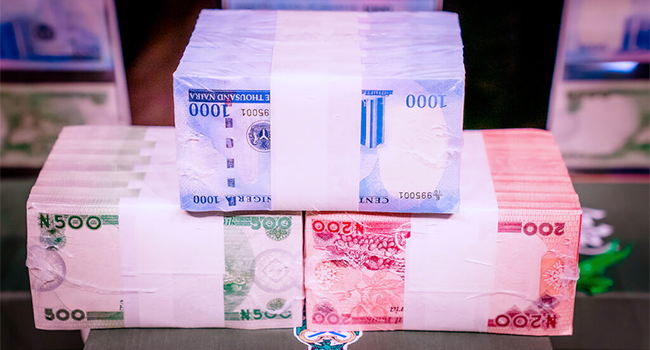
Abia State Governor, Alex Otti, has lamented the free fall of the naira, saying the Federal Government printed too much money in circulation.
The governor stated this during an interview on Channels Television’s Politics Today on Thursday.
“I believe that the major problem we have is financial discipline. We are dealing with an economy where we printed so much money, at the last count, we will be nearing N30 trillion,” he said.
“So what happens with ways and means is that the quantum of goods that you have available in an economy does not increase with the quantity of money that you print.”
Consumption To Production
During the interview, the governor, who is a member of the Labour Party (LP), said the nation must move from consumption to production for the economy to recover.
He condemned the situation whereby Africa’s largest economy imports virtually every product, saying it piles much pressure on the foreign market.
“The issue of production versus consumption, if the economy must recover, we must move to production.
“That does not necessarily mean we will reduce consumption; what it means is that we will be consuming what we produce, to the extent that we are importing virtually everything. You keep piling pressure on the foreign exchange market,” he said.
Economy
See Black Market Dollar To Naira Exchange Rate Today 25th May 2026
Dollar To Naira Exchange Rate Today 27 January 2023(Black Market)
The Black Market Dollar-to-Naira Exchange Rate for 25th May 2026 Can Be Accessed Below.
NOTE: The exchange rate changes hourly. It depends on the volume of dollars available and the Demand. This means…you can buy or sell 1 dollar at a certain rate, and the price can change (high or low) within hours.
READ ALSO: Popular Rap Star Dies After Battling Cancer
The official naira black market exchange rate in Nigeria today, including the Black Market rates, Bureau De Change (BDC), and CBN rates.
Please note that the exchange rate is subject to hourly fluctuations influenced by the supply and demand of dollars in the market.
What’s the dollar to naira black market today, 25th May 2026?
The exchange rate for a dollar to naira at Lagos Parallel Market (Black Market) players sell a dollar for ₦11400 and buy at ₦1385 on Monday, 25th May, 2026, according to sources at Bureau De Change (BDC).
Please note that the Central Bank of Nigeria (CBN) does not recognize the parallel market (black market), as it has directed individuals who want to engage in Forex to approach their respective banks.
Dollar to Naira Black Market Rate Today
Dollar to Naira (USD to NGN) Black Market Exchange Rate Today
Selling Rate ₦1400
Buying Rate ₦1385
Dollar to Naira CBN Rate Today
Dollar to Naira (USD to NGN) CBN Rate Today
Highest Rate ₦1374
Lowest Rate ₦1370
Economy
Tax reform: FG targets mining revenue leakages, illegal operators
The Federal Government has unveiled a sweeping new framework aimed at transforming Nigeria’s solid minerals sector into a major revenue driver.
Under the reforms, the Nigeria Revenue Service has assumed responsibility for the collection of mineral royalties and related fees, while the Ministry of Solid Minerals Development retains its role as sector regulator.
The government said the era of weak compliance, illegal mining and poor revenue capture must come to an end.
Speaking at the joint stakeholder sensitisation programme organised by the Nigeria Revenue Service (NRS) and the Ministry of Solid Minerals Development (MSMD), Executive Chairman of the NRS, Zaccheus Adedeji, declared that Nigeria could no longer tolerate a system where vast mineral wealth failed to translate into economic prosperity and social development.
The sensitisation programme, themed “From Resources to Revenue: Aligning Solid Minerals Operations with the 2025 Tax Reform Act,” brought together mining operators, regulators, investors, licence holders and government agencies to clarify the operational procedures under the new royalty framework.
Adedeji, who was represented by the Executive Director of Finance and Corporate Services at the NRS, Muhammad Lawal, said the implementation of the 2025 Tax Reform Act marked a historic turning point for the mining industry.
According to him, the reform was designed not merely to increase government revenue, but to establish a transparent, efficient and sustainable royalty administration system capable of boosting investor confidence and strengthening accountability across the mining value chain.
He said: “Nigeria is richly blessed with abundant solid mineral resources spread across every region of this country, yet for far too long, the full economic value of these resources has not been optimally captured for national development.
“As a nation, we can no longer afford a system in which enormous natural wealth fails to translate into measurable prosperity, infrastructure, jobs and improved social outcomes for our people.”
He explained that under the new framework, which took effect from January 1, 2026, the NRS has become the sole authority responsible for royalty assessment, collection, review and enforcement in the solid minerals sector, while the Ministry of Solid Minerals Development retains oversight of mineral titles, operational regulation and official reference pricing.
Adedeji said: “The reforms are designed not merely to increase revenue but to establish fairness, efficiency and sustainability across the value chain.
“For us at NRS, this engagement is not about enforcement alone. It is about partnership, education and shared prosperity. We recognise that effective compliance goes with clarity, trust and continuous engagement with stakeholders.”
Adedeji further assured operators that the revenue agency would work closely with the Ministry of Solid Minerals Development and other relevant agencies to ensure a seamless transition into the new tax regime.
“Our objectives are clear: to strengthen voluntary compliance; close leakages in royalty and tax administration; improve transparency across the mining value chain; create a more investment-friendly environment; and ensure that Nigeria derives maximum value from its natural resources,” he added.
He maintained that the new system would significantly improve domestic revenue mobilisation, enhance investor confidence, support responsible mining practices and contribute to overall economic growth.
Adedeji explained that all mining operators are now required to register with the NRS and obtain Tax Identification Numbers (TINs), while monthly royalty returns must be filed on or before the 21st day of every month.
Under the framework, royalty payments will be computed based on the quantity of minerals sold or used, multiplied by the official reference price published by the Ministry and the applicable royalty rate.
The NRS chief warned that operators who default on payments could face stiff sanctions, including a 10 per cent penalty, compound interest, demand notices and possible licence revocation through referrals to the Ministry.
Also speaking at the event, the Minister of Solid Minerals Development, Dele Alake, lamented Nigeria’s overdependence on imports and the collapse of local production capacity, which he said contributed significantly to the weakening of the naira and the broader economy.
“I was privileged to have lived in this country when the naira was strong and in the early 80s I bought one dollar for 80 kobo. That was not the official rate. The official rate was 52 kobo,” Alake recalled.
He added: “It was at that rate because the production capacity of the country was higher — factories were all over the country. We had factories in Kano, Ibadan, Port Harcourt, Lagos, Enugu and Onitsha. Factories were producing goods and employment was rife.”
The minister blamed the country’s economic decline on what he described as an “importation bonanza” that shifted attention away from local production.
“But when the importation bonanza came, we forgot about production and we started importing,” he said.
Alake disclosed that the administration of President Bola Tinubu identified solid minerals as one of the strategic sectors capable of reviving the Nigerian economy and diversifying government revenue away from crude oil dependence.
According to him, the Federal Government has already begun creating incentives and policies to stimulate private sector investments in mineral processing and value addition.
“Today, I can tell you another gold refinery is ready and up and running in Abuja. Two more are still being built,” the minister revealed.
“As we speak, we are in the process of also enabling another private sector investor to bring a refinery to Jos. Without the Federal Government creating the enabling environment through incentives and policies, these factories would not have been possible,” Alake added.
Alake also highlighted the government’s crackdown on illegal mining activities, describing the establishment of Mining Marshals as a major milestone in restoring order to the sector.
“Illegal operators were operating with impunity for decades, so we had to create a special security architecture around illegal mining. That is what led to the creation of Mining Marshals,” he explained.
He said the special enforcement unit had so far recovered over 100 mining sites from illegal operators and returned them to their legitimate owners.
“The Mining Marshals have arrested over 300 operators and prosecuted more than 150 illegal miners as we speak. None of these happened before in the sector,” the minister stated.
Alake further disclosed that Nigeria’s local value addition policy had already attracted more than $2.6 billion in investments into the mining sector within the last two years.
“In the last two years, our local value addition policy has attracted over $2.6 billion investment into the sector, and it is still going on,” he said.
He described the stakeholder engagement as part of broader consultations aimed at refining policies and ensuring industry-wide collaboration.
“This stakeholder engagement is to further create that platform where we can hear from you, share your concerns, express your views, offer suggestions and recommendations to panel-beat policies wherever possible because nothing is etched in stone and nobody is an island,” Alake added.
Also speaking, Executive Director of the Government and Large Taxpayers Directorate (GLTD), Nigeria Revenue Service, Amina Ado said that Nigeria’s mining sector has operated in the shadows for too long.
Ado warned that weak institutions and poor regulation had denied the country the full value of its vast mineral wealth for more than a century.
She said Nigeria’s challenge was not the absence of mineral resources, but the failure to build systems capable of translating those resources into lasting national development.
Tracing the history of mining in the country, she noted that tin mining on the Jos Plateau and gold extraction in Northern Nigeria predated the oil industry by decades, yet contributed little to sustainable economic growth.
“Mining is not new to us. It is, in fact, older than our oil,” she said.
Ado added that despite over 100 years of mining activity, the sector still contributes less than one per cent to the nation’s Gross Domestic Product.
She lamented that much of Nigeria’s mineral economy had remained outside the reach of government oversight, with artisanal and small-scale miners accounting for the bulk of production while contributing only a fraction of expected royalties.
“A government cannot assess what it cannot see. It cannot collect what it has not assessed. It cannot account for what it has not collected,” she stated, describing the situation as a “problem of sight” before it became a revenue issue.
She further linked the lack of regulation in the mining sector to rising insecurity in parts of the country, particularly in Zamfara, Niger and Kaduna states.
According to her, illegal operators, foreign syndicates and armed groups had taken advantage of the vacuum created by weak state presence in mining communities.
“When the state cannot see a sector, it does not merely lose money. It loses the territory and its legitimacy to govern,” she warned.
The GLTD executive acknowledged, however, that many operators had struggled to enter the formal economy because of overlapping regulations, bureaucratic bottlenecks and unresolved disputes between different levels of government.
She said the new reforms introduced in 2025 were designed to address those challenges by creating a more predictable and transparent system for royalty collection and compliance.
Ado added that the reform would reduce multiple taxation and encourage operators to remain within the formal system.
She assured stakeholders that the new framework would prioritise fairness, transparency and collaboration, while also protecting licensed operators from illegal competitors.
“We will administer the tax laws in the spirit of a Service that wants the sector alive, formal, and thriving — not just taxed,” she said.
She urged mining operators to embrace formalisation as a pathway to security, predictability and long-term growth for the industry and the country.
Economy
Cardoso rejects calls for CBN to return to intervention programmes
The Governor of the Central Bank of Nigeria, Olayemi Cardoso, has defended the apex bank’s return to orthodox monetary policy and warned against renewed calls for interventionist programmes, saying such measures previously distorted the institution’s balance sheet and weakened policy effectiveness.
Cardoso made the remarks during the opening session of a Monetary Policy Committee workshop held on May 21, 2026, according to a statement issued by the CBN on Sunday.
The statement said the governor reaffirmed the bank’s commitment to orthodox monetary policy, transparency and evidence-based decision-making, describing the ongoing reforms as critical to restoring confidence in the Nigerian economy and strengthening macroeconomic stability.
The workshop, themed “Strengthening Monetary Policy Effectiveness Towards Sustainable Macroeconomic Stability,” brought together MPC members, deputy governors, directors and other stakeholders to discuss ways of improving monetary policy effectiveness amid evolving domestic and global economic conditions.
According to the statement, Cardoso reflected on Nigeria’s recent monetary policy history and highlighted the challenges facing the bank when the current administration assumed office. These, he said, included weakened institutional autonomy, reduced policy credibility and reliance on unorthodox monetary tools.
The statement read, “According to him, these challenges blurred the distinction between fiscal and monetary responsibilities, reduced transparency, and limited the effectiveness of policy interventions. He also observed that the foreign exchange market was opaque and inefficient, while weak fiscal-monetary coordination further constrained economic outcomes.”
The CBN noted that these structural weaknesses contributed to rising inflationary pressures, exchange-rate volatility and an erosion of investor and public confidence.
However, the statement said reforms introduced by the current leadership had begun reversing those trends.
It explained that the apex bank had restored a more orthodox approach to monetary policy under the current MPC framework, with renewed emphasis on conventional instruments and the Monetary Policy Rate as the primary signalling tool.
The statement added that improvements in liquidity management, forward guidance and policy communication had enhanced transparency and helped anchor expectations among households, businesses and investors.
“As a result, the Governor noted that inflation, while still elevated and requiring close monitoring, has begun to moderate, and exchange-rate stability has improved. Enhanced transparency in the foreign exchange market has also supported more efficient price discovery and reduced volatility, contributing to a gradual restoration of confidence,” the statement read.
The apex bank further stated that the economy’s growing resilience to external shocks, including recent geopolitical developments in the Middle East, reflected the impact of ongoing reforms and improved policy coordination.
Beyond monetary policy outcomes, the statement highlighted progress in strengthening the institution’s internal processes.
It noted that decision-making within the bank was increasingly anchored on data-driven analysis and structured deliberation, while communication practices had become more consistent and predictable.
According to the statement, those efforts align with the CBN’s medium-term objective of transitioning to a more explicit inflation-targeting framework, a process that will require deeper institutional reforms, stronger collaboration and sustained technical work.
The statement also quoted Cardoso as describing the recently concluded banking recapitalisation exercise as evidence of effective policy coordination, extensive stakeholder engagement and the diligence of the bank’s financial-sector supervision teams.
Reiterating the bank’s commitment to orthodox monetary management, Cardoso cautioned against a return to interventionist measures.
“The Governor reiterated the Bank’s focus on orthodox monetary policy and cautioned against renewed calls for interventionist measures, noting that such programmes had previously distorted the Bank’s balance sheet. He stressed that the institution’s renewed credibility over the past two and a half years has largely stemmed from its disciplined reliance on conventional policy tools,” the statement read.
The governor also reaffirmed the bank’s commitment to transparency, evidence-based policymaking and institutional strengthening, stressing the importance of continuous learning and adaptation in achieving sustainable macroeconomic stability.
According to the statement, he expressed confidence that the workshop would generate practical insights to strengthen the implementation of monetary policy and support sustainable economic growth.
Earlier in his welcome address, the Deputy Governor for Economic Policy, Dr Muhammad Abdullahi, emphasised the importance of broad-based participation in monetary policy discussions.
The statement quoted Abdullahi as saying that facilitators at the workshop were drawn from policy, research and professional practice, adding that the diversity of perspectives was essential for informed dialogue, rigorous analysis and collaborative engagement.
He explained that the workshop was designed to provide a platform for structured dialogue, technical exchange and shared learning.
According to the statement, Abdullahi noted that the workshop theme was particularly relevant in the current environment, where monetary policy is influenced by evolving domestic economic conditions, global spillovers and heightened uncertainty.
He added that the theme reflected the bank’s commitment to continuous improvement in policy formulation and implementation and expressed optimism that the outcomes of the workshop would support ongoing efforts to strengthen policy analysis and execution within the CBN.
The two-day event featured technical sessions led by experts with practical experience in monetary policy and financial markets. Discussions focused on policy transmission mechanisms, financial market development, analytical frameworks and institutional processes tailored to Nigeria’s economic environment, the statement added.
-
News19 hours ago2027: Lamido’s son picks PDP gov’ship ticket in Jigawa
-
Sports19 hours agoEPL final day: Guardiola, Salah make history as they leave Man City, Liverpool
-
News19 hours agoNigeria-Vietnam Relations Growing in Trade and Investment — Amb. Bako
-
Sports19 hours agoArsenal coach, Arteta names world’s best manager, team in EPL history
-
Sports19 hours agoEPL: Tottenham survive relegation scare as West Ham drop after 14-year stay
-
Economy19 hours agoCardoso rejects calls for CBN to return to intervention programmes
-
News19 hours agoCP condemns killing of 3 worshippers, abduction of 15 others in Kwara
-
Sports19 hours agoEnugu Rangers Beat Ikorodu City To Clinch Historic 9th NPFL Title