
Foreign
The odds against war in the Middle East

- /home/naijuinz/public_html/wp-content/plugins/mvp-social-buttons/mvp-social-buttons.php on line 27
https://naijablitznews.com/wp-content/uploads/2024/07/UN-Gaza-1.jpeg&description=The odds against war in the Middle East', 'pinterestShare', 'width=750,height=350'); return false;" title="Pin This Post">
- Share
- Tweet /home/naijuinz/public_html/wp-content/plugins/mvp-social-buttons/mvp-social-buttons.php on line 72
https://naijablitznews.com/wp-content/uploads/2024/07/UN-Gaza-1.jpeg&description=The odds against war in the Middle East', 'pinterestShare', 'width=750,height=350'); return false;" title="Pin This Post">


The winds of an all-out regional war and a possible Third World War are right now blowing fiercely in the Middle East. Countries including Nigeria are evacuating their nationals from the region and those without means to do so are asking them to leave as quickly as feasible.
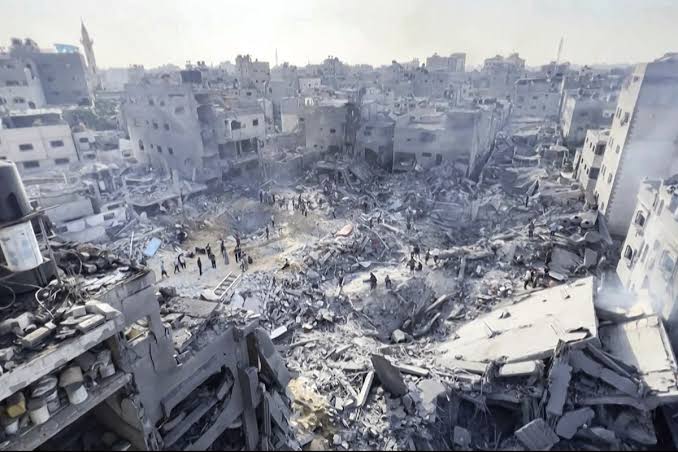
For about a year now Israel has been bombing the Palestinian Gaza strip to smithereens in retaliation for the killing of several Israelis revelling in an outdoor event inside Israel last October by members of the Palestinian Hamas group. In the attack, the Hamas operatives took with them scores of Israelis in addition to the killing
In response, the Israeli government led by Prime Minister Benjamin Netanyahu vowed to exact a severe retribution on Hamas by going after its infrastructure in the Gaza strip. In the process about 50,000 Palestinians have been killed in the non-stop combined bombing raids and ground attacks by the Israeli Defence Forces. The Israelis too have suffered thousands killed in pitch battles with the Hamas operatives.
Shunning calls across the world for a ceasefire and to allow humanitarian convoys to convey relief supplies get to the besieged Palestinians, Israel had carried on its relentless aerial bombing and ground attacks indiscriminately targeting hospitals, schools, worship places, residential areas, water and electricity plants and other critical infrastructure.
To the north of Israel in southern Lebanon, the Lebanese guerrilla group Hizbollah which supports Hamas had been launching intermittent attacks on targets in Israel while the latter has been engaged in Gaza. The Israeli army’s engagement against Hizbollah took a turn for the worst recently when its leader Hassan Nasrallah and several of the group’s leaders were killed in coordinated bomb blasts through their pagers using electronic timing devices to detonate hidden bombs placed in the pagers. Israel has followed up its aerial bombing of Lebanon with ground attacks intended to smash Hizbollah and its infrastructure in Lebanon.
In retaliation last week, Iran to which Hizbollah is affiliated, launched hundreds of missiles some of them hypersonic on targets including the strategic Nevatzim Airforce home to some of Israel’s cutting edge fighter airplanes and the headquarters of the Israeli foreign Intelligence out-fit MOSSAD in Herzliyya district (named after Theodor Herzl, the founder of the World Zionist movement). Iran said the attacks were carried out in response to the killing of the Hizbollah leader and his associated and vowed that should Israel launch any counter attack, Iran with greater force.
Israel has promised to respond to these missile attacks ‘’at a time of its choosing’’. Analysts looking at implication of this statement have zeroed in on some scenarios that the possible Israeli strike will take.
As there are no land borders between Israel and Iran the possibility of such an attack will most likely be launched by air. Israel could decide to respond in kind by missiles and Unarmed Air Vehicles (UAVs, also known as Drones) targeted at sensitive Iranian installations like air and army bases. It could also target refineries, arms production and headquarters of the Iranian defence and intelligence establishment, especially the elite Iranian Revolutionary Guards.
Israel could also send squadrons of its air force to bomb targets deep in Iran. For this, the Israeli air force may opt to use land air bases in Cyprus or Azerbaijan. Israel could also request the United States to allow it use its aircraft Carrier stationed nearby in the gulf. There is also the option of using the huge US base in nearby Qatar.
For Israel to exact retribution on Iran it must be commensurate or even more that what Iran did with its recent strike. And I believe in their preparations for such, Prime Minister Netanyahu and Defence Minister Yoav Gallant would not rule out the nuclear option.
For Israel all of these scenarios are fraught with heavy implications.
Using air bases in both Cyprus and Azerbaijan will certainly be balked at by Erdogan’s Turkey. Both countries are deep sore points for Turkey and using any or both of them to attack Iran will draw serious reservations among the Turkish population. This is in addition to the unmanageable blowbacks that will likely follow the use of such option. Using this option also will not afford the Israeli planes the needed surprise element as mid-air refuelling and air manoeuvres on the way to bombing Iran will be picked up by radars.
And in the unlikely case of some of the planes evading detection and dropping their payloads, they may not return safely back. Although much has been made about the stealth and radar evading capabilities of the American made F-35 stealth fighter planes which are in the inventories of the Israeli air force, it will not be beyond the capabilities of the Russians, Turks and even the Iranians to detect the movement of those planes at some point.
In planning an air invasion of Iran, the Israelis would certainly reflect on the incident in 1980 when American Delta Special Forces failed in their attempt to rescue American hostages held by the Iranians following the Iranian revolution. Some reports had it that it was the Soviets who tampered with the communications of the American Special Forces which in turn resulted in the helicopters carry the forces clashing against each other.
In the present scenario it will not be out of place to expect the Russians, Turks and Iranians who have assets in the vicinity to track the movement of Israeli planes towards Iran and proceed to thwart their mission.
Sending using agents in Iran to plant and detonate bombs in selected Iranian targets is something the Israelis have done before. But the commensurate damage in this regard would not match the scale of what Iran did to Israel. And the danger involved in such operations in terms of likely capture of the agents and malfunctioning of the devices could result in terrible consequences for Israel.
Israel could also consider using nuclear bombs on Iran. But that will be suicidal. First the radiation effects could drift far beyond Iran and spread throughout the region endangering the population of other countries. Secondly if Israel does not have first strike nuclear capability to knockout Iran’s counter strike abilities then it will be a worthless effort. In such a scenario, Israel will be a target not only the Iranians but other countries in the region as well.
Let us face the reality; between Israel and Iran there is a state of mutually assured destruction. A war between both countries under the present circumstances would not be limited to them but would drag in other significant parties as well. Meir Dagan the former Chief of the Israel’s MOSSAD cautions that Israel should not contemplate going into a war with Iran alone. He wants the US and its allies to help Israel do the job. But Iran has warned that any US involvement would result in its assets in the region being legitimate targets for Iranian attacks.
That means the huge US base in Qatar and others in Saudi Arabia will come under attack from Iran. And there is a distinct possibility that the oil infrastructure in Saudi Arabia, Kuwait and other gulf states will be affected. Iran could also shut down the strategic straits of Hormuz through which about a third of global oil shipping passes through. All these will lead to an immediate spike in global oil prices resulting in serious negative consequences for the world economy.
Is there a way out of this looming quagmire?
My take is that Saudi Arabia and other gulf states who stand in the line of fire will try to persuade Russia, China the US and other parties to prevail on Iran to allow Israel as a face saving measure ‘’avenge’’ the strike on it by Iran in a certain way agreed by all the parties. As arranged, Iran will refrain from retaliation.
And then there will be strident calls for restraint and de-escalation. And there will be secret negotiations between Iran and Israel brokered by Russian, US, China and Saudi Arabia. All issues like the Palestinian question, the Iran nuclear plans, guarantees of Israel’s security in the region and security of oil infrastructure will be on the table.
Similar diplomatic conclave has happened before during the 1973 war between Egypt and Syria on the one hand and Israel on the other. That war went to the brink of nuclear war as the Arab forces came to within a sight of defeating Israel with only option left was to use nuclear weapons on Egypt.
A deal was done whereby the US provided satellite images of the Egyptian army formations in the Sinai to the Israeli army to through a gap and surround the Egyptian army. This strategic manoeuvre resulted in a ceasefire and for secret negotiations to commence between Egypt and Israel leading to the historic Camp David Accords in 1977.
The Iranians too are not new to this type of diplomatic manoeuvres. The hostilities that had existed between Iran and the US following the Iranian revolution did not deter both from negotiating secretly on the Iran-Contra deal.
In the present circumstances where the world is on the brink nobody would want a regional war in the Middle East as a trigger. Where the only alternative left is the devil’s alternative of a nuclear war, all the major parties involved certainly find a way to prevent it in view of the consequences.

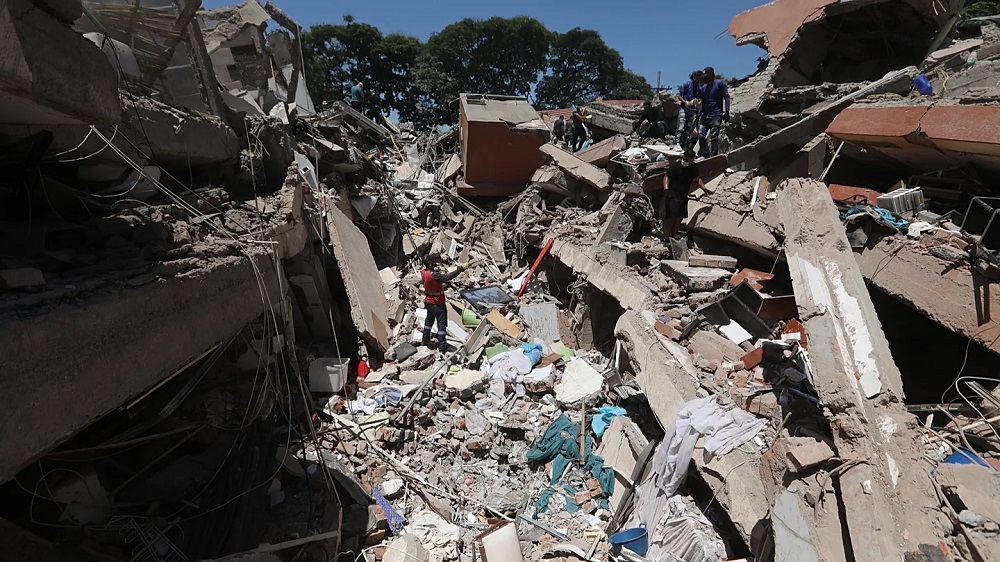
Colombia on Monday declared a state of emergency following a powerful earthquake that caused at least 111 deaths and flattened dozens of buildings, trapping more victims underneath.
The 7.4-magnitude quake struck western Colombia at 7:34 am (1234 GMT) and triggered a frantic search for survivors in several cities.
“The national government is maintaining all its capacities deployed to protect lives, assist affected communities and deliver aid to every area that needs it,” President Abelardo de la Espriella stated from Bogota.
The leader appointed just three days ago reported 111 deaths, 87 people injured and over 1,000 buildings were damaged.
The quake’s epicenter was in Colombia’s coastal Choco region at a depth of 100 kilometers (60 miles). Authorities in the impoverished area reported 12 deaths.
The nearby city of Pereira was one of the worst-hit areas, with local authorities earlier announcing that at least 40 people had died in the Risaralda region of which it is the provincial capital.
The quake crumpled a tower of a beloved cathedral in the city of Manizales, an AFP journalist observed.
“A great many buildings” in the city sustained damage, said administrative worker Jaime Zuluaga, 50. “Traffic is paralyzed and people don’t want to go back to their homes for fear of an aftershock.”
– ‘Missing people’ –
At least 20 buildings crumbled in Colombia’s third-largest city, Cali, trapping people beneath the debris, Mayor Alejandro Eder said.
Choco’s governor warned of serious damage in the provincial capital Quibdo, where videos showed more buildings reduced to rubble.
“We are all devastated,” Quibdo community leader Luis Gregorio Moreno told AFP.
“At this moment there are reported deaths, dozens of wounded, but what there are most of are missing people,” he said.
Ecuador, Panama and Venezuela also felt the early-morning quake, which prompted building evacuations in the Colombian capital, Bogota.
Still wearing their pajamas, crowds of people rushed out into the street upon feeling the tremor, AFP reporters saw.
“The quake was very, very strong,” said content creator Valeria Polo, 29, in the capital, where only minimal damage was recorded.
Six small airports in western Colombia suspended operations, the civil aeronautics agency said, and the soccer governing body postponed upcoming football matches.
Washington is “closely monitoring the large earthquake that struck Colombia and stands ready to support the people of Colombia,” US Secretary of State Marco Rubio wrote on X.
European Union chief Ursula von der Leyen said the EU was “ready to provide more support” to the South American country.
“We have already mobilised Copernicus, our satellite service, to help with rescue operations,” she wrote on social media.
Israel, Mexico, Ecuador and France also offered assistance.
Latin America is already reeling from two disastrous quakes that struck Venezuela in June, killing more than 6,000 people and causing widespread destruction.
AFP

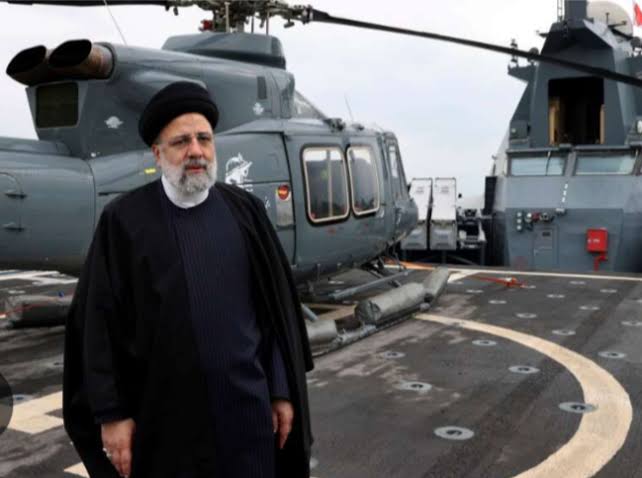
Iran on Saturday gives conditions for the reopening of the Strait of Hormuz, including compensation for war damages, complicating a potential deal to open the waterway essential to the world economy.
Tehran has imposed an effective blockade of the strait since the United States and Israel struck Iran in late February, and wants to charge tolls for passage, attacking ships it accuses of attempting to circumvent its preferred route.
Continued attacks in the strait, which was free to transit before the war, led to the collapse of an April ceasefire. Mediators have since urged both sides to return to the terms of a June memorandum.
Iranian Foreign Minister Abbas Araghchi said discussions with Oman over transit and management of the strait were “approaching the final stages”, but added the reopening of Hormuz “is subject to other conditions and compensation for the violation” of the June agreement.
Security chief Mohammad Bagher Zolghadr on Saturday laid out a list of demands for reopening the strait, including an end to the “war and aggression against Iran and its allies in Lebanon, Palestine, Yemen, and Iraq”.
He also demanded the lifting of a parallel US naval blockade of Iran, the end of sanctions, the release of frozen assets and compensation for wartime damage, according to remarks reported by Tasnim news agency.
Iran’s Revolutionary Guards, meanwhile, said Hormuz’s reopening had “nothing to do with the negotiations between Iran and Oman”, adding that the “enemy is forced to accept Iran’s conditions for the opening of the strait”.
The comments came as transit through Hormuz has dropped significantly, with Iran targeting ships it accuses of skirting its preferred route through Iranian waters.
The United Arab Emirates’ foreign ministry on Saturday condemned what it called a “hostile Iranian attack that targeted a tanker belonging to ADNOC (Abu Dhabi National Oil Company) with a missile while it was transiting the Strait of Hormuz, without causing casualties”.
Later on Saturday, the United Kingdom Maritime Trade Operations (UKMTO) said a ship was hit by a projectile off Oman in the Strait of Hormuz, causing a fire that was extinguished but no casualties. It was unclear whether they were referring to the same ship.
On Friday, ADNOC had put out a statement saying that since the start of the war, 15 of its vessels had been attacked in Hormuz, “including three vessels this week alone”.
Oman’s foreign ministry on Saturday condemned “repeated attacks on vessels transiting the Strait of Hormuz”, without naming Iran.
It also said that “ongoing negotiations regarding navigation arrangements in the Strait of Hormuz are proceeding in a positive and constructive atmosphere”, and urged against any actions that might jeopardise the progress.
The previous Iran-US deal — meant to serve as a jumping-off point for negotiations on a permanent settlement — had said Iran and Oman would hash out future arrangements for the strait in discussion with other Gulf countries and “in line with the applicable international law”.
International law generally forbids tolling in such waterways.
Security agreement
Turkey’s foreign minister said Saturday he expected Egypt to join a joint defence agreement between Turkey, Saudi Arabia and Pakistan designed to stabilize the region, calling the country a “natural partner on all issues”.
“I believe that at the next stage Egypt will also be among us in the alliance. We already act toward one another as if we were alliance members,” Foreign Minister Hakan Fidan said in an interview.
A drone struck US assets at an Egyptian port on the Mediterranean last month, marking the first drone attack on Egyptian territory since the outbreak of the Iran war.
Fidan said the agreement does not target a specific country.
“There is no common threat that we have put in writing,” he said, according to the news agency.
Pakistan’s foreign ministry said Friday the pact meant an attack on any member would be regarded as an attack on all, adding it was “intended to strengthen collective deterrence”.
AFP
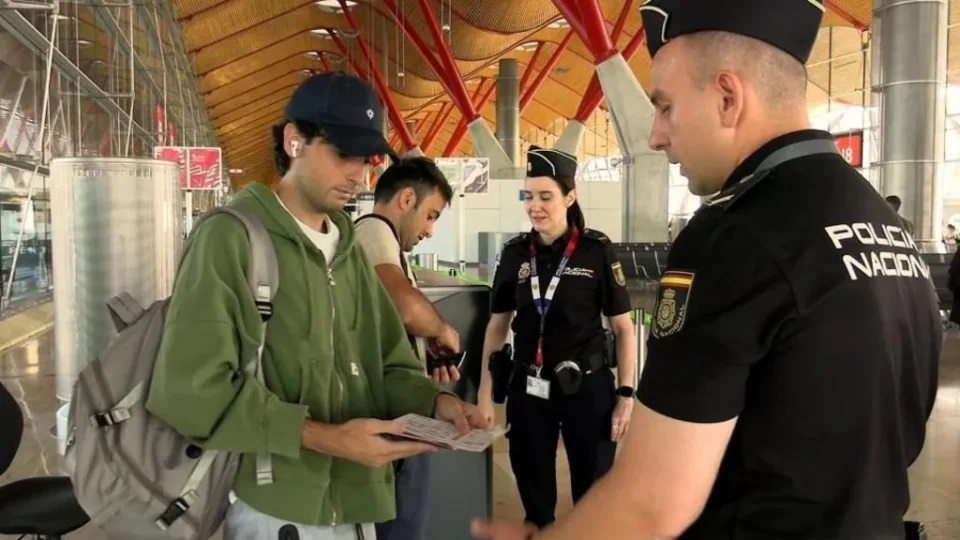
Spain on Saturday started border checks on travellers arriving from Italy, responding to similar measures Rome imposed following an unprecedented migrant rush into the Spanish north African enclave of Ceuta.
“I don’t see a lot of the word ‘diplomacy’ used in these decisions, not by the Italian government, nor by the Spanish government,” said one 36-year-old Italian tourist, Maria Celeste Grillo, who had just flown into Madrid.
She said she had not seen any added checks as she stepped off the plane, but found their implementation “sad”.
Spain announced Friday it would proceed with the heightened controls, citing “persistent irregular migration pressure” facing Italy — deepening a row between the EU partners and NATO allies.
Spain’s left-wing government has complained that Italy’s hard-right government on July 31 unfairly imposed one month of border checks on travellers from Spain — suspending the EU’s Schengen Area visa-free travel arrangements — because of the Ceuta influx.
More than 70,000 migrants had crossed from Morocco into the Ceuta enclave on July 30 and 31, though almost all of them subsequently returned to Morocco within 48 hours.
The inflow alarmed European nations, especially right-wing ones urging tougher rules on irregular migrants. However, rules for Ceuta mean migrants cannot travel onward to continental Europe without passing another layer of border checks.
Spain’s interior ministry said the new checks on incoming travellers from Italy would apply until September 7.
AFP

Kalu Flags Off Skills Training for 150 Abia Youths

Enikanolaiye Appoints Elesho, Oni As Media Aides to Drive Strategic Communications, Digital and Public Diplomacy
Osun guber: 72hours to polls, APC in confusion mode as 76 leaders seek inclusion as defection mount




-
 News11 hours ago
‘Helicopter Brought Money For Kidnappers’ – Kwara Victims Rejects Govt’s Claim Of No Ransom
-

 Politics11 hours ago
Osun election: Atiku, Aregbesola storm Osogbo for Najeem Salaam
-

 Metro11 hours ago
Military Airstrikes Wipe Out Nine Terrorists In Borno
-
Politics11 hours ago
Osun APC Raises Alarm Over Alleged Plot to Blackmail Police With Hired Protesters
-

 News24 hours ago
Top army officer confesses on why he planned coup against TInubu, identifies officers involved
-

 News11 hours ago
Meet twins who secured NNPC jobs in 2026 without connections
-

 Metro11 hours ago
23-Year-Old Nigerian Law Student Dies After Incident at 4-Storey Hostel on Lagos Campus
-

 News11 hours ago
Appointment of 4,000 SAs not an issue, says Okpebholo
Warning: Undefined variable $user_ID in /home/naijuinz/public_html/wp-content/themes/zox-news/comments.php on line 49
You must be logged in to post a comment Login