Connect with us

News

Rep Amos reacts as Dutsin-Ma Varsity honours Appropriation chair, Bichi with Doctorate degree

Published

on

ADVERTISEMENT
Zoom Ad
ADVERTISEMENT
Zoom Ad

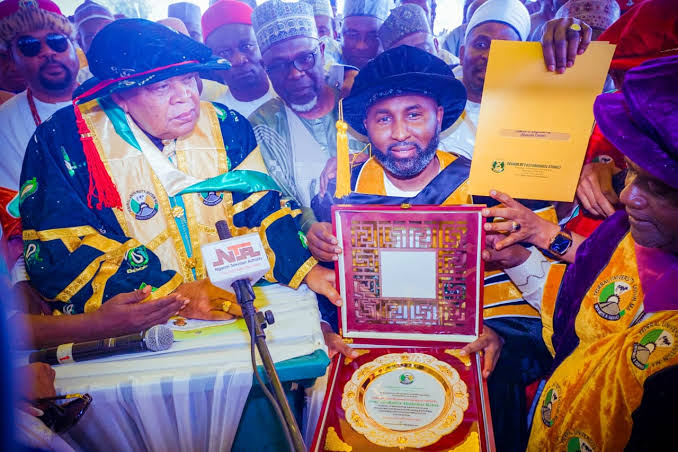
The Chairman, House of Representatives Committee on House Services, Rep. Dan Amos, has joined other well wishers to congratulate Rep. Abubakar Bichi, for bagging Doctorate degree Honoraris Causa, from Federal University, Dutsin-Ma, Katsina State.


Rep. Bichi, the Member representing Bichi Federal Constituency at the House of Representatives and Chairman of the House Committee on Appropriations, was honoured at the weekend for his commitment to the university.

Over the past five years, he has contributed to funding infrastructure projects and providing scholarships for students in his constituency, helping them achieve their academic goals.

In a message of felicitations personally signed Monday morning by Rep. Amos, who currently represents Jema’a/Sanga Federal Constituency of Kaduna State, the Lawmaker ascribed the honorary Doctorate degree to the selfless and dedicated services of Rep. Bichi to his Constituency and promotion of good governance and national development.

Advertisement

“I am thrilled to extend my warmest congratulations to you on receiving an honorary doctorate from the Federal University Dutsin-Ma, Katsina State.

“This prestigious recognition is a well-deserved acknowledgment of your tireless efforts and exemplary leadership in promoting good governance and development in Nigeria.

“Your commitment to your constituents and the nation at large is truly inspiring. Your achievements in infrastructure development, education, and healthcare have made a lasting impact on your community. Your dedication to transparency, youth empowerment and development has positioned your constituency as a model for progress.

“Please accept my heartfelt congratulations on this remarkable achievement. May this honour continue to motivate you to strive for greater heights”, the message read.

Advertisement

Other notable Nigerians honoured at the weekend by the university include, the First Lady of Nigeria, Senator Oluremi Tinubu; President of the Senate, Distinguished Senator Goodwill Akpabio; and former Governor of Sokoto State and Chairman, Senate Committee on Security, Senator Aliyu Wamako.
Continue Reading
Advertisement
Click to comment

Warning: Undefined variable $user_ID in /home/naijuinz/public_html/wp-content/themes/zox-news/comments.php on line 49

You must be logged in to post a comment Login

Leave a Reply

News

Lagos professors earn less than secondary school principals – ASUU

Published

on

By

ADVERTISEMENT
Zoom Ad
ADVERTISEMENT
Zoom Ad

The Academic Staff Union of Universities (ASUU) has alleged that senior professors in Lagos State-owned universities now earn less in monthly remuneration than secondary school principals in the state’s public service.

The union described the situation as a reflection of the declining welfare of academics, while accusing the Lagos State Government of failing to implement the 2025 Federal Government-ASUU Agreement, subjecting lecturers to what it called “starvation wages,” increased tax deductions and alleged victimisation of union leaders.

The allegations were made on Wednesday during an emergency joint press conference by ASUU branches in Lagos State University (LASU), Lagos State University of Science and Technology (LASUSTECH), and Lagos State University of Education (LASUED), held at the ASUU Secretariat, LASU, Ojo.

Speaking on behalf of the coalition, ASUU Zonal Coordinator, Comrade Oluwaseun Babalola, appealed to Governor Babajide Sanwo-Olu to urgently implement the 2025 agreement in the state-owned universities.

Advertisement

He said the government’s failure to implement the agreement, eight months after its agreed commencement date of January 1, 2026, had worsened the condition of academic staff.

“We have invited you today to draw the attention of the Lagos State Government, the people of Lagos State, and indeed all Nigerians to the continued failure of the State Government to implement the provisions of the 2025 Federal Government/ASUU Agreement in its three public universities, despite the mutually agreed commencement date of January 1, 2026,” Babalola said.

To support the union’s claim on salary disparity, Babalola displayed what he described as a payslip of a secondary school principal showing a monthly earning of N799,000, insisting that no professor in LASU currently earns such an amount.

He also criticised increased tax deductions on lecturers despite the non-implementation of the new salary structure.

Advertisement

“Somebody that is already complaining of what he is earning is not enough. You are increasing your deduction,” he said.

Babalola added that associate professors and professors were paying over N120,000 monthly in tax deductions from salaries he described as inadequate.

The union also demanded the unconditional reinstatement of five ASUU-LASU executives dismissed between seven and nine years ago, alleging that they were punished for their union activities.

The affected officials include former Chairman, Dr. Isaac Oyewunmi; Vice Chairman, Dr. Suenu; Secretary, Dr. Tony Dansu; Assistant Secretary, Dr. Oyekan; and Treasurer, Dr. (Mrs.) Sonibare.

Advertisement

Babalola alleged that the affected officials were subjected to disciplinary actions over issues connected to their union activities.

Also speaking, ASUU-LASUED Chairman, Dr. Victor Akinola, said internal mechanisms for addressing grievances within the universities had become ineffective.

He alleged that complaints from unions to governing councils and relevant authorities often received no attention, leaving lecturers without effective channels for redress.

Akinola also alleged that threats from management had created an atmosphere of fear on campuses, discouraging some lecturers from participating in union activities.

Advertisement

Similarly, ASUU-LASUSTECH Chairman, Comrade Murisiku Onigemo, blamed irregular promotion exercises for low morale among academic staff.

He said promotion processes had not consistently followed established guidelines, affecting staff motivation and institutional growth.

The union called on the Lagos State Government to immediately implement the 2025 Federal Government-ASUU Agreement in all state-owned universities from January 1, 2026, address outstanding welfare issues, reinstate the dismissed ASUU-LASU leaders and stop what it described as victimisation of union officials.

Advertisement
Continue Reading

News

Osun Guber: 15,000 Police Officers To Be Deployed For August 15 Poll — CP Etaifo

Published

on

By

ADVERTISEMENT
Zoom Ad
ADVERTISEMENT
Zoom Ad

The Commissioner of Police in charge of the August 15 Osun governorship election, Samuel Etaifo, has said no fewer than 15,000 operatives will be deployed for the poll.

Etaifo disclosed this in Osogbo, Osun State on Wednesday during a meeting with police personnel deployed for the election.

He said the deployment will include conventional policemen, specialists, the dog section, medical team and the Police Mobile Force, PMF.

According to him, a Deputy Inspector General of Police, DIG, and an Assistant Inspector General of Police, AIG, will also be in the state to oversee the exercise.

Advertisement

“As I speak with you the total number of officers that will come for this election should be nothing less than 15,000. This includes conventional policemen, specialists, dog section, medical, PMF. The DIG and AIG in charge of these operations are coming,” he said.

“I will be the CP in charge of the election. That is why the IGP has deployed me here. We are supposed to arrive here about four or five days before the election but because of the heightened tension the IGP said I should come earlier.”

Etaifo said some personnel had earlier been deployed to the state following an escalation of violence ahead of the poll.

He urged officers on duty to uphold high ethical standards and act within the ambit of the law.

Advertisement

He warned that anyone caught trying to disrupt the conduct of a free and fair election, regardless of status, would face the full weight of the law.

*“Arrested Violators Will Be Moved To Abuja”*

The CP said anyone arrested during the election would be moved to Abuja for prosecution, noting that the governorship poll is a national event.

“Arrested violators of electoral laws will be moved straight to Abuja. No one arrested here in Osun during the course or after the election will be taken to any state command. This election is a federal government election. Anybody arrested will be taken to Abuja. That’s the order,” Etaifo stated.

Advertisement

Electorate in Osun State will go to the polls on August 15 to elect a governor.

Fourteen candidates, including the incumbent Governor Ademola Adeleke, are contesting in the election.

Continue Reading

News

FG Sets Aside N2.47tn For 124 Strategic Road Projects In 2026 Budget

Published

on

By

ADVERTISEMENT
Zoom Ad
ADVERTISEMENT
Zoom Ad

The Federal Government has earmarked N2.47 trillion in the 2026 budget for the rehabilitation and reconstruction of 124 roads considered critical to Nigeria’s economic activities.

An analysis of the 2026 budget shows the road projects are spread across both northern and southern Nigeria, targeting key transport corridors that support agriculture, trade and the movement of goods. Analysts say improving these routes could reduce logistics costs, enhance market access and stimulate economic growth.

Among the priority projects is the 105-kilometre road linking Borno and Kano states, for which the government has allocated N13.3 billion for dualisation. The project is expected to improve the transportation of agricultural produce from Borno, Yobe, Jigawa and Bauchi states to Kano, the commercial hub of the North-West.

Next is the Lokoja-Abuja Road, which serves as a major gateway between the North and the South. The road is divided into two sections, both of which will cost the sum of N12.6 billion for construction and rehabilitation.

Advertisement

Another important road that the Federal Government is embarking on this year is the Enugu-Port Harcourt Road, targeted at linking the South-East to the South-South, connecting major industrial, commercial and logistics hubs. The road, divided into sections III and IV, is expected to cost N19.6 billion.

The government is also planning to rehabilitate the Gbagi-Apa-Owode Road in Badagry, which is aimed at connecting communities in Badagry to the Owode/Seme border with the Republic of Benin. The 30.6-kilometre road, which is expected to boost cross-border trade and movement and lower logistics costs for businesses, will cost N4.2 billion.

The government has also earmarked N1.4 billion for the construction of access roads linking the Second Niger Bridge to both Onitsha in Anambra State and Asaba in Delta State.

The Kano–Katsina Road is one of the most important highways in northern Nigeria, connecting two major commercial centres and serving as a gateway to the Niger Republic. The Federal Government plans to spend N23.6 billion for the dualisation of the critical road.

Advertisement

‘You know, the road links Kano’s markets with Katsina and neighbouring Niger Republic, supporting domestic and cross-border trade. Farmers of crops like sorghum, millet, groundnuts, onions, rice and tomatoes can easily find a ready market in Kano. Infrastructure can be an enabler for most of the roads in the 2026 budget’, said an emerging markets analyst, Ike Ibeabuchi.

The Federal Government is also funding the Aba-Owerri-Ikot Ekpene Road, a strategic economic corridor linking Akwa Ibom, Abia and Imo states. It connects major commercial, industrial and agricultural centres in the South-South and South-East, making it one of the region’s most important highways. The government will spend N7.7 billion on the road, which will create a ready market for Aba shoe makers.

The government will likewise spend N1.4 billion to rehabilitate Ikorodu-Shagamu Road, which serves as an alternative route to the ever-busy Lagos-Ibadan Expressway to boost trade and industries. The government also plans to spend N1.4 billion to repair Iganmu Bridge in Lagos. Economists say the bridge will connect the Lagos port corridor with the rest of the city.

Moreover, there is a plan to construct rural farmers’ feeder roads in Ikirun, Kwara State, at the cost of N1.75 billion. The road, analysts say, will connect farming communities with markets and processing centres while reducing post-harvest losses.

Advertisement

Similarly, there is N3.5 billion set aside for the upgrade of Ekiti Cargo Airport, N7 billion for the construction and rehab of Abeokuta-Ibooro Road, as well as N4.2 billion for Ibi Bridge construction in Taraba State to connect Ibi with communities across the Benue River.

About N7 billion has been set aside for the construction of Kano-Dayi Road to serve farming communities and link them to Kano. Also, N4.2 billion will be used for the rehabilitation of Kunya-Kanya-Barbura-Mutum Road in farming communities of Jigawa State, while N6.3 billion is devoted to the rehab of FCET New Site-Bagwai-Gwarzo Road in Kano.

The government is equally setting aside N25.2 billion for the construction of the four sections of Ota-Idiroko Road, including N3.5 billion for the dualisation of Bende-Ohafia Road with four bridges.

The Federal Government intends to spend N3.5 billion for the rehabilitation of Kabba in Kogi State (Iyamoye – Omuo – Ekiti – Ikole – Ifaki-Ado Ekiti (Omuo), with a view to linking these communities. Another N7 billion is earmarked for washout sections of Rivers, Delta and Akwa Ibom states, while N17.8 billion serves for the dualisation of phases 1 & 2 of the Benin-Akure-Ijesha Road.

Advertisement

Again, the sum of N14 billion is budgeted for the Kano Bypass, while N12.6 billion is earmarked for the rehab of the Onitsha-Owerri Road to make trading between Onitsha and Imo and Abia states easy.

The PUNCH found that if the budget is implemented religiously, there will be appreciable growth in Nigeria’s infrastructure stock, estimated at 30 per cent to 35 per cent of the Gross Domestic Product. This level falls far below the international benchmark of 70 per cent recommended by the World Bank for middle-income and growing economies.

The ex-Minister of Finance and Coordinating Minister for the Economy, Olawale Edun, disclosed that Nigeria has a $14 billion annual infrastructure investment gap.

The Alvin Report says decades of underinvestment in infrastructure have led to the present predicament, and with Nigeria’s population growing by about three per cent annually, the infrastructure deficit could balloon to about $20 billion–$25 billion by 2035.

Advertisement

‘Nigeria risks slower growth, higher poverty, and reduced competitiveness if it does not close this gap’, the report warned,

According to the Nigerian Economic Summit Group, Nigeria’s weak physical and technological infrastructure continues to erode its competitiveness relative to peer economies (see Figure 1). It added that data reveal significant gaps in basic infrastructure, such as unreliable power supply, inadequate transport networks, and limited logistics capacity, which raise business costs and constrain productivity.

‘These shortcomings have discouraged investment, undermined efficiency, and left Nigeria lagging behind countries that have modernised their infrastructure to drive competitiveness and economic growth.

A consultant economist, Chukwunonso Iheoma, is worried that the money will not all be released, stressing that such a situation will be another missed opportunity for Africa’s fourth biggest economy.

Advertisement

‘It is not just about how much is budgeted; it is how much is released. We have been struggling with the implementation of the budgets since this administration came to power.

‘Right now, the 2025 budget is still being implemented. So, tell me, when will this budget be implemented? There is no guarantee that half of the budget will be implemented’.

Continue Reading

Trending

Copyright © 2024 Naija Blitz News