Economy
SEE Dollar To Naira Exchange Rate For Today January 2nd 2025
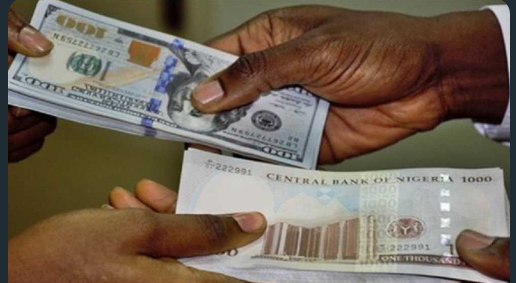
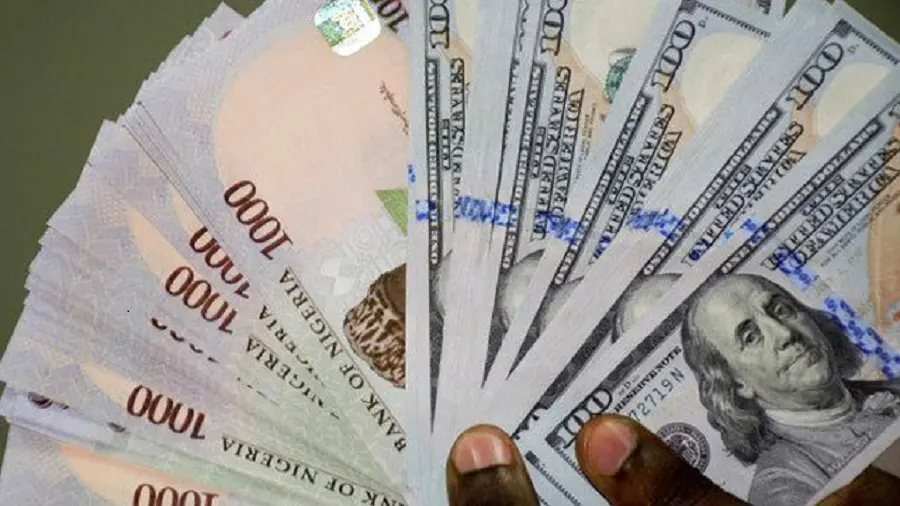
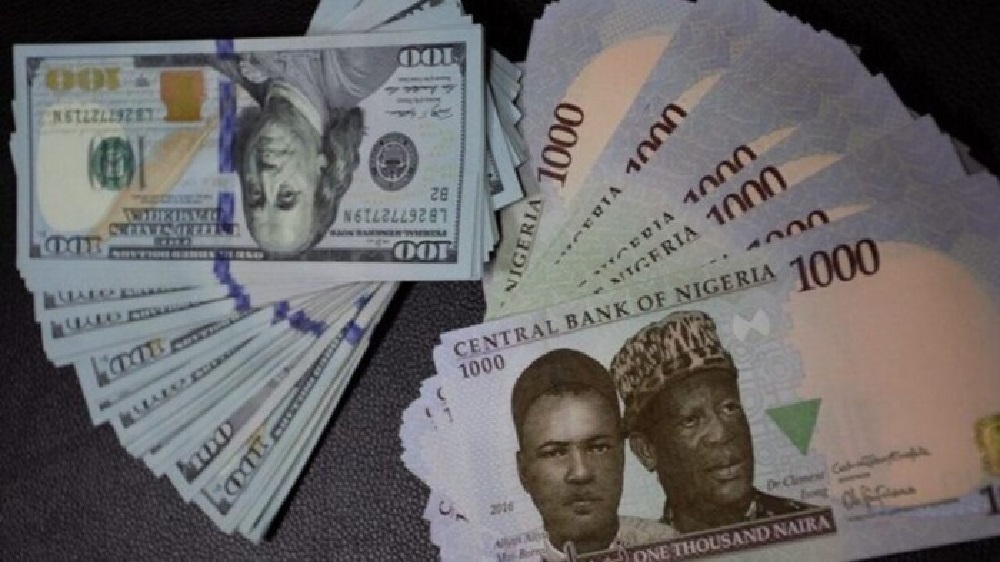
Below, is the Dollar to Naira exchange rate for today, 02 January 2025.

What Is The Official Exchange Rate For Dollar To Naira Today?
The exchange rate between the Naira and the US dollar according to the data released on the FMDQ Security Exchange, the official forex trading portal showed that the Naira opened at ₦1544.00 and per $1 on Monday, December 30, 2024 and closed at ₦1538.25 per $1 on Tuesday, December 31, 2024.

However, the Naira is trading as high as ₦1,655 per Dollar at the black market even though the Central Bank of Nigeria (CBN) announced the unification of all segments of the foreign exchange market.
The apex bank, in a circular on Wednesday 14th June 2023, said all FX windows were now collapsed into the investors & exporters (I&E) window.
The statement read, “Abolishment of segmentation. All segments are now collapsed into the Investors and Exporters (I&E) window. Applications for medicals, school fees, BTA/PTA, and SMEs would continue to be processed through deposit money banks.
“Re-introduction of the “Willing Buyer, Willing Seller” model at the I&E Window. Operations in this window shall be guided by the extant circular on the establishment of the window, dated 21 April 2017, and referenced FM/DIR/CIR/GEN/08/007. All eligible transactions are permitted to access foreign exchange at this window.
“The operational rate for all government-related transactions shall be the weighted average rate of the preceding day’s executed transactions at the I&E window, calculated to two (2) decimal places.
“Proscription of trading limits on oversold FX positions with permission to hedge short positions with OTC futures. Limits on overbought positions shall be zero.
“Re-introduction of order-based two-way quotes, with bid-ask spread of N1. All transactions shall be cleared by a Central Counter Party (CCP).
“Reintroduction of Order Book to ensure transparency of orders and seamless execution of trades.
“The operational hours of trades shall be from 9 a.m to 4 p.m, Nigeria time.”
The apex noted that further guidance on the operational changes would be communicated to authorized dealers and the general public in due course.
The changes to operations in the country’s FX market imply that Nigeria has eased its control of the naira, allowing the local currency to float freely.
Meanwhile, a free-floating exchange rate occurs when a government allows the exchange rate to be determined purely by market forces and there is no attempt to ask the central bank to influence the external value of the exchange rate.

Economy
Naira Slumps At Official FX Market
The Nigerian naira depreciated slightly against the United States (US) dollar, trading at N1,343.6398 per dollar at the Central Bank of Nigeria (CBN) official foreign exchange window on Friday, 17th April, 2026.
According to the data on the CBN’s official platform, the naira traded at the Nigerian Foreign Exchange Market (NFEM) rate of N1,343.6398/$per dollar and closed at N1,342.5000 per dollar.
When compared with the previous trading rate, the Nigerian currency traded at N1342.3037 on 16th April, 2026. With this, the Nigerian currency depreciated slightly by a minimum of N1.3.
At the parallel market, the naira-to-dollar exchange rate for the buying rate didn’t change while the selling rate increased by N3 when compared to that of the previous trading rate.
According to Aboki FX , the Naira-to-dollar exchange rate at the black market on Friday, 17th April, 2026, was N1,395 and N1,405 per dollar for buying and selling rate respectively.
Economy
Monetary Shake-Up! CBN Unveils New Interest Rate Benchmark
The Central Bank of Nigeria on Friday unveiled the Nigerian Overnight Financing Rate (NOFR) as a new benchmark for the country’s money market, a move aimed at boosting transparency and improving the effectiveness of monetary policy.
The announcement was made in a statement by the bank’s Acting Director of Corporate Communications, Hakama Sidi-Ali, who noted that the initiative was developed in partnership with the Financial Markets Dealers Association to strengthen Nigeria’s financial system.
According to the apex bank, the new benchmark is designed to bring Nigeria in line with global standards for short-term interest rates, while enhancing price discovery and ensuring more consistent pricing across money market instruments.
The CBN explained that NOFR is expected to improve monetary policy transmission, encourage financial innovation, and boost investor confidence, while also reinforcing risk management practices within the financial system.
With the introduction of NOFR, Nigeria joins other economies that use similar benchmarks, such as SOFR in the United States, SONIA in the United Kingdom, €STR in the Eurozone, TONA in Japan, and JIBAR in South Africa.
The bank disclosed that the rate followed a stakeholder engagement held on February 27, 2026, where market participants adopted the framework before receiving regulatory approval. NOFR is now operational, with the CBN serving as its administrator and responsible for ensuring transparency, governance, and regular publication.
Further details provided in an FAQ document show that NOFR is a risk-free benchmark reflecting the cost of overnight secured lending in the interbank market. Unlike estimates, it is based strictly on actual transactions, improving accuracy and credibility.
The rate is published daily at 10:00 a.m. on the next business day and applies only to naira-denominated overnight secured interbank transactions that meet specified criteria. It is calculated using a volume-weighted trimmed mean approach to remove outliers and ensure reliability.
Where there is insufficient transaction data, the previous day’s rate will be retained and clearly disclosed to maintain consistency.
The CBN clarified that NOFR is not a replacement for key monetary policy tools such as the Monetary Policy Rate but will serve as a reference for pricing financial instruments, contracts, and some corporate loans.
For investors, the benchmark is expected to improve valuation, pricing, and risk management of naira assets, thereby deepening activity in the domestic money market.
While retail customers may not see immediate changes in loan or savings rates, the bank noted that increased transparency from the new system should strengthen overall confidence in Nigeria’s financial sector.
On governance, the CBN stated that any adjustments to the rate would only occur in cases of significant errors and would be fully disclosed, adding that the methodology will be reviewed at least once a year to keep it aligned with market realities.
Economy
Nigerian stocks rally again as investors gain N1.66tn, market cap crosses N136tn
The Nigerian equities market sustained its bullish momentum on Thursday, delivering a fresh massive gains of N1.663 trillion to investors as market capitalization surged beyond the N136 trillion mark.
At the close of trading, total market value rose by 1.23 percent to N136.435 trillion, up from N134.772 trillion recorded at the start of the session.
In the same vein, the All-Share Index (ASI) advanced by 2,583.61 points, representing a 1.23 percent increase, to settle at 211,901.02, compared to 209,317.41 in the previous trading day.
The market’s Year-To-Date (YTD) return strengthened further to 36.17 percent, while sentiment remained positive as 45 stocks posted gains against 20 decliners.
Leading the gainers’ table were Trans-Nationwide Express and Guinea Insurance, both appreciating by 10 per cent to close at N5.50 and N1.21 per share, respectively. Aradel rose by 9.99 percent to N1,547.50; Ecobank Transnational gained 9.97 percent to close at N61.20, while Daar Communications climbed 9.93 percent to N1.66 per share.
On the losers’ side, Ikeja Hotel topped the chart with a 9.73 per cent decline to N33.40. WAPIC followed with an 8.77 per cent drop to N2.60, while CAP shed 8.61 per cent to close at N95 per share. International Energy Insurance and McNichols also recorded losses of 8.18 per cent and 5.82 per cent, respectively.
Trading activity, however, slowed during the session. Total volume traded declined by 17.19 percent to 584.96 million shares valued at N34.76 billion across 45,559 deals.
Zenith Bank emerged as the most actively traded stock, accounting for 61.74 million shares worth N7.60 billion, representing 10.55 per cent and 21.86 per cent of total volume and value, respectively.
The latest performance extends the market’s winning streak to four consecutive sessions, following a strong N2.28 trillion gain recorded on Wednesday.
-
Politics23 hours ago2027: Why Tinubu should be afraid — ADC
-
Economy23 hours agoMonetary Shake-Up! CBN Unveils New Interest Rate Benchmark
-
News23 hours agoCourt Fixes Ruling Date In High-Profile Godwin Emefiele Trial
-
Metro23 hours agoPolice Inspector joins robbery gang, shot dead during operation
-
News23 hours agoAliko Dangote always tells me to save my money – Davido
-
News15 hours agoExpulsion: Bala, Abejide vow to battle Mark-led ADC faction to finish
-
News23 hours agoSecurity Operatives Arrest Seven Suspects Linked To Benue Abduction
-
News17 hours agoFuel, diesel prices will drop in Nigeria as crude oil slumps

You must be logged in to post a comment Login