Foreign
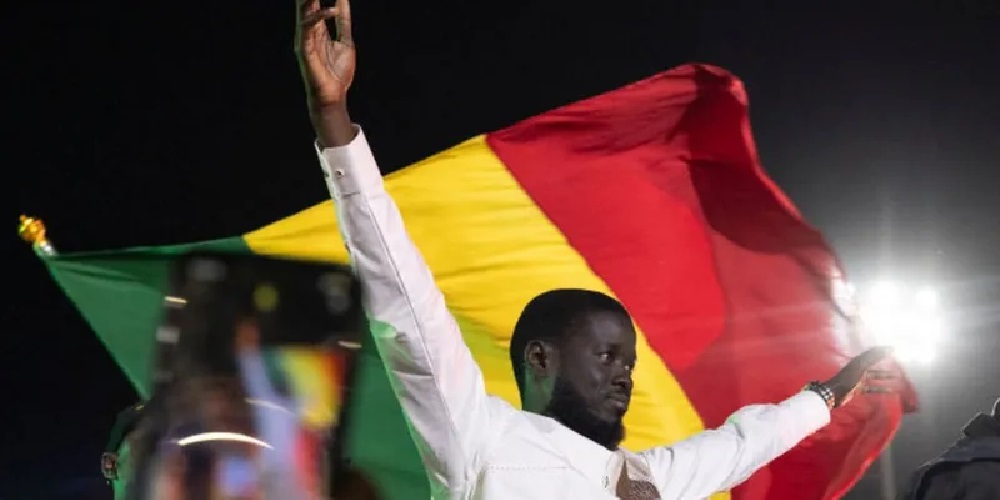
Senegal election result: Bassirou Diomaye Faye to become Africa’s youngest president
- /home/naijuinz/public_html/wp-content/plugins/mvp-social-buttons/mvp-social-buttons.php on line 27
https://naijablitznews.com/wp-content/uploads/2024/03/Bassirou-Diomaye.jpg&description=Senegal election result: Bassirou Diomaye Faye to become Africa’s youngest president', 'pinterestShare', 'width=750,height=350'); return false;" title="Pin This Post">
- Share
- Tweet /home/naijuinz/public_html/wp-content/plugins/mvp-social-buttons/mvp-social-buttons.php on line 72
https://naijablitznews.com/wp-content/uploads/2024/03/Bassirou-Diomaye.jpg&description=Senegal election result: Bassirou Diomaye Faye to become Africa’s youngest president', 'pinterestShare', 'width=750,height=350'); return false;" title="Pin This Post">
“Politics never crossed my mind,” says the tax collector and husband to two wives

Few had heard of him a year ago, and now he is set to become president.
Bassirou Diomaye Faye’s extraordinary rise caps a rollercoaster period in Senegalese politics that caught many off-guard.

Months in jail alongside ally and kingmaker Ousmane Sonko ended suddenly, with the pair released the week before the presidential election.
Now Mr Clean, as he’s nicknamed, must get to work on the sweeping reforms he has promised.
“Methodical” and “modest” are words often used to describe the tax collector, who celebrates his 44th birthday on Monday.
Mr Faye fondly recalls his rural upbringing in Ndiaganiao, where he says he returns every Sunday to work the land.
His love and respect for village life is matched by his deep distrust of Senegal’s elites and establishment politics.
“He’s never been a minister and wasn’t a statesman so critics question his lack of experience,” analyst Alioune Tine tells the BBC.
“But, from Faye’s point of view, the insiders who’ve run the country since 1960 have made some catastrophic failures.”
Fighting poverty, injustice and corruption are top of Mr Faye’s agenda. While working at the Treasury, he and Mr Sonko created a union taskforce to tackle graft.
Gas, oil, fishing and defence deals must all be negotiated to better serve the Senegalese people, says Mr Faye.
He is ushering in an era of “sovereignty” and “rupture” as opposed to more of the same, he told voters, and that is especially true of ties to France.
Senegal’s president-elect says he will drop the much-criticised CFA franc currency, which is pegged to the euro and backed by former colonial power France.
Mr Faye wants to replace it with a new Senegalese, or regional West African, currency, although this will not be easy.
“He will have to deal with the reality of the budget to begin with… But I see that he has a lot of ambition,” former Prime Minister Aminata Touré, who served under outgoing President Macky Sall, tells the BBC.
Strengthening judicial independence and creating jobs for Senegal’s large young population are also key priorities for Mr Faye – neither of which “President Sall paid much attention to and it caught up with him”, Ms Touré adds.
She is not the only political heavyweight to have thrown her support behind the 44-year-old – former President Abdoulaye Wade did the same just two days before Sunday’s vote.
It is a remarkable turnaround for Mr Faye who spent the last 11 months in prison on charges of insurrection, and many more years before that in his ally’s shadow.
‘Bassirou is me’
Bassirou Diomaye Faye was announced in February as the so-called “Plan B” candidate, replacing the charismatic opposition firebrand Ousmane Sonko. “I would even say that he has more integrity than me,” Mr Sonko said proudly.
Both men founded the now-disbanded Pastef party, both men are tax collectors, and both men found themselves jailed last year on charges they said were politically motivated.
Mr Sonko ended up being convicted of two offences, which meant he was barred from the election, so Mr Faye stepped in.
“Bassirou is me,” Mr Sonko told supporters recently. “They are two sides of the same coin,” Pastef colleague Moustapha Sarré agrees.
This has led to criticism that Mr Faye is merely “president by default”.
Not so, says analyst Mr Tine. But the pair’s relationship could usher in a new style of leadership.
“Maybe they will establish a tandem and break away from the hyper-presidential model of having an all-powerful head of state.
“Sonko is of course the uncontested leader of Pastef – an icon, even… [But] the two have had a [dynamic of] complicity and collusion.”
Once upon a time, Mr Faye wanted nothing to do with politics. “It never crossed my mind,” he said in 2019 while recalling his childhood.
One of Mr Faye’s heroes is the late Senegalese historian Cheikh Anta Diop – whose work is seen as a precursor to Afrocentrism. Both are seen as left-wing cheerleaders for pan-Africanism.
As early results came in on Monday showing Mr Faye was set for victory, people in the capital, Dakar, celebrated by honking car horns and singing to loud music.
The reaction from international markets was less jubilant, with Senegal’s dollar bonds falling to their lowest level in five months. Reuters news agency reports that investors are concerned Mr Faye’s presidency may wind down the country’s business-friendly policies.
The election was originally due last month but Mr Sall postponed it just hours before campaigning was set to begin, triggering deadly opposition protests and a democratic crisis.
Most candidates had very little time to prepare once the new election date was set – but Mr Faye had just over a week after being freed from jail.
Despite the shortened campaign period, Senegal’s citizens were adamant they would turn out and use their vote, Christopher Fomunyoh – of the National Democratic Institute for international affairs – told BBC Newsday.
“Senegal is in the process of confirming that democracies can self-correct and come out stronger and more resilient.”
And the true test for Senegal’s clean-up guy has only just begun.
Foreign
Iran accuses US of violating ceasefire over past 48 hours
Iran’s foreign ministry on Tuesday accused the United States of violating a fragile ceasefire during the past 48 hours in the southern coastal province of Hormozgan, without specifying the incident.
“The US terrorist army, continuing its illegal and unjustified actions since the ceasefire … has, in the past 48 hours, committed a gross violation of the ceasefire in the Hormozgan region,” the ministry said in a statement.
The US Central Command said forces had on Monday attacked missile sites and boats it said were trying to lay mines in the Gulf, while Iran’s Revolutionary Guards said it had fired at US aircraft attempting to enter the country’s airspace.
AFP
Foreign
Iran president orders internet restored after war suspension
Iranian President Masoud Pezeshkian has ordered the restoration of international internet access in Iran, which had been suspended since the United States and Israel launched attacks against the country, local media reported Monday.
“The decree aimed at restoring internet access to its pre-January state was communicated to the Ministry of Communications by the president,” Iranian news agencies Tasnim and Fars reported.
Authorities shut down the internet during large-scale anti-government protests that peaked in early January, then suspended it again on February 28 at the start of the Middle East war.
Since then, the population has only had access to domestic platforms and websites.
AFP
Foreign
Trump says Iran deal ‘largely negotiated’ including reopening Strait of Hormuz
US President Donald Trump says an agreement with Iran has been “largely negotiated” and details will be announced soon.
The deal would include the reopening of the Strait of Hormuz, he said on Saturday, without giving further details.
Iranian foreign ministry spokesman Esmaeil Baqaei earlier told state television that US and Iranian positions had been converging in the last week, but warned that did not mean agreements would be reached on key issues and accused the Americans of “contradictory statements”.
On social media, Trump said he had a “very good call” with the leaders of Saudi Arabia, the United Arab Emirates, Qatar, and others about a “Memorandum of Understanding pertaining to PEACE”.
“An agreement has been largely negotiated, subject to finalization between the United States of America, the Islamic Republic of Iran, and the various other Countries, as listed,” Trump said.
“Final aspects and details of the deal are currently being discussed, and will be announced shortly.”
He also said he had a call on Saturday with Israeli Prime Minister Benjamin Netanyahu, which “went very well”.
The president has not given any further details on the deal, but has insisted any agreement would “absolutely” prevent Iran from obtaining a nuclear weapon.
Later, Pakistan’s Prime Minister Shehbaz Sharif said: “I congratulate President Donald Trump on his extraordinary efforts to pursue peace,” and said the phone call had been “very useful and productive”.
Pakistan has been helping to negotiate a peace deal, serving as an intermediary.
“We hope to host the next round of talks very soon,” he wrote in the statement on X.
The US and Israel launched wide-ranging strikes on Iran on 28 February, sparking conflict across the Middle East. Iran responded by launching attacks on Israel and US-allied states in the Gulf.
A ceasefire in Iran was agreed in early April, and since then Washington and Tehran have engaged in talks over a long-term peace deal.
Speaking to state television on Saturday, Iranian foreign ministry spokesman Esmaeil Baqaei also described a “memorandum of understanding”, saying Iran’s intention was to reach an agreement “in the form of a framework, consisting of 14 points”.
Baqaei said they were in the process of finalising the memorandum, so further talks could be held within 30 to 60 days “and ultimately a final agreement can be reached”.
The new sense of momentum comes after the mood appeared to have soured in Washington, with anonymous officials briefing US media on Friday that the administration was preparing for a fresh round of military strikes, although no final decision had been made.
On Friday, the president posted on Truth Social that he would not attend his son Donald Jr’s wedding this weekend so he could remain in Washington DC “during this important period of time”.
Last week, Trump had said the truce was on “massive life support” after rejecting Tehran’s demands, labelling them “totally unacceptable”.
The US has blockaded Iranian ports since 13 April.
On Saturday, US Central Command (Centcom) said it had redirected 100 vessels, disabled four, and allowed 26 humanitarian aid ships to pass since the blockade began.
Centcom commander Admiral Brad Cooper said its forces had been “highly effective” in “allowing zero trade into and out of Iranian ports which has squeezed Iran economically”.
Meanwhile, Iran has claimed military control of an area around the Strait of Hormuz, and has said all transit through the strait “requires coordination with and authorisation from the Persian Gulf Strait Authority”.
The US and Gulf allies have repeatedly rejected Iranian attempts to assert control over the strait, and the US has told ships not to comply with Iran’s rules.
-
News22 hours agoTech Derby hosts funding readiness programme for start-ups in UK
-
Metro13 hours agoBandits hold abducted Niger State medical doctor despite N20m ransom payment
-
Politics13 hours agoDickson Welcomes Omo-Agege, Ochei to NDC, Grants Senatorial Primary Waivers
-
News13 hours agoIgnore ‘Illogical’ Election Results In Circulation, We’ll Hold Our Primaries Today – NDC
-
Sports13 hours agoUCL final: Thierry Henry to present trophy as Arsenal face PSG
-
Sports13 hours agoSinner Stunned In Paris, Crashes Out Of French Open
-
Entertainment13 hours ago‘I have checked out of marriage,’ says Regina Daniels
-
News13 hours agoConversion Rumours Untrue, President Tinubu Remains A Muslim-Aide