
News
*ECHONO’S THREE-YEAR BLITZKRIEG IN TETFUND*(PHOTOS)

- /home/naijuinz/public_html/wp-content/plugins/mvp-social-buttons/mvp-social-buttons.php on line 27
https://naijablitznews.com/wp-content/uploads/2025/03/IMG-20250309-WA0002-1000x600.jpg&description=*ECHONO’S THREE-YEAR BLITZKRIEG IN TETFUND*(PHOTOS)', 'pinterestShare', 'width=750,height=350'); return false;" title="Pin This Post">
- Share
- Tweet /home/naijuinz/public_html/wp-content/plugins/mvp-social-buttons/mvp-social-buttons.php on line 72
https://naijablitznews.com/wp-content/uploads/2025/03/IMG-20250309-WA0002-1000x600.jpg&description=*ECHONO’S THREE-YEAR BLITZKRIEG IN TETFUND*(PHOTOS)', 'pinterestShare', 'width=750,height=350'); return false;" title="Pin This Post">


*By Tunde Olusunle*
One very well reasoned appointment into a very critical government
department in recent years, is bound to be the “conscription” of Sonny Togo Echono to the leadership of the Tertiary Education Trust Fund, (TETFUND). The last five years of his most eventful public service career were spent as Permanent Secretary in the Federal Ministry of Education. On a daily basis, he engaged with Vice Chancellors, Rectors and Provosts of Universities, Polytechnics and Colleges of Education, owned by the federal government. Added together, we are speaking here of well over 100 such institutions, with the federal government hosting this tripod of institutions, universities, polytechnics and colleges of education, in most of the 36 states and the Federal Capital Territory, (FCT). Echono’s office distilled the needs of these citadels of knowledge and activated the bureaucracy of the ministry to tend to their operational requirements.
Following his retirement from service early 2022, Echono momentarily reclined into his couch to savour desired rest and rejuvenation after a racy and most eventful career. Before his last port of call in the Federal Ministry of Education, Echono’s career which began as an architect with the Federal Ministry of Works and Housing in 1987, had taken him through several key Ministries, Departments and Agencies, (MDAs), availing him multisectoral experiential rootedness across the public service. He had served variously in the Budget Monitoring and Price Intelligence Unit, (BMPIU), and the ministries of Defence; Water Resources; Environment; Agriculture and Power. He had therefore planned to shuttle between his address in Nigeria’s capital city and his countryside abode in the Idoma heartland in Benue State, which he cherishes dearly.

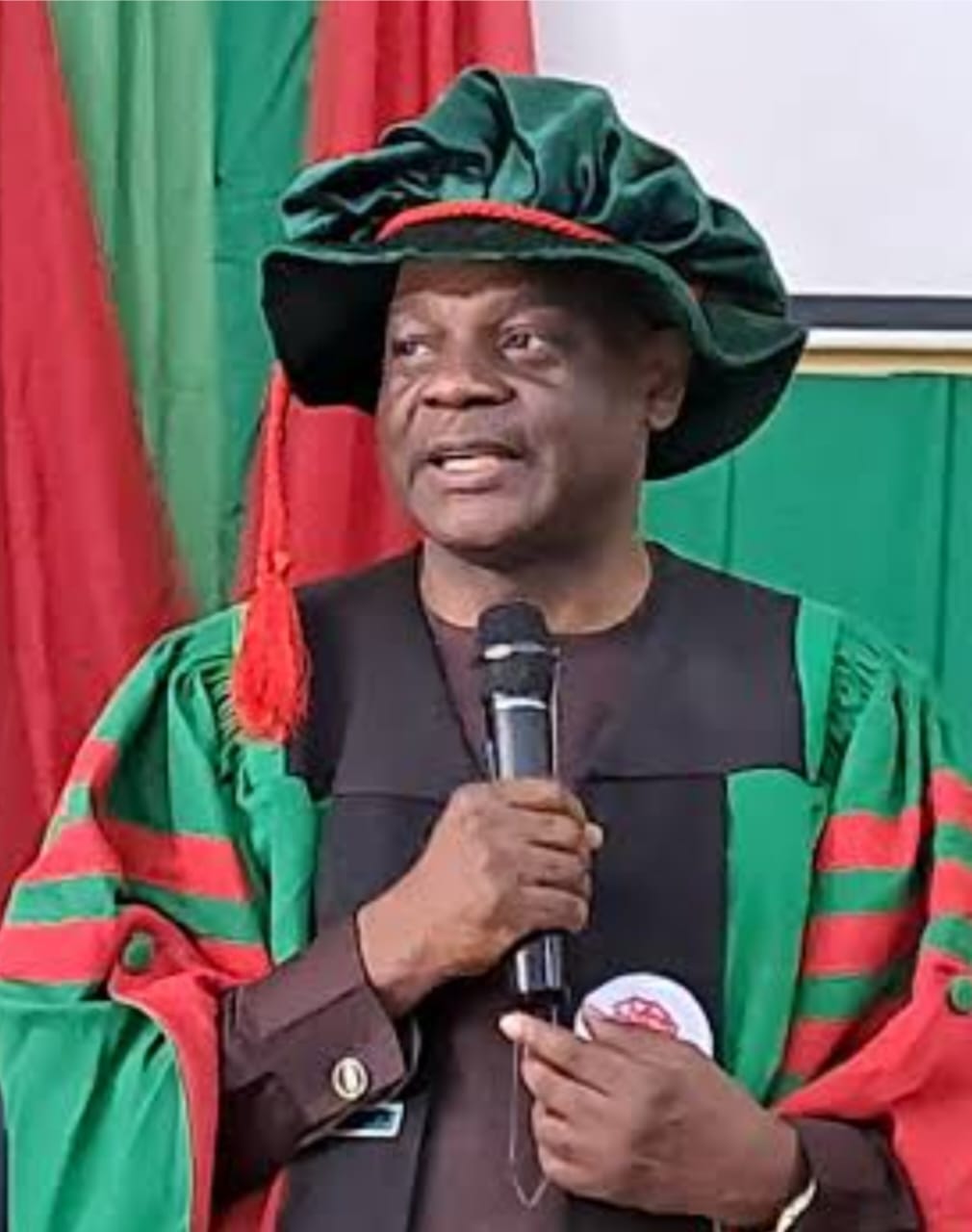
*Ademola Adeleke, Governor of Osun State being received by Sonny Echono during his visit to TETFUND.*
Duty, however, beckoned within weeks of his retirement. Echono, seasoned architect, experienced public servant, consummate patriot, was appointed Executive Secretary of TETFUND. He formally assumed office on March 18, 2022. The scheme was established by the federal government in 2011, with the primary responsibility of disbursing, managing and monitoring the deployment of education tax remitted to government-owned tertiary institutions in Nigeria. Public tertiary institutions were hitherto poorly funded. This situation, expectedly, had very negative impact on knowledge dissemination, periodically engendering unrest in the institutions. TETFUND is supervised by the Federal Ministry of Education, Echono’s last official post. This naturally has ensured smooth and seamless collaboration between the parent ministry and its parastatal, since the onset of the Echono dispensation.
Three years into his five-year stewardship, Echono continues to chalk up milestones for the organisation. It was not going to be “business as usual” under his watch so he began with desirable “housekeeping” by addressing the work ethic in TETFUND. Previously perceived as a “cash cow,” entrenched interests had constituted themselves into a cabal which determined the award of contracts to predetermined interests. There were also murmurs and talks about stealing and underhand dealings which cast the organisation in bad light in the public sphere. Steeped and stewed in the ethos of due process and public procurement, Echono moved speedily to bring his imprimatur to bear on the workings of the organisation. He has since striven, gradually and unobtrusively, to straighten the administration of TETFUND and realign its operations with its core mandate.
*Sonny Echono, (right), receiving Governor Bassey Otu of Cross River State, in his Abuja office*
Such revolutionary novelties in an organisation previously steeped and stuck in its ways were not going to make new friends for Echono. Fifth columnists in the system and their external collaborators, periodically engineered phoney petitions to anti-graft agencies, notably the Independent Corrupt Practices and Related Offences Commission, (ICPC). They equally generated submissions to the nation’s parliament contending in one particular instance, that an accumulated allocation of over N2 Trillion to TETFUND over the years, could not be accounted for! The ever calm Echono has always responded to such claims and invitations to clarify the issues with impeccable documents and records. These have serially deflated the schemes and mischief of faceless rabble rousers.
Sonny Echono’s regime has brought a fresh air of activism into the endeavours of TETFUND. The federal government has also continued to reaffirm its faith in the establishment via regular upward reviews of its budgetary allocations. TETFUND continues to renew, or open fresh, possibilities for collaboration between it and a plethora of organisations. Callers at the Abuja headquarters of the organisation over time, have included the Senate and House Committees on Tertiary Institutions. Governor Ademola Adeleke of Osun State and his Cross River State counterpart, Bassey Otu, have also visited TETFUND seeking partnership. Nigeria’s Chief of Defence Staff, (CDS), General Christopher Gwabin Musa has also been a guest of Echono’s TETFUND. Musa exercises oversight over the Nigerian army, navy and airforce. Over the years, the military has continued to reinvent its training institutions many of which are degree awarding citadels today. Musa believes there are areas of potential cooperation between the military and TETFUND, and has begun a conversation around this. The Federal Road Safety Corps, (FRSC), recently followed the precedence of the military, when its Corps Marshal, Shehu Mohammed, led a team to TETFUND. The FRSC canvassed support for its training institutions to enhance the capacity and professionalism of road safety personnel across the country.
*General Musa, Chief of Defence Staff, (CDS), and Sonny Echono during the visit of the CDS to TETFUND.*
Simultaneously, Echono is regularly on the road with his own officials, knocking on doors of MDAs whose partnership can strengthen the enterprise of TETFUND. Among several others, he has in recent months, led delegations to the Economic and Financial Crimes Commission, (EFCC), and the Nigerian Extractive Industries Transparency Initiative, (NEITI). Echono is equally a much sought-after speaker these days at university convocation lectures and similar public engagements. These have availed him the platform to address burning issues in Nigeria’s all-important educational sector. Echono’s Convocation Lecture at the Federal University of Technology, (FUTO), Owerri, Imo State, last December, was titled *Impact of Leadership Selection on Governance in Public Universities in Nigeria.* At a similar event at the Olabisi Onabanjo University, (OOU), Ago-Iwoye, Ogun State last January, Echono spoke on *TETFUND and Educational Development in Nigeria: The History, the Treasures and the Future.*
Echono addressed the subject *University Autonomy and the Challenge of Quality Tertiary Education in Nigeria,* at the Convocation ceremony of the Federal University Oye-Ekiti, Ekiti State, in February. He has deployed these speaking opportunities to address issues of inadequate funding in tertiary institutions, and to restate the imperative of the payment of tuition fees in public universities. This, he has regularly maintained is crucial to support that critical level of the educational hierarchy. Echono has canvassed synergy between institutions in the areas of research, innovation, alumni obligations and student exchange to broaden the worldview of young scholars. He has equally admonished on the inescapability of full autonomy in public universities, if educational standards must improve and be sustained. The acquisition of quality literacy never comes cheap, he has consistently maintained.
Elsewhere, Echono has decried the penchant of many Nigerians who were sponsored abroad on public resources, but refusing to return home to contribute to national development. Many such nationals opt to stay back in foreign lands, against the spirit of their scholarships. Echono regards this as a dimension of the pervading *japa* syndrome, the abscondment abroad of Nigerians fleeing excruciating socioeconomic conditions at home. Last November, TETFUND under Echono stopped government funding for intending foreign students. This should mitigate the double-sided loss of the country’s fiscal and human resources, respectively. At an August 2024 *Conference on Digital Pedagogy and Fundable Research Writing,* Echono criticised the arbitrary upgrading of Colleges of Education into Universities of Education, by governments at various levels. His contention is that the country remains in short supply of teachers and instructors at the foundational level of education.
Sonny Echono has also criticised the continuing politicisation and corruption inherent in the appointment of Vice Chancellors in Nigerian universities. In one of his public presentations, he abhorred political interference and financial inducement in leadership selection processes in our universities. These factors he observed are combining to erode the sanctity of the hallowed university system. Echono expressed worry about the fact that competition for appointment into principal offices in universities has become a lucrative venture which has made members of governing councils prone to fiscal inducement. Echono has received several awards through the years including that of the national honour of *Officer of the Order of the Niger, (OON).* He has demonstrably distinguished himself beyond the the half line of his present assignment. He can be trusted and should be continually supported to consolidate on his legacies in the years to come.
*Tunde Olusunle, PhD, Fellow of the Association of Nigerian Authors, (FANA), is an Adjunct Professor of Creative Writing at the University of Abuja*
News
NDLEA intercepts N6.2bn worth of ‘Jihadi drug’ in Ghana soap, opioids at Lagos Airport (Photos)
. Arrests cross-border kingpin; recovers cocaine, heroin from iron safe seized at Rivers drug den
Operatives of the National Drug Law Enforcement Agency (NDLEA) have intercepted consignments of captagon, widely known as ‘Jihadi drug’ and millions of opioid pills worth over N6.2 billion at the Murtala Muhammed International Airport (MMIA), Ikeja Lagos.
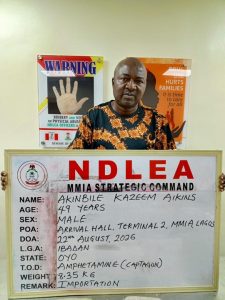
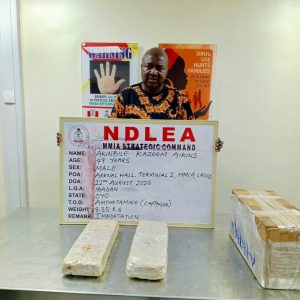
The captagon shipment was seized at the Lagos airport on Saturday 22nd August 2026 following the arrest of a 49-year-old cross-border kingpin Akinbile Kazeem Aikins, who arrived from Accra Ghana aboard an African World Airlines flight.
A search of his carton of local bathing soap, popularly called “Ghana Soap,” led to the recovery of 47,200 pills of the illicit amphetamine drug worth over N1.5 billion concealed within blocks of soap. Captagon, which is notoriously dubbed the ‘Jihadi drug’ for its use in funding extremist activities in conflict zones, was first intercepted in Nigeria by NDLEA in September 2021 at the Apapa port in Lagos. After his arrest, Akinbile claimed he was meant to deliver the consignment in the North.
In another successful interdiction operation at the Lagos airport, no fewer than 3,900,030 tablets of Tramaking 225mg and Tapentadol 250mg, with a combined gross weight of 2,787.40 kilograms and more than N4.6 billion in street value, were recovered from four abandoned consignments at the import shed of the MMIA. Three of the consignments, comprising 900,000 tablets of Tramaking (815.40kg), arrived aboard RwandAir flights from Bangladesh, while a fourth, comprising 3,000,030 tablets of Tapentadol (1,972kg), arrived on Qatar Airways from Amsterdam.
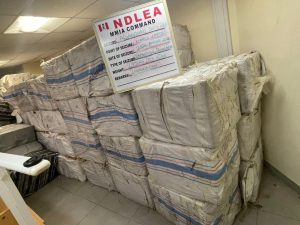
The shipments, which had been placed under close watch after no one showed up to claim them, were formally retrieved after a joint examination by NDLEA officers, Customs and other stakeholders on Friday 28th August.
A 31-year-old US-returnee, Sowunmi David Oludotun was on 19th August arrested by NDLEA operatives at Ikate area of Lekki after he showed up to take delivery of 3.350 kilograms of Loud, a synthetic strain of cannabis imported from the United Kingdom.
Fireproof safe cracked open in Rivers drug den raid In Rivers state, NDLEA operatives have raided the notorious Abuja Down/Up area of Port Harcourt where they recovered a fireproof iron safe among other items. When the safe was cracked open with a welding machine on Tuesday 25th August, 237 grams of colorado; 316 grams of cocaine, and 10 grams of heroin were recovered from it.
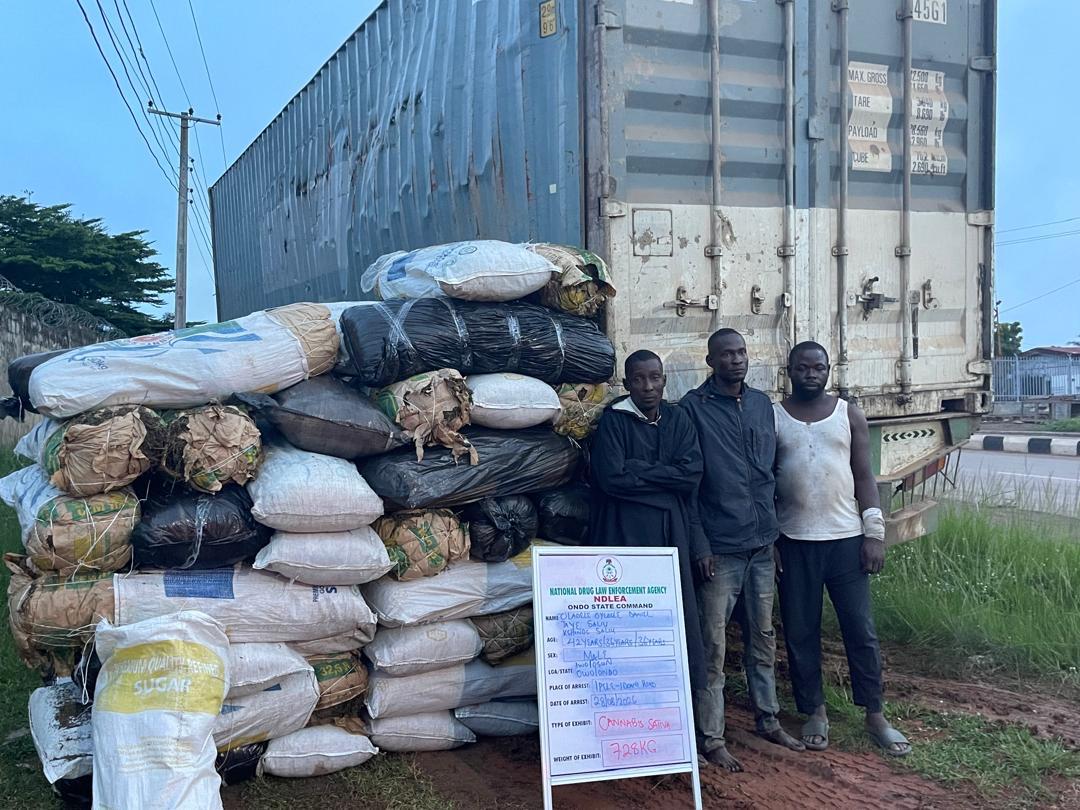
Three suspects: Oyedele Daniel, 42; Taye Saliu, 36; and Kehinde Saliu, 36, were on Friday 28th August nabbed at Ipele-Idoani road, in Ondo state with a total of 728kg skunk recovered from their truck marked KRE 120 XB. Two other suspects: Uche Joseph, 35, and Godwin Umeh, 21, were arrested at Aponmu forest with 341kg of same substance on Wednesday 26th August.
In Delta state, over 176,000 pills of assorted opioids including tramadol, molly and others were recovered from two interdiction operations in parts of the state between Wednesday 26th and Friday 28th August.
With the same vigour, Commands and formations of the Agency across the country continued their War Against Drug Abuse (WADA) sensitization activities to schools, worship centres, work places and communities among others in the past week. These include: WADA enlightenment lecture to students and staff of Markaz Littahfizul Quran Wal Islamiyyat, Dadin Kowa, Gombe; Zangina Islamiyyah Alasawa Kurna, Ungogo LGA, Kano; youths at the adolescent lifestyle programme organised by NNPCL in Benin city, Edo state; while the Ondo State Command of NDLEA paid a WADA advocacy visit to the State Governor, Dr. Lucky Aiyedatiwa, with the Taraba state command of the Agency paying a similar advocacy visit to the State Governor, Dr. Agbu Kefas, among others.
While commending the officers and men of MMIA, Ondo, and Delta Commands for the various successful operations, Chairman/Chief Executive Officer of NDLEA, Brig. Gen. Mohamed Buba Marwa (rtd) enjoined them and their colleagues across the country to continue with the ongoing balanced approach to the drug control efforts of the Agency.
He also directed them to sustain the momentum against drug traffickers who are desperate to explore every means, including concealment in everyday household items like soap, to move their illicit consignments.

The Federal Government has approved N10bn for the 2026 National Research Fund Grant Cycle of the Tertiary Education Trust Fund.
TETFund, in a call for concept notes, said the grant would support research projects across 30 priority thematic areas under Humanities and Social Sciences; Science, Engineering, Technology and Innovation; and Cross-Cutting.
The fund said the 2026 grant cycle followed the successful completion of the 2025 cycle, which resulted in the award of a little over N6.09bn to support 174 research projects.
According to TETFund, accessing the 2026 NRF grant will begin with the submission of concept notes by Principal Investigators of proposed research projects.
Only Principal Investigators whose concept notes are evaluated and considered fundable will be invited to submit full proposals.
Who can apply?
TETFund said lecturers in public tertiary institutions in Nigeria are eligible to apply for the grant.
Sustainable Use of Natural Resources and Terrestrial Ecosystems
Transport and Infrastructure
Water and Sanitation
Cross-Cutting
Blue Economy
Clean and Affordable Energy
Entrepreneurship and Wealth Creation
Environment, Housing, Urban and Regional Development
Innovation and Technology in National Defence Capabilities
Resource Governance
National System of Innovation
The call was signed by the TETFund Executive Secretary, Arc. Sonny S. T. Echono, PhD, FNIA, OON.
For enquiries, applicants can contact the TETFund NRF Secretariat through [email protected], [email protected], [email protected] and [email protected].

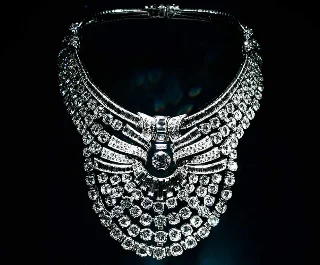
Austrian police are searching for two men who allegedly stole a 200-carat platinum necklace encrusted with 673 diamonds from a museum in Vienna.
The necklace, which was on loan to the Museum of Applied Arts (MAK), reportedly once belonged to Queen Nazli of Egypt. Police released images of the suspects captured by security cameras during the theft and appealed to members of the public for information that could help identify or locate them.
The two men reportedly entered the museum after buying tickets to the exhibition. During opening hours on Thursday afternoon, they allegedly smashed a glass display case with a hammer before taking the necklace and fleeing the scene. In an appeal for information, police said: “The perpetrators fled with the jewellery in an unknown direction.”
Officers searched parts of central Vienna and deployed a police tracking dog as they attempted to trace the suspects. Austrian newspaper Kronen reported that investigators believe the theft may have been carried out as a “contract job” for a criminal gang.
The stolen necklace was part of an exhibition that had been on display at the MAK since June. The exhibition featured more than 300 works associated with French luxury jewellery house Van Cleef & Arpels. No one was injured during the incident, although several visitors were reportedly present in the exhibition room when the theft occurred.
Museum documentation states that the necklace once belonged to Queen Consort Nazli of Egypt.
She reportedly wore the piece during the 1939 wedding of her daughter, Princess Fawzia, to Iran’s then Crown Prince Mohammad Reza Pahlavi, who later became shah. The necklace was sold by Sotheby’s in New York in 2015 for $4.3 million.
The MAK said the exhibition brought together about 200 “unique and rarely seen objects” from its own collection and pieces from the heritage collection of Van Cleef & Arpels, covering about 120 years of the jewellery house’s history.
Following the theft, a guided tour scheduled for Friday afternoon was cancelled, while the exhibition was temporarily closed.
The exhibition had been scheduled to run until September 27. The theft comes amid a series of high-profile robberies targeting European museums and cultural institutions.
In Spain on Thursday, thieves reportedly raided the Treasure of Villena, a collection of Bronze Age gold artefacts regarded as one of Europe’s most important prehistoric hoards.
Earlier this month, four significant works by 15th-century Renaissance painter Antonello da Messina were stolen from a museum in the Sicilian city of Messina.
Italian police also recently recovered three paintings by Paul Cézanne, Pierre-Auguste Renoir and Henri Matisse that had been stolen from a private museum near Parma. A recent Europol report warned that museum robberies in Europe are becoming increasingly violent, with criminals using weapons and heavy tools, including sledgehammers, axes and explosives, to target valuable cultural objects.

NDLEA intercepts N6.2bn worth of ‘Jihadi drug’ in Ghana soap, opioids at Lagos Airport (Photos)

SEE How to apply for FG’s N10bn TETFund research grant

Egyptian Queen’s 673-diamond Necklace Stolen From Museum




-

 News23 hours ago
Confusion in Niger as gunfire, explosions rock presidential palace, airport
-

 News9 hours ago
I Won’t Ever Forgive APC – El-Rufai’s Son
-

 News8 hours ago
Power Mystery: FG probes missing 100MW, N120bn revenue loss
-

 Politics9 hours ago
Kwara 2027: Zakari Mohammed, Kale Kawu, Speaker Danladi, Apaokagi Make The List As INEC Displays Names, Details Of Guber Candidates
-

 News23 hours ago
Police rescue two abducted Colombian women in Lagos
-

 Metro8 hours ago
Sokoto Hisbah denies imposing restrictions on Christian worship
-

 Metro8 hours ago
25 terrorists killed as troops repel attack on Borno community
-
 News8 hours ago
How to apply for FG’s N10bn TETFund research grant
Warning: Undefined variable $user_ID in /home/naijuinz/public_html/wp-content/themes/zox-news/comments.php on line 49
You must be logged in to post a comment Login