Connect with us

Economy

Asian stocks jump as Trump postpones painful tariffs

Published

on

ADVERTISEMENT
Zoom Ad
ADVERTISEMENT
Zoom Ad

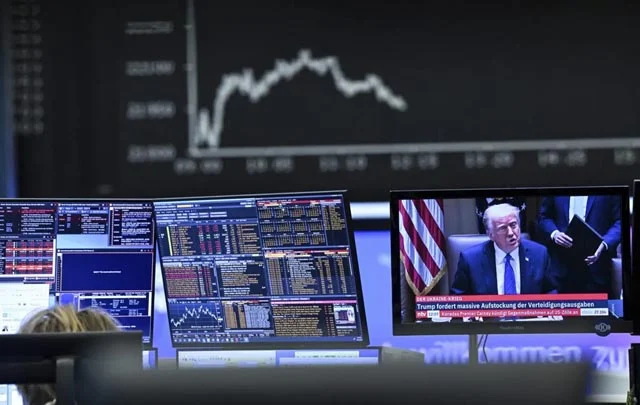
Stocks rocketed Thursday as a relief rally spread through markets after Donald Trump paused crippling tariffs on US partners, with Chinese markets even brushing off his decision to ramp up duties on Beijing to 125 percent.


The across-the-board gains tracked a blistering performance on Wall Street as the US president said he would delay for 90 days measures announced last week that set off a firestorm on trading floors and sparked global recession fears.

Trump said he would keep in place a basic levy of 10 percent on dozens of countries but upped the ante in his brutal trade war with superpower rival China by hitting it even harder after it retaliated.

China’s own 84 percent retaliatory measures kicked in at 0401 GMT Thursday, later saying that US tariffs would “severely impact the stability of the global economic order”.

Advertisement

Trump made the decision because he said investors were “jumping a little bit out of line” as markets collapsed and US Treasuries — considered the safest option in times of crisis — were also showing signs of cracking on concerns about the world’s top economy.

People “were getting yippy, a little bit afraid”, he added, referring to a term in sports to describe a loss of nerves.

The extra tariffs on Beijing, however, were “based on the lack of respect that China has shown to the world’s markets”, Trump said.

The president denied he had made a U-turn, telling reporters that “you have to be flexible”.

Advertisement

And his top trade advisor, Peter Navarro, said, “This will go down in American history as the greatest trade negotiating day we have ever had.

“We’re in a beautiful position for the next 90 days, we’ve got over 75 countries that are going to come in and negotiate with us and what they’re going to have to do, without fail, is they’re going to have to lower their non-tariff barriers.”

Trump’s shock announcement on his Truth Social network sparked a buying frenzy as Asian and European investors chased beaten-down stocks.

“Asia markets are flipping the switch — from fear to euphoria — as Trump throws a 90-day lifeline, pausing the reciprocal tariff barrage,” said Stephen Innes at SPI Asset Management.

Advertisement

“The president’s post nodded to the ‘yippy’ reaction to his historic hikes, and honestly, that sums it up.

“We just witnessed one of the all-time bouncebacks — and now, we look for Asia investors, much like their North American counterparts, to step in and buy the ‘yips’.”

Hong Kong rallied more than two percent — a third day of gains after collapsing more than 13 percent on Monday in its worst day since 1997 during the Asian financial crisis. Shanghai gained more than one percent.

The two markets have been given extra support by optimism that China will unveil fresh stimulus to support its economy in light of the tariff measures. Official data showing another drop in consumer prices last month added to those hopes.

Advertisement

– ‘Fear to euphoria’ –

Tokyo’s Nikkei surged more than nine percent, while Taipei’s 9.3 percent gain was its best rise on record — after Monday’s 9.7 percent drop represented its worst fall.

Seoul, Singapore, Jakarta, Sydney, Saigon and Bangkok climbed between four and 6.6 percent. Manila and Wellington were also well in the positive territory.

London, Paris and Frankfurt soared at the open.

Advertisement

Tech firms were the standout performers, with Sony, Sharp, Panasonic and SoftBank chalking up double-digit gains, while airlines, car makers and casinos also enjoyed strong buying.

Apple suppliers posted strong rallies — Hong Kong-listed AAC Technologies surged 5.6 percent and in Taiwan, Hon Hai added almost 10 percent.

Gold surged almost three percent to around $3,120 — around $50 short of its record touched last month — thanks to the weaker dollar and as the uncertainty saw investors rush into the safe haven.

Chihiro Ota, at SMBC Nikko Securities, said: “What happens now? If the US takes a hardline stance (in negotiations), then the market would be disappointed. If it turns out that they can engage in talks, then it may create a room for (an upswing).”

Advertisement

US Treasury yields also edged down after a successful auction of $38 billion in notes, said Briefing.com.

That eased pressure on the bond market, which had fanned worries that investors were losing confidence in the United States.

However, observers warn that the China-US standoff could be another step towards a disengagement from the world’s top two economies.

“The escalation of the trade war between the US and China suggests that a full trade decoupling is increasingly likely,” said Mali Chivakul, emerging markets economist at J. Safra Sarasin bank.

Advertisement

“Even if we may see a de-escalation later, a decoupling could still be the result.”

Trump’s trade war is also causing a headache for the US Federal Reserve as it weighs whether to cut interest rates to protect the economy, or keep them elevated to ward off the inflation many say tariffs will fuel.

Minutes from its March meeting, released Wednesday, showed members felt they “may face difficult tradeoffs if inflation proved to be more persistent while the outlook for growth and employment weakened”.

Oil prices edged down after bouncing more than four percent Wednesday, though they remain under pressure amid concerns about the global economy and its impact on demand.

Advertisement

– Key figures around 0715 GMT –

Tokyo – Nikkei 225: 9.1 percent at 34,609.00 (close)

Hong Kong – Hang Seng Index: UP 2.7 percent at 20,804.08

Shanghai – Composite: UP 1.2 percent at 3,223.64 (close)

Advertisement

London – FTSE 100: UP 6.1 percent at 8,145.26

Dollar/yen: DOWN at 147.05 yen from 147.82 yen on Wednesday

Euro/dollar: UP at $1.0968 from $1.0948

Pound/dollar: UP at $1.2875 from $1.2810

Advertisement

Euro/pound: DOWN at 85.20 pence from 85.45 pence

West Texas Intermediate: DOWN 0.6 percent at $62.00 per barrel

Brent North Sea Crude: DOWN 0.7 percent at $65.04 per barrel

New York – Dow: UP 7.9 percent at 40,608.45 (close)

Advertisement

AFP

Continue Reading
Advertisement
Click to comment

Warning: Undefined variable $user_ID in /home/naijuinz/public_html/wp-content/themes/zox-news/comments.php on line 49

You must be logged in to post a comment Login

Leave a Reply

Economy

VAT collections rise to N2.42tr in Q1 2026 – NBS

Published

on

By

ADVERTISEMENT
Zoom Ad
ADVERTISEMENT
Zoom Ad

The National Bureau of Statistics (NBS) has reported that Value Added Tax (VAT) collections rose to ₦2.42 trillion in the first quarter of 2026 (Q1 2026), up from ₦2.20 trillion recorded in Q4 2025.

According to the VAT Q1 2026 report, the figure represents a 9.98 per cent increase on a quarter-on-quarter basis.

The bureau stated that of the total revenue collected during the period, local payments accounted for ₦1.11 trillion, while foreign VAT payments stood at ₦830.47 billion. Import VAT contributed ₦477.55 billion.

“Value Added Tax (VAT) in Q1 2026 was ₦2.42 trillion, showing an increase of 9.98% on a quarter-on-quarter basis from ₦2.20 trillion in Q4 2025.

Advertisement

“Of the total VAT collected, local payments stood at ₦1.11 trillion, foreign VAT payments were ₦830.47 billion, while import VAT contributed ₦477.55 billion during the quarter,” the NBS stated.

The report further showed that sectors such as food services and accommodation recorded ₦13.20 trillion, while arts, entertainment, and recreation contributed ₦8.98 trillion to VAT-generating activities.

Continue Reading

Economy

Nigeria exceeds OPEC quota as crude production hits 11-month high

Published

on

By

ADVERTISEMENT
Zoom Ad
ADVERTISEMENT
Zoom Ad

Nigeria’s crude oil production surged to an 11-month high in May 2026, with the country exceeding its Organisation of the Petroleum Exporting Countries (OPEC) production quota.

The average crude oil production recorded during May represents 102 per cent of Nigeria’s 1.5mbpd of production quota allocated by OPEC.

The production report released by the Nigerian Upstream Petroleum Regulatory Commission (NUPRC) on Thursday disclosed that Nigeria’s oil production averages 1,530,354 barrels of crude oil and 170,446 barrels of condensates per day (bpd).

According to the report, this brings the total combined production to 1,700,800 barrels per day and consolidates Nigeria’s position as Africa’s largest oil producer.

Advertisement

The report said the production performance during the review period remained robust, with combined crude oil and condensate output ranging from a low of 1.51 million bpd to a peak of 1.86 million bpd.

It said the May 2026 production figures represented the highest recorded by Nigeria since July 2025, when output surged to 1,712,282.

“In strict crude oil terms (excluding condensates), the 1.53 million barrels recorded in May 2026 represents the highest Nigeria has witnessed since January 2025, when crude oil production hit 1.538mbpd.

“The latest crude oil production statistics thus represent a 15-month high on a month-on-month basis, production rose by 2.77 per cent in May 2026 as against 1.48mbpd in April,” it said.

Advertisement

The report said the broader production trend over the last five months had also remained positive.

It said combined crude oil and condensate output increased from 1.48 million bpd in February to 1.54 million bpd in March, 1.66 million bpd in April, and 1.7 million bpd in May, underscoring sustained growth in Nigeria’s hydrocarbon production.

According to the report, among production streams, Bonny Terminal led the pack with a total blend of 293,870 bpd, closely followed by Forcados Terminal at 289,900 bpd, Qua Iboe ranked third with 173,360 bpd, while Escravos Oil Terminal contributed 135,470 bpd.

It said the Odudu (Amenam Blend) accounted for 63,250 bpd across the top five production streams during the month under review.

Advertisement

The NUPRC attributed the rise in production to sustained positive momentum, as operations remained stable throughout the reporting period, with no significant pipeline or facility outages recorded.

It added that all previously scheduled turnaround maintenance activities had been completed, thereby improving operational reliability and production efficiency.

(NAN)

Advertisement
Continue Reading

Economy

CBN proposes stricter regulation of banks, affiliated companies’ business dealings

Published

on

By

ADVERTISEMENT
Zoom Ad
ADVERTISEMENT
Zoom Ad

The Central Bank of Nigeria (CBN) has issued draft guidelines that would impose stricter controls on transactions between banks, financial institutions and their affiliated entities as part of efforts to protect depositors’ funds, strengthen consumer protection and reduce risks within the financial system.

The proposed ‘Guidelines on Ring-Fencing Operations of Closely Linked Entities in the Nigerian Financial System’ seek to establish clear operational and functional boundaries among entities under the same corporate group and prevent the commingling of activities across different licence categories.

In a circular signed by the Director of the Financial Policy and Regulation Department, Dr Rita Sike, the apex bank said the framework was developed to promote a safe, sound and stable financial system, safeguard consumer interests and strengthen regulatory oversight.

According to the CBN, the guidelines prescribe requirements relating to governance, intra-group transactions, segregation of customer funds and data, operational independence, recovery and resolution planning, and consolidated supervision.

Advertisement

“The guidelines are intended to strengthen consumer protection, enhance transparency and accountability, mitigate contagion risks among closely linked entities, and preserve financial stability while supporting innovation and fair competition within the financial services sector,” the bank stated.

Under the proposed framework, boards of closely linked entities would be required to ensure that such entities operate independently and maintain separate governance, risk management and control structures. Each entity would also be expected to have a dedicated board and establish policies that ring-fence its operations from those of affiliated companies.

The CBN also proposed limits on overlapping leadership roles within financial groups, stating that the number of directors serving simultaneously on the boards of closely linked entities should not exceed 20 per cent of the total board membership.

To strengthen oversight, the draft guidelines require external auditors to certify annually the effectiveness of board-approved policies and processes designed to ensure operational independence.

Advertisement

The apex bank further proposed that all intra-group transactions must be conducted on arm’s-length terms and reported to the regulator on a quarterly basis.

It also stated that no closely linked entity should extend a loan to, or guarantee the obligations of, another affiliated entity without prior written approval from the CBN.

“The boards of closely linked entities shall ensure that transactions between such entities are conducted at arm’s length and are properly documented,” the draft stated.

The guidelines place significant emphasis on customer onboarding and consumer protection. Where customers choose services offered by an affiliated company, the receiving entity would be required to establish a direct business relationship with the customer, conduct its own KYC verification and provide account or wallet details where necessary.

Advertisement

The draft also requires affiliated entities to remain adequately capitalised at all times and ensure that critical functions are managed independently.

To reduce operational risks, the CBN proposed restrictions on the use of shared technology infrastructure , as entities would not be allowed to use their information technology platforms to offer services outside the scope of their licences or process transactions on behalf of affiliated entities.

The regulator said it could require the separation of data centres where necessary to reduce contagion risks and ensure that each entity can operate independently.

The framework further seeks to protect customer funds by requiring strict separation of accounts belonging to affiliated entities and daily reconciliation of balances, with discrepancies corrected within 24 hours.

Advertisement

Customer funds would not be permitted for intra-group lending, servicing debts, proprietary trading activities, external borrowings or operational expenses of related entities.

The CBN also proposed tighter controls on customer data, requiring data to be stored independently and prohibiting its sharing among affiliated entities without the explicit consent of customers, except as permitted under the Nigeria Data Protection Act.

“Sharing of customer data between closely linked entities without explicit consent of the customer is prohibited,” the draft guidelines stated.

The proposed framework further requires promoters of closely linked entities to establish a non-operating holding company structure. Such holding companies would be required to maintain regulatory capital at least 20 per cent above the combined minimum capital requirements of their subsidiaries.

Advertisement

However, shareholders unwilling to establish a holding company may choose to merge affiliated entities into a single business, subject to regulatory conditions, including the surrender of excess licences.

The CBN has exposed the draft guidelines for public review and invited stakeholders to submit comments before July 9, 2026.

Continue Reading

Trending

Copyright © 2024 Naija Blitz News