Connect with us

News

‘Cabals’ still fighting against our refinery — Dangote

Published

on

ADVERTISEMENT
Zoom Ad
ADVERTISEMENT
Zoom Ad

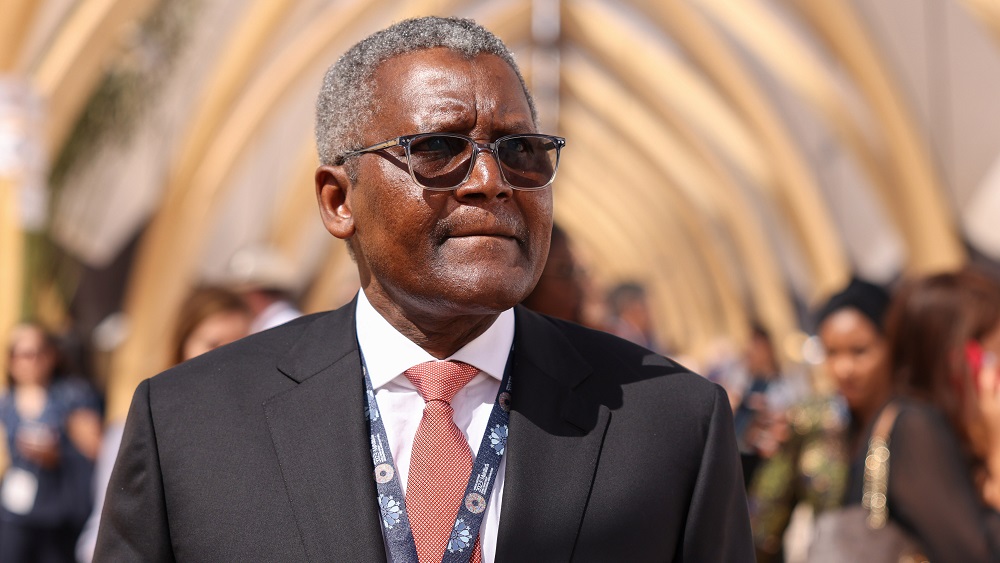
The President of Dangote Group, Alhaji Aliko Dangote, says he is still fighting for the survival of his $20bn refinery, stressing that the fight is not yet finished.


Dangote expressed optimism that he would win the fight for the refinery, stating his determination to fight on.

According to Semafor, an international news medium, Africa’s richest man spoke at an investor forum in Lagos on Friday.

The report stated that Dangote pointed out that some individuals who “for a very, very long time” have “made a lot of money from” government-subsidised oil imports into Nigeria, were the ones trying to sabotage the 650,000 barrels per day oil refinery situated in Lekki, Lagos.

Advertisement

Dangote was quoted as saying that “those groups have funded resistance to the Bola Tinubu government’s removal of petrol subsidies and are opposed to the refinery operating easily in the country.”

However, Dangote was confident that the battle between him and the groups would be won, priding himself as a long-time fighter.

“We’re fighting, and the fight is not yet finished. But I have been fighting all my life, and I am ready and 100 per cent sure I will win at the end of the day,” he was quoted.

Dangote’s latest comments came as Nigeria plans to increase its capacity to stockpile petroleum products, to prepare against shocks to the global oil market following US President Donald Trump’s shake-up of international trade with the threat of tariffs.

Advertisement

Recall that Dangote has since last year raised the alarm that some mafias were sabotaging his refinery.

He specifically mentioned that some international oil companies were sabotaging his investment by denying the facility adequate crude supply despite the domestic crude supply obligation.

Dangote had alleged that the Nigerian Midstream and Downstream Petroleum Regulatory Authority was issuing licences to marketers to import substandard petroleum products into the country.

He vowed to push his $20bn refinery to full operational capacity despite what he said were challenges from oil importers seeking to undermine his venture to retain their dominance in the country’s energy sector.

Advertisement

At a point last year, Dangote said he regretted building the refinery, saying the mafias in the oil and gas sector were stronger than those of drugs.

However, he refused to give up on the project as the facility targets its full capacity soon.

The PUNCH recalls that the Dangote Group boss once accused some powerful individuals of frustrating his refinery.

“In a system where, for 35 years, people are used to counting good money, and all of a sudden, they see that the days of counting that money have come to an end, you don’t expect them to pray for you. Of course, you expect them to fight back.

Advertisement

“And I think that is the process that we’re now really going through. But the truth is that, yes, the country, the sub-region, and also the continent of sub-Saharan Africa, need this refinery. So, you expect them to fight through non-supply of crude, non-purchase of the product, but I think it’s all temporary. We’ll get there,” Dangote added.

He had recalled that he was once persuaded by a former Minister of Energy in Saudi Arabia, Khalid Al-Falih, to shelve the idea of building a refinery. However, he said he told the former minister that he did not need his advice.

In June 2024, the Vice President of Oil and Gas at Dangote Industries Limited, Devakumar Edwin, accused IOCs in Nigeria of plans to frustrate the survival of the new Dangote refinery.

Edwin said the IOCs were “deliberately and willfully frustrating” the refinery’s efforts to buy local crude by hiking the cost above the market price, thereby forcing the refinery to import crude from countries as far as the United States, with its attendant high costs.

Advertisement

Edwin also accused the NMDPRA of granting licences indiscriminately to marketers to import dirty refined products into the country.

“It appears that the objective of the IOCs is to ensure that Nigeria remains a country that exports crude oil and imports refined petroleum products. They (IOCs) are keen on exporting the raw materials to their home countries, creating employment and wealth for their countries, adding to their Gross Domestic Product, and dumping the expensive refined products into Nigeria – thus making us dependent on imported products,” Edwin had stated.

The refinery, which started petrol production last September, is seen as a way for Africa’s biggest crude oil producer to end its reliance on the costly importation of refined fuel.

It was reported that the refinery’s entry has helped push down the pump prices of refined products even as retailers count their losses.

Advertisement

With the naira-for-crude deal, the Dangote refinery promised to ensure enough fuel supply to Nigeria, Africa, and the world.

IPMAN supports Dangote

The Independent Petroleum Marketers Association of Nigeria said they are with Dangote as he pushes ahead to fight the cabal.

IPMAN Publicity Secretary, Chinedu Udadike, said Dangote had promised before that he would fight the so-called cabal for the good of the masses, stressing that the association is behind him.

Advertisement

He said the fight is just the usual competition in any business, especially when a product is doing better than others in the market.

“Well, this is business. Competition abounds. There is no businessman whom people will not fight if he is doing well, especially when it is only your goods that are being produced, and the others are not being patronised because of the price. So, it is evident that every businessman wants to survive. It’s not an issue. What we can do is encourage him.

“We independent marketers are happy with him for his price slashes, although sometimes it’s against our own business strategy and projections. But that is part of the business, it is profit and loss.

“You know the factor of demand and supply matter determines the market. So, if he’s talking about how people want to sabotage him, he has told us that he’s ready to fight the oil cabals, and he is in this business to ensure that Nigerians don’t suffer. So, we encourage him not to lose hope, and we independent marketers support him in all ramifications,” Ukadike said.

Advertisement

No need to fight, says PETROAN

The National President of the Petroleum Products Retail Outlet Owners Association of Nigeria, Billy Gillis-Harry, said there should be no form of discord in the downstream.

According to him, Dangote should be allowed to refine its products with the naira-for-crude deal while importers and other traders should be given a level playing field to operate.

Gillis-Harry noted that there should be facts to back up all claims, saying there will be competition in any business, pleading, however, that it should be healthy.

Advertisement

He appealed to the Federal Government to supply enough crude to Dangote and other refineries.

Asked whether he felt the temporary stoppage of the naira-for-crude deal by the Nigerian National Petroleum Company Limited could have prompted Dangote’s comment, he replied that there was a need to review the pilot phase of the deal, emphasising that PETROAN was always in support of the naira petrol sales deal, which he said would make petroleum products available for all Nigerians.

He stressed that other refineries are coming onstream and there will be more competitors in the market.

“I just want all players to do their business without any fight,” the PETROAN boss said.

Advertisement

The naira-for-crude deal ordered by President Bola Tinubu allowed the sale of crude in naira to the Dangote refinery, prompting a crash in fuel prices.

With the supply of crude in naira, the Dangote refinery continued to crash petrol prices across the country. From about N1,100 per litre, the company slashed the price of premium motor spirit to N860.

But importers of petroleum products lamented the repeated reduction of petrol prices by the refinery. Some of the importers lamented that they were compelled to sell below their costs, as consumers only buy from where the product is cheaper.

While Nigerians were rejoicing over the price slashes, fuel importers and retailers said they were counting losses.

Advertisement

Credit: PUNCH

Continue Reading
Advertisement
Click to comment

Warning: Undefined variable $user_ID in /home/naijuinz/public_html/wp-content/themes/zox-news/comments.php on line 49

You must be logged in to post a comment Login

Leave a Reply

News

ECOWAS Parliament Charts New Course to Electrify West Africa

Published

on

ADVERTISEMENT
Zoom Ad
ADVERTISEMENT
Zoom Ad

…outline ambitious policies to tackle chronic electricity shortages despite vast energy reserves

By Gloria Ikibah

ECOWAS has unveiled a broad strategy aimed at closing West Africa’s persistent electricity deficit, despite the region possessing some of the world’s most significant untapped energy resources.

The plan was highlighted during a presentation at the ongoing delocalised joint meeting of the ECOWAS Parliament’s Committees on Energy and Mines; Infrastructure; and Agriculture, Environment and Natural Resources in Dakar, where policymakers and experts are examining pathways to accelerate energy access and rural development across the sub-region.

Advertisement

Delivering a presentation on “ECOWAS Regional Energy Policies and Key Energy Statistics,” the Acting Head of Conventional Energy at the ECOWAS Directorate of Energy and Mines, Mr Koumoin Arbaduis, painted a stark picture of a region blessed with abundant energy resources but still struggling to provide reliable electricity to millions of its citizens.

According to Arbaduis, West Africa possesses extensive reserves of crude oil, natural gas, biomass, uranium and coal, as well as an estimated 25,000 megawatts of hydroelectric potential. However, these advantages have yet to translate into adequate energy access and dependable power supply across the region.

He identified limited electricity generation capacity, poor access rates, costly transmission networks, significant technical and commercial losses, and heavy reliance on petroleum products as some of the key obstacles hindering progress.

Arbaduis explained that ECOWAS has developed a succession of regional policies and frameworks over the decades to address these challenges and build a more integrated and sustainable energy market.

Advertisement

He noted that the first ECOWAS Energy Policy, adopted in 1982 in the aftermath of the global oil crises of the 1970s, established the foundation for regional cooperation in energy production, petroleum exploration and electricity grid integration.

He said that the 2003 ECOWAS Energy Protocol subsequently provided a legal framework for investment, trade and long-term collaboration in the sector while laying the groundwork for the West African Power Pool initiative.

He also highlighted the significance of the 2006 ECOWAS/UEMOA White Paper on Access to Energy Services for Rural and Peri-urban Populations, which was designed to expand electricity access and modern energy services to underserved communities.

According to Arbaduis, major policy reforms introduced in 2013, including the ECOWAS Renewable Energy Policy and the Energy Efficiency Policy, were aimed at increasing the contribution of renewable energy to the region’s power mix, reducing energy losses and improving access to cleaner cooking technologies.

Advertisement

The ECOWAS official further pointed to the adoption of the ECOWAS Bioenergy Policy and the Policy for Gender Mainstreaming in Energy Access in 2017, noting that sustainable energy development must be inclusive and ensure equal opportunities for both women and men.

On emerging technologies, Arbaduis said the regional bloc had begun positioning itself for the future through the ECOWAS Green Hydrogen Policy Framework and Strategy, adopted in 2023. The initiative seeks to make West Africa one of the world’s most competitive producers and exporters of green hydrogen, with a production target of at least 500,000 tonnes by 2030.

He explained that the updated ECOWAS Energy Policy, adopted in July 2023, reflects changing economic conditions, technological advancements and climate realities. The revised framework prioritises improved governance, universal access to affordable and reliable electricity, energy diversification, efficiency improvements and wider access to clean cooking solutions.

Summarising the region’s long-term ambition, Arbaduis said the goal is to build “a community with access to modern, reliable and sustainable energy services for improved living standards and socio-economic development.”

Advertisement

At the end of the five-day parliamentary meeting, which started on June 15, with the theme, “Harnessing Renewable Energy for Rural Electrification and Empowerment of Rural Economies in the ECOWAS Region: The Role of the ECOWAS Parliament” , participants are expected to develop recommendations aimed at strengthening energy access, promoting investment and accelerating sustainable development throughout West Africa.

Continue Reading

News

Kwara ADC guber candidate, Mohammed mourns death of Oba Aweda while in captivity

Published

on

ADVERTISEMENT
Zoom Ad
ADVERTISEMENT
Zoom Ad


The gubernatorial candidate of ADC in Kwara, Hon Zakari Mohammed has expressed sadness over the death of Asamu of Olayinka, Oba Salman Olatunji Aweda, while in the captivity.

This was contained in a statement he personally signed stating that:

“It is with a heavy heart and profound sorrow that we received the devastating news of the death of the Asamu of Olayinka, Oba Salman Olatunji Aweda, while in the captivity of his abductors despite the enormous sacrifices made by his family, subjects, and well-wishers to secure his release.

Advertisement

” Reports indicate that ransom and other demands were met, yet the revered monarch did not return alive to his people.

“Olayinka, a peaceful town in Ifelodun Local Government Area of Kwara State, has been thrown into mourning by this tragic loss. The death of Oba Aweda is not only a loss to his immediate family and the people of Olayinka, but also to the entire traditional institution and the people of Kwara State.

“We extend our deepest condolences to the royal family, the elders, youths, women, and all sons and daughters of Olayinka. We share in your grief and stand with you at this difficult time.

“This unfortunate incident further exposes the alarming deterioration of security across our communities and underscores the failure of both the Federal and Kwara State Governments to adequately discharge their constitutional responsibility of protecting lives and property.

Advertisement

” It is unacceptable that a traditional ruler could be abducted from his palace, held for weeks, and eventually die in captivity despite desperate efforts by his community to secure his freedom.

“Government must rise to its responsibilities and take decisive action against the menace of kidnapping and banditry that has continued to traumatize innocent citizens. The lives of our people must never be treated as expendable.

“As we mourn this painful loss, we pray that Almighty Allah (SWT), in His infinite mercy, forgives the shortcomings of Oba Salman Olatunji Aweda, expands and illuminates his grave, admits him into Al-Jannatul Firdaus, and grants his family, subjects, and the entire Olayinka community the strength and patience to bear this irreparable loss.

“May Allah comfort the bereaved family, preserve the unity of the people of Olayinka, and protect our communities from further tragedies.

Advertisement
Continue Reading

News

ADC alleges plot to cripple opposition, thumbs down court deregistration order

Published

on

ADVERTISEMENT
Zoom Ad
ADVERTISEMENT
Zoom Ad


The African Democratic Congress (ADC) has rejected a Federal High Court ruling directing the Independent National Electoral Commission (INEC) to deregister the party and four others, describing the judgment as an attempt to use the judiciary to undermine Nigeria’s democratic process.

Justice Peter Lifu of the Federal High Court in Abuja on Monday ordered INEC to deregister the ADC, Accord Party, Action Peoples Party, Action Alliance and Zenith Labour Party for allegedly failing to satisfy constitutional and electoral requirements outlined in Section 225A of the 1999 Constitution (as amended) and the Electoral Act 2022.

The judgment followed a suit instituted by the National Forum of Former Legislators, which sought a declaration that INEC was obligated to remove political parties that failed to meet prescribed electoral performance benchmarks. These include securing at least 25 per cent of votes in any state during a presidential election or winning at least one elective position.

Advertisement

Responding in a statement posted on X and signed by its National Publicity Secretary, Bolaji Abdullahi, the party condemned the ruling as unconstitutional and deeply troubling.

According to the ADC, the decision runs contrary to established legal precedents and even conflicts with positions previously advanced by INEC on the issue of political party deregistration.

“The African Democratic Congress (ADC) wishes to warn, in the strongest possible terms, against any attempt to use the judiciary as an instrument to undermine democracy and plunge Nigeria into a major political crisis.

“We are deeply alarmed by the judgment reportedly delivered by Justice Peter Lifu of the Federal High Court, Abuja, in a case filed by the so-called National Forum of Former Legislators seeking the de-registration of the ADC and four other political parties. This judgment stands in direct conflict with constitutional principles and all known judicial processes and procedures.”

Advertisement

The ADC maintained that INEC had expressly defended the party’s status before the court, arguing that it remained fully compliant with all constitutional and statutory requirements for political parties.

According to the party, the electoral commission clearly informed the court that the ADC had neither breached any registration condition nor failed to meet any constitutionally prescribed electoral-performance benchmark that could justify its deregistration.

The party quoted INEC as insisting that political parties could only be deregistered on grounds recognised by law, stressing that such decisions must not be influenced by political interests, public sentiment or pressure from vested groups.

Beyond challenging the substance of the judgment, the ADC also questioned the procedure that led to the ruling. It alleged that the Federal High Court proceeded with the matter despite an existing order of the Court of Appeal issued on May 22, 2026, directing that proceedings be stayed.

Advertisement

The party described the development as a violation of established judicial procedure and a disregard for the hierarchy of courts.

We are therefore left in no doubt that this latest development is a continuation of the ruling party’s persistent efforts to undermine the opposition, especially the ADC,” the statement said.

The ADC also raised concerns about the timing of the judgment, noting that it came shortly after the party concluded its primaries and began preparations for the 2027 general elections, including the presidential race.

It warned that attempts to remove a major opposition platform through what it termed judicial manipulation posed a serious threat to democratic stability.

Advertisement

“Any attempt to eliminate the country’s major opposition party through judicial manoeuvring… is a direct invitation to anarchy,” the party stated.

Describing the ruling as “reckless, provocative, and even incendiary,” the ADC argued that efforts to use state institutions to restrict political competition amounted to tampering with the foundations of Nigeria’s democracy.

The party said the case had grown beyond a dispute over party registration and now touched on a broader national question — whether Nigerians would be presented with genuine political alternatives in the 2027 elections.

“Let it be clearly stated: the ADC will not stand by while the democratic rights of millions of Nigerians are threatened. We reject any and all attempts to intimidate, suppress, deregister, or politically extinguish our party and other opposition parties through means that offend both the spirit and the letter of the Constitution.”

Advertisement

Reaffirming its confidence in the rule of law, the party said it would challenge the judgment through all available legal and constitutional avenues. It also pledged to engage democratic stakeholders across the country while continuing to protect the interests of its candidates, members and supporters.

The ADC further alleged that the ruling formed part of a wider effort to weaken opposition parties ahead of the next election cycle.

“Make no mistake, this is another act of desperation by the ruling party and the government to hand President Tinubu a second term without contest. This will not work,” it said.

The party warned that any attempt to create what it described as a “civilian dictatorship” could have far-reaching implications for national stability, adding that those responsible should be held accountable for any tensions arising from such actions.

Advertisement

It also announced plans to petition the National Judicial Council, accusing the trial judge of misconduct and conduct capable of bringing the judiciary into disrepute.

While calling on its members, supporters and coalition partners to remain peaceful, the ADC urged them to stay alert and committed to the democratic process.

The party declared that, “Whatever it takes, the ADC will be on the ballot so long as the 2027 election is to hold.”

The ADC and other opposition parties have repeatedly accused Tinubu and the APC of attempting to dominate the political space and steer the country toward a one-party system.

Advertisement

However, the President and his party have also repeatedly dismissed claims that Nigeria is drifting towards a one-party state, insisting that a strong and credible opposition remains essential for democratic growth.

Continue Reading

Trending

Copyright © 2024 Naija Blitz News