News
NUPRC AT 4 AND TRIBUTES TO MODEL OF EXCELLENCE


- /home/naijuinz/public_html/wp-content/plugins/mvp-social-buttons/mvp-social-buttons.php on line 27
https://naijablitznews.com/wp-content/uploads/2025/10/NUPRC.jpeg&description=NUPRC AT 4 AND TRIBUTES TO MODEL OF EXCELLENCE', 'pinterestShare', 'width=750,height=350'); return false;" title="Pin This Post">
- Share
- Tweet /home/naijuinz/public_html/wp-content/plugins/mvp-social-buttons/mvp-social-buttons.php on line 72
https://naijablitznews.com/wp-content/uploads/2025/10/NUPRC.jpeg&description=NUPRC AT 4 AND TRIBUTES TO MODEL OF EXCELLENCE', 'pinterestShare', 'width=750,height=350'); return false;" title="Pin This Post">


By Nnoli Okojie
Four years ago, a quiet ceremony in Abuja marked the birth of a new institution. The Nigerian Upstream Petroleum Regulatory Commission (NUPRC) was not launched with fanfare or fireworks—just a signed document, a handshake, and a promise to fix what had long been broken.
From that modest beginning, under the steady hand of Engr. Gbenga Komolafe, appointed Chief Executive in October 2021, a regulator once seen as a mere successor to legacy bodies has emerged as the architect of Nigeria’s upstream renaissance. This is not a tale of slogans, but of systems rebuilt, revenues reclaimed, and a nation’s energy future reclaimed—one bold decision at a time.
The Nigerian Upstream Petroleum Regulatory Commission (NUPRC) stands as the apex regulatory agency established to oversee and supervise upstream petroleum operations in Nigeria, ensuring compliance, efficiency, and sustainable growth.
Its broad Regulatory Action Plan (RAP) is meticulously focused on enhancing regulatory certainty and predictability, advancing future licensing rounds through robust policy and seamless implementation, optimizing the unit cost of production for greater competitiveness, automating processes and improving business workflows for heightened operational efficiency, promoting ease of entry and retention of investments, vacating burdensome entry barriers such as exorbitant asset acquisition fees, deepening transparency, accountability, and the elimination of discriminatory regulatory practices, implementing a comprehensive carbon credit earnings framework for upstream operations, accelerating the execution of oil and gas development and production projects, and enforcing the Drill or Drop provisions of the Petroleum Industry Act (2021).
It also emphasizes the optimization of federation revenues, decarbonization and greenhouse gas (GHG) emissions management in production environments, incorporating green sustainability narratives into Field Development Plans (FDPs), diligent monitoring and implementation of the Nigerian Gas Flare Commercialization Programme (NGFCP) awarded sites for optimal flare-out monetization, Host Community Trust Fund implementation and guiding trust fund activities to minimize agitations in operational areas, achieving 100% hydrocarbon accounting, implementing the new production curtailment regime and domestic crude supply obligations, conducting annual asset performance assessments and reviews, enforcing Domestic Crude Supply Obligation (DCSO) and Domestic Gas Distribution Obligation (DGDO) to bolster domestic refining capacity, maintaining zero tolerance for defaults in royalty payments, creating value through rigorous approval of annual work programmes/budgets and monitoring financial viability, addressing crude oil and gas pricing in contemporary terms, and pursuing revenue generation with a zero-default strategy on royalty payments.
These are by no means exhaustive, as the mandate of the Commission encompasses its general objectives and functions as outlined in the PIA and, by extension, all other laws governing upstream petroleum operations in Nigeria. This includes rapidly actualizing the transformative vision of the PIA (2021) and elevating the efficiency and performance of the sector, with a strategic agenda tailored for Nigeria, Africa, and other resource-rich developing economies. This agenda navigates the evolving energy dynamics, calibrated against geography, history, and politics, while advocating for energy justice, equity, inclusivity, and long-term sustainability.
Today, the commission marks its fourth anniversary, birthed as a child of necessity to reclaim and restore our nation’s lost glory in the global energy arena. Instructively, a major challenge with such special purpose vehicles is the critical question of leadership, which can make or break their effectiveness.
It is against this backdrop that Engr. Gbenga Komolafe was appointed the Commission Chief Executive in October 2021, armed with a clear vision and mandate to drive systemic change. In this role, the mission was known and clearly defined from the outset by the leadership.
Since then, he has been instrumental in shaping the direction of the Nigerian Upstream Petroleum Regulatory Commission (NUPRC) through proactive, visionary, and significant leadership, transforming Nigeria’s oil and gas industry into a model of excellence in Africa’s energy sector. This has significantly boosted revenue generation, with the commission consistently surpassing its budgeted revenue target by 84%, demonstrating its unparalleled effectiveness in managing the nation’s hydrocarbon resources.
Engr. Gbenga’s institutionalization of positive reforms that promote transparency and accountability in the industry has led to enhanced oil production, with Nigeria’s output increasing to 1.7 million barrels per day, a significant reduction in oil theft from 200,000 barrels per day to 5,000 barrels per day, and driving Nigeria’s gas development agenda through initiatives like the National Gas Policy and the Gas Flare Commercialization Program. Additionally, the development of 25 priority regulations, with 17 already gazetted, provides a clear, structured framework for the industry, earning several awards and nominations, including the SERVICOM Outstanding Leadership Award and the Africa Energy Sector Regulator of the Year award.
Indeed, Engr. Gbenga has convincingly demonstrated his commitment to excellence, transparency, and sustainability in regulating Nigeria’s oil and gas industry through various frameworks that aid the autonomization of NUPRC’s operations, allowing it to make balanced decisions that foster investor confidence while safeguarding national interests. He has showcased competence and expertise in regulating the upstream petroleum industry, with reforms that promote transparency, efficiency, and professionalism, coupled with a data transparency model that publishes clearer data on production, investment flows, and environmental performance, ensuring accountability and informed decision-making.
He has also implemented the most ambitious Host Communities Development Trust (HCDT), an innovation that grants oil-producing communities a direct voice in project planning and environmental management, and introduced automated regulatory processes which have positively reduced inefficiencies, time wastages, and improved data accuracy and reliability in monitoring upstream activities.
Engr. Gbenga’s pursuit of excellence and verifiable results has led to the promotion of sustainable value creation from Nigeria’s petroleum resources for shared prosperity. With his various intentionally driven efforts to increase transparency and accountability in the oil and gas sector, he has favourably aligned the Commission with the provisions of the Petroleum Industry Act (PIA), leading to the development of 25 priority high-impact regulations, with 17 gazetted, to provide clarity and structure to the industry. This regulatory framework is expected to boost investor confidence and promote sustainable development in the upstream petroleum sector, while the automated regulatory processes have greatly reduced inefficiencies, time wastage, and improved precision and data accuracy in monitoring upstream activities, substantially improving oil production and increasing it to over 1.6 million barrels per day, with efforts to reach 1.8 million barrels per day and beyond.
Engr. Gbenga’s enhanced positive efforts to reduce emissions and promote sustainable energy development have aligned the Commission with global best practices. The several reforms introduced by him are taking shape, increasing Nigeria’s oil production to over 1.6 million barrels per day, with efforts to reach 1.8 million barrels per day and beyond.
The commission aims to retain existing investments, encourage additional investments, and attract fresh investments by eliminating identified barriers. Presently, Engr. Gbenga is driving Nigeria’s gas development agenda through initiatives like the National Gas Policy and the Gas Flare Commercialization Program.
Through this pragmatic problem-solving approach, the commission has also approved 28 new Field Development Plans, which are expected to unlock an additional 600,000 barrels of oil per day and more than 2 billion standard cubic feet of gas daily. His prioritization of transparency and accountability in the operations of the Commission, with a focus on regulatory compliance and stakeholder engagement, has led to the implementation of measures to deepen transparency, accountability, and eliminate discriminatory regulatory practices.
These actions amplify his commitment to forging strategies aimed at reducing emissions and promoting sustainable energy development, driving efforts towards reducing greenhouse gas emissions and promoting the use of cleaner energy sources, while aggressively working to promote investment in the upstream petroleum sector by providing a conducive business environment and streamlining regulatory processes that position Nigeria as a prime destination for foreign direct investment in the sector.
Already, NUPRC has developed a comprehensive strategic plan that outlines its goals, strategies, and actions for the next decade. This plan focuses on optimizing value creation, diversifying revenue resources, enhancing stakeholder relationships, ensuring regulatory compliance, attracting investors, and improving operational efficiency in the nearest future, and is anchored on the dynamic and people-oriented leadership of Engr. Gbenga Komolafe. The plan is to implement its Regulatory Action Plan, which focuses on regulatory certainty and predictability, future licensing rounds policy and implementation, unit cost of production optimization, and automation and business process improvements for operational efficiency.
This will surely attract fresh investments in the upstream petroleum sector by providing a conducive business environment and streamlining regulatory processes, and increase revenue generation for the government through increased oil and gas production, improved regulatory compliance, and effective management of the nation’s petroleum resources, while also promoting sustainable development in the upstream petroleum sector by ensuring that operations are carried out in an environmentally friendly and socially responsible manner.
The Commission will also evolve plans for the actualization of the Project 1 Million Barrels of Oil Per Day, an initiative which aims to ramp up oil production and create solutions for production growth, coupled with driving a stronger commitment to reducing emissions and promoting sustainable energy development while holistically digitizing regulatory processes to enhance efficiency and service delivery.
Today, four candles burn bright on NUPRC’s anniversary cake—not just symbols of survival, but emblems of transformation. What began as a regulatory reset has become a national success story, powered by a leader who turned policy into progress and potential into performance.
Engr. Gbenga Komolafe didn’t just inherit a mandate; he redefined it. And in doing so, he has given Nigeria more than oil—he has given it ownership of its future.
As the next chapter unfolds, one thing is certain: with Komolafe at the helm, NUPRC is not just keeping pace with global energy shifts—it is setting the rhythm. From the Niger Delta to the world stage, the message is clear: Nigeria’s upstream sector is open, accountable, and unstoppable. The journey of excellence continues—and the best, without question, is yet to come.
Okojie is an oil and gas expert writing from Abu Dhabi, UAE.
By Emmanuel Sanders Agaji
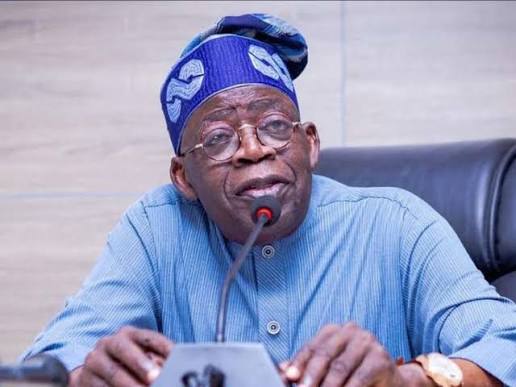
President Bola Ahmed Tinubu has declared that Nigeria has moved beyond its most difficult phase of economic reforms and is entering what he described as an “age of prosperity.”
Tinubu made the declaration in his Independence Day address to Nigerians on Thursday, October 1, as the country marks its 66th anniversary of independence.
The President said his administration had taken difficult decisions over the past three years to address what he described as deep-rooted economic distortions, insisting that the reforms were necessary to reposition the country for sustainable growth.
According to him, Nigeria’s journey since independence has been marked by war, military rule, economic crises, insecurity and political upheaval, but the country has endured because of the resilience and determination of its people.
He said independence was not merely about attaining sovereignty, but about creating a country where citizens could shape their own destinies and enjoy opportunity, dignity and a better quality of life.
‘Nigeria was like a sick patient’
Reflecting on the state of the economy when his administration assumed office in 2023, Tinubu likened Nigeria to a sick patient diagnosed with cancer who must choose between painful treatment and temporary relief.
“For too long, Nigeria’s leaders chose morphine while praying for a miracle that never came,” he said, arguing that successive administrations had avoided difficult decisions while allowing structural economic problems to worsen.
Tinubu said his administration instead chose to “excise the cancer,” acknowledging that the reforms had produced painful side effects but insisting that they were different from the problems they were designed to address.
He specifically defended the removal of fuel subsidies and other economic measures, saying the government would resist calls to return to what he described as “addictive subsidies.”
Economy has improved, Tinubu claims
The President said the reforms had begun producing measurable improvements, citing economic growth of more than four per cent, reduced oil theft, lower inflation compared with its peak, rebuilt foreign reserves and greater stability in the foreign exchange market.
He also said Nigeria recorded more than $6 billion in non-oil export revenue in 2025, describing it as the highest in the country’s history.
“These are not idle claims,” Tinubu said, adding that international institutions and the private sector had recognised improvements in Nigeria’s economic stability and resilience.
He declared that the country had now reached “a turning point,” saying the immediate task of correcting the economic course had given way to the broader goal of achieving shared prosperity.
‘Now begins the age of prosperity’
According to Tinubu, the next phase of his administration will focus on reducing the cost of living, expanding agricultural production, creating jobs and strengthening industrial growth.
He said the government would invest in mechanised irrigation, dry-season farming, improved access to seeds and fertiliser, agricultural mechanisation, storage and transportation.
The President also highlighted ongoing investments in roads, railways and ports, saying better infrastructure would help reduce the cost of moving goods from farms and factories to markets.
“Our priority is to bring down the cost of living,” he said, adding that this would be achieved by reducing the cost of producing and transporting goods.
Jobs, industries take centre stage
Tinubu said his administration would place jobs, enterprise and industrial expansion at the centre of its economic agenda.
He pledged to leverage Nigeria’s gas resources to power industries, support the revival of factories, expand digital connectivity and provide Nigerians with skills required by employers.
“I want to see more Nigerians making things. I want to see more Nigerian farms feeding our cities.
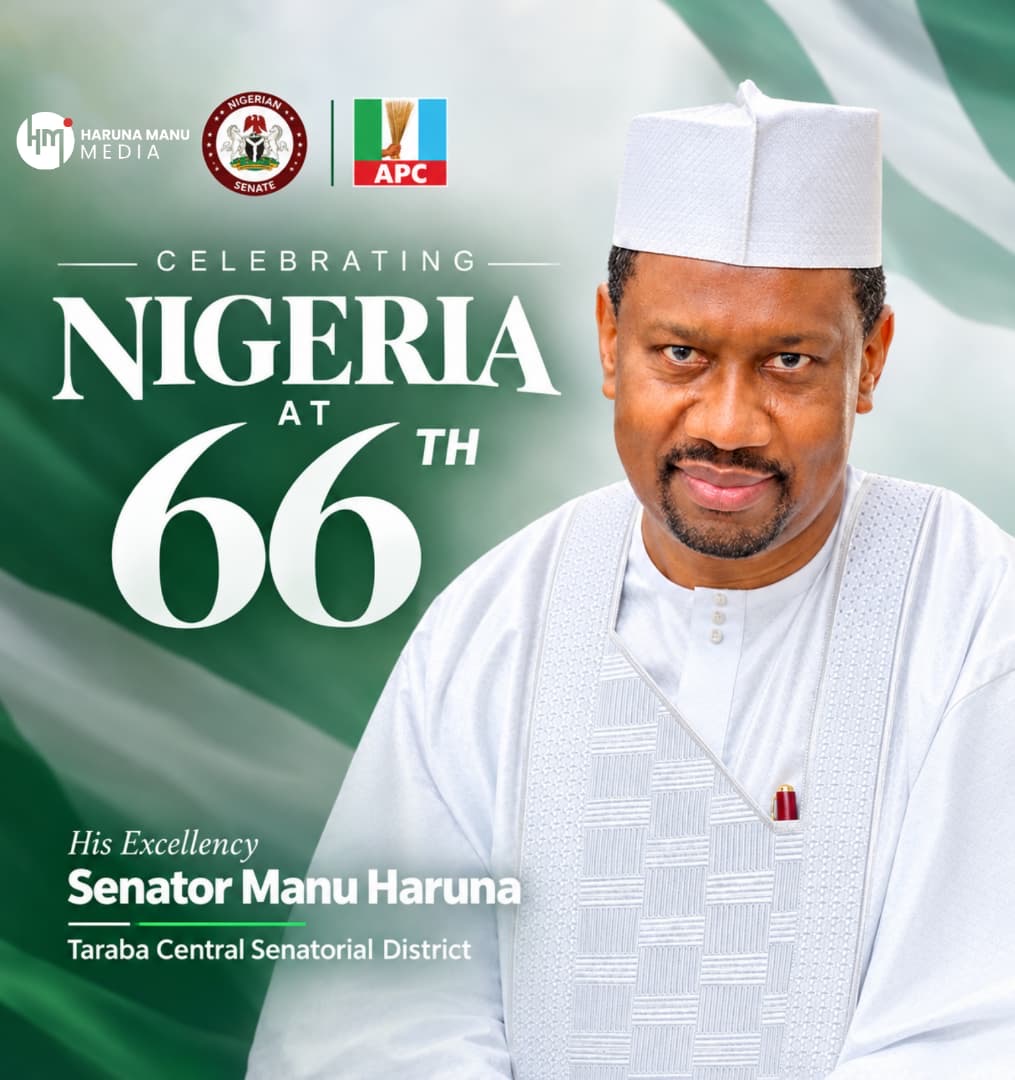
Senator Haruna Manu, representing Taraba Central Senatorial District, has felicitated with his constituents, the people of Taraba State and Nigerians across the country as Nigeria marks its 66th Independence Anniversary.
Manu, a former Deputy Governor of Taraba State, in an Independence Day message on Thursday, called on Nigerians to promote peaceful coexistence, unity and mutual understanding as the country reflects on its journey since independence.
He urged communities across Taraba Central and other parts of the country to embrace one another and work together towards building a more peaceful and prosperous Nigeria.
According to him, the challenges confronting the country require collective responsibility, tolerance and a renewed commitment to national unity.
«“A united Nigeria will ensure progress and overcome adversity at all times in our nationhood. As we celebrate this anniversary, may this unity continue to embrace Nigeria on all fronts,” Manu said.»
The senator also commended Nigerians for their resilience, perseverance and determination to keep the country moving forward despite the challenges it has faced over the years.
He urged citizens to continue to uphold the values of peace, unity and patriotism, stressing that the strength of the nation lies in the ability of its diverse people to live and work together.
Nigeria gained independence from British colonial rule on October 1, 1960. The 66th anniversary provides an opportunity for citizens to reflect on the country’s political, economic and social journey while renewing their commitment to its unity and development.
Manu expressed optimism that with greater understanding, cooperation and peaceful coexistence among Nigerians, the country would overcome its challenges and achieve its full potential.


The Nigeria Democratic Congress (NDC), Benue State chapter, has condemned the gruesome murder of one of its chairmen, Mr Job Igbu Job, in Makurdi, the Benue State capital.
A statement signed by NDC Publicity Secretary, Agile Bem, said Mr Igbu, until his death, was the NDC chairman of Fiidi Council Ward in Makurdi Local Government Area of the state.
Igbu was reportedly attacked by suspected hoodlums, who allegedly tied him with ropes, injected him with substances suspected to be poisonous, and abandoned him near his residence around the NNPC depot along Makurdi-Otukpo Road.
He was later found in an almost unconscious state and was reportedly unable to speak or communicate with anyone before he eventually passed away.
Reacting to the incident, the state chairman of the party, Mr Ohini Ojegbe, described the killing as a “broad daylight evil” and called on security agencies to urgently investigate the incident, apprehend all those responsible, and ensure that they are brought to justice.
The party described the deceased as a committed and dedicated party member whose contributions to the growth of the NDC would be greatly missed, particularly at a time when his service and commitment were most needed.
The NDC extended its condolences to the immediate family of the deceased, the Fiidi community, and the entire NDC family, praying God to comfort them and grant them the fortitude to bear the irreparable loss.

Nigeria @66: Tinubu Declares ‘Age of Prosperity’ Begins, Says Nigeria Has Corrected Its Course
Nigeria at 66: Manu Urges Peaceful Coexistence, Unity Among Nigerians

Benue NDC ward chairman murdered in Makurdi


-
 News21 hours ago
Five men arraigned in Borno over ‘Tinubu must go’ t-shirts
-
 News14 hours ago
2027: If President Tinubu Loses FCT, Rivers, I Will Resign As Minister — Wike(Video)
-
 News14 hours ago
141 Days in Captivity: Kwara Kidnap Victim Walks Nine Days Through Bush Before Final Escape
-
 News13 hours ago
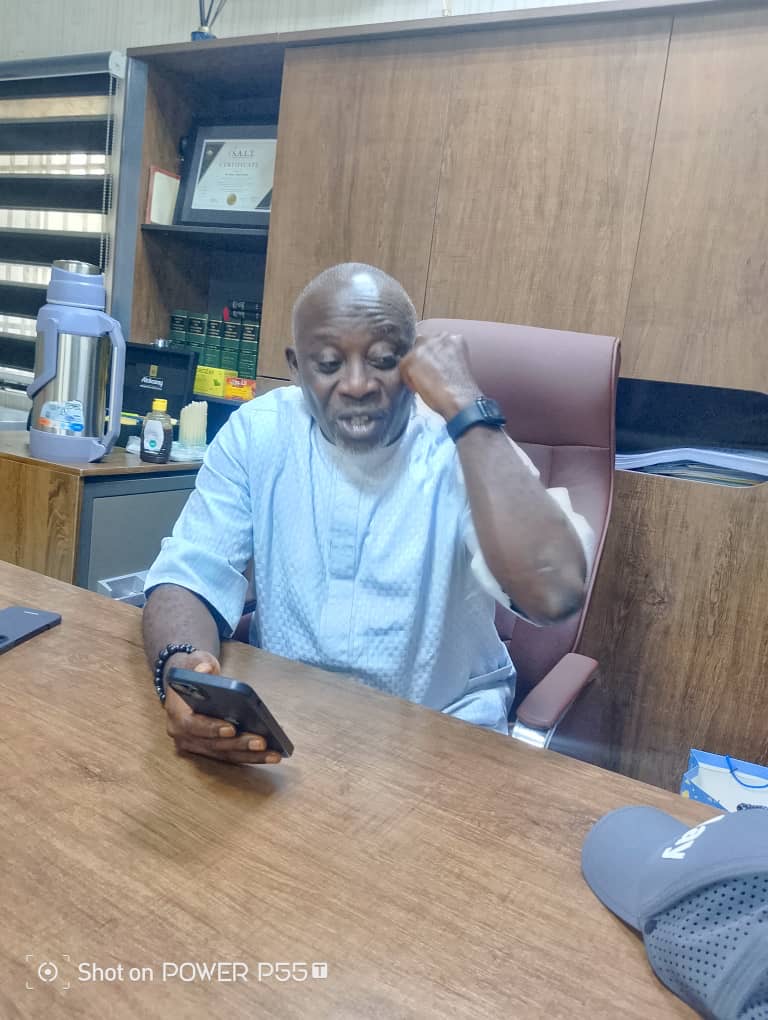
2027: I’ll Replicate Kabba-Bunu/Ijumu Achievements in Kogi West — TeeJay Yusuf
-
 News21 hours ago
Jerry Eze Apologises After Thousands Shut Out of NSPPD Prayer Conference at Old Trafford
-
 News13 hours ago
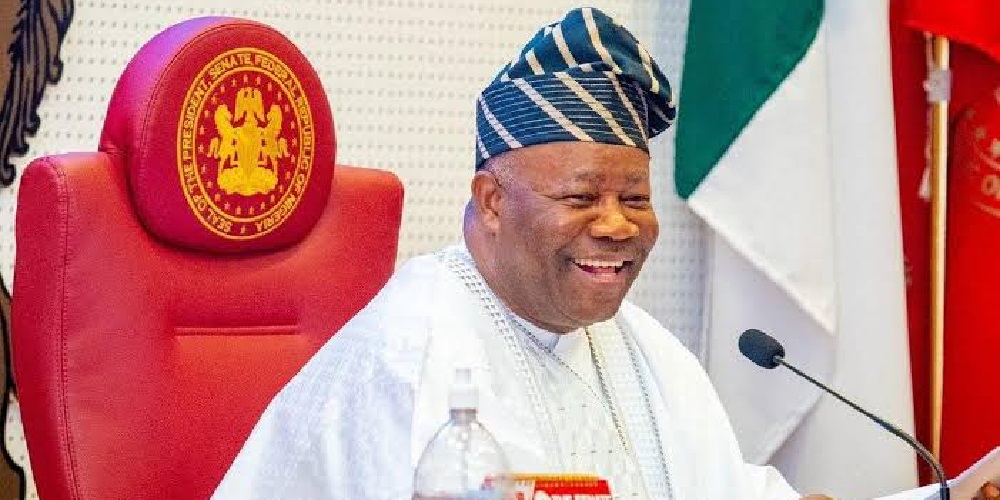
Nigeria @66: Akpabio celebrates Nigerians’ resilience; urges love, unity, belief in country’s future