
Economy
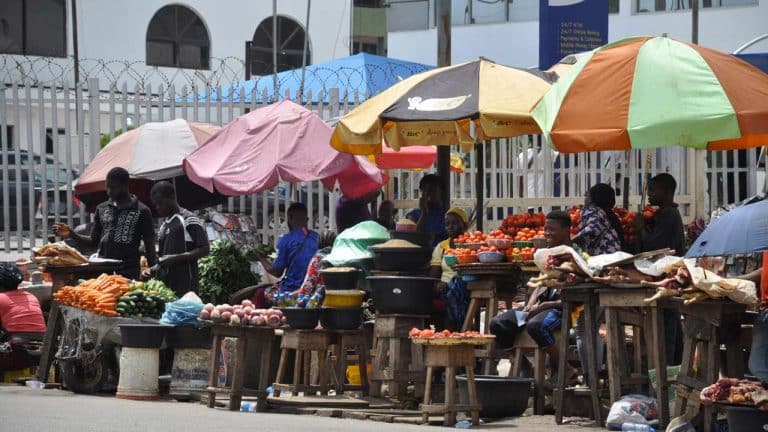
SEE States With Highest And Lowest Food Price Inflation Rates In Nigeria For March 2024

- /home/naijuinz/public_html/wp-content/plugins/mvp-social-buttons/mvp-social-buttons.php on line 27
https://naijablitznews.com/wp-content/uploads/2024/04/73EBD9EF-C654-46A0-B454-7E2929B0747A.jpeg&description=SEE States With Highest And Lowest Food Price Inflation Rates In Nigeria For March 2024', 'pinterestShare', 'width=750,height=350'); return false;" title="Pin This Post">
- Share
- Tweet /home/naijuinz/public_html/wp-content/plugins/mvp-social-buttons/mvp-social-buttons.php on line 72
https://naijablitznews.com/wp-content/uploads/2024/04/73EBD9EF-C654-46A0-B454-7E2929B0747A.jpeg&description=SEE States With Highest And Lowest Food Price Inflation Rates In Nigeria For March 2024', 'pinterestShare', 'width=750,height=350'); return false;" title="Pin This Post">


The lastest data released by the National Bureau of Statistics (NBS), has unveiled states in Nigeria with the highest and lowest food inflation rates.
The data released on Monday by the NBS, are for the month of March 2024.
According to the NBS, the states with the highest food inflation rates are:
Abia (5.17%)
Cross River (5.14%)
Bayelsa (4.75%)
Those with the lowest food inflation rates are:
Borno (1.59%)
Yobe (2.08%)
Adamawa (2.12%)
Meanwhile, Nigeria’s inflation rate has increased to 33.2% for the month of March 2024 according to the latest data released on Monday by the National Bureau of Statistics (NBS).
The new figure represents a 1.5% increase from the 32.7% recorded in February 2024.
The NBS data shows that on a year-on-year basis, the headline inflation rate was 11.16% points higher compared to the rate recorded in March 2023, which was 22.04%. This shows that the headline inflation rate (year-on-year basis) increased in the month of March 2024 when compared to the same month in the preceding year (i.e., March 2023).
Furthermore, on a month-on-month basis, the headline inflation rate in March 2024 was 3.02%, which was 0.10% lower than the rate recorded in February 2024 (3.12%). This means that in the month of March 2024, the rate of increase in the average price level is less than the rate of increase in the average price level in February 2024.


The International Monetary Fund has recommended introducing taxes on fuel products and telecommunications services in Nigeria as part of broader measures to increase government revenue and create fiscal space for development spending and social interventions.
The recommendation was contained in the IMF’s 2026 Article IV Consultation report on Nigeria, where the Fund argued that additional tax measures would be needed over the medium term despite the recent overhaul of the country’s tax system.
“Further tax policy changes will likely be needed—such as increasing the VAT rate, extending VAT to fuel products, rationalising tax expenditures in particular VAT exemptions on extractive industries and some customs duties, and introducing telecom excises—to complement administrative gains,” the IMF said.
The Washington-based institution, however, cautioned that the timing of any new taxes must take into account Nigeria’s rising poverty levels and worsening food insecurity.
“The timing of reforms must consider the poverty and food insecurity situation and ensure that the cash transfer system is in place and funded,” the Fund added.
The recommendation is likely to trigger fresh debate across the country, given the sensitivity surrounding fuel prices and telecommunications costs.
A previous attempt by the Federal Government to introduce a five per cent excise duty on telecom services faced widespread opposition from operators, subscribers and consumer advocacy groups before it was eventually suspended and later scrapped.
Telecommunications companies had argued that the sector was already burdened by multiple taxes, rising energy costs, foreign exchange pressures and infrastructure challenges, warning that any additional levy would ultimately be passed on to consumers through higher call and data charges.
Similarly, proposals linked to fuel taxation have generated opposition from labour unions and private sector groups amid concerns over rising living costs following the removal of petrol subsidies and increases in transport and food prices.
The IMF’s latest recommendation comes as it projects that Nigeria will need stronger revenue mobilisation efforts to sustain planned increases in public spending and support vulnerable households.
According to the report, revenue-enhancing tax policies could generate additional revenues equivalent to 3.9 per cent of Gross Domestic Product within three years of implementation. The Fund identified a two-percentage-point increase in the Value Added Tax rate as the single largest contributor, with an estimated revenue gain of 0.8 per cent of GDP.
It also projected that removing pioneer status incentives and revising free zone regulations would generate another 0.7 per cent of GDP, while reforms to capital gains taxation and adjustments to personal income tax bands, allowances and rates would each contribute 0.6 per cent of GDP.
The IMF further estimated that a top-up tax on multinationals and large firms could raise 0.5 per cent of GDP, while rationalising investment allowances would add another 0.4 per cent.
Notably, the category labelled “others”, which includes telecom excise duties and other measures such as a carbon tax on fuel, was projected to contribute an additional 0.4 per cent of GDP in revenue gains.
Beyond new tax measures, the Fund said Nigeria could generate even larger gains through stronger tax administration.
It projected that administrative reforms would yield an additional 3.1 per cent of GDP through improved compliance, enforcement and efforts to reduce informality in the economy.
According to the report, measures such as fiscalisation, electronic invoicing and cross-validation of tax deductions could generate 1.5 per cent of GDP, while expanded tax identification registration and consolidation of taxpayer databases could contribute another 1.6 per cent of GDP.
The IMF acknowledged that some of Nigeria’s recently enacted tax reforms would reduce government revenue in the short term because they were designed to support households and small businesses.
It estimated that revenue-reducing measures would lower revenues by 2.4 per cent of GDP, with expanded VAT input credits, additional zero-rated items and broader exemptions on basic consumption goods accounting for 1.7 percentage points.
Lower corporate income tax obligations for smaller firms would reduce revenues by 0.4 per cent of GDP, while lower personal income tax rates and expanded exemptions for low-income earners would account for another 0.3 percentage point reduction.
Overall, the IMF projected that the combined impact of revenue-enhancing measures, administrative reforms and revenue-reducing policies would result in a net increase in government revenue equivalent to 4.6 per cent of GDP over the medium term.
The Fund argued that stronger revenue mobilisation had become increasingly important because Nigeria’s fiscal position remained under pressure despite recent reforms.
The National Bureau of Statistics (NBS) has reported that Value Added Tax (VAT) collections rose to ₦2.42 trillion in the first quarter of 2026 (Q1 2026), up from ₦2.20 trillion recorded in Q4 2025.
According to the VAT Q1 2026 report, the figure represents a 9.98 per cent increase on a quarter-on-quarter basis.
The bureau stated that of the total revenue collected during the period, local payments accounted for ₦1.11 trillion, while foreign VAT payments stood at ₦830.47 billion. Import VAT contributed ₦477.55 billion.
“Value Added Tax (VAT) in Q1 2026 was ₦2.42 trillion, showing an increase of 9.98% on a quarter-on-quarter basis from ₦2.20 trillion in Q4 2025.
“Of the total VAT collected, local payments stood at ₦1.11 trillion, foreign VAT payments were ₦830.47 billion, while import VAT contributed ₦477.55 billion during the quarter,” the NBS stated.
The report further showed that sectors such as food services and accommodation recorded ₦13.20 trillion, while arts, entertainment, and recreation contributed ₦8.98 trillion to VAT-generating activities.

Nigeria’s crude oil production surged to an 11-month high in May 2026, with the country exceeding its Organisation of the Petroleum Exporting Countries (OPEC) production quota.
The average crude oil production recorded during May represents 102 per cent of Nigeria’s 1.5mbpd of production quota allocated by OPEC.
The production report released by the Nigerian Upstream Petroleum Regulatory Commission (NUPRC) on Thursday disclosed that Nigeria’s oil production averages 1,530,354 barrels of crude oil and 170,446 barrels of condensates per day (bpd).
According to the report, this brings the total combined production to 1,700,800 barrels per day and consolidates Nigeria’s position as Africa’s largest oil producer.
The report said the production performance during the review period remained robust, with combined crude oil and condensate output ranging from a low of 1.51 million bpd to a peak of 1.86 million bpd.
It said the May 2026 production figures represented the highest recorded by Nigeria since July 2025, when output surged to 1,712,282.
“In strict crude oil terms (excluding condensates), the 1.53 million barrels recorded in May 2026 represents the highest Nigeria has witnessed since January 2025, when crude oil production hit 1.538mbpd.
“The latest crude oil production statistics thus represent a 15-month high on a month-on-month basis, production rose by 2.77 per cent in May 2026 as against 1.48mbpd in April,” it said.
The report said the broader production trend over the last five months had also remained positive.
It said combined crude oil and condensate output increased from 1.48 million bpd in February to 1.54 million bpd in March, 1.66 million bpd in April, and 1.7 million bpd in May, underscoring sustained growth in Nigeria’s hydrocarbon production.
According to the report, among production streams, Bonny Terminal led the pack with a total blend of 293,870 bpd, closely followed by Forcados Terminal at 289,900 bpd, Qua Iboe ranked third with 173,360 bpd, while Escravos Oil Terminal contributed 135,470 bpd.
It said the Odudu (Amenam Blend) accounted for 63,250 bpd across the top five production streams during the month under review.
The NUPRC attributed the rise in production to sustained positive momentum, as operations remained stable throughout the reporting period, with no significant pipeline or facility outages recorded.
It added that all previously scheduled turnaround maintenance activities had been completed, thereby improving operational reliability and production efficiency.
(NAN)

DSS intercepts arms shipment bound for bandit kingpin, nabs suspect

Toyin Adewale Says Marriage Is Not A Do-Or-Die Affair
Revenue: IMF asks FG to impose fuel, telecom taxes




-

 Sports24 hours ago
Just in: Thomas Partey to miss Ghana’s World Cup opening match
-

 Entertainment24 hours ago
Veteran Nollywood Actor Is Dead
-

 Metro24 hours ago
Sad democracy Day as bandits kill 17 farmers in Zamfara
-

 News24 hours ago
Gombe Rep Yaya Bauchi Tongo dies
-

 Sports24 hours ago
Transfer: Arsenal eye €40m move for Christos Tzolis amid interest in Morgan Rogers
-
 Politics24 hours ago
Anambra APC sets up reconciliation committee, ratifies expulsion of seven members
-

 News24 hours ago
My father’s detention shows Nigeria’s democracy far from complete – El-Rufai’s son
-

 News24 hours ago
NDC: Dickson, Obi hold closed door meeting amid internal crises
Warning: Undefined variable $user_ID in /home/naijuinz/public_html/wp-content/themes/zox-news/comments.php on line 49
You must be logged in to post a comment Login