…urges member states to fix 8nfrastructure, go digital


By Gloria Ikibah
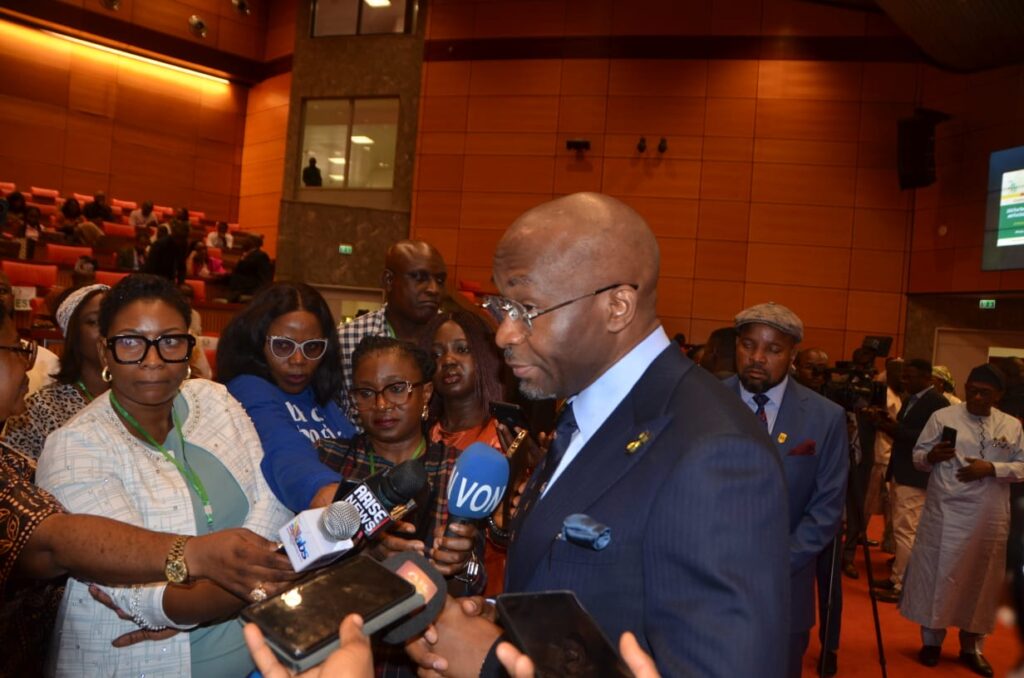
Deputy Speaker of the Nigerian House of Representatives, Rt. Hon. Benjamin Kalu, has called for a bold rethink of West Africa’s trade architecture, urging ECOWAS leaders to prioritise infrastructure, digital payments and regional production over prolonged debates about a single currency. 
Speaking on the sidelines of the ongoing First Extraordinary Session of the ECOWAS Parliament in Abuja, Kalu who is also a member of Parliament said intra-regional trade remains far too low and must improve if the bloc is to unlock its economic potential.
“At the moment, Africa, especially the ECOWAS, is trading more with other parts of the world, more than we are trading with ourselves.
“Our intra-trade is giving us about 16% increase in the year 2025, while the trade we are having among ourselves is only at the paltry percentage of about 11%. It ought not to be.
“This is because infrastructure is still a problem between one country and the other within the ECOWAS region.
“For example, the various corridors that are supposed to be open and sustained to increase this trade, they are not happening,” he explained.
He pointed in particular to delays at land borders, describing what he termed “rate tapism” — long hours of waiting before goods are cleared.
“Rate tapism is when these trucks, after 14 hours, get to the borders, they stay 14 hours before they are cleared. It is affecting trade. The time you will use to get your goods into Europe, you are in Africa and you are being delayed.”
He cautioned that such bottlenecks are slowing the movement of goods and services across West Africa and undermining the region’s competitiveness.
ECOWAS has long pursued the ambition of a common currency. But Mr Kalu suggested it may be time to expand the conversation.
“It is also important that we begin to look at a little shift from what we have always thought was the solution to increasing the trade in ECOWAS, which is common currency — the ECOWAS common currency.
“While we struggle with whose head will be on the currency, I think it is about time we begin to think about digital currency. Digital payment platforms. So that which we could not do with paper notes, currencies and heads of who is there, we can do through digital payment platforms”, he added.
He therefore argued that such a shift could significantly cut transaction costs, particularly those tied to dollar-denominated trade.
“Most of our dollar denominated transactions, which is costing the ECOWAS region at the moment about $5 billion in charges — we are going to save that.
“Because most of the transactions that are going to anchor on digital platforms, they are going to be on local denominated currencies”, he said.
For Hon. Kalu, reforming payment systems alongside improving transport links would give practical meaning to regional trade agreements.
“This Africa trade free agreement can only move from paper diplomacy to what we can feel and touch, when we begin to innovate outside the box. Let’s fix the infrastructure. Let’s fix the payment system. And trade will boom in the ECOWAS”, he noted.
When asked if digital platforms might be a way of sidestepping the region’s high inflation rates, a key obstacle to currency convergence, the Deputy Speaker was candid.
“Of course, it is going to sidestep the issue,” he said, before adding that deeper trade integration would itself help ease inflationary pressures.
“The issue of inflation is going to drop down if there is more trade among ourselves, movement of goods and services among ourselves. But you know that most of the goods that we are using in the ECOWAS region, they are imported”, he noted.
He also argued that reducing dependence on imports and stimulating domestic production would have a stabilising effect on prices.
“If we start trading with ourselves, productivity, production in Africa will increase.
“Ghana has cocoa. Africa has cocoa. Nigeria has cocoa. Are we going to trade cocoa with one another? The answer is no.
“But if I do what the principle of economics calls nearshoring, which is bringing the technology and the capital from Europe or America into Nigeria, my country, and bring them closer to those cocoa farms, and converting cocoa farms into chocolate factories, I will now increase productivity in Nigeria, reduce unemployment, and then what I’ll be exporting to Ghana will be chocolate, not cocoa for cocoa.
He offered a similar example in the minerals sector.
“If I have lithium, and you have lithium in other African countries, and we export it to each other, we can’t do much.
“But if I convert my lithium mines into battery factories, I can exchange my lithium for battery or your lithium for my battery,” he said.
Instead of relying on imports from China or Europe, he said, West Africa can build its own value chains.
“When these economic activities are stimulated, the ripple effect of it is that inflation goes down. And that is the truth.”
“It’s a lot of gain if we start trading more with ourselves so that we can reduce importation and encourage production,” he said.
For Kalu, the path forward is clear: strengthen regional infrastructure, modernise payment systems, encourage local production and deepen intra-African trade.
As deliberations continue in Abuja, his message adds fresh momentum to calls for ECOWAS to turn longstanding integration ambitions into tangible economic outcomes.