
News
It’s an injustice to blame Tinubu over economic hardship – Sanusi

By Francesca Hangeior
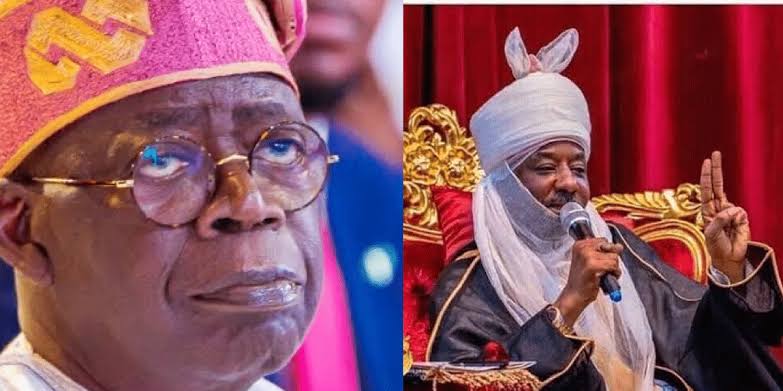
Former Governor, Central Bank of Nigeria, Mohammed Sanusi, has said it is an injustice to blame the administration of President Bola Tinubu for the current economic hardship the country is facing.
Sanusi said the country is battling a failing economy due to mismanaged economic policies of the past eight years.
He stated this while speaking virtually on Sunday at a religious event in Abuja.
He said he would not join those who are bent on criticising Tinubu over the current economic challenges in the country.
Sanusi said, “I have been, over the years, talking about the pending crisis ahead of the current economic hardship. Any economist who has studied monetary policy in the last eight years knows that Nigerians will fall into this difficult situation.
“The difficult situation Nigerians are facing is just the beginning (if the right decision is not put in place) because Nigeria is not exceptional; such situations happened in Germany, Zimbabwe, Uganda, and Venezuela.
“The previous administration turned adamant about our appeal for corrective measures (on the economic policy). I have said in the presence of the now sitting president in Kaduna state, any politician who tells you that things will be easy, don’t vote for him because he is lying. People merely dismissed my advisory as a political statement.
“If I am to be fair and just to President Bola Tinubu, he is not to blame for the current hardship; for eight years, we were living a fake lifestyle with huge debt from foreign and domestic debts. The Central Bank of Nigeria owes over N30 trillion, which resulted in debt service surpassing 100 percent.
“I can’t join other Nigerians criticising Tinubu on the current economic hardship, and I am not saying he is a saint free from wrongdoing, but in this current economic situation, President Tinubu is not to be blamed. I will also speak if I see any wrong economic policy of the Tinubu administration in the future, Stated.
He added that Tinubu’s decision to remove fuel subsidy should be applauded.
He said, “It’s injustice for anyone to blame the Tinubu administration for the current economic hardship because there is no other alternative than the removal of the fuel subsidy. After all, Nigeria cannot even afford to pay the subsidy. In the last eight years, the Central Bank continued to print more money, and the naira continued to depreciate. There is too much naira in circulation because the CBN is printing the currency without restraint.
“The economy was poorly managed, and they are not willing to take advice; in the last eight years, apart from sycophancy, nothing has been done; those sycophants are those buying the dollar at the rate of N400 and selling it at the rate of N600 to N700.
“A boy who has no record of service has a private jet and owns houses in Dubai and England just because he is buying dollars at so a rate and selling them.
“I can only plead with the people to endure the hardship, and those who have the means to help the downtrodden should do so.
“I am also pleading with commoners to live according to their earnings; we must not peg our lives above our earnings in this difficult situation where people are looking for what to eat.”
During his inaugural speech in 2023 after the general elections, Tinubu announced the removal of fuel subsidy.
He stated that the country could no longer maintain it, noting that the trillions of naira yearly spent to sustain the subsidy were meant to better the healthcare and transportation sector, schools, housing, and national security, among others.
However, following the removal, Nigerians had been thrown into hardship from the soaring cost of food to increased drug prices.

News
Kyari in trouble as N/Delta youths vow to storm Abuja over failed promises on Port Harcourt refinery

…urge NNPCL Boss to resign
By Kayode Sanni-Arewa
Groups, under the aegis of Coalition of Niger Delta Youths Against Poverty, Insecurity & Environmental Degradation (CONDYAPIED), have expressed disappointment over failure of the Group Chief Executive Officer (GCEO) of the Nigerian National Petroleum Company Limited (NNPCL), Mele Kyari, to operationalise the Port Harcourt Refinery before the end of September, 2024, as promised.
The NNPCL Boss had severally assured Nigerians that the Port Harcourt refinery would start local refining and that prices of petroleum products would reduce drastically before the deadline of September 2024.
One month later, neither of the Port Harcourt, Warri or Kaduna refineries is functioning, safe for only Dangote refinery, as marketers still import refined petroleum into the country, thereby causing serious hike in the price of the products.
A press statement on Sunday, jointly signed by Engr. Jonas Igariga, Coordinator of the Coalition, and Comrade Jack Opobo, General Secretary, the Coalition called on Kyari to tender his resignation letter and apologize to Nigerians.
“In a sane society where leaders have conscience, the likes of Mele Kyari should burry their heads in shame and tender their resignation and apologies to Nigerians for plunging the entire nation into untold hardship”, the Coalition said.
The Coalition averred that, inspite of huge funds injected into the Port Harcourt refinery, Kyari prefers importation of refined products, to making local refinery operational, despite his many promises.
“The NNPCL GCEO has failed Nigerians, times without number, on the issue of Port Harcourt, Kaduna and Warri refineries, after blowing over 3 billion dollars on the project. It has been discovered that Mele Kyari and his goons have no plans to fix any refinery as they prefer to import adulterated products into the country and milk the citizens dry.
“NNPCL cabal and their importers are deliberately sabotaging the good intentions of President Tinubu by making sure there are queues and Nigerians buy the product at any price fixed and given to them by the oil Lords. We shall not fold our hands and allow this to happen”, the statement added.
According to the statement, several warnings had gone to Kyari in the past, to fulfill his promise by making sure the Port Harcourt refinery became operational in September; but to no avail.
“We read the statement signed by the Coalition of Niger Delta Youth On Energy Reforms and Transparency in the Oil and Gas Sector, urging Kyari to ensure that the Port Harcourt Refinery became operational before the end of September as he promised.
“The group expressed concern about the energy crisis in the country caused by the non-functionality of local refineries, continued dependence on the importation of petroleum products, and the resulting cost implications for the country.
“They noted that the failure of NNPC has further worsened the country’s energy crisis and impoverished the people of the oil-producing Niger Delta.
“The group alleged that the Port Harcourt refinery is being planned to be converted into a blending plant. They claimed that substandard petroleum products from Russia will be mixed with chemicals and sold to the people of the Niger Delta.
“This is basically our fear too. We at the CONDYAPIED are not only concerned about the corruption going on at the NNPCL, but we are grately worried over the plan to convert the Port Harcourt refinery to a mere blending plant. We shall resist this with all our might. We shall shut down Abuja in protest, in the coming weeks, and occupy the NNPC towers until the needful is done.
“We will not allow our refinery to be converted to blending plant, because we are aware of the potential environmental degradation and terrible impacts on our people. This move could expose the people of Niger Delta to harmful chemicals from environmental pollutions and degradation caused by the waste products released into the environment, if it is allowed”, the Coalition submitted.
By Kayode Sanni-Arewa
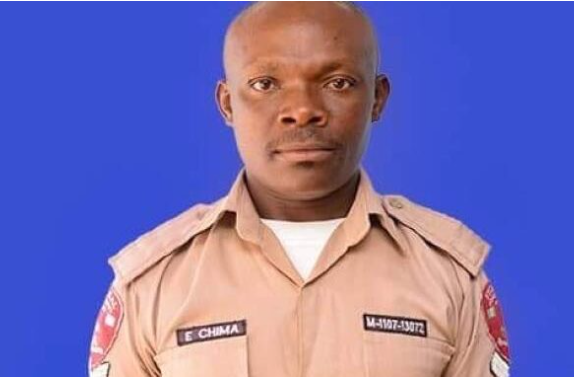
Gunmen in Enugu have kidnapped an official of the Federal Road Safety Corps (FRSC), Emeason Chima.
Chima, who is attached to RS4.211, Ugbokolo unit of the agency, was kidnapped on Saturday around Maduka University in Nsukka, Enugu State.
The gunmen are demanding N50 million ransom to release the victim, a senior FRSC official in the state revealed.
The official who wasn’t authorised to speak to journalists said Chima was driving alone in his car when he was attacked and abducted.
Meanwhile, an internal memo within the agency confirmed that the gunmen – using the officer’s phone -demanded for a ransom of N50 million.
“The Command Is In Receipt Of Information About The Kidnap Of SRMA Emeason Chima,” Emmanuel Al-Hassan, Ugbokolo unit commander said in the memo.
“Place Of Incidence: After Maduka University, Nsukka Enugu Road through OPI junction, in Enugu State. Information extracted so far confirmed that the staff was driving alone in a Toyota saloon car when he was kidnapped.
“The unit commander has already been contacted by the kidnappers using the staff phone, where a demand of 50million ransom has been made.
“Further details will be made available as events unfolds. This is forwarded for your information and further guide sir.”
Security has deteriorated in the South-East part of the country with frequent attacks by non-state actors in recent times.
The gunmen have carried out a series of abductions, collected huge ransoms and in some occasions killed their victims.
Aside from government officials and facilities, military and police personnel and others have been targets of attacks by these gunmen in the region.
The Nigerian government has accused pro-Biafra group, Indigenous People of Biafra (IPOB), of being responsible for the deadly attacks in the region.
But the group has repeatedly denied its involvement in the attacks.
By Kayode Sanni-Arewa
The NNPC Ltd. wishes to announce that beyond the three bodies found in the ill-fated helicopter operated by East Winds Aviation that crashed on Thursday in Port Harcourt, no other bodies have been recovered.
The Company further notes that intensified search and rescue operations for the remaining bodies along with relevant authorities is still ongoing
Once again, our hearts and prayers are with family members of this unfortunate incident.
Olufemi Soneye
Chief Corporate Communications Officer
NNPC Ltd.
Abuja


Kyari in trouble as N/Delta youths vow to storm Abuja over failed promises on Port Harcourt refinery

Just in: Gunmen Abduct Road Safety Agency, FRSC Official In Enugu, Demand N50Million Ransom

NNPC Update on Helicopter Crash: No Additional Bodies Recovered

Just in: Terrorists ambush military truck, kill all soldiers on board

Nigerian Dancer, Korra Obidi Attacked with acid, stabbed on stage In UK

Meet Rare Gem 16 Years Old Chiaza, CEO of ‘RUN MARKET PLACE’
-

 News9 hours ago
Angry presidency says The Guardian trying to incite Nigerians
-

 News15 hours ago
Reps Say Dichotomy Btw HND, Degree Will Be Eliminated
-

 News23 hours ago
Rivers Assembly Battle: Plot by Gov Fubara to unleash mayhem exposed
-

 News23 hours ago
Our Zone Will Not Vote APC In 2027 Elections, We Are Now Wiser — Gov Makinde
-

 News23 hours ago
REVEALED! Major reason some leaders want Damagum out exposed as PDP group insists it’s about 2027
-

 Metro8 hours ago
EXPOSED! Officer who k!lled Ogene musician, Igbo Jah
-

 Entertainment9 hours ago
Police probe viral video released by VDM featuring their uniform
-

 Opinion8 hours ago
CBN: THE DIASPORA EXPLORATION