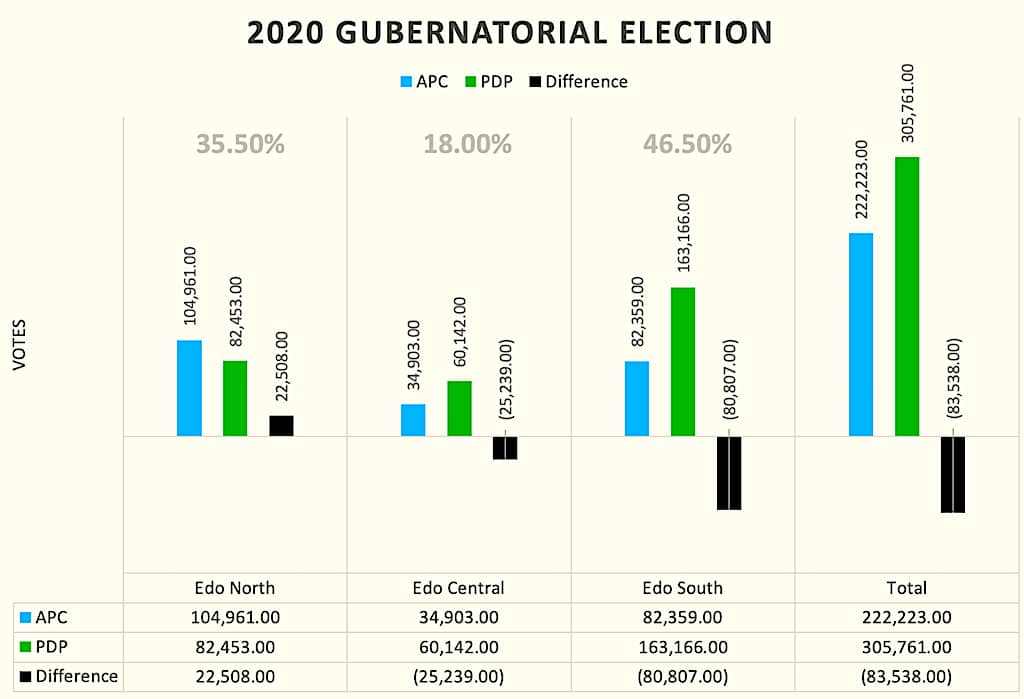
■ Findings put Edo South at 46.50 per cent, Edo North at 35.50 and Edo Central at 18 per cent
Contrary to the age-long assumptions that the majority Edo South senatorial zone accounts for about 60 per cent of Edo State’s voting population, new research by The PROVE Foundation has proved otherwise.
The research, released by the Coordinator, Omotola Ariyo, who was previously an associate at Morgan Stanley and an analyst at Goldman Sachs, delved into the voting patterns across various senatorial districts. 
Ariyo said that it meticulously examined the performance of key political parties like All Progressives Congress (APC), Peoples Democratic Party (PDP), and Labour Party (LP).
According to him, “We have meticulously dissected the trends and preferences that have emerged in different zones of Edo State, providing a clear picture of the electorate’s evolving sentiments.
“Furthermore, the report goes beyond mere statistics to explore the underlying factors influencing voter behavior and election outcomes.
“This includes an assessment of socio-political dynamics, economic influences, and other critical elements that have played a pivotal role in shaping the electoral decisions of the populace.”
The research findings showed that the much-acclaimed majority that is usually associated with Edo South (which is always put at between 55-60 per cent voting population) was discounted in the 2020 governorship election, settling down at a contributed 46.50 per cent of the votes to the outcome of that election.
It was followed by Edo North’s 35.50 per cent and Edo Central’s 18 per cent.
There were noticeable and significant shifts in percentages of voters populations (based on turnout during elections) between the 2016 and 2020 governorship elections as well as the 2023 general elections (presidential and National Assembly and House of Assembly elections in the State)
“Our analyses indicated that the 2016 gubernatorial elections in Edo State showed that the political dynamics weighed in favour of the two major parties, APC and PDP, and this cut across the three zones.
“The APC emerged as the victor in that election with a significant margin of 66,310 votes. Analysis of the voting pattern showed a clear geographic divide in party preferences, with APC dominating in Edo North and Edo-South, while PDP was the favourite in Edo Central.
“Our analysis further showed that contrary to the commonly cited figure, Edo-South accounted for 48.37% of the votes, not the 60% often claimed, indicating a substantial but not dominating influence on the electoral outcome.
“This figure, coupled with the 32.23% from Edo North and the 19.40% from Edo Central, with a 15.85% vote difference between Edo South and Edo North, underscored the diverse political inclinations within the state.
‘However, the 2020 gubernatorial elections in Edo State marked a significant shift in political alignment, with the Peoples Democratic Party (PDP) defeating the All Progressive Congress (APC) by 83,538 votes.
“A marked decrease in overall turnout was noted, with 527,984 total votes cast, reflecting a reduction of 44,672 from the previous election. Edo North increased its contribution to 35.50%, up from 32% in 2016, while Edo South’s share decreased to 46.50% from 48%. Edo Central’s contribution also saw a decline to 18%.
“These changes narrowed the gap between Edo South and Edo North by 4.85%. Our analyses implicated factors that contributed to APC’s loss to include a lack of support from federal members and governors within the APC, perceived hypocrisy due to the party leader’s past criticism of their candidate Pastor Ize Iyamu, a united front from PDP stalwarts including Obaseki, Shaibu, Orbih, and Governor Wike, and insufficient mobilisation efforts at the grassroots level by the APC.
‘While our analysis showed that the 2023 presidential and senatorial election data cannot be used for a one-to-one comparison with the 2016 and 2020 gubernatorial data due to anomalies that do not exist in gubernatorial elections, the 2023 presidential and senatorial elections in Edo State underscored a notable realignment in voter preferences, showcasing the emergence of the Labour Party (LP) as a formidable force.
“In the presidential race, the LP achieved a striking victory, securing 331,163 votes. This figure surpassed the vote counts of the traditional political heavyweights, APC and PDP, in previous gubernatorial contests and signaled a considerable transition in the electorate’s alignment. “Despite an increase in voter engagement from the 2020 elections, participation levels did not reach the heights of the 2016 elections, indicating variable voter enthusiasm.
■ Zonal Contributions
The research findings showed that Edo South emerged as a pivotal zone, contributing 50.26% to the total vote count, clearly indicating its status as a critical battleground.
It stated that the LP’s success in this region reflected an adaptive voting pattern, where voter preferences shifted in favour of candidate attributes. Conversely, Edo North and Edo Central declined their electoral contributions, with Edo North decreasing from 35.50% in 2020 to 32.18% in 2023 and Edo Central from 18% to 17.55%.
It continued:
■ Backdrop of National Events
The backdrop of national events, including dissatisfaction with the incumbent administration’s policies and the controversial APC’s Muslim-Muslim ticket, played a significant role in shaping voter sentiment. In contrast, the LP’s candidate, perceived positively for his integrity and experience, offered a refreshing alternative to the established parties, further buoyed by support from followers of Professor Yemi Osinbajo post the APC primaries.
■ Complex Electoral Dynamics
However, the same-day 2023 senatorial elections in Edo State further reflected the complex electoral dynamics. Despite the LP’s presidential success, the party saw a 34.85% reduction in its senatorial vote share. This decline was most pronounced in Edo North, with a 66.31% decrease, followed by Edo Central at 49.82% and Edo South at 23.63%, highlighting the distinct regional responses to domestic candidates. In contrast, the APC made significant gains, particularly in Edo Central, where they achieved an unprecedented victory since 1999, indicating a possible shift in regional political alliances or the effectiveness of their senatorial campaign strategy. These results underscore the nuanced understanding and response of the electorate in Edo State to local candidates, reflecting a dynamic and region-specific voting behaviour.
II. VOTER SENTIMENT AND BEHAVIOR
From 2016 to 2023, Edo State’s electoral landscape has been marked by dynamic voter sentiment and behaviour shifts, reflecting a sophisticated electorate across its three senatorial zones: Edo South, Edo North, and Edo Central. Notably, the 2023 elections did not surpass the 2016 turnout, suggesting factors like voter apathy or socioeconomic influences impacted civic engagement. Edo North, in particular, saw a growth in voter percentage from 32% in 2016 to 35.50% in 2020, indicating an increase in political participation or demographic shifts. Approximately 330,000 voters, representing 58.87% of the electorate, were influenced by candidate attributes such as integrity and experience, signaling a shift from party loyalty to individual candidate’s qualities. This is more notable in Edo South, housing 218,984 of the 330,000 (66.36%) candidate-centric voters.
■ Local Candidates’ Influence
Local candidates profoundly affected voting in the more rural Edo Central and Edo North while having a lesser impact in the urban Edo South. This distinction suggests a form of localised voting behaviour more pronounced in rural areas. The APC, consistently victorious in Edo North, reflecting solid party structure and regional loyalty, has never lost in this zone. The data illustrates Edo South’s leading role with an average electoral contribution of 48.38% across all elections, compared to Edo North’s 33.30% and Edo-Central’s 18.32%. For gubernatorial polls, these figures adjust slightly to 47.43% for Edo-South, 33.86% for Edo North, and 18.70% for Edo Central, indicating a consistent voting strength pattern across the zones.
■ People’s Value of Result-Oriented Governance
Additionally, voter sentiments reveal that the general populace in Edo South values governance that delivers tangible results, such as better roads and schools. This sentiment aligns with the significant sway candidate attributes hold in the region. This mirrors the views of some party members who prioritise the ability to retain governorship through electoral victory as a critical consideration, resonating with the electorate’s preference for candidates who can govern effectively regardless of their origin. In the rural regions of Edo Central and Edo North, local candidates have a more pronounced impact, as evidenced by the strong sentiment of having been marginalised and the desire for it to be their ‘turn’, a reflection of a voting pattern that favours local affiliation and the promise of focused development.
■ Fidelity to APC’s Consistent Success in Edo North
The APC’s unbroken success in Edo North could be seen as a response to consistent party performance and perceived loyalty, with the electorate there showing a strong belief in rewarding the party’s commitment to the state. Edo South’s pivotal role, leading average electoral contribution, and Edo North’s loyal base contrast with Edo Central’s more localised political dynamics, where feelings of marginalisation have reinforced the importance of having a candidate from within the region. This complex interplay of regional affinities, candidate characteristics, and party dynamics indicates a politically astute electorate considering a broad spectrum of factors in electoral decisions.
■ Discerning Electorate
The sharp variations in the 2023 presidential and senatorial election results on the same day further underscore an electorate that is discerning and strategic, capable of differentiating between individual candidates and party platforms, highlighting the multifaceted nature of democracy in Edo State and the importance of candidate selection and localised campaign strategies for political success.
II. REGIONAL VOTING PATTERN BASELINE
In examining Edo State’s voting behaviour, two baselines were considered: Baseline 1 and Baseline 2, which serve as crucial analytical tools. Baseline 1, which included data from the 2016 and 2020 gubernatorial elections alongside the 2023 presidential election, was rejected due to incomplete Labour Party (LP) data for the earlier elections.
This resulted in an average falling short of 100%, rendering it an unreliable metric for comprehensive analysis. Despite its rejection, Baseline 1 underscored a significant political development: the LP’s entrance as a considerable force in the 2023 election, particularly in Edo South, with 13.02% of the vote. However, it could not compete with APC’s 56.03% lead in Edo North or PDP’s strong showing in Edo Central with 45.00%.
Baseline 2 was adopted as it provided a normalised data set, focusing solely on the APC’s and PDP’s consistent electoral presence in the 2016 and 2020 gubernatorial elections. This baseline presented a clear and reliable depiction of the electoral landscape, revealing a 19.12% advantage of APC over PDP in Edo North and an 18.94% lead of PDP over APC in Edo Central.
The electoral narratives derived from Baseline 2 offer a threefold perspective on Edo State’s regional dynamics. In Edo North, a strong preference for APC is evident, with the party receiving 59.51% of the vote, suggesting a robust party structure and significant voter allegiance. Edo Central displays a contrasting pattern, with PDP leading by a substantial 18.94%, reflecting the zone’s entrenched support for the party, signified by its 59.42% vote share.
Meanwhile, Edo South emerges as a competitive zone, indicating a more open political contest. These percentages not only highlight the historical voting patterns and emerging trends but also reflect the sentiments and priorities of the electorate, which range from a desire for effective governance and development to calls for political representation and an end to regional marginalisation. The interplay of these factors underscores the nuanced and evolving nature of democracy in Edo State.
III. IMPLICATIONS FOR FUTURE ELECTIONS
The future electoral landscape of Edo State is poised for complexity and sophistication, informed by a deep understanding of past voting behaviours, senatorial sentiments, and the established Baseline 2.
■ Edo South
With its urban diversity, Edo South is a critical swing zone where voters increasingly prioritise candidate quality over party affiliation. This signifies a departure from traditional voting patterns. Political parties must thus field candidates with solid attributes and focus on issues like integrity, governance, and development to resonate with this electorate. The challenge lies in breaking past entrenched party loyalties and addressing the multifaceted problems of a diverse voter base. Still, the opportunity to capture this segment lies in presenting candidates who epitomise capable governance.
■ Edo Central
Edo Central’s political narrative is shaped by its strong PDP loyalty and a profound sense of marginalisation, as articulated in the Esan Agenda. To secure votes here, political parties should field local candidates and actively engage with the community to address their representation concerns. The main challenge for opposition parties is dismantling deep-seated PDP loyalty by offering credible alternatives that align with local aspirations. However, the potential to change the political tide exists if parties can genuinely address the issues of marginalisation and advocate the region’s development.
■ Edo North
In Edo North, a sentiment of being the genuinely marginalised group has surfaced, creating a platform for political dialogue on equality and local representation. The path forward for the APC, which has a stronghold in the area, involves presenting candidates with strong local connections and reputable credentials. Opposition parties can gain ground by also promoting candidates with local ties and addressing the growing calls for empowerment. The risk is real for any party disconnected from these local sentiments. Nonetheless, the prospect for parties to either reinforce their position or gain new support lies in their commitment to addressing local development issues and grievances.
CONCLUSIONS
In conclusion, candidates’ ability to align local advocacy with efficient governance will significantly influence Edo State’s electoral future. Political parties must evolve, recognising that the electorate’s growing discernment will guide their electoral choices. Success in upcoming elections will hinge on presenting candidates who are locally connected and exude integrity, competence, and a compelling developmental vision. This approach will likely be the deciding factor for political entities aiming to meet Edo State’s voters’ intricate and evolving expectations.
IV. RECOMMENDATIONS TO PARTIES FOR A SUCCESSFUL 2024 ELECTION
The electoral analysis of Edo State reveals distinct voter patterns and preferences, which form the basis of strategic recommendations for parties contesting in future elections.
■ PDP
For the PDP, the suggestion is to select a candidate with significant appeal and credentials from Edo Central, tapping into the local sentiment and loyalty. This should yield a starting point of 45,931 votes and is a robust approach that could consolidate PDP’s existing strongholds while making inroads into other zones.
■ APC
For the APC, which holds sway in Edo North, the recommended strategy is to nominate a candidate from the same region with commendable attributes and a strong track record. This approach leverages the region’s kindred association and sentiments of actual marginalisation in governance representation at the federal and state level, potentially securing a base of 104,222 votes with the possibility of gaining an additional 45,909 votes, considering the LP’s loss of 66.31% of votes between the 2023 presidential and Senate elections and PDP’s internal dynamics. This strategy not only fortifies APC’s position in its stronghold but also has the potential to appeal to the swing voters of Edo South, setting a substantial foundation for a victorious campaign.
■ LP
On the other hand, the Labour Party (LP) should focus on capitalising on its recent success in Edo South by fielding a competent candidate and leveraging the momentum from the 2023 presidential election. LP can position itself as a formidable force across the state by retaining the support gained and targeting the close margins in regions like Akoko-Edo LGA, where they trailed APC by only 1,181 votes.
SUMMARY
In summary, each party’s success will likely depend on its ability to identify and promote candidates whose attributes resonate with the electorate’s regional sentiments and demands for competent governance. For APC, the focus is on reinforcing its northern base and extending its appeal southward. PDP must work on solidifying its central dominance and expanding its influence. At the same time, LP’s strategy hinges on building upon its southern inroads and narrowing the gap in the north. These tailored strategies, grounded in a thorough understanding of zonal inclinations and statewide electoral currents, provide a roadmap for securing electoral victory in Edo State’s complex political landscape.