Connect with us

News

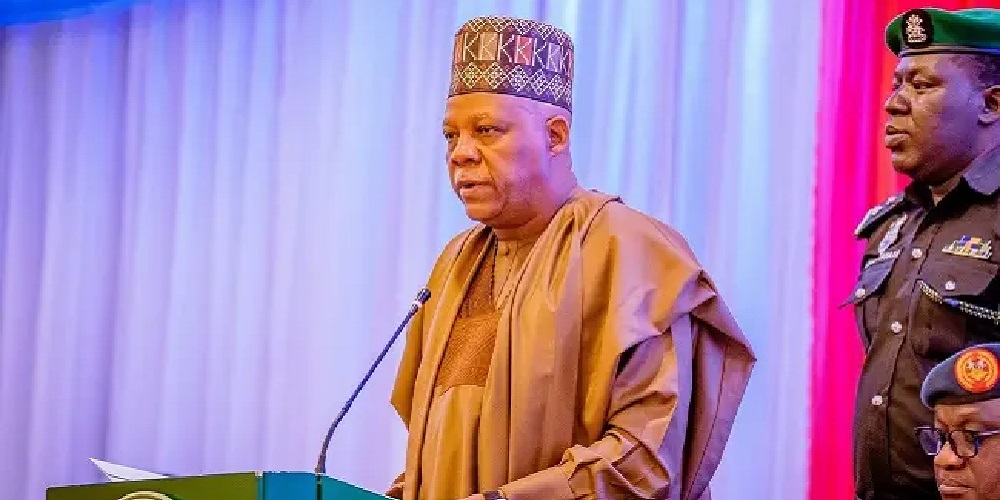
Rising Cost of Food: Highlights of Our Decisions  – Vice President Kashim Shettima

Published

on

ADVERTISEMENT
Zoom Ad
ADVERTISEMENT
Zoom Ad

“At the Presidential Villa, I joined my boss, President Bola Ahmed Tinubu, to meet with State Governors to discuss the challenges currently facing the country, especially the rising cost of food and insecurity.

Some key highlights of the meeting, after extensive deliberations, include an agreement to work together to solve the problems and tackle the economic pressure faced by citizens.

Other key points are:

  1. More police personnel will be recruited to strengthen the force.
  2. President Tinubu informed the Governors that the Federal Government will collaborate with them and the National Assembly to establish a mechanism for State police instead of relying on vigilantes in some states.
  3. The President charged the Governors to strengthen their Forest Rangers and arm them to keep all the forests safe from criminals.
  4. Modalities for State police and addressing security issues will be further discussed at the National Economic Council.
  5. Regarding the rising cost of food, the President directed that State and Federal Governments collaborate to increase local food production. He advised against food importation and price control, urging support for local producers
  6. Additionally, the President advised Governors to follow Kano State’s example in dealing with the hoarding of food for profiteering, directing law enforcement agencies to monitor warehouses and prevent profiteering.
  7. The President also charged Governors to focus on livestock development in their States, emphasizing increased production, especially in poultry and fishing.
  8. The President pleaded with Governors to ensure all salary arrears, gratuities, and pensions are cleared to put money into the hands of the people, as States are now receiving more monthly FAAC revenue. He urged the Governors to spend the money but not neglect the people.”
Continue Reading
Advertisement

News

ECOWAS Seeks New Regional Pact as Climate Crisis Threatens Security

Published

on

ADVERTISEMENT
Zoom Ad
ADVERTISEMENT
Zoom Ad

By Gloria Ikibah

The Economic Community of West African States (ECOWAS) has called for a new regional compact to tackle climate change, environmental degradation, population displacement and insecurity, warning that the region can no longer treat climate change as an environmental concern alone.

The call was made on Tuesday by the President of the ECOWAS Commission, General Birame Diop, represented by the Commissioner for Human Development and Social Affairs, Professor Nassirou Bako-Arifari, at the Second 2026 Joint Parliamentary Seminar in Accra, Ghana.

The seminar, which runs from September 21 to 23, is focused on “Climate Change as a Driver of Environmental Degradation, Population Displacement and Rising Insecurity in the ECOWAS Region.”

Prof. Bako-Arifari said the consequences of climate change were already placing growing pressure on communities, livelihoods and regional stability, making coordinated action by governments and parliaments increasingly necessary.

He said: “The theme before us is not simply an environmental issue. It is a development issue, a humanitarian issue, a peace and security issue, and ultimately an issue of human survival and regional stability confronting ECOWAS member states. West Africa is among the regions of the world particularly vulnerable to the consequences of climate change. Rising temperatures, changing rainfall patterns, prolonged droughts, desertification, coastal erosion, floods and the degradation of forests and farmlands are placing unprecedented pressure on communities and livelihoods.”

Naijablitznews.com reports that the World Bank has projected that West African countries could see as many as 32 million people moving within their own countries by 2050 because of climate factors if concrete climate and development action is not taken.

Bako-Arifari said ECOWAS had begun work to address the financing challenge facing climate action, including efforts to establish a regional carbon market platform under Article 6 of the Paris Agreement.

“Honourable Parliamentarians, Since 2024, the ECOWAS Commission has initiated an ambitious process aimed at establishing a regional carbon market platform in accordance with Article 6 of the Paris Agreement, a mechanism intended to mobilise necessary investments to address climate financing needs estimated at $294 bn for the region.

“Against this background, this Seminar is organised to provide a veritable platform for dialogue, knowledge-sharing, inter-institutional consultations to come up with concrete recommendations to strengthen climate resilience, human security and sustainable development in the ECOWAS Region”, he noted.

According to ECOWAS the region’s climate financing needs are estimated at $294 billion, while its regional carbon market initiative is being developed as one avenue for mobilising additional resources.

The ECOWAS commissioner placed particular emphasis on the role of parliamentarians, saying lawmakers had the power to translate regional commitments into national policies and practical action.

“This brings us to the critical role of Parliamentarians. Parliaments are uniquely positioned to translate regional commitments into national action. You provide the legislative frameworks, approve national budgets, exercise oversight and, importantly, serve as a direct bridge between governments and citizens”, he said.

Bako-Arifari proposed stronger climate-responsive legislation and oversight, increased domestic and regional financing, better early-warning systems and more inclusive management of natural resources.

“First, strengthen climate-responsive legislation and oversight. Our laws and policies must adequately address environmental protection, climate adaptation, disaster risk reduction and sustainable management of natural resources.

“Second, prioritise climate financing. Climate resilience cannot be achieved through declarations alone. We need predictable domestic and regional resources, while also mobilising international climate finance and strengthening access to available funding mechanisms.

“Third, strengthen early warning and early action. We must move from reacting to climate-related disasters to anticipating and preventing them. Regional early warning systems should be linked to communitylevel preparedness and rapid response mechanisms.

“Fourth, promote inclusive management of natural resources. Land, water, forests and fisheries must be managed transparently and sustainably. Local communities, women, young people, traditional authorities and other stakeholders must have a meaningful role in decision-making.

“Fifth, place youth and women at the centre of climate resilience. They are not merely victims of climate change. They are innovators, entrepreneurs, community leaders and agents of resilience. Investing in their skills, enterprises and participation is therefore an investment in the future stability of our region.”

Bako-Arifari said ECOWAS must also strengthen cooperation among member states on climate adaptation, disaster management, food and water security, environmental protection and the management of resources shared across borders.

He therefore called for closer collaboration between governments, parliaments, civil society organisations, traditional authorities, the private sector, academia and development partners.

On the broader security implications, he said ECOWAS needed to adopt a wider understanding of security which went beyond the protection of borders and prevention of armed conflict.

But cautioned against waiting for environmental pressures to develop into humanitarian or security crises.

“The scale and complexity of this challenge require us to move from fragmented responses to a comprehensive regional climate-resilience and human-security agenda. We need a new understanding of security—one that recognises that security is not only about protecting borders and preventing armed conflict. It is also about ensuring that citizens have access to food, water, livelihoods, a safe environment and opportunities for a dignified life.

“We must therefore be proactive and invest in resilience before crises occur. We must protect our ecosystems before they become irreversibly degraded. We must create livelihoods before desperation drives communities into displacement. Last but not the least, we must address grievances before they become conflict”, he added.

The commissioner urged parliamentarians to ensure that the seminar produced practical outcomes rather than becoming another forum for discussing the region’s climate challenges.

“Let us build an ECOWAS region embedded in in which climate resilience is development planning; where displacement is managed with dignity; where natural resources become instruments of cooperation rather than sources of conflict; and where our young people see a future of opportunity rather than one defined by environmental vulnerability and insecurity.

“Let our efforts continue to advance peace, security, resilience and sustainable development in the ECOWAS Region as ECOWAS transitions from ECOWAS of States to ECOWAS of People and Prosperity for All”, he stated. 

Continue Reading

News

Wike promises to deliver ongoing road projects in December as Christmas gift to residents(Photos)

Published

on

ADVERTISEMENT
Zoom Ad
ADVERTISEMENT
Zoom Ad

Minister of the Federal Capital Territory (FCT), Nyesom Wike, has assured residents of Abuja that ongoing road projects will be completed and delivered in December as special Christmas gifts from President Bola Tinubu.

Wike gave the assurance in Abuja on Tuesday, after he inspected the ongoing construction of Arterial Road NI, from Wuye to Ring Road II, Tungan Madaki to Zuba road and Zaudna-Kaba-Kagini to Kubwa Expressway.

Speaking to journalists after assessing the pace and quality of work, the minister expressed satisfaction with the progress recorded so far and commended the contractors for their dedication to meeting the completion timelines.

“I’m very impressed with the jobs so far, and I’m also impressed with the commitment of the contractors.

“We have promised the residents that this will be their Christmas gift by Mr President as part of their Christmas gift so that they’ll go back home and enjoy their Christmas celebration.

“You can imagine the happiness of those who stay here. You know that with these roads the economy of the affected communities will change,” he said.

Highlighting the impact of the road infrastructure on the beneficiary communities, Wike noted that completing the roads would alleviate transport difficulties and revitalise local economic activities ahead of the festive season.

The minister particularly emphasised the transformation taking place in suburban and rural areas, describing community satisfaction as the primary goal of public service.

“When you see a rural area like this, it makes us very happy when the people are happy and of course, that’s the essence of good governance,” Wike added.

Addressing initial concerns regarding weather-induced delays, Wike acknowledged that seasonal rainfall had temporarily slowed earthworks.

He, however, expressed confidence that the contractors would accelerate operations as the rainy season winds down.

“You know, I was having doubts, but the contractors are fully committed. If not for the rains, I know they would have gone far.

“I believe that from the first week of October, the rains will not be much again, and you will see how they will continue with earthworks,” he said.

The minister assured residents that the administration remains steadfast in delivering on its commitments.

Addressing the excited residents, Wike urged them to vote Tinubu for president and Philip Aduda to represent FCT in the Senate.

He told residents of Tungan Shanu village, on the Tungan Madaki to Zuba road corridor not to forget Tinubu and Aduda during the 2027 elections.

“We will push the contractor to deliver the road by December so that you’ll be happy. That is what the President is doing for you.

“The president said this road will be a Christmas gift for all of you. So, when the election comes too, don’t forget to vote for Tinubu and Aduda,” he said.

Speaking to the cheering residents of Kaba, on the Kagini to Kubwa Expressway road corridor, the minister said: “I’m happy that you people are happy that this road will be completed in December.

“I came here with the man that will represent you well in the Senate and that is Sen. Philip Aduda. He’s the one that will connect you directly with Tinubu.

“So, I hope all of you will vote for Tinubu and Aduda.”

Continue Reading

News

2027: Rainbow Coalition Signals Fresh Political Realignment in Nigeria — Sokoto PDP Guber Candidate

Published

on

ADVERTISEMENT
Zoom Ad
ADVERTISEMENT
Zoom Ad

The Peoples Democratic Party (PDP) governorship candidate in Sokoto State, Abubakar Sokoto, has described the emerging Rainbow Coalition as another chapter in Nigeria’s long history of political alliances and realignments.

Sokoto, in a statement issued in Sokoto on Tuesday, said political coalitions had remained a recurring feature of Nigeria’s electoral history, with parties and political groups often coming together to pursue shared political objectives.

According to him, while the names, personalities, circumstances and goals behind such alliances may change, political realignment remains an established part of the country’s democratic process.

He cited the 1999 AD-APP joint presidential ticket of Olu Falae and Umaru Shinkafi as one of the notable examples of political cooperation in Nigeria.

He also recalled the Coalition of Progressive Political Parties ahead of the 2015 general elections, as well as the merger involving the Action Congress of Nigeria (ACN), Congress for Progressive Change (CPC) and All Nigeria Peoples Party (ANPP), which eventually led to the formation of the All Progressives Congress (APC).

“The greatest lesson from these experiences is that political coalitions are about people as much as they are about parties,” he said.

On the latest political realignment, Sokoto noted that the Minister of the Federal Capital Territory (FCT), Nyesom Wike, had described the Rainbow Coalition as a multi-party platform mobilising support for President Bola Tinubu’s 2027 re-election bid.

He added that Wike had also maintained that the coalition was not an APC structure.

Sokoto said concerns reportedly expressed by some APC governors over the emerging coalition should be viewed within the broader context of Nigeria’s history of political alliances and realignments.

He urged APC governors and other party leaders to adopt what he described as a pragmatic approach to the developing political configuration ahead of the 2027 elections.

The PDP candidate also called on Nigerians to support efforts aimed at ensuring that the 2027 general elections are free, fair and credible.

Continue Reading

Trending

Copyright © 2024 Naija Blitz News