
News
Governors Should Not Be Allowed To Abuse State Police – PSC Boss, Arase

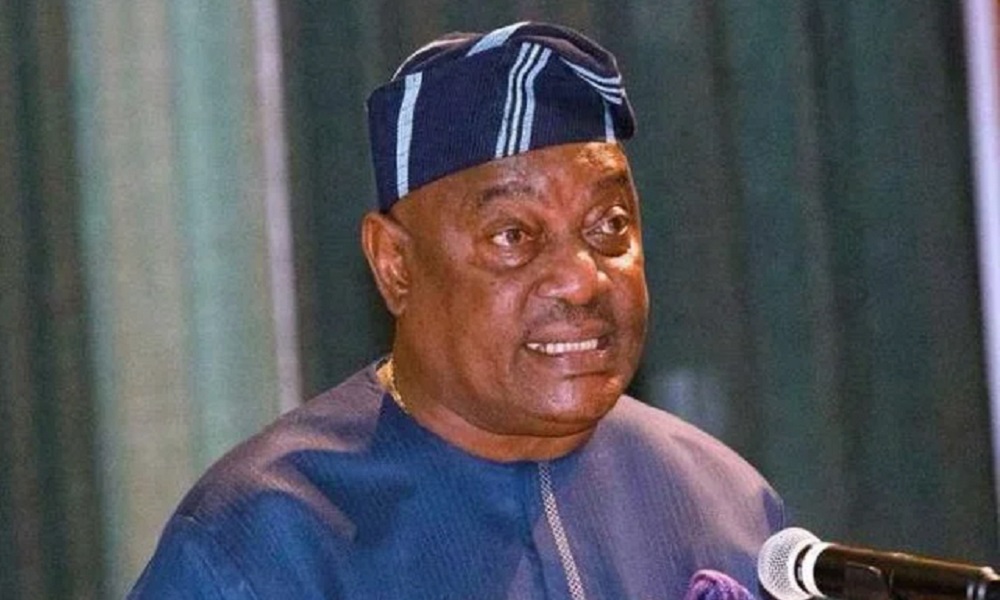


With talks about the establishment of state police gaining momentum in the country, the Chairman of the Police Service Commission (PSC), Solomon Arase, has warned state governors not to abuse state police.
Arase, the 18th Inspector General of Police, made this known on Inside Sources with Laolu Akande aired on Channels Television on Friday.
On Thursday, President Bola Tinubu and the 36 state governors met and considered the establishment of state police as a way to solve the escalating security challenges and the booming kidnap-for-ransom menace in the country.
Speaking on the state police alternative, Arase said, “Policing is local. Crime is environmental. State police is what we should be thinking about but then, there must be some safeguards put in place like is the governor going to be the one to appoint a commissioner of police and deputy commissioner of police?
“In order areas, the governor does not have control over the appointment of police commissioners. The truth about it is that of we are going to have state police, our political culture must be such that accommodate oppositions. Most of our governors, if they have control over police apparatus, their oppositions won’t be able to campaign anywhere.”
The police commission boss said there should be laws to check the excesses or otherwise of governors who abuse state police. He suggested that members of the civil society organisations, lawyers of repute, traditional rulers, religious leaders should be empowered to appoint police commissioners under the state police system.
He lamented that crimes will fester in a country where there are no consequences for crimes.
“We want to see more of prosecution; prosecution is a deterrence to others who want to go that route. The number of arrests in the past eight years is quite huge but it is not commensurate to the prosecution.
“You cannot attract investment in a place where there is no consequence for crimes committed,” he said.
He said technology should be used to aid or supplement the deficiency in manpower within the various security agencies.
He said Police-public partnership should be encourage and a bill should be passed that having closed-circuit television will be a mandatory requirement of public buildings like residential estates, shopping malls and the likes.
Arase said the government should embark on mass recruitment into the security agencies, train them along professional lines and skill acquisition in semi-formal areas for them to be financially independent. He said thereafter the trained pool can be made reservists and be called upon when the country needs extra hands to combat security challenges.
He reminded the President to actualise one of his campaign promises on mass recruitment into the Force, saying that may be the solution to the country’s internal disorder.
On police welfare, he urged the Federal Government to build units of two-bedroom flats for officers of the Nigeria Police Force to take care of their housing issues, especially after retirement. He also said there should be scholarships for the children of serving police officers.
“What will it cost the police management to start building two-bedroom apartments especially for the inspectors and rank and file; those are the ones I call the street managers because those guys are their come rain and come shine and even when it comes to shedding their blood?” he asked.
He further said the calls for right to bear arms by citizens should be discouraged because of mental health issues and the proliferation of firearms in the country.

News
How NDLEA operatives uncovered cocaine, loud in food flasks, snacks, nabs fashion designer, others(Photos)

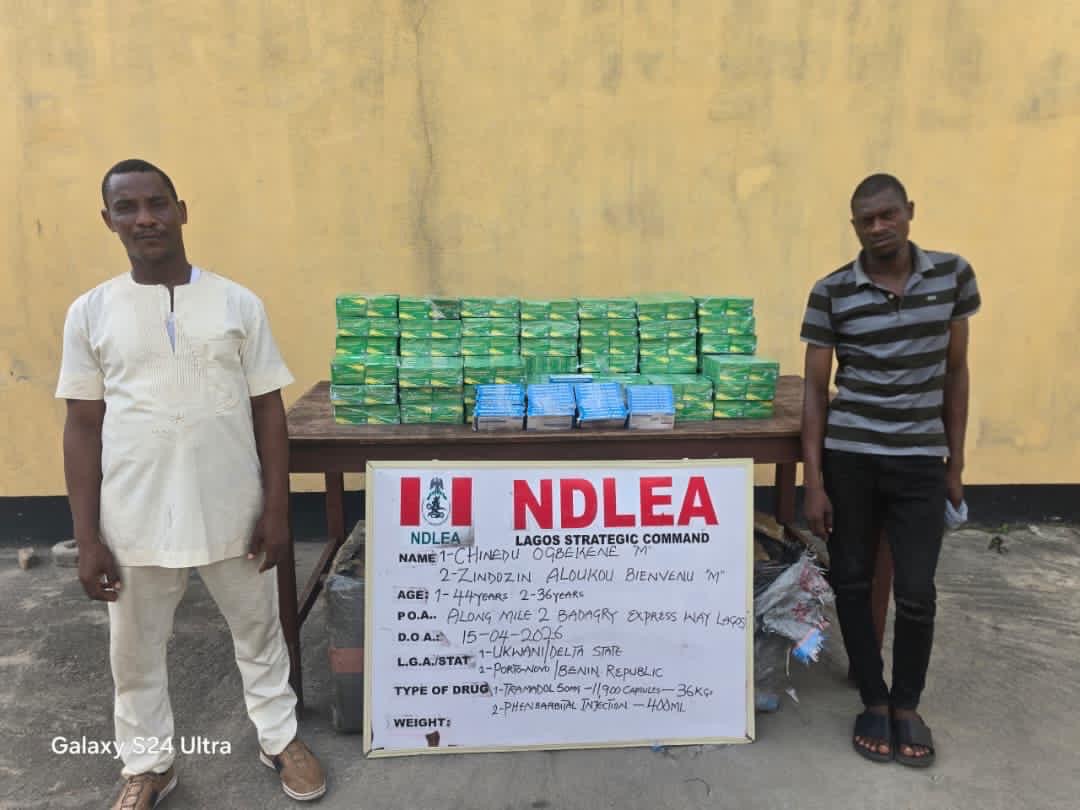
. Raids Edo, Cross River forests, destroys over 17,000kg skunk; recovers large consignments in Lagos, Delta, Kaduna operations
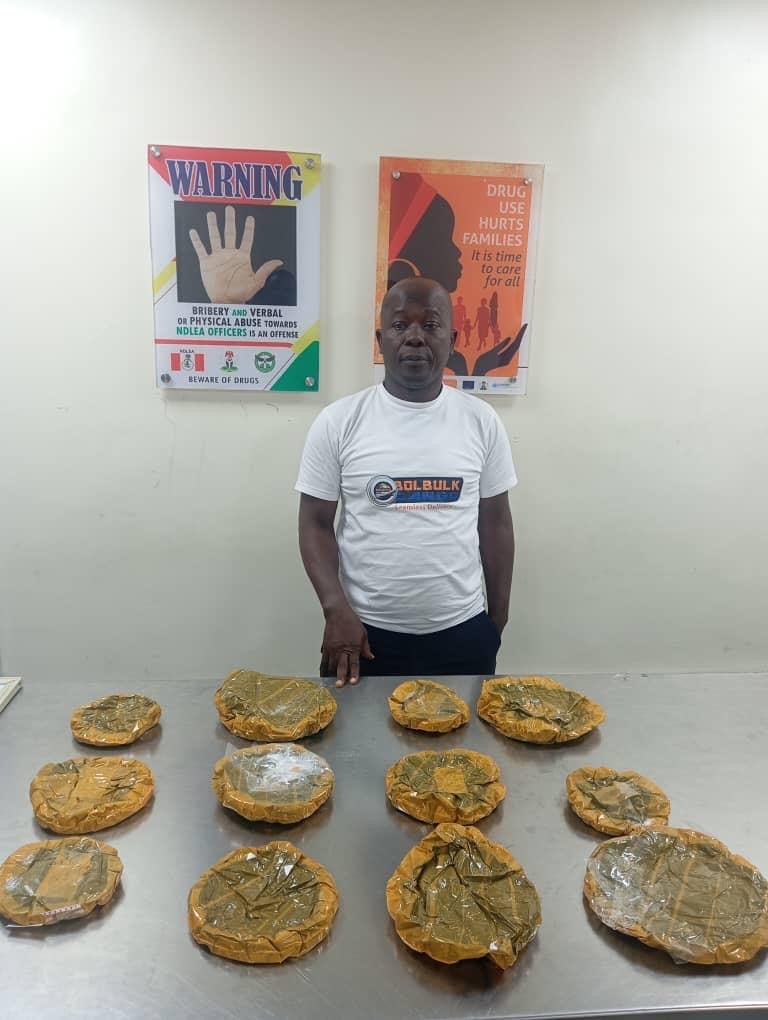
Operatives of the National Drug Law Enforcement Agency (NDLEA) have intercepted 12 large parcels of cocaine concealed in false bottom of food flasks heading to the United Kingdom via a Virgin Atlantic Airline flight from the Murtala Muhammed International Airport (MMIA) Ikeja, Lagos.
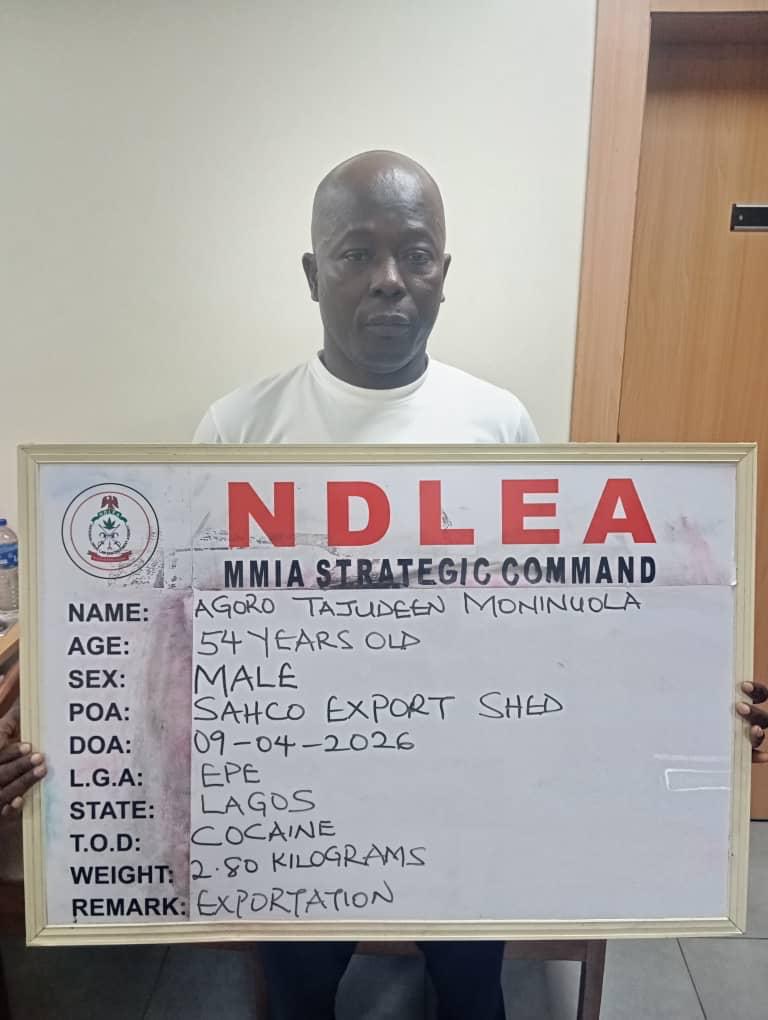
The cocaine consignment with a gross weight of 2.80 kilograms was intercepted on Thursday 9th April 2026 by NDLEA operatives attached to the export shed of the Lagos airport while two cargo agents involved in the export bid: Ama Obinna Ufeim, 33, and Ogabi Monday Akorede, 39, were swiftly arrested. Further investigation revealed a 52-year-old freight and forwarding agent Agoro Tajudeen Moninuola as the sender of the consignment and he was arrested in a follow-up operation.
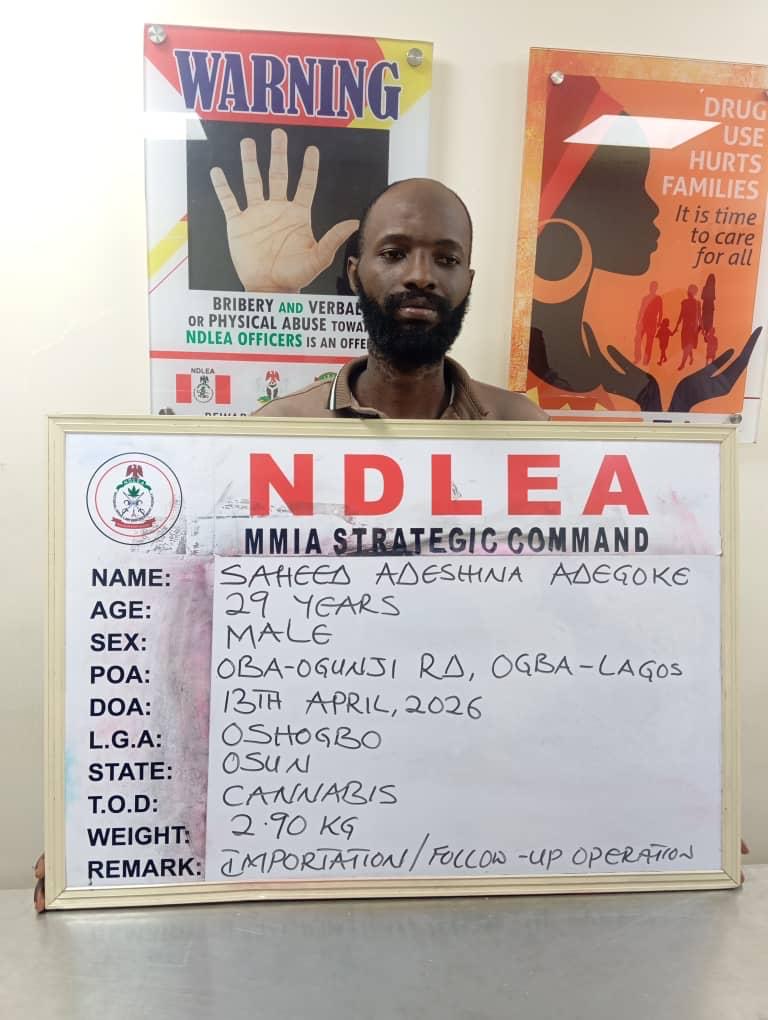
In a similar operation, NDLEA officers at the import shed of the Lagos airport on Wednesday 8th April intercepted a consignment of Loud, a strong strain of cannabis, with a gross weight of 2.90 kilograms and concealed in snack food packs, which arrived from the United States of America aboard a Delta Airlines flight.
Two cargo clearing agents: Animashaun Moshood Adetunji and Mercy Gabriel Oluwasegun, were initially arrested in connection with the seizure before the consignee, Saheed Adeshina Adegoke, a 29-year-old fashion designer, was nabbed in a follow-up operation at 3 Oba Ogunji road, Ogba, Lagos, on Monday 13th April.
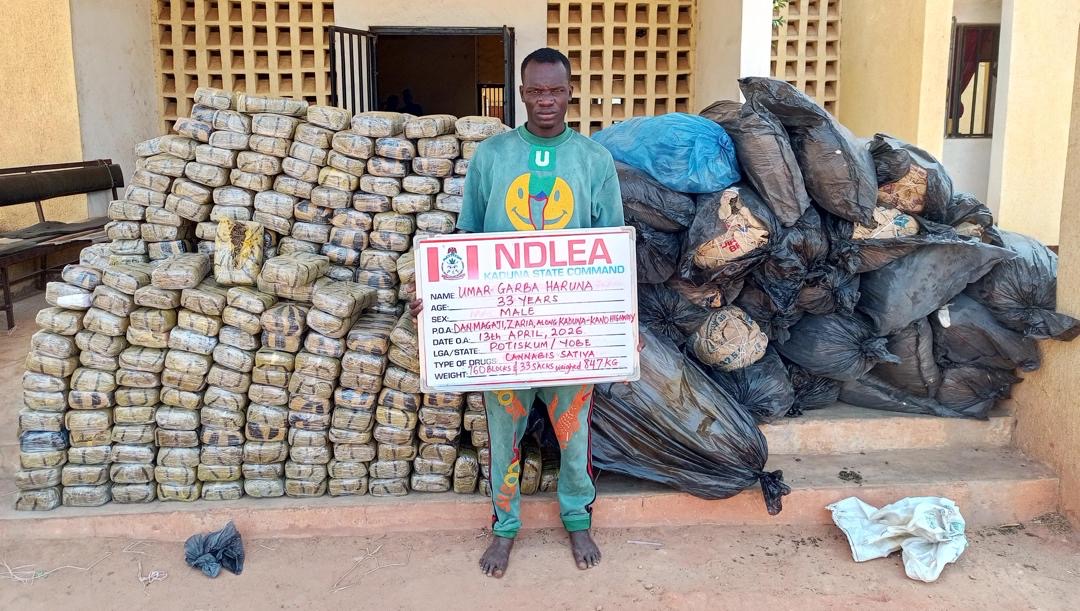
In Kaduna, NDLEA operatives on patrol along Kaduna-Zaria highway by Gwargwaje Zaria on Monday 13th April intercepted a trailer conveying cement heading to Hadeja in Jigawa state. A search of the truck led to the recovery of 760 blocks and 33 jumbo bags of skunk, a strain of cannabis, weighing 847 kilograms. The truck driver Umar Garba Haruna, 33, was arrested in connection with the seizure.
A 53-year-old female suspect, Alice Sunday Udoh, was arrested on Thursday 16th April when NDLEA officers supported by soldiers raided a forest in Uwet community, Akamkpa LGA, Cross River state, where 15,000 kilograms of skunk on six hectares of farmland were destroyed and 119kg of same substance recovered.
Another cannabis farm was raided on Tuesday 14th April at Saboro camp, Ovia North East LGA, Edo state where NDLEA operatives destroyed 2,281.43kg of same psychoactive substance, while three suspects: Nweke Smart, 27; Christopher Egbe, 62; and Monday Ayan, 45, were arrested, with the duo of Christopher and Monday caught with 38.5kg cannabis and its seeds. Two suspects: Sunday Odili, 49, and Ijenebe Joshua, 39, were nabbed with 87.838kg skunk and seeds at Powerline area of Okwo, Delta state on Friday 17th April.
In Lagos, two suspects: Chinedu Ogbekene and Zindozin Aloukou Bienvenu were arrested on Wednesday 15th April at Mile 2, Lagos/Badagry expressway while conveying 11,900 capsules of tramadol and 400 ampoules of phenobarbital injection in a truck to Ghana. Same day, NDLEA operatives raided a two-storey building at Petti, Lagos Island, where a total of 95.8kg skunk was recovered.
With the same zeal, Commands and formations of the Agency across the country continued their War Against Drug Abuse, WADA, sensitization activities in schools, worship centres, work places and communities among others in the past week. These include: WADA enlightenment lecture for students and staff of Alfurgan Islamic School, Paiko, Niger state;
Edgerly Memorial Girls Secondary School, Calabar, Cross River; Heritage Model School, Ankpa, Kogi; Government Day Junior and Senior Secondary School, Kankia, Katsina; Government Senior Secondary School, Rano, Kano, and De Ambassador Secondary School, Epe, Lagos state, among others.
While commending the officers and men of MMIA, Edo, Delta, Cross River, Kaduna, and Lagos Commands of the Agency for the arrests and seizures, Chairman/Chief Executive Officer of NDLEA, Brig. Gen. Mohamed Buba Marwa (Rtd) noted their drug supply reduction efforts balanced with WADA sensitization activities while he charged them and their compatriots across the country to maintain the current tempo.


Five Nigerian soldiers were reportedly killed on Friday, April 17, 2026, when suspected fighters of the Islamic State West Africa Province (ISWAP) attacked a military base in Mussa village, Borno State.
According to militia sources who spoke to AFP, the insurgents stormed the base before being repelled by troops. Following the attack, clashes were also reported in nearby Leho village.
However, the Armed Forces of Nigeria (AFN) have recorded significant operational successes across multiple theatres of operation between April 10 and 16, 2026, as troops sustained coordinated offensives against Boko Haram, ISWAP, JAS, violent extremist groups, kidnappers, and secessionist armed elements nationwide.
According to a statement issued by the Directorate of Defence Media Operations, the operations led to the arrest of several suspects, rescue of kidnapped victims, interception of terrorist logistics supplies, and neutralisation of armed criminals in ongoing efforts to create a safer and more secure environment across the country.
Troops of Operation HADIN KAI in the North East also maintained sustained pressure on insurgent networks across Borno, Yobe, and Adamawa States, recording multiple arrests and seizures.
In Gubio Local Government Area of Borno State, a suspect who confessed to supplying Premium Motor Spirit (PMS) to terrorists for about 10 years was arrested, with 60 litres of fuel, a mobile phone, and cash recovered.
In Adamawa State, 20 suspects were apprehended during raids on criminal hideouts in Mubi North, with items including electronics, cash totaling over ₦2.1 million, and other materials recovered.
In Yobe State, troops arrested three suspected informants linked to monitoring troop movements.
However, the Nigerian military had also in recent times suffered set backs in the fight against insurgency in the North East. Nigeria Tourism Guide
Suspected fighters of Islamic State West Africa Province (ISWAP) had last week attacked a military formation, killing a colonel, I.A. Mohammed, and other soldiers.
Also Brigadier General Oseni Omoh Braimah and 6 soldiers paid the supreme price early in a coordinated attacks by suspected members of the Islamic State of West Africa Province (ISWAP) on military formations in Benisheikh, Kaga Local Government Area, as well as Ngamdu and Pulka town in the Gwoza LGA of Borno state.
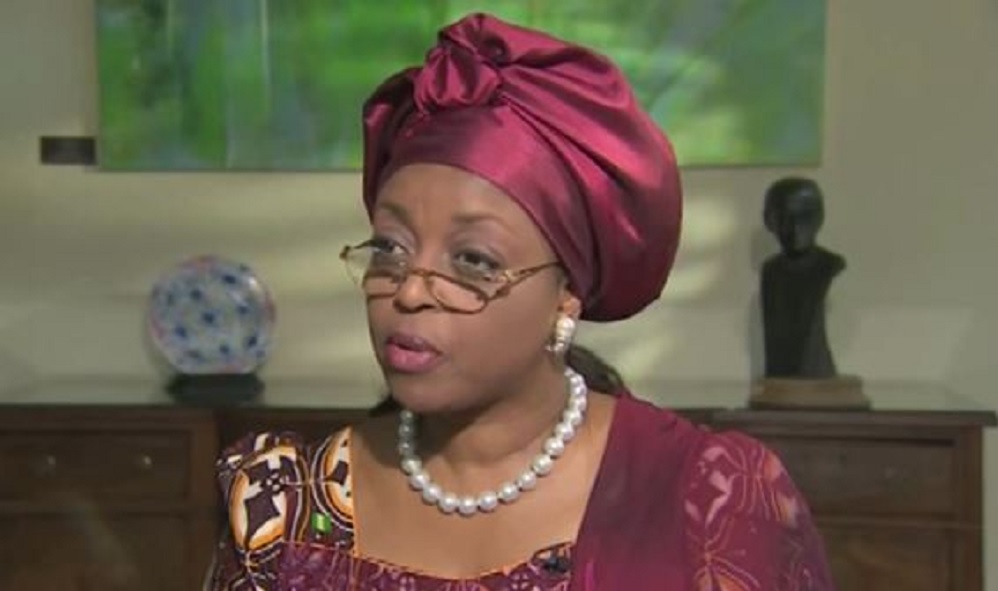
Former Nigerian Petroleum Minister Diezani Alison-Madueke told a UK court that her role in approving oil contracts was largely routine, stating that major decisions were already taken before documents reached her desk.
Speaking at Southwark Crown Court in London, she explained that the structure of Nigeria’s oil sector meant she had limited direct control, as key operations were handled by the leadership of the Nigerian National Petroleum Corporation (NNPC).
“The system was already in motion before files came to me,” she said, adding that the size and complexity of the industry made it difficult for a minister to oversee everything directly.
She said she rarely declined contract approvals because they had already passed through detailed technical and regulatory checks.
“I was, in many instances, a rubber stamp in the process,” she said.
Diezani also recounted a 2014 incident in which she discovered a questionable crude oil deal allegedly linked to businessman Igho Sanomi. She said the matter came to light following a whistleblower report, prompting her to cancel the arrangement.
However, she told the court that powerful individuals opposed her decision and escalated complaints to then President Goodluck Jonathan.
On allegations that $20 billion in oil revenue went missing, she disagreed with former Central Bank Governor Lamido Sanusi, insisting the reports were inaccurate.
“There were no missing funds as widely reported,” she said, explaining that audits and legislative reviews later showed the money was tied to subsidy payments and operational costs.
She acknowledged serious challenges in the fuel subsidy system, including multiple claims by some marketers, but said reforms were introduced to reduce fraud.
According to her, these efforts came with risks. She said she faced security threats, including the kidnapping of family members, which she linked to her attempts to challenge powerful interests in the sector.
She also said politicians and business figures frequently pressured her office for preferential treatment in oil allocations.
“I declined requests that did not follow due process,” she said.
Addressing questions about her personal finances, Diezani said she used Nigerian bank cards even during foreign trips, in line with rules preventing public officials from holding foreign accounts.
She added that the cards sometimes failed abroad, forcing others to temporarily cover expenses.
The court also examined records of her official trips between 2011 and 2015.
She said she usually travelled with about 30 officials, including aides, security personnel, and protocol staff.
“All movements were documented and archived in ministry records,” she said, noting that both commercial and chartered flights were used depending on official requirements.
Despite the allegations against her, Diezani insisted her time in office focused on increasing local participation in the oil sector and improving transparency, saying she has been unfairly portrayed.
She is currently on trial alongside Olatimbo Ayinde and Doye Agama on five counts related to bribery.
All the defendants have pleaded not guilty, and the case is ongoing in London.

How NDLEA operatives uncovered cocaine, loud in food flasks, snacks, nabs fashion designer, others(Photos)
CBN, FMDA introduce the Nigerian Overnight Financing Rate

ISWAP attacks military base in Borno, kill five soldiers




-

 News18 hours ago
JAMB: See How To Check, Print 2026 UTME Result Slip
-

 News21 hours ago
Expulsion: Bala, Abejide vow to battle Mark-led ADC faction to finish
-

 News22 hours ago
Fuel, diesel prices will drop in Nigeria as crude oil slumps
-

 News20 hours ago
Just in: Iran seals Strait of Hormuz again, blames US
-

 News18 hours ago
Troops nab nine suspected terrorists in Plateau, recover arms, ammunition
-

 News22 hours ago
Wife demands divorce from husband for being poor
-
 Metro6 hours ago
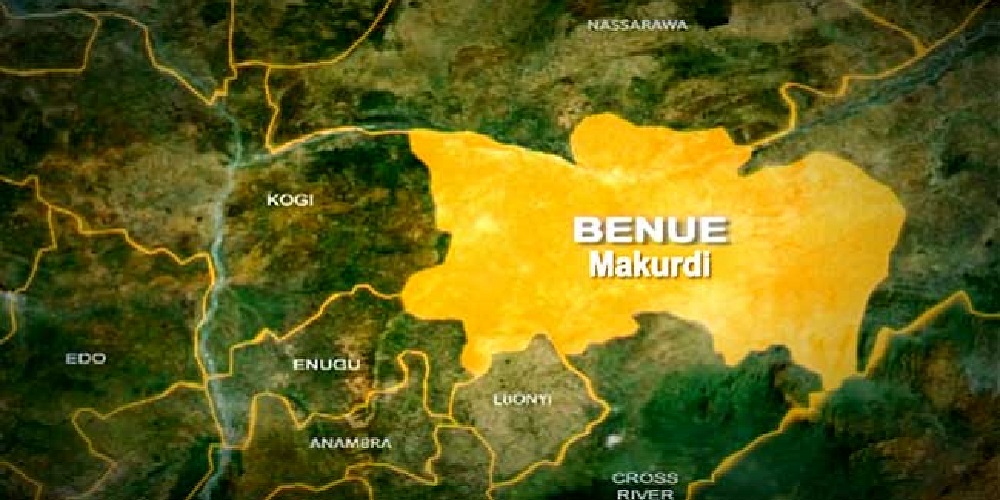
Bandits Demand N9m Per Benue JAMB Victim As Police Nab Seven
-

 Economy22 hours ago
Naira Slumps At Official FX Market