

News
Speaker Abbas unveils policy on lawmakers, staff capacity development
- /home/naijuinz/public_html/wp-content/plugins/mvp-social-buttons/mvp-social-buttons.php on line 27
https://naijablitznews.com/wp-content/uploads/2024/02/E8A3D083-A2DF-470E-9D8A-C20C8FB65F9C.jpeg&description=Speaker Abbas unveils policy on lawmakers, staff capacity development', 'pinterestShare', 'width=750,height=350'); return false;" title="Pin This Post">
- Share
- Tweet /home/naijuinz/public_html/wp-content/plugins/mvp-social-buttons/mvp-social-buttons.php on line 72
https://naijablitznews.com/wp-content/uploads/2024/02/E8A3D083-A2DF-470E-9D8A-C20C8FB65F9C.jpeg&description=Speaker Abbas unveils policy on lawmakers, staff capacity development', 'pinterestShare', 'width=750,height=350'); return false;" title="Pin This Post">
…as UNDP, other partners hail 10th House’ policy direction
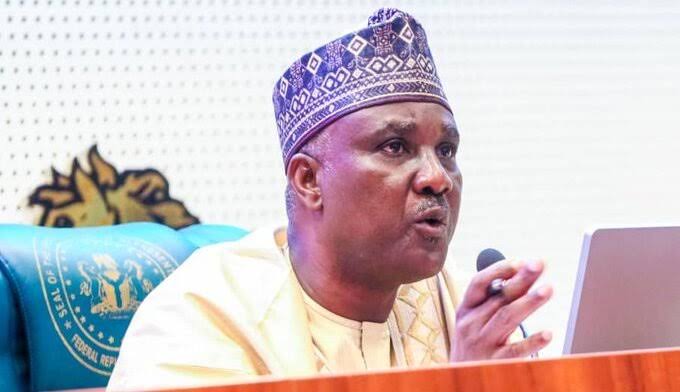
The Speaker of the House of Representatives Hon. Abbas Tajudeen, Ph.D, on Monday, unveiled a policy document on training, retraining and capacity building of members of the 10th House, legislative aides and support staff for better performance and output.

The document, titled ‘Parliamentary Development Programme for 10th House of Representatives, National Assembly, 2023-2027’, was prepared by the Office of the Speaker in collaboration with the United Nations Development Programme.
The Programmes Coordinating Unit (PCU) in the Research and Policy division of the Office of the Speaker spearheaded the process of formulating the document.
At the unveiling done by the Deputy Speaker of the House, Rt. Hon. Benjamin Okezie Kalu, on behalf of the Speaker, were several local and international development and technical partners of the National Assembly.
Speaker Abbas, in his address, noted that the document contained the results of the assessment study conducted by the House with the support of the UNDP and other partners.
“The results are presented today in a document titled Parliamentary Development Programme. This is in line with our Legislative Agenda, which identifies the strengthening of the internal capacity of the legislature as a critical factor towards achieving all our other legislative objectives.
“As a result, the document before us today reflects our current capabilities and the urgent requirements needed to elevate the standards of our legislative functions,” he said.
The Speaker noted that the need for continuous capacity strengthening in the legislature was well known to all. He also stated that the high turnover rates at the National Assembly posed a significant challenge to maintaining continuity and building on the institutional knowledge crucial for effective governance.
He said: “In this 10th Assembly, over 80 per cent of the members are new to the legislature. This phenomenon, combined with the growing expectations of our citizens for transparency, accountability, and efficiency, underscores the urgent need for a robust framework for capacity building within the legislature.
“As evidenced by the level of engagement, especially on social media, our constituents are becoming increasingly aware and involved in the governance process, demanding greater accountability and better service delivery from their representatives.
“This heightened expectation requires us to be at the forefront of legislative knowledge and practices. Also, the intricate landscape of modern governance demands a higher level of expertise, analytical skills, and adaptability among our members and supporting staff.”
Speaker Abbas added that the UNDP’s Capacity and Institutional Needs Assessment Study had “laid bare the gaps in our current system,” stressing that it had highlighted areas where the House needed to strengthen its capabilities to meet the demands of contemporary governance.
The Speaker noted: “These include but are not limited to strengthening our law-making functions, enhancing our legislative drafting capabilities, improving our research and analysis functions, bolstering our oversight mechanisms, and advancing our engagement with the citizens we serve.
“In view of these challenges, we must embrace a culture of continuous learning and capacity development. We must invest in human capital development, ensuring that members, staff and legislative aides are equipped with the knowledge and tools necessary to navigate the complexities of modern legislative work.
“This involves not only formal training programmes but also fostering an environment that encourages innovation, critical thinking, and a deep understanding of the issues facing Nigeria.”
Chairman, House Committee on Monitoring and Evaluation of the Implementation of the Legislative Agenda, Hon. Patrick Umoh, recalled how Speaker Abbas, upon assumption of office, pledged to ensure full and unhindered access to capacity-building programmes in the 10th House.
Hon Umoh, who spoke through the Chairman, House Committee on Media and Public Affairs, Hon. Akin Rotimi, noted that the Speaker met with partners and shared his vision in this regard with them.
He said: “Following the interaction with partners, the United Nations Development Programme (UNDP), took the lead in commissioning a research and study to put together a capacity building development programme for the 10th House.
“After three months of engagement with some committees of the House, development partners, members and management of the bureaucracy, we now have a document to provide direction for capacity building in the House. This is what the Honourable Speaker and the leadership of the House is here to present to us this afternoon.”
In his remarks, Chairman, House Committee on Civil Societies and Development Partners, Hon. Victor Obuzor, thanked the Speaker for the initiative, saying “this is really assisting (us in) our work.”
The Clerk of the House, Dr. Yahaya Danzaria, also described the development as “an inter-parliamentary wedding between the House of Reps and the development partners through the PCU.”
The Clerk also noted that it was “an effort kick-started since the inauguration of the 10th NASS by the Rt. Hon. Speaker with the collaboration of the leadership.”
Partners represented at the event included UNDP, Policy and Legal Advocacy Centre (PLAC), Konrad Adenauer Stiftung (KAS), YIAGA Africa, Civil Society Legislative Advocacy Centre (CISLAC), Order Paper, BudgIT, Partnership to Engage, Reform and Learn (PERL), the European Union and the National Assembly Business Environment Roundtable (NASSBER), among others.
Signed:
Musa Abdullahi Krishi, Special Adviser on Media and Publicity to the Speaker, House of Representatives, Federal Republic of Nigeria.
News
FG jerks WAEC exam fees by 82%, parents to pay N50k
The Federal Government has endorsed a new examination fee of N50,000 for candidates sitting the West African Examinations Council (WAEC) and National Examinations Council (NECO) Senior School Certificate Examinations (SSCE), effective from 2027.
The approval was conveyed in a statement dated June 18 and signed by the Director of Senior Secondary Education at the Federal Ministry of Education, Adeniji Ibrahim. According to the statement, the decision followed a request by WAEC for an upward review of the SSCE registration fee for candidates from 2027.
The new fee represents an 82 per cent increase from the current registration fee of N27,500. Ibrahim explained that the decision stemmed from a meeting held on March 31, 2026, between the Minister of Education and examination bodies, where the need to review examination fees was discussed.
He stated that the Minister directed both WAEC and NECO to adopt a uniform examination fee for the conduct of their SSCE examinations.
You may recall that at a meeting of examination bodies held with the Honourable Minister of Education on March 31, 2026, where the need for an upward review of examination fees was discussed, the Honourable Minister directed that WAEC and NECO should adopt a uniform fee for the conduct of WAEC and NECO SSCE,” the statement read.
“Consequently, I am directed to convey the Honourable Minister of Education’s approval of the sum of Fifty Thousand Naira (N50,000) only as the new examination fee per candidate, with effect from NECO SSCE (Internal), 2027.”
The ministry also directed that the approval be communicated to all relevant stakeholders.
Confirming the development, the Ministry of Education’s Director of Press and Public Relations, Folasade Boriowo, told TheCable that the Federal Government had approved the upward review of the examination fees.
“I can confirm the approval of an upward review of the examination fees. I spoke with the director in charge a few minutes ago and he said the approval was done,” she said.
News
Iranian Newspaper lists Trump, European leaders as alleged revenge targets
An Iranian newspaper has published a controversial list naming former U.S. President Donald Trump, Israeli Prime Minister Benjamin Netanyahu, and several European leaders as alleged targets for revenge following the killing of Iran’s former Supreme Leader, Ali Khamenei.
The publication is linked to hardline elements in Iran but it is not clear whether the list reflects official Iranian government policy.
The report comes amid heightened tensions after Khamenei’s death and follows renewed vows of retaliation by Iran’s current Supreme Leader, Mojtaba Khamenei, who has publicly promised revenge for his father’s assassination.
The newspaper’s publication has raised international concern, with analysts warning that such inflammatory rhetoric could further escalate the already volatile security situation in the Middle East. While the list has attracted widespread attention, there has been no official confirmation that it represents an operational threat or an approved policy of the Iranian government.
The development comes as tensions between Iran, the United States, Israel, and their allies remain at one of their highest levels in recent years, with governments closely monitoring the situation for any signs of further escalation.
News
Military identifies Army lieutenant who paid supreme sacrifice in rescue of abducted Oyo pupils, teachers
Military sources have confirmed the death of an Army officer, Lieutenant F.A. Isaac, during the operation that rescued 44 abducted pupils and teachers from the Old Oyo National Park.
The victims were rescued on July 10, 2026, in a coordinated operation involving security agencies after spending several days in captivity.
According to the sources, Lieutenant Isaac was killed in the line of duty during the rescue mission and was buried the same day.
Oyo State Governor Seyi Makinde had earlier confirmed that the military recorded a casualty during the operation.
Sources said Lieutenant Isaac was among the officers leading efforts to rescue the abducted pupils and teachers when he was fatally wounded.
The pupils and teachers were abducted in Oriire Local Government Area of Oyo State on or about June 6, 2026, before their eventual rescue by security operatives.
-
News20 hours ago“We lost gallant men”,Makinde confesses after rescue of Oyo school children, teachers
-
Sports20 hours agoNoskova Defeats Compatriot Muchova In Dramatic Final, Wins First Wimbledon Title
-
Foreign20 hours agoThousands Of Albanians March Against Trump-Linked Resort
-
News20 hours agoCourt orders deployment of police lawyer to every station
-
Sports20 hours agoWorld Cup 2026: They’re outstanding – Argentina coach Scaloni names two favourites to win trophy
-
Foreign20 hours agoUS launches fresh strikes as Iran closes Strait of Hormuz
-
News13 hours agoNDLEA nabs South African lady with 3-year-old son as cover to traffic heroin(Photos)
-
News20 hours agoNELFUND debunks fake upkeep suspension notice