

News
Quarantine service begins clampdown on food smugglers, hoarders
- /home/naijuinz/public_html/wp-content/plugins/mvp-social-buttons/mvp-social-buttons.php on line 27
https://naijablitznews.com/wp-content/uploads/2024/02/2C90A299-8A02-4DC9-9AF2-963EEC20CF00.jpeg&description=Quarantine service begins clampdown on food smugglers, hoarders', 'pinterestShare', 'width=750,height=350'); return false;" title="Pin This Post">
- Share
- Tweet /home/naijuinz/public_html/wp-content/plugins/mvp-social-buttons/mvp-social-buttons.php on line 72
https://naijablitznews.com/wp-content/uploads/2024/02/2C90A299-8A02-4DC9-9AF2-963EEC20CF00.jpeg&description=Quarantine service begins clampdown on food smugglers, hoarders', 'pinterestShare', 'width=750,height=350'); return false;" title="Pin This Post">
By Francesca Hangeior
The Nigeria Agricultural Quarantine Service has commenced the clamped down on hoarders and smugglers of food items and other agricultural produce, as it announced the deployment of more officers to Nigeria’s land and sea borders.

It said the move was to support the Federal Government’s efforts to stabilise food prices nationwide and ensure food security in Nigeria.
“To support the Federal Government’s efforts to stabilise food prices and ensure food security, the NAQS has initiated a nationwide crackdown on the smuggling and hoarding of agricultural commodities,” the agency announced in a statement issued in Abuja.
It added, “The decisive action is part of the agency’s mandate to regulate the handling of agricultural products in Nigeria, ensuring they are safe for consumption and available at fair prices to the Nigerian populace.
“In line with the Renewed Hope Agenda of the current administration, we are fully committed to ensuring that Nigerians have more food on their table, by strengthening our borders and clamping down on the smuggling of hoarded agricultural commodities.”
NAQS, according to its Establishment Act 2017, was established to prevent the entry, establishment and spread of foreign pests and diseases of plant, animal and aquatic resources and products into the country.
The agency is to also promote sanitary and phytosanitary measures as it relates to the import and export of agricultural products, to minimise the risk to agriculture, food safety and the environment.
The agency in its statement on Monday, noted that “Food security is a paramount concern for the Nigerian government, and we are committed to ensuring that agricultural commodities are not smuggled out of the country through our ports and land borders.
“We believe that our efforts to clamp down on smuggling practices will not only help to stabilise food prices but also promote transparency and fairness in the agricultural supply chain.”
It stated that more officers of the agency had been deployed to the borders to tackle the menace of food smuggling and hoarding.
“To combat the illegal smuggling and hoarding of agricultural commodities, NAQS is enhancing its surveillance and control measures at all entry and exit points.
“Officers of the agency are working tirelessly across the country’s borders and control posts, conducting rigorous inspections, and monitoring to ensure no agro commodity is exported.
“This initiative reflects a comprehensive approach to tackling some of the recent challenges facing the agricultural sector and aims to ensure food security and promote sustainable development.”
The agency’s acting Comptroller-General, Dr Godwin Audu, urged the public to report any suspicious activities related to the hoarding or smuggling of agricultural commodities.
He said community participation and collaboration were vital for the success of this campaign.
The Federal Government has intensified efforts to stop the hoarding and smuggling of food outside Nigeria following the recent astronomical hike in the cost of food items nationwide.
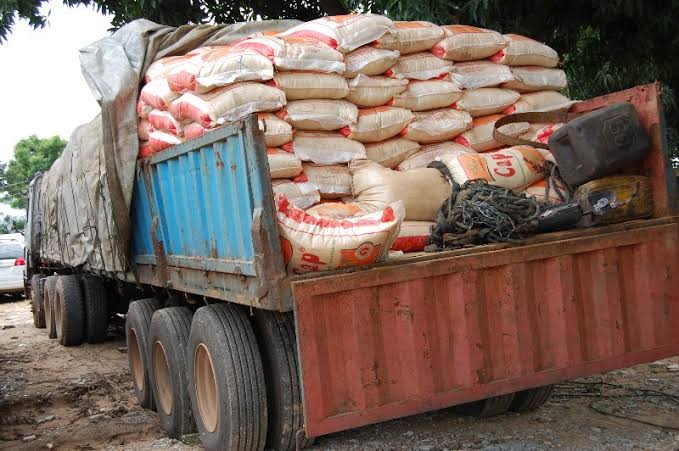
It could be recalled that the Nigeria Customs Service had declared that it intercepted 15 trailers that were fully loaded with food items and were heading out of the country through the Sokoto State border.
It said the trailers were stopped and the food items were returned to Nigeria, adding that this was part of measures to stabilise the prices of food items across the country in line with the mandate of the Federal Government.

News
BREAKING: Adeleke dismantles APC with 511,067 votes
…won 19 LGAs To Defeat Oyebamiji by 66,252 Votes
The Independent National Electoral Commission on Sunday declared Adeleke of the Accord Party winner of the 2026 Osun State governorship election, defeating APC’s Munirudeen Bola Oyebamiji by a margin of 66,252 votes.
The announcement ended days of tension, IReV blackouts, and allegations of foul play.
THE FINAL FIGURES—
After collation across all 30 LGAs, INEC announced:
– Accord Party – Ademola Adeleke: 511,067 votes
– APC – Bola Oyebamiji: 444,815 votes
– ADC – Najeem Salaam: 17,180 votes — distant third
Total valid votes: 985,079
Rejected ballots: 20,721
Total votes cast: 1,005,800
From 2,339,544 registered voters, 1,010,684 were accredited — a turnout of 43.2%.
—LGA BREAKDOWN: ADELEKE DOMINATES—
Adeleke carried 19 of 30 LGAs, including his strongholds of Ede, Osogbo, Ilesa, and Iwo.
Oyebamiji won 11 LGAs, but couldn’t overcome Adeleke’s margins in the populous urban centres.
The 66,252-vote gap is one of the widest in a competitive Osun governorship contest in the last decade.
The result is a massive blow to the APC.
The party had thrown everything at Osun.
National Chairman Nentawe Yilwatda called it a “must-win.”
A 276-member campaign council led by Gov. Hope Uzodimma was deployed. Senate President Godswill Akpabio, Speaker Tajudeen Abbas, Minister Adegboyega Oyetola, and several governors stormed Osogbo for the mega rally.
Despite that, APC leaders were seen leaving the state late Saturday as results tilted heavily against them.
“This was a referendum on performance, not party structure,” a political analyst in Osogbo said. “Osun people voted for continuity.”
—ADELEKE’S VICTORY SPEECH—
While INEC had yet to issue the Certificate of Return at press time, celebrations had already erupted in Ede, Adeleke’s hometown.
Supporters were seen dancing in the streets chanting “Imole ti de.”
Adeleke, who defected from PDP to Accord Party earlier this year, campaigned on consolidating his welfare programmes, infrastructure projects, and grassroots empowerment.
With 95.85% of results uploaded to IReV by 1:33am Sunday and collation now complete, INEC is expected to issue Adeleke his Certificate of Return in the coming days.
For the APC, the loss raises urgent questions ahead of 2027.
If a “must-win” state with full federal backing can be lost by over 66,000 votes, the party’s 2027 playbook may need a rewrite.
News
How to apply: UK opens 2026 Commonwealth Fellowships for Nigerians
The United Kingdom has opened applications for the 2026/27 Commonwealth Fellowship Programme, offering Nigerian professionals and university academics an opportunity to undertake fully funded fellowships in the UK.
Applications for the programme opened on July 28, 2026, and will close at 4:00 p.m. BST on August 25, 2026.
The fellowship is designed for mid-career professionals and university academics from eligible Commonwealth countries, including Nigeria. Successful applicants will spend between six weeks and three months in the UK, depending on the fellowship category.
Announcing the programme on X, the UK in Nigeria urged eligible candidates to submit their applications before the deadline.
“Applications are currently open for the #CommonwealthFellowships 2026/27! Professional Fellowships for mid-career professionals and Academic Fellowships for PhD-holding university staff. Open to candidates from all Commonwealth countries till 25 August 26.”
According to the Commonwealth Scholarship Commission (CSC), the programme has two categories: the Commonwealth Professional Fellowship and the Commonwealth Academic Fellowship.
The Professional Fellowship is aimed at experienced professionals seeking to develop their skills and expertise through placements with UK organisations working in their respective fields.
The Academic Fellowship is designed for university lecturers and researchers who hold a PhD and are employed by a recognised university in an eligible Commonwealth country outside the UK.
Around 40 fellowship places are expected to be available for the 2026/27 cycle, with about 30 allocated to applicants from Commonwealth countries eligible for official development assistance, including Nigeria.
Who can apply?
For the Commonwealth Professional Fellowship, applicants must have at least five years of relevant full-time work experience, or the equivalent in part-time experience, before the fellowship begins.
Applicants for the Commonwealth Academic Fellowship must hold a PhD and be employed by a recognised university in an eligible Commonwealth country outside the UK.
All applicants must also meet several general requirements.
They must:
Be citizens of, or have refugee status in, an eligible Commonwealth country.
Be permanently resident in an eligible Commonwealth country.
Be employed by an organisation they intend to return to after completing the fellowship.
Provide at least two references, including one from their current employer, unless they are self-employed.
Not have received a Commonwealth Fellowship within the previous five years.
How long will the fellowship last?
Professional Fellowships will last between six weeks and three months and are expected to begin between mid-February and mid-March 2027.
Academic Fellowships will run for three months, with programmes scheduled to begin in January or February 2027.
Successful applicants are therefore expected to undertake their fellowships in the UK in early 2027.
How can Nigerians apply?
Interested Nigerian applicants must complete the online application through the Commonwealth Scholarship Commission’s application portal before the August 25 deadline.
Applications close at 4:00 p.m. BST on August 25, 2026.
Applicants will be required to provide information and documents including:
Educational qualifications.
Employment history.
Relevant professional experience.
Publications and awards, where applicable.
Two references.
A personal statement.
A development impact statement.
Leadership and voluntary experience.
A scanned copy of a valid passport or national identity card.
The development impact statement is an important part of the application. Candidates are expected to explain how their proposed fellowship aligns with one of the CSC’s six development themes and how the skills and knowledge gained will contribute to development in their home country after they return.
The six themes are:
Science and technology for development.
Improving health systems and population health.
Innovation and entrepreneurship.
Peace, security and governance.
Crisis response and resilience.
Access, inclusion and opportunity.
What does the Commonwealth Fellowship cover?
The Commonwealth Fellowship is fully funded, meaning successful applicants do not have to cover the main costs associated with undertaking the programme in the UK.
According to the CSC, fellows will receive:
Return airfare between their home country and the UK.
Reimbursement of the standard UK visa application fee.
A monthly stipend of £2,218, or £2,753 for fellows based in the London metropolitan area.
An arrival allowance of up to £1,247.09.
Additional funding for approved conferences, short courses and visits to other UK organisations where necessary.
For Nigerian professionals and academics seeking international exposure and professional development, the fellowship provides an opportunity to gain experience in the UK while receiving financial support for travel and living expenses.
Eligible candidates are encouraged to complete their applications before the August 25, 2026 deadline.
News
Enugu 2027: Nnaji signs one-term pact, vows to quit after four years
The Enugu State governorship candidate of the Peoples Democratic Party (PDP) in the 2027 election, Uche Nnaji, has signed an undertaking to serve only one term of four years if elected governor.
Nnaji signed the pact on Friday at Akpugo, Nkanu West Local Government Area, during a grand reception organised in his honour by PDP supporters and stakeholders.
The candidate said the decision was in recognition of the existing zoning arrangement in the state, assuring that he would not seek re-election after completing his first term.
According to him, the one-term commitment would enable him to focus on good governance and the implementation of his development agenda without being distracted by the pursuit of a second term.
“I am not interested in perpetuating myself in power. That is not the idea. That is why I said I am not going to disrupt the arrangement that is running, which is zoning of power.
“I am aware that Nkanu has gone for four years. So, being an Nkanu man, I will go for one term. After the one tenure, I will go.
“I am going to bring a different approach to governance. My approach will be just for human beings. I am not going to govern for animals. We must have conscience in governance. Government is said to be for the people, by the people and for the people,” he said.
Nnaji also promised to introduce what he described as a “one-day, one-project” policy, through which his administration would initiate and execute development projects across the state.
He said his ambition was to leave a legacy of rapid development and improved living standards at the end of his four-year tenure.
The PDP candidate appealed to the people of Enugu to support his aspiration, promising that his administration would be people-oriented, transparent and committed to the development of the state.
On taxation, Nnaji said his administration would govern with “conscience”, arguing that policies imposing excessive burdens on residents and businesses should be reviewed.
“So, we must govern with conscience. If you put a tax regime in place and it becomes so bad for the people, why are you keeping it? You withdraw it.
“Look at all these taxes going on in Enugu State. The cost of living has risen so high. Enugu State has become the most expensive state in the whole federation, and this is a civil service town, a public service town.
“Most people who want to build industries in Enugu State are taking them to Anambra because of the fear of taxation. So, we must govern with conscience,” he said.
Also speaking, a PDP chieftain, Basil Ani, pledged the support of party members and supporters for Nnaji’s ambition, saying they would work to ensure his emergence as governor in 2027.
Ani said Nnaji had grown beyond being a political candidate, describing him as a movement with growing support among the people.
“I want to tell you that Uche Nnaji has become a movement that is at the heart of the people. It is no longer about the political party; it is about the conviction of the people towards him.
“Nwakaibie is here to stay. Nwakaibie is here to take over,” he said.
Ani maintained that Enugu State remained a stronghold of the PDP, expressing confidence that the party would reclaim the governorship in the 2027 general election.
-
News23 hours agoOsun decides: Ahead today’s poll, police dogs deployed to combat thugs
-
News16 hours agoBREAKING: Gov Adeleke in Early Lead, Wins First INEC Announced Results
-
News3 hours agoJonathan, Oborevwori, Diri, Ibori Mourn 104-Year-Old Prince Penawou
-
News20 hours agoOsun Decides: We’re monitoring INEC boss from all sides— Peterside
-
News20 hours agoPolice Bust Human Parts Syndicate in Oyo, Nab 10, Recover Heart, Skull
-
News4 hours agoFerran Torres Joins PSG From Barcelona
-
News24 hours agoJust in: Security operatives take over Osun Assembly Speaker residence
-
News14 hours agoOsun election: Oyinlola Loses Polling Unit to Accord Party