Connect with us

News

Those Who Couldn’t Get Into Power Are Plunging Nigeria Into Anarchy – Shettima

Published

on

ADVERTISEMENT
Zoom Ad
ADVERTISEMENT
Zoom Ad

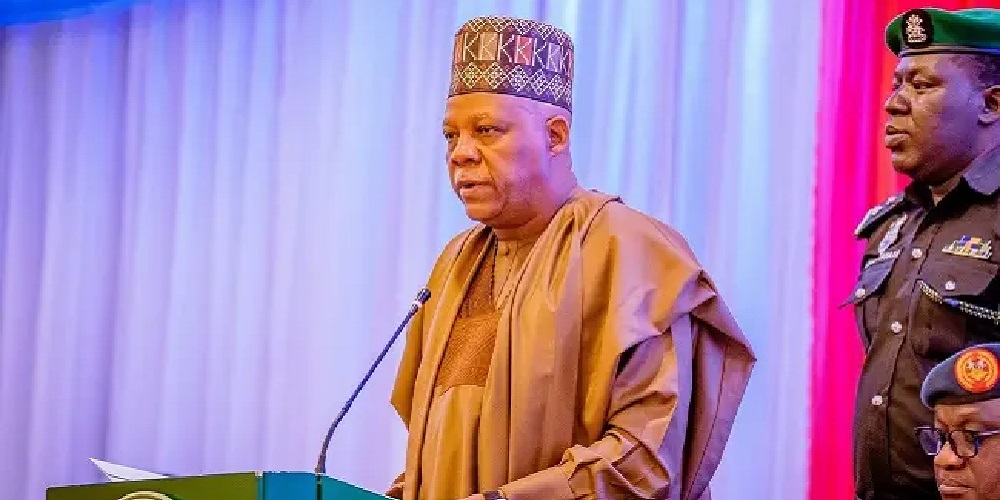
Vice President Kashim Shettima has claimed that some forces in the country are planning to disrupt the country’s stability and plunge it into anarchy.


Shettima led this out on Tuesday while speaking at the Public Wealth Management Conference organized by the Ministry of Finance and the Ministry of Finance Incorporated (MoFI) in Abuja.

He said: “We know the consequences of unveiling the masquerade. Forces are hell-bent on plunging this country into a state of anarchy, those that could not get into power through the ballot box.

“Just a few nights ago, 45 trucks of maize were caught being transported into a neighbouring country.

Advertisement

“There are 32 illegal routes on that axis. At the moment when they were intercepted, the price of maize fell by N10,000, from N60,000 to N50,000.

“So there are forces that are hell bent on undermining our nation but this is the time for us to come together.

“Let us rally around our President, rally round our governors, and rally round each other.

“We have the resources, we have the intellect, and we have the resources. I am assuring you that we have crossed the Rubicon.”

Advertisement

“We are not altogether in a very bad shape than the FX challenge. All hands are on deck to address the FX challenge.”


Continue Reading
Advertisement

News

From Abuja to Hangzhou (1): A Handshake with the Chinese

Published

on

ADVERTISEMENT
Zoom Ad
ADVERTISEMENT
Zoom Ad

By Max Amuchie | The Sunday Stew


It began, unexpectedly, with a telephone call one evening in May.

I was at my desk in Abuja when my phone rang. On the other end was Kemi Yusufu, Publicity Secretary of the Guild of Corporate Online Publishers (GOCOP). She had an unusual message. A friend had contacted her to say that the Chinese Embassy in Abuja was looking for a way to reach me.

Advertisement

Kemi had done what friends sometimes do when opportunity comes knocking in an unfamiliar voice: she passed on my contact.

The following morning, a message arrived from the Chinese Embassy. I was invited to an event scheduled for 2 p.m. that day. There was only one problem. I was in the middle of the week-long District Conference of Rotary International District 9127, and the timing simply would not work.

I explained.

Another appointment was fixed for noon the following day.

Advertisement

That meeting at the Chinese Embassy in Abuja would prove to be the beginning of a journey that, two months later, would take me from Nigeria’s federal capital to Hangzhou, one of China’s most celebrated cities and one of the places where the country’s extraordinary experiment with technology, commerce and development can be observed at close quarters.

At the embassy, I was warmly received by Mr Sun, who introduced me to his colleague, Miss Chen. There was nothing dramatic about the meeting. No grand announcement. No fanfare. Just a conversation, a handshake and an invitation whose full significance was yet to unfold.

At that point, China was still an idea. A vast country encountered largely through books, news reports, economic statistics and the growing evidence of its presence across Africa. Within weeks, however, that idea would acquire faces, voices, roads, cities, lakes, factories, classrooms and conversations.

On July 21, we left Nigeria aboard Ethiopian Airlines for a three-week programme, making the customary layover at Bole International Airport in Addis Ababa. From there, we continued to Guangzhou Baiyun International Airport, known by its airport code, CAN.

Advertisement

Max Amuchie with Prof Shi Xinjie of Zhejiang University

China had begun to feel real.

At Guangzhou, we boarded a local flight to Hangzhou Xiaoshan International Airport, HGH, Zhejiang Province. Waiting for us on arrival was a local organising team made up of Mr Kai, Ms Ally Tang and others.

There were smiles, handshakes, photographs and the unmistakable excitement that accompanies the beginning of a new experience.

After the long journey eastwards, we arrived at the Haiwaihai International Hotel in Hangzhou on the night of July 22. Registration formalities completed, everyone finally settled in for what was, after hours in airports and aircraft, a well-deserved rest.

The programme began in earnest at 9 a.m. the following morning.

Advertisement

We converged in one of the halls of the hotel for a lecture by Zhang Gangfeng, an Associate Professor at Zhejiang University. He provided an overview of China’s national conditions.

It was an appropriate starting point.

Before one can understand China’s development model—or attempt to draw lessons from it—one must first understand China itself: its history, geography, population, political system, development trajectory and the particular conditions that have shaped its remarkable transformation.

China’s development story is often compressed into impressive statistics: spectacular economic growth, world-class infrastructure, technological innovation, the expansion of cities and the lifting of hundreds of millions of people out of poverty. But statistics, useful as they are, can conceal the historical and political processes behind them. Zhang’s lecture was, therefore, an invitation to look behind the headlines and examine the country whose experience we had travelled thousands of kilometres to study.

Advertisement


Later that afternoon, the programme was formally declared open, with Mr Fan Yijun, Deputy Director of the Free Trade Development Board of Zhejiang Province, presiding.

We were in China for the ‘Seminar on Digital Villages and Economic Development for Nigeria’, organised under the auspices of China’s Foreign Aid Cooperation Programme on Human Resources Development and implemented by the Free Trade Development Board of Zhejiang Province, which also serves as the Secretariat of the China Centre for Cooperation on Special Economic Zones in BRICS Countries.

The Nigeria team


Nigeria was not alone

Advertisement

Representatives had also arrived from countries including South Africa and Solomon Islands. But with 31 participants, Nigeria had the largest delegation—a striking indication of the scale of the engagement and, perhaps, of the possibilities China saw in a country whose enormous population, entrepreneurial energy and developmental challenges increasingly make digital transformation a matter of national urgency.

For Nigeria, the subject of digital villages could hardly have been more relevant. The question of development is not merely how to build prosperous cities or attract investment into already thriving commercial centres. It is also how to ensure that communities beyond the major urban centres are connected to the opportunities created by technology—through broadband, digital commerce, financial inclusion, agricultural innovation, skills and access to markets.

Each delegation had an opportunity to speak at the opening ceremony. For Nigeria, Mr Benjamin Ogugua Ogugua, Special Adviser to the Deputy Speaker of the House of Representatives, spoke on behalf of the team.

The opening ceremony formally set the programme in motion, but the intellectual journey had begun hours earlier with the effort to understand the China behind the development story—the country whose experience we had travelled thousands of kilometres to examine.

Advertisement

That evening, the Nigerian delegation was treated to a welcome dinner.

It was only our first full day in Hangzhou.

Yet, from that unexpected telephone call in Abuja in May to a room filled with delegates and hosts thousands of kilometres away, one thought was already becoming clear: sometimes, international engagement begins not with a carefully laid plan, but with a phone call, a handshake—and an invitation to see another country with your own eyes.

And this was only the beginning.

Advertisement


The Lake, the Legend and the Lesson

The following day, July 24, offered our first opportunity to encounter Hangzhou beyond the walls of the conference hall.

We were driven around the West Lake Scenic Area, with Tang Qingqing, Programme Manager at the Free Trade Development Board of Zhejiang Province, serving as our guide.

Advertisement

West Lake is not merely a body of water. It is one of the great cultural landscapes of China, celebrated as a UNESCO World Cultural Heritage Site and a major national tourist attraction. It is often described as a “Paradise on Earth”—a phrase that captures the way natural beauty, history, poetry, architecture and legend have combined over centuries to give the place an identity that is larger than geography.

We did not step out for a leisurely exploration of the lake. Much of what we saw was from the vehicle. But Tang Qingqing more than compensated for the brevity of the encounter with her copious explanations of the lake’s history, its cultural influence and, especially, the romantic legends associated with it.

It was one of the first reminders that China’s development story cannot be understood only through skyscrapers, factories, e-commerce platforms and high-speed infrastructure.

There is also the China of memory.

Advertisement

The China of legend.

The China that has preserved and continually reinterpreted cultural inheritance while simultaneously racing into the digital age.

That coexistence—between ancient civilisational memory and contemporary technological ambition—would become one of the recurring impressions of the journey.


Advertisement

From Poverty Alleviation to Common Prosperity

The second lecture took us directly into one of the most important ideas in contemporary Chinese development policy.

Its title was: “From Poverty Alleviation to Common Prosperity: China’s Practice and Experience (Course on Xi Jinping Thought).”

The lecturer was Professor Shi Xinjie of Zhejiang University.

Advertisement

The subject was significant not only because of the centrality of poverty reduction to China’s modern development narrative, but also because the name behind the course was one that would recur repeatedly throughout our stay.

Xi Jinping, China’s current leader, is a former governor of Zhejiang Province. His connection with the province was frequently referenced during our field visits. In different places, our hosts and lecturers spoke warmly about him, recalled statements he had made, and pointed to policies or actions associated with his years in Zhejiang.

That made the lecture more than an abstract discussion of national policy. We were studying ideas associated with China’s present leadership while standing in one of the provinces that had played an important part in the political and administrative career of that leadership.

At the centre of Xi’s thinking on poverty alleviation and common prosperity is a relatively straightforward proposition with far-reaching implications: a country’s development cannot be considered complete if large sections of its population remain poor; but the elimination of extreme poverty is itself only the first stage of a longer journey towards more broadly shared prosperity.

Advertisement

This idea is central to what China describes as Xi Jinping Thought on Socialism with Chinese Characteristics for a New Era.


Poverty Alleviation as Responsibility

The first principle is that poverty alleviation is not treated merely as an economic programme. It is also presented as a political and moral responsibility.

Advertisement

The underlying argument is that development should be people-centred and that the improvement of ordinary people’s lives is one of the fundamental measures of successful governance. In this conception, economic growth is not simply about enlarging national wealth. It must eventually answer a more basic question: What has development done for the people?

The elimination of poverty, the improvement of well-being and the pursuit of common prosperity are therefore presented as essential objectives of socialist development.


No One Should Be Left Behind

Advertisement

A second defining principle is inclusion.

Economic growth, by itself, is not necessarily sufficient if particular regions, communities or households remain trapped in deprivation. The objective, therefore, is not simply to report an improvement in national averages while pockets of extreme deprivation remain invisible within the larger picture.

This gave prominence to the idea of targeted poverty alleviation: identifying who was poor, understanding why they were poor and applying measures suited to their particular circumstances.

The logic was simple but administratively demanding.

Advertisement

Poverty in one village may arise from poor road access. In another, it may be the absence of markets. Elsewhere, it may be lack of education, health challenges, geographical isolation or limited employment opportunities.

A uniform policy, therefore, may not produce uniform results.

The targeted approach sought to bring policy closer to the specific household, community and locality experiencing deprivation.


Advertisement

Development as the Foundation of Poverty Reduction

Xi’s approach is not primarily framed as the redistribution of existing wealth.

Its central proposition is that poverty cannot be sustainably eliminated without expanding productive capacity and economic opportunity. In other words, before prosperity can be shared, it must also be created.

This is where the emphasis on development becomes critical.

Advertisement

The approach has involved investments in:

Infrastructure;

Employment and income generation;

Local industries;

Advertisement

Education and skills;

Health and housing;

Underdeveloped regions; and

Greater economic connections between poorer and more prosperous areas.

Advertisement

The underlying development philosophy is that inadequate development is itself a fundamental cause of poverty.

This is an important point for countries seeking to learn from the Chinese experience. Poverty policy cannot be divorced from productive policy. A programme that provides temporary relief may alleviate immediate suffering, but long-term poverty reduction requires communities and households to be connected to the engines of economic opportunity.


Poverty Eradication Is Not the Finish Line

Advertisement

Perhaps the most important connection between poverty alleviation and common prosperity is the insistence that escaping extreme poverty is not the final destination.

After China declared victory over extreme poverty, the focus moved towards preventing people from slipping back into poverty, promoting rural revitalisation and pursuing a wider distribution of the benefits of development.


The conceptual journey can be expressed simply:

Advertisement

Extreme poverty eradication leads to broader prosperity, which in turn engenders common prosperity.

The first task is to remove absolute deprivation. The next is to build a society in which prosperity is more widely accessible and sustainable.

Common prosperity, therefore, represents a longer-term development ambition.

What Does Common Prosperity Mean?

Advertisement

One of the misconceptions about common prosperity is that it means everybody must have exactly the same income.

That is not the idea.

The Chinese approach accepts wealth creation, markets, entrepreneurship and economic growth. The concern is that the benefits of development should not become permanently concentrated in the hands of a narrow segment of society or create severe and enduring regional and social inequalities.

One useful way of understanding the philosophy is through the metaphor of “making the pie” and “sharing the pie.”

Advertisement

First, a society must produce sufficient wealth. Then, the institutions of that society must ensure that the resulting prosperity is shared more broadly and fairly.

The issues that follow from this concern include:

Income distribution;

Wages and employment;

Advertisement

Regional inequality;

Access to public services;

Social security;

Rural development; and

Advertisement

Opportunities for upward mobility.

For a Nigerian visitor, it was difficult not to reflect on these ideas in relation to our own circumstances. Nigeria’s development debate often swings between growth and distribution, between the creation of wealth and the question of who benefits from it. The Chinese experience, whatever its differences from Nigeria’s political, economic and historical circumstances, raises an important question: Can development be regarded as successful when it produces islands of extraordinary wealth alongside large populations who remain disconnected from its benefits?

The answer to that question may vary from country to country. But the question itself is universal.


Advertisement

The President’s Book

As we moved from lectures to visits and from Hangzhou to other locations in Zhejiang Province, references to President Xi Jinping continued to surface.

Our hosts occasionally recalled something he had said or referred to an initiative or policy associated with his time as governor of Zhejiang Province. There was a sense of local pride in the relationship between the province and the man who would later become China’s most powerful political leader.

Each participant in the programme received a copy of the third volume of Xi Jinping’s book, The Governance of China.

Advertisement

For me, it was another reminder that we were not simply on a technical programme about digital villages.

We were also being introduced, directly and indirectly, to the ideas, institutions and development philosophy that China considers important in explaining its contemporary trajectory.


Twelve Lectures and a Classroom Beyond the Hotel

Advertisement

In all, the programme featured 12 lectures.

Most of them were held at the Haiwaihai International Hotel, which served not only as our accommodation but also as the principal classroom for much of the seminar.

Three of the lectures, however, took place at Yiwu Industrial & Commercial College.

The change of location was significant. It took the learning environment beyond the hotel and into an educational institution connected to the wider economic environment we had travelled to examine.

Advertisement

One of the lectures at Yiwu was titled “Zhejiang’s Digital Economy: Where We Are, Where We’re Going.”

It was delivered by Xiong Aisha, an Associate Professor.

The title itself captured one of the central questions of the entire visit.

Zhejiang is widely associated with China’s digital transformation, entrepreneurship, e-commerce and innovation. But development is never static. The question is not only how far a region has travelled. It is also where it believes the next stage of the journey will lead.

Advertisement

Where we are.

Where we’re going.

Those words could, in many ways, have served as the larger theme of our journey.

For China, they pointed to a development story that continues to evolve.

Advertisement

For Nigeria, they raised a different but equally important question: What can we learn, what can we adapt, and—most importantly—where are we going?

The answer would not be found in a single lecture or a single visit.

It would emerge gradually—in classrooms and conference halls, in villages and industrial centres, in conversations with academics and officials, and in the everyday scenes that revealed how deeply technology had become woven into the fabric of Chinese life.

The journey from Abuja to Hangzhou had begun with a handshake.

Advertisement

The real work was now to understand what lay beyond it.


Trust is sacred. Stay seasoned.


Advertisement

•Dr Max Nwabueze Amuchie is an African scholar-practitioner and framework builder whose original intellectual work spans insecurity, sovereignty, institutional development, and journalism as knowledge production. His frameworks include the Insecurity Triad, the Trinity of Sovereignty Decay, the Decoupling Sovereignty Index, and the Sundiata Post Model. He is the CEO & Theorist-In-Chief of Sundiata Post, Lead Researcher at the Sundiata Post Intelligence Unit (SPIU), and an Expert Member and Peer Reviewer in Behavioural and Social Sciences at ScienceOpen.

Continue Reading

News

Gunmen kidnap popular Kwara monarch

Published

on

ADVERTISEMENT
Zoom Ad
ADVERTISEMENT
Zoom Ad

Gunmen invaded Igbesi community in Isin Local Government Area of Kwara State, abducting the traditional ruler, Oba Moses Oyinloye Iwedunmoye I, the Kabiyesi Onigbesi of Igbesi land, alongside other residents.

The attack reportedly occurred at about 11:00 p.m. on Saturday, August 22, 2026, when the armed assailants invaded the community.

A local source revealed that the monarch was taken to an unknown location, while an unspecified number of residents were also abducted during the attack.

The incident has raised fresh concerns over the security situation in Kwara State, coming amid multiple reports of kidnapping attacks in different parts of the state within the past 24 hours.

Advertisement

The exact number of victims abducted during the latest attack remains unclear as of the time of filing this report.

Security agencies are expected to intensify efforts to locate the abducted monarch and other victims and secure the community.

Continue Reading

News

BREAKING: Popular Nollywood actor, Ogogo is dead

Published

on

ADVERTISEMENT
Zoom Ad
ADVERTISEMENT
Zoom Ad

Popular veteran Nollywood Yoruba actor, Taiwo Hassan, popularly known as Ogogo, has reportedly died after battling cancer.

The actor’s daughter, Kira Taiwo, disclosed the development on Sunday evening during a live session on Instagram.

Ogogo’s reported death comes days after his daughter revealed that he was battling stage-four cancer.

Before his death, efforts had been made to secure medical treatment for the veteran actor, with reports indicating that the Ogun State All Progressives Congress (APC) governorship candidate, Adeola Olamilekan, popularly known as Yayi, offered financial support for his treatment.

Advertisement

Details shortly…

Continue Reading

Trending

Copyright © 2024 Naija Blitz News